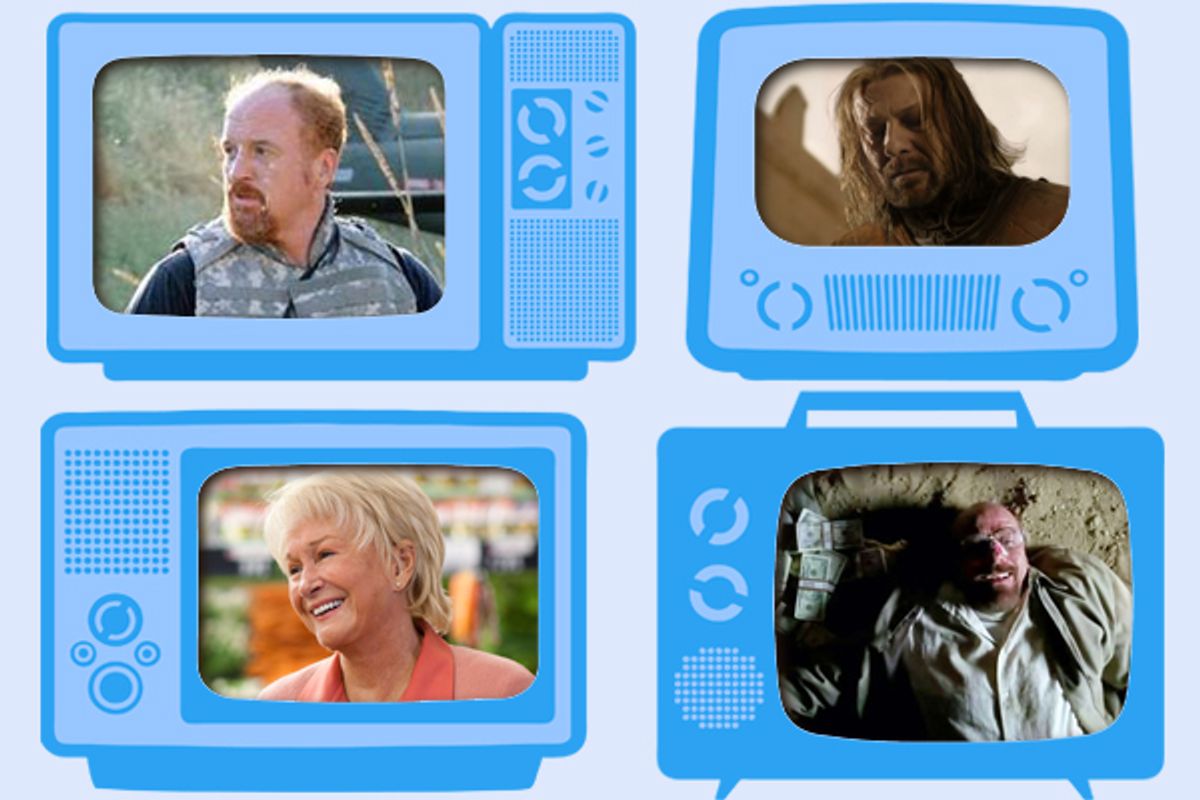
Friday Night Seitz
2011's best TV episodes
It's easy to rank the year's best shows. But what were the individual episodes you need to see?
-
10. “Baelor”
"Game of Thrones" (HBO)
Written by David Benioff. Directed by D.B. WeissEvery scene, every line, every shot seemed to have been carved from marble. And that ending was a knockout.
-
9. “Subway/Pamela”
"Louie" (FX)
Written and directed by Louis C.K.A magnificent two-fer, starting with an underground reverie (Louie witnessing a surreal incident on a subway platform, then fantasizing a bizarrely exhibitionist act of sorta-chivalry) and then progressing toward Louie’s magnificently awkward confession of love for his friend Pamela.
-
8. “Consider Helen”
"Enlightened" (HBO)
Written by Mike White. Directed by Phil Morrison -
7. “End Times”
"Breaking Bad" (AMC)
Written by Thomas Schnauz and Moira Walley-Beckett. Directed by Vince GilliganAn amazing episode from start to finish, but especially in its last act, which contained one of the tensest extended action sequences in the show’s history — and that’s saying quite a bit. (Gus’ spider sense did not fail him this time. Later, though …) This episode contains one of my favorite scenes involving a minor character — ATF agent Steven Gomez bantering with Gus’ laundry plant manager, trying to get him to consent to a search without a warrant. And that violent confrontation between Walt and Jesse was one for the time capsule. In retrospect, it feels like the season’s most important moment — the moment when we see (perhaps without consciously realizing it) just how low Walt can sink.
-
6. “Duckling”
"Louie" (FX) Written and directed by Louis C.K.
Writer-director-star-cameraman-editor Louis C.K. must have been feeling his oats when he went to FX and asked for extra money and extra running time so that he could air a mini-epic in which the title character went on a USO tour of Afghanistan. The result was well worth it — a sterling confirmation of C.K.’s interest in documentary values, of just going somewhere with somebody and watching what happens. The comedy was poignant and raucous as always (especially in the scene where Louie won over the troops by being as blunt and basic as he could). But atmosphere really took over here. There were several sequences in which we were just kind of hanging out with Louie, seeing the mix of boredom and terror that real soldiers experience.
-
5. “Graduation Day”
"Southland" (TNT)
Written by John Wells and Heather Zuhlke Directed by Christopher ChulackA magnificent example of ensemble storytelling, the season finale of “Southland” was TV at its best. And it featured the year’s greatest televised action sequence, a rooftop fight and chase climaxing in a tragedy that played out — daringly — in a wide shot that made the event all the more horrifying. By the way, if you’re not watching this show, you’re really missing out. It’s probably the closest equivalent to an early Joseph Wambaugh cop novel ever to air on American television.
-
4. “Crawl Space”
"Breaking Bad" (AMC)
Written by Sam Catlin and George Mastras. Directed by Scott WinantA lot happens in this episode. Among other things, Walt tries and fails to implicate Gus’ henchman, Tyrus, in Walt’s own theft of the company product; Gus leans on Jesse to join the Dark Side; Saul sends his “A-team” to pressure Skyler’s old boss (and former lover) Ted to write a check to the IRS, and the poor bastard accidentally dies; Gus threatens Walt’s family, and he decides to go into witness protection, but when he goes under the house to get the necessary drug money to go underground, he discovers that Skyler gave most of it to Ted. D’oh! A great episode, with maybe the greatest closing shot in “Breaking Bad” history.
-
3. “Hermanos”
"Breaking Bad" (AMC)
Written by Sam Catlin and George Mastras. Directed by Johan Renck“Where to begin describing ‘Hermanos,’ the tightest, scariest episode of ‘Breaking Bad’ this year?” I wrote of this amazing episode. “I could start with that close-up of the blood in the swimming pool, glimpsed briefly in a preliminary flashback by Gustavo Fring; blue-green water with crimson seeping into it. A lovely and mysterious image, one of the best on a series that’s very, very good at showcasing abstract and often haunting close-ups. Or I could start by admiring the show’s decision to structure that last act as a long flashback that showcased one of the program’s more spectacular talents, its ability to put you in the middle of a real-time moment of violence that builds with a nightmarish mix of inevitability and surprise.” The last 10 minutes were as horrifically magnificent as the climaxes of “Carrie” and “Inglourious Basterds.” The rest of the episode was merely brilliant; everyone should deal with such quality control issues. This was costar Giancarlo Esposito’s finest hour as an actor. He says more with a look than most performers say with a monologue — and he had some great monologues this year.
-
2. “The Weekend”
"Homeland" (Showtime)
Written by Meredith Stiehm. Directed by Michael CuestaBipolar CIA agent Carrie Mathison (Claire Danes) and Marine-turned-suspected-sleeper-agent Nick Brody (Damian Lewis) enjoy a body- and soul-baring idyll in the woods. This episode could have been called “Last Tango in Homeland,” not because it had explicit sex (it was actually pretty circumspect compared to the preceding week’s episode) but because the two main characters divested themselves of their illusions and delusions and connected as people. Meanwhile, Carrie’s superior Sal (Mandy Patinkin) goes to Mexico to capture the girlfriend of another suspected terrorist and reveals quite a bit about his own character during the long drive back. This was a consistently brilliant and surprising hour, as perfect in its way as the “Mad Men” episode “The Suitcase.”
-
1. “Critical Film Studies”
"Community" (NBC)
Written by Sona Panos. Directed by Richard AyoadeWhen it was announced that Dan Harmon’s sitcom “Community” would do an episode built around a “Pulp Fiction”-themed party, it sounded like a natural, even obvious fit. What better program to satirize the pop-culture-crazy riffing of writer-director Quentin Tarantino? But the episode turned out to be the year’s most conceptually daring half-hour, a meditation on life, art, acting, self-deception, being and nothingness, referencing not just “Pulp Fiction” but “My Dinner With Andre” and “Six Characters in Search of an Author.” On top of all that, the episode was funny, sweet and disturbing, and in the end, haunting.