Glenn Greenwald

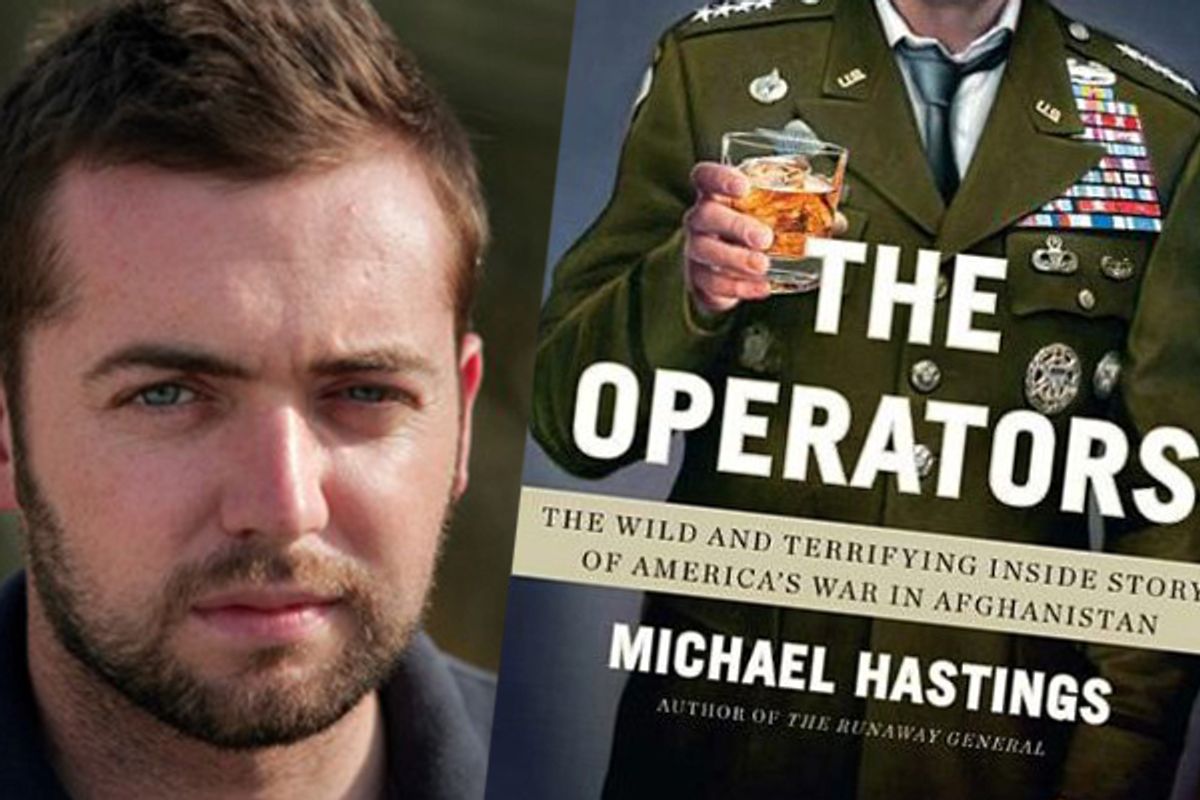
Michael Hastings on war journalists

The Rolling Stone reporter who got the commander fired has an indispensable new book on the Afghan war

  • more
    • All Share Services

Michael Hastings on war journalistsMichael Hastings

Rolling Stone‘s Michael Hastings — whose 2010 article on Gen. Stanley McChrystal ended the Afghanistan War commander’s career by accurately reporting numerous controversial statements made in a series of interviews — embodies the pure journalistic ethos. Some of the most celebrated establishment military reporters in America attacked Hastings for that article on the ground that it violated a sacred trust between Generals and war reporters (The New York Times‘ John Burns), and even baselessly insinuated that he fabricated the quotes and then went on to impugn his patriotism when compared to The Great General (CBS News’ Lara Logan).

Even worse, The Washington Post, ABC News and others irresponsibly published totally anonymous military sources claiming with no basis that Hastings violated ground-rule agreements for the interviews. In the face of that media-military onslaught, it would have been easy for this young reporter to protect his careerist ambitions and back down. Instead, he doubled down, accusing military officials of “lying” and then unapologetically explaining to these lions of American journalism that the role of a journalist is to scrutinize and expose — not protect and glorify– the nation’s most powerful political and military leaders:

Look, I went into journalism to do journalism, not advertising. My views are critical but that shouldn’t be mistaken for hostile – I’m just not a stenographer. There is a body of work that shows how I view these issues but that was hard-earned through experience, not something I learned going to a cocktail party on fucking K Street. That’s what reporters are supposed to do, report the story.

That mindset shapes Hastings’ superb new book on the Afghanistan War: The Operators: The Wild and Terrifying Inside Story of America’s War in AfghanistanThe bulk of the book is devoted to his experiences in Afghanistan and his examination of how the war has been managed and the propaganda that has been disseminated to sustain it. Because Hastings writes as someone who expressly believes that U.S. should not be in Afghanistan, and (even more rarely) as someone who has no concern whatsoever for whom he offends by reporting the truth, the book provides vital insights about the war and how it has been run that are not available anywhere else.

Hastings’ exposé on the war is what has received the bulk of the attention in book reviews — both positive and negative (The Wall Street Journal amusingly compared him — as though it were a grave insult — to Vietnam War reporters David Halberstam and Neil Sheehan for the crime of reporting the negative aspects of a war and the government deceit behind it). But his discussions of national security journalists and how the Pentagon uses them are at least equally valuable. First, consider how Gen. McChrystal viewed the role the American media played in helping to sell the Iraq War:

When even George Bush’s own Press Secretary and his Pentagon spokesman mock the American media for its mindless subservience to government war propaganda — and when even the war General who is a the subject of a glowing Atlantic profile derides the writer as “totally co-opted by the military” – perhaps that’s a sign that the profession (also known as: The Liberal Media) should take account of the actual function it serves. The other lesson from this passage is, as Hastings put it to me by email: ”Though these big time journalists like to view themselves as ‘peers’ of McChrystal and the generals, the generals often view the big time journalists with a healthy dose of contempt.” People who are easily and eagerly used are often appreciated for the value they provide, but are rarely viewed with respect.

Then there’s the reaction of many establishment journalists to Hastings’ Rolling Stone article on McChrystal — a reaction that did as much to expose their mindset and the role they play as any other single incident:

One sees this over and over; there is a perverse, inverse relationship between the amount of power someone wields in Washington and the willingness of most establishment journalists to engage in reporting that exposes or embarrasses them. These journalists love to swarm with contempt on the marginalized and powerless in their world (people and groups like Julian Assange, Occupy Wall Street, Christine O’Donnell, Ron Paul, Dennis Kucinich, etc.), but when it comes to those who exercise real power and are members in good standing of the Washington establishment — war Generals, senior White House officials, corporate officials and lobbyists — they tread with extreme caution when they do anything other than obediently convey messages. That dynamic is supposed to be precisely the reverse for a real journalist, which is why Hastings was genuinely confused and confounded at first by the angry reaction to his article from his (ostensible) peers.

But Hastings ultimately realized that these were not his peers at all, because they were engaged in completely different functions. Whereas Hastings viewed himself as an “outsider” reporting on those in power, these journalists very much viewed themselves as insiders, with a function not to report on those in power but to serve them. Hastings entitled Chapter 43 of this book the “Media-Military-Industrial-Complex” to make this point clear:

This is exactly why these journalists were so offended by Hastings’ career-ending reporting on McChrystal: because they so identify with the powerful officials whom they “cover” that any harm to those officials is viewed as harm to these journalists themselves — much the way that aides to a Senator get angry when a newspaper article reflects poorly on their boss. That same dynamic was quite visible when it was media figures who tellingly led the chorus of anger and scorn against WikiLeaks for doing what should have been those journalists’ job: namely, exposing the secret corruption and illegality of the world’s most powerful political and corporate factions. But because those journalists see themselves as integrated members of those factions, they reacted with as much anger to that exposure as government officials themselves. That’s because there is no real division between these media figures and the political officials whom they cover. That is exactly what explains the anger toward Hastings from his fellow national security journalists for the crime of reporting in a way that reflected negatively on the Honorable Gen. Stanley McChrystal.

Ordinarily, I would urge as many people as possible to buy the book of someone like Michael Hastings solely in order to support the kind of journalism he does: the more successful his book is, the more it bolsters this journalistic approach and the more of a repudiation it is to the power-serving reporters who attacked him. But this book is very worthwhile in its own right. The Afghanistan War is now more than ten years old with no end in sight, and this is one of the most eye-opening accounts provided yet about why it has dragged on, from one of the bravest and most intrepid journalists who has covered it.

Obama the Warrior

A new NYT article sheds considerable light on the character of the Democratic Commander-in-Chief

  • more
    • All Share Services

Obama the WarriorPresident Obama (Credit: AP)

(updated below)

“I am not going to play in this dirty game. This is not democracy. These elections are a joke” — Abdel Fattah, Egyptian subway worker, explaining why he cannot support either Mohamed Morsi, the Muslim Brotherhood candidate, or Ahmed Shafik, President Hosni Mubarak’s final prime minister, in the two-candidate election runoff to determine Egypt’s next President (NYT, “Some Disdain Both Options in Egypt’s Narrowed Race,” May 26, 2012).

* * * * * *

Last week, the journal Foreign Policy published an extraordinary article – not extraordinary because of what it says, but because of who said it. It was written by Aaron David Miller, a lifelong D.C. foreign policy bureaucrat who served as a Middle East adviser to six different Secetaries of State in Democratic and GOP administrations. Miller’s article, which compared Barack Obama and Mitt Romney on foreign policy, was entitled “Barack O’Romney,” and the sub-headline said it all: “Ignore what the candidates say they’ll do differently on foreign policy. They’re basically the same man.” It began this way: “If Barack Obama is reelected, he ought to consider making Mitt Romney his new secretary of state” because “despite his campaign rhetoric, Romney would be quite comfortable carrying out President Obama’s foreign policy because it accords so closely with his own.”

Miller devotes himself to debunking one of the worst myths in Washington, propagated out of self-interest by conservatives and progressives alike: namely, that there is a vast and radical difference between the parties on most key issues and that bipartisanship is so tragically scarce. In the foreign policy context which is his expertise, Miller explains that — despite campaign rhetoric designed to exaggerate (or even invent) differences in order to motivate base voters — the reality is exactly the opposite:

That brings up an extraordinary fact. What has emerged in the second decade after 9/11 is a remarkable consensus among Democrats and Republicans on a core approach to the nation’s foreign policy. It’s certainly not a perfect alignment. But rarely since the end of the Cold War has there been this level of consensus. Indeed, while Americans may be divided, polarized and dysfunctional about issues closer to home, we are really quite united in how we see the world and what we should do about it.

Ever wondered why foreign policy hasn’t figured all that prominently in the 2012 election campaign? Sure, the country is focused on the economy and domestic priorities. And yes, Obama has so far avoided the kind of foreign-policy disasters that would give the Republicans easy free shots. But there’s more to it than that: Romney has had a hard time identifying Obama’s foreign-policy vulnerabilities because there’s just not that much difference between the two.

A post 9/11 consensus is emerging that has bridged the ideological divide of the Bush 43 years. And it’s going to be pretty durable. . . .  As shown through his stepped-up drone campaign, Barack Obama has become George W. Bush on steroids.

None of this is new to anyone paying attention (people like former Bush DOJ official Jack Goldsmith long ago gleefully pointed out that Obama was doing more to entrench Bush/Cheney Terrorism policies than anything his GOP predecessors could have dreamed of achieving on their own). But what’s remarkable here is that it’s coming from someone like Aaron David Miller, a long-time member in good standing of America’s Foreign Policy Community. A proven devotee of Israeli interests, Miller is not lamenting this bipartisan consensus but celebrating it: “ I, for one, am ecstatic about it.” And he does so by repudiating a standard D.C. trope — that bipartisanship is woefully lacking and the parties are so very far apart — because, in the age of Obama, that trope, at least when it comes to foreign policy, Terrorism and civil liberties, has become so glaringly false as to be unsustainable (Matt Taibbi, among others, has made similar arguments in the domestic policy context: namely, that the two parties adopt wildly disparate Election Year rhetoric and campaign vows but end up serving the same interests).

Today, the New York Times has a long, detailed article about the personal role played by President Obama in the massive amount of death and destruction the U.S. has brought to the Muslim world at his direction. The article, by Jo Becker and Scott Shane, is based on interviews with “three dozen of his current and former advisers” and thus uses sources who — with a couple of exceptions — attempt to cast the Commander-in-Chief in the best and most glorious possible light. Nonetheless, the article provides as clear a picture of the character of this individual politician as any stand-alone article in some time. Earlier today, I wrote about one specific revelation from the article that I most wanted to highlight — the way in which Obama, in order to conceal the civilian casualties he causes and justify the raining down of death he orders, has re-defined “militant” to mean “all military-age males in a strike zone” – but there are numerous other revealing passages in this article meriting attention.

* * * * *

The article describes in detail how “Mr. Obama has placed himself at the helm of a top secret ‘nominations’ process to designate terrorists for kill or capture, of which the capture part has become largely theoretical” — an actual presidential-led death panel (as always in American media parlance, “Terrorist” means: individuals alleged by the U.S. Government — with no evidence, transparencey or due process — to be Terrorists). Specifically, Obama himself “insisted on approving every new name on an expanding ‘kill list,’ poring over terrorist suspects’ biographies on what one official calls the macabre ‘baseball cards’ of an unconventional war.” In total secrecy — with no transparency or oversight of any kind — he then selects who will live and who will die. The ugliest detail about this may be the presence of one of the attendees at these death sentence meetings:

It is the strangest of bureaucratic rituals: Every week or so, more than 100 members of the government’s sprawling national security apparatus gather, by secure video teleconference, to pore over terrorist suspects’ biographies and recommend to the president who should be the next to die.  . . . David Axelrod, the president’s closest political adviser, began showing up at the “Terror Tuesday” meetings, his unspeaking presence a visible reminder of what everyone understood: a successful attack would overwhelm the president’s other aspirations and achievements.

In other words, the person in charge of Obama’s political fortunes attends the meetings where the Leader decrees who lives and dies. Just think about how warped that is, or what progressives would be saying if Karl Rove did that with George Bush. Here are some of the fabulous results of Obama’s sophisticated wisdom and progressive judgment that come from his death panel, including one incident that took place a mere two months after he was awarded the 2009 Nobel Peace Prize:

The very first strike under his watch in Yemen, on Dec. 17, 2009, offered a stark example of the difficulties of operating in what General Jones described as an “embryonic theater that we weren’t really familiar with.”

It killed not only its intended target, but also two neighboring families, and left behind a trail of cluster bombs that subsequently killed more innocents. It was hardly the kind of precise operation that Mr. Obama favored. Videos of children’s bodies and angry tribesmen holding up American missile parts flooded You Tube, fueling a ferocious backlash that Yemeni officials said bolstered Al Qaeda.

Beyond telling a fun joke about his drone strikes, here’s how Obama responded to the carnage he caused in Yemen:

In Pakistan, Mr. Obama had approved not only “personality” strikes aimed at named, high-value terrorists, but “signature” strikes that targeted training camps and suspicious compounds in areas controlled by militants.

But some State Department officials have complained to the White House that the criteria used by the C.I.A. for identifying a terrorist “signature” were too lax. The joke was that when the C.I.A. sees “three guys doing jumping jacks,” the agency thinks it is a terrorist training camp, said one senior official. Men loading a truck with fertilizer could be bombmakers — but they might also be farmers, skeptics argued.

Now, in the wake of the bad first strike in Yemen, Mr. Obama overruled military and intelligence commanders who were pushing to use signature strikes there as well. . . .

Mr. Obama had drawn a line. But within two years, he stepped across it. Signature strikes in Pakistan were killing a large number of terrorist suspects, even when C.I.A. analysts were not certain beforehand of their presence. And in Yemen, roiled by the Arab Spring unrest, the Qaeda affiliate was seizing territory.

Today, the Defense Department can target suspects in Yemen whose names they do not know. Officials say the criteria are tighter than those for signature strikes, requiring evidence of a threat to the United States, and they have even given them a new name — TADS, for Terrorist Attack Disruption Strikes. But the details are a closely guarded secret — part of a pattern for a president who came into office promising transparency.

In the wake of massacres like the December, 2009 slaughter of dozens of women and children in Yemen, Obama has steadily escalated his drone attacks in multiple countries — not just numerically, but in terms of how indiscriminate they can be.

Many Obama fans claimed during the 2008 election that his background as a constitutional lawyer would ensure reversal of the most extremist Bush/Cheney policies, but he has instead used that background for the opposite goal:

When he applies his lawyering skills to counterterrorism, it is usually to enable, not constrain, his ferocious campaign against Al Qaeda — even when it comes to killing an American cleric in Yemen, a decision that Mr. Obama told colleagues was “an easy one.”  .  . . .

Asked what surprised him most about Mr. Obama, Mr. Donilon, the national security adviser, answered immediately: “He’s a president who is quite comfortable with the use of force on behalf of the United States.”

No late-night wrestling with conscience for this Nobel Peace laureate. Even his most radical decision — ordering an American citizen assassinated without a whiff of due process or transparency — is “easy” for him, and he’s so very “comfortable” with ordering people killed, say his aides who believe this to be a compliment.

No article about Obama’s Terrorism policies would be complete without noting the extensive continuity between Bush/Cheney and the progressive Democratic leader:

A few sharp-eyed observers inside and outside the government understood what the public did not. Without showing his hand, Mr. Obama had preserved three major policies — rendition, military commissions and indefinite detention — that have been targets of human rights groups since the 2001 terrorist attacks.

Nor would it be complete without the most extremist right-wing Bush officials lavishing praise on Obama for this continuity:

Mr. Hayden, the former C.I.A. director and now an adviser to Mr. Obama’s Republican challenger, Mr. Romney, commended the president’s aggressive counterterrorism record, which he said had a “Nixon to China” quality. . . .

No one would have imagined four years ago that his counterterrorism policies would come under far more fierce attack from the American Civil Liberties Union than from Mr. Romney.

One of the most glaring myths progressives like to tell themselves and others is that the GOP refuses to praise Obama no matter what he does. This is patently false. Virtually every one of the most far-right neocon Bush officials — including Dick Cheney himself — has spent years now praising Obama for continuing their Terrorism policies which Obama the Senator and Presidential Candidate once so harshly denounced. Every leading GOP candidate except Ron Paul wildly praised Obama for killing U.S. citizen Anwar Awlaki without a shred of due process and for continuing to drop unaccountable bombs on multiple Muslim countries.

But the most amazing thing about the quotes from Gen. Hayden — who implemented George Bush’s warrantless eavesdropping program while NSA chief and then became Bush’s CIA Director — is that he actually thinks Obama has gone much too far in his secrecy obsessions:

But, [Hayden] said, “secrecy has its costs” and Mr. Obama should open the strike strategy up to public scrutiny.

“This program rests on the personal legitimacy of the president, and that’s not sustainable,” Mr. Hayden said. “I have lived the life of someone taking action on the basis of secret O.L.C. memos, and it ain’t a good life. Democracies do not make war on the basis of legal memos locked in a D.O.J. safe.” . . .

As the ACLU’s Jameel Jaffer put it today: “That Hayden, of all people, is complaining about secrecy is one measure of how far Obama has strayed from his commitment to transparency.” Of course, that Hayden — George Bush’s handpicked NSA and CIA chief — has spent two years lavishing Obama with praise on the substance of his Terrorism policies demonstrates even more about who Obama is.

And then finally we have this, the most consequential aspect of the Obama legacy:

Moreover, Mr. Obama’s record has not drawn anything like the sweeping criticism from allies that his predecessor faced. John B. Bellinger III, a top national security lawyer under the Bush administration, said that was because Mr. Obama’s liberal reputation and “softer packaging” have protected him. “After the global outrage over Guantánamo, it’s remarkable that the rest of the world has looked the other way while the Obama administration has conducted hundreds of drone strikes in several different countries, including killing at least some civilians,” said Mr. Bellinger, who supports the strikes.

As I’ve written about many times before, Obama — by leading blind-partisan Democrats and progressives to cheer for these policies rather than denounce them — has converted what were just recently highly divisive and controversial right-wing Assaults on Our Values into fully entrenched bipartisan consensus. But worse than that, he has put a prettier and more palatable face on extremely ugly policies.

Recall the 2010 CIA Report, leaked to WikiLeaks, which discussed how Barack Obama was the key asset for preventing Western European populations from abandoning war policies in Afghanistan. That’s because with Obama, rather than the swaggering cowboy George Bush, as the face of these wars, they would be more effectively marketed. That is precisely what Obama has done to the American citizenry with regard to what was recently known in Democratic Party circles as the Radical Bush/Cheney Terrorism agenda.

Just to underscore the level of right-wing extremism which Obama has normalized, consider his deceitful re-definition of the term “militant” to encompass ”all military-age males in a strike zone as combatants,” which I wrote about earlier today. In 2006, the pro-Israel activist Alan Dershowitz created a serious scandal when he argued – mostly in order to justify Israeli aggression — that “civilian causalties” are a “gray area” because many people in close proximity to Terrorists — even if not Terrorists themselves — are less than innocent (“A new phrase should be introduced into the reporting and analysis of current events in the Middle East: ‘the continuum of civilianality’ . . . . Every civilian death is a tragedy, but some are more tragic than others”).

Even more repellent was John Podhoretz’s argument in 2006 that “the tactical mistake” which “we made in Iraq was that we didn’t kill enough Sunnis in the early going to intimidate them and make them so afraid of us they would go along with anything,” specifically that the real error was that the U.S. permitted “the survival of Sunni men between the ages of 15 and 35.” In other words, “all military-age males” in Sunni areas should have been deemed “combatants” and thus killed. Podhoretz’s argument created all sorts of outrage in progressive circles: John Podhoretz is advocating genocide!

But this is precisely the premise that President Obama himself has now adopted in order to justify civilian deaths and re-classify them as “militants.” Here is the rationale of Obama officials as described by the NYT: “people in an area of known terrorist activity, or found with a top Qaeda operative, are probably up to no good.” Probably up to no good. That’s a direct replica of Dershowitz’s argument, and is closely related to Podhoretz’s. They count someone as a “militant” — worthy of death — based purely on the happenstance of where they are and the proximity they’re in to someone else they suspect is a Bad Person. If such a person is killed by a U.S. missile, then, by definition, they are “militants,” not “civilians” — even if we don’t know the first thing about them, including their name.

That’s official Obama policy. It won’t even be reported on most MSNBC shows, and won’t even be acknowledged, let alone denounced, by the vast majority of Democrats, including progressives. That’s the Obama legacy.

And it’s all justified by this definitively warped premise: we have to keep doing things we know will result in large-scale civilian deaths in order to stop the Terrorists, who are really terrible because they keep killing civilians. Besides, continuously killing a bunch of foreigners is hardly some reflection on our President’s character, especially in an Election Year.

* * * * *

Note how the Obama administration clearly wanted this discussion to appear in the New York Times — believing that depictions of Obama as Brave Warrior would result in political gain – even as they continue to insist to federal courts that their actions cannot be subject to judicial review because national security would be jeopardized if they were forced to acknowledge these programs in a judicial proceeding.


UPDATE: As John Santore correctly notes — and he confirmed it with both Shane and Becker — Axelrod attends the “Tuesday Terror” meetings where decisions are made about who will die, not the larger teleconference calls where “nominations” are made. It doesn’t change the point at all, but the way I quoted the NYT article gave the incorrect impression that Axelrod attends the latter, not the former. It’s the other way around.

Continue Reading Close

“Militants”: media propaganda

To avoid counting civilian deaths, Obama re-defined "militant" to mean "all military-age males in a strike zone"

  • more
    • All Share Services

Virtually every time the U.S. fires a missile from a drone and ends the lives of Muslims, American media outlets dutifully trumpet in

headlines that the dead were ”militants” – even though those media outlets literally do not have the slightest idea of who was actually killed. They simply cite always-unnamed “officials” claiming that the dead were “militants.” It’s the most obvious and inexcusable form of rank propaganda: media outlets continuously propagating a vital claim without having the slightest idea if it’s true.

This practice continues even though key Obama officials have been caught lying, a term used advisedly, about how many civilians they’re killing. I’ve written and said many times before that in American media discourse, the definition of “militant” is any human being whose life is extinguished when an American missile or bomb detonates (that term was even used when Anwar Awlaki’s 16-year-old American son, Abdulrahman, was killed by a U.S. drone in Yemen two weeks after a drone killed his father, even though nobody claims the teenager was anything but completely innocent: “Another U.S. Drone Strike Kills Militants in Yemen”).

This morning, the New York Times has a very lengthy and detailed article about President Obama’s counter-Terrorism policies based on interviews with “three dozen of his current and former advisers.” I’m writing separately about the numerous revelations contained in that article, but want specifically to highlight this one vital passage about how the Obama administration determines who is a “militant.” The article explains that Obama’s rhetorical emphasis on avoiding civilian deaths “did not significantly change” the drone program, because Obama himself simply expanded the definition of a “militant” to ensure that it includes virtually everyone killed by his drone strikes. Just read this remarkable passage:

Mr. Obama embraced a disputed method for counting civilian casualties that did little to box him in. It in effect counts all military-age males in a strike zone as combatants, according to several administration officials, unless there is explicit intelligence posthumously proving them innocent.

Counterterrorism officials insist this approach is one of simple logic: people in an area of known terrorist activity, or found with a top Qaeda operative, are probably up to no good. “Al Qaeda is an insular, paranoid organization — innocent neighbors don’t hitchhike rides in the back of trucks headed for the border with guns and bombs,” said one official, who requested anonymity to speak about what is still a classified program.

This counting method may partly explain the official claims of extraordinarily low collateral deaths. In a speech last year Mr. Brennan, Mr. Obama’s trusted adviser, said that not a single noncombatant had been killed in a year of strikes. And in a recent interview, a senior administration official said that the number of civilians killed in drone strikes in Pakistan under Mr. Obama was in the “single digits” — and that independent counts of scores or hundreds of civilian deaths unwittingly draw on false propaganda claims by militants.

But in interviews, three former senior intelligence officials expressed disbelief that the number could be so low. The C.I.A. accounting has so troubled some administration officials outside the agency that they have brought their concerns to the White House. One called it “guilt by association” that has led to “deceptive” estimates of civilian casualties.

“It bothers me when they say there were seven guys, so they must all be militants,” the official said. “They count the corpses and they’re not really sure who they are.”

For the moment, leave the ethical issues to the side that arise from viewing “all military-age males in a strike zone as combatants”; that’s nothing less than sociopathic, a term I use advisedly, but I discuss that in the separate, longer piece I’ve written. For now, consider what this means for American media outlets. Any of them which use the term “militants” to describe those killed by U.S. strikes are knowingly disseminating a false and misleading term of propaganda. By “militant,” the Obama administration literally means nothing more than: any military-age male whom we kill, even when we know nothing else about them. They have no idea whether the person killed is really a militant: if they’re male and of a certain age they just call them one in order to whitewash their behavior and propagandize the citizenry (unless conclusive evidence somehow later emerges proving their innocence).

What kind of self-respecting media outlet would be party to this practice? Here’s the New York Times documenting that this is what the term “militant” means when used by government officials. Any media outlet that continues using it while knowing this is explicitly choosing to be an instrument for state propaganda — not that that’s anything new, but this makes this clearer than it’s ever been.

Continue Reading Close

The Authoritarian Mind

Yet another Afghan family (and a bakery in Pakistan) is extinguished by an airstrike: unleash the justifications

  • more
    • All Share Services

The Authoritarian MindMore than 1,500 Afghans block the highway between Kabul and Kandahar in Seed Abad, Wardak province, Afghanistan, Saturday, May 26, 2012. (Credit: AP/Rahmatullah Nikzad)

(updated below – Update II)

Yesterday, I wrote about the rotted workings of the Imperial Mind, but today presents a tragic occasion to examine its close, indispensable cousin: the Authoritarian Mind. From CNN today:

A suspected NATO airstrike killed eight civilians — including six children — in eastern Afghanistan, a provincial spokesman said.

The airstrike took place Saturday night in Paktia province, said Rohullah Samoon, spokesman for the governor of Paktia. He said an entire family was killed in the strike.

The LA Times identified the victims as “Mohammed Shafi, his wife and his six children,” and cited the statements from the spokesman for the Paktia governor’s office that “there is no evidence that Shafi was a Taliban insurgent or linked with Al Qaeda.” The Afghan spokesman blamed the incident on the refusal of NATO to coordinate strikes with Afghan forces to ensure civilians are not targeted (“If they had shared this with us, this wouldn’t have happened”). Also yesterday:

An American drone fired two missiles at a bakery in northwest Pakistan Saturday, killing four suspected militants, officials said, as the U.S. pushed ahead with its drone campaign despite Pakistani demands to stop. This was the third such strike in the country in less than a week. . . .

The officials said the victims were buying goods from a bakery when the missiles hit. Residents were still removing the debris, officials said. All of the dead were foreigners, but the officials did not have any information on their identities or nationalities.

All of this is so widely tolerated, even cheered, among large factions of the American citizenry due to three premises:

(1) I have absolutely no idea who my government is continuously bombing to death by drone, but I assume they deserve it;

(2) when my government extinguishes the lives of entire families, including small children, as it often does, I know it’s all for a just and important cause even if I can’t identify it; and,

(3) we have to stop the Terrorists, because they keep killing innocent civilians.

That’s the Authoritarian Mind, and it appears everywhere the Imperial Mind does.

* * * * *

The Washington Post yesterday reported that “on the periphery of Bagram Airfield, farmers, scrap-metal collectors and sheep herders have been crippled, blinded and burned by U.S. military ammunition on an unfenced and poorly marked training ground.” Because “there is no barrier between nearby villages and the range — it is unclear where the dusty townships end and the vast military training area begins,” Afghan villagers routinely stumble into unexploded ordnance and are severely injured or even killed, all because the U.S. military never bothered to demarcate the base. In 2009, its Commander-in-Chief, President Barack Obama, was awarded the Nobel Peace Prize.


UPDATE: This contrast from MSNBC’s home page, as it appears right now, speaks volumes about the mindset of the American government and its establishment media:

For why this is exactly the reverse of what a responsible U.S. media outlet would do, see here.


UPDATE II: ABC News‘ Jake Tapper this morning interviewed Defense Secretary Leon Panetta and asked him about civilian deaths caused by U.S. drones: specifically, whether the U.S.’s relentless air strikes in multiple Muslim countries are exacerbating rather than containing the problem of anti-American Terrorism:

TAPPER:  President Obama recently said that — recently told John Brennan, his counterterrorism adviser at the White House that he wanted a little bit more transparency when it comes to drones, which are the – is one of the approaches that you’re alluding to in Yemen.

And “The Times of London” reported last week that the civilian casualties in Yemen as a result of drone strikes have, quote, “emboldened Al Qaeda.”

Is there not a serious risk that this approach to counterterrorism, because of its imprecision, because of its civilian casualties, is creating more enemy than it is killing?

PANETTA:  First and foremost, I think this is one of the most precise weapons that we have in our arsenal.  Number two, what is our responsibility here?  Our responsibility is to defend and protect the United States of America.

And using the operations that we have, using the systems that we have, using the weapons that we have, is absolutely essential to our ability to defend Americans. That’s what counts, and that’s what we’re doing.

Note that Panetta studiously ignored, rather than addressed, the question of whether the U.S. — by continuously killing Muslim civilians and thus intensifying anti-American animus — is creating more Terrorists than it is killing and thus making the U.S. less safe. That’s because there is no answer. Continuously bombing Muslim countries and killing civilians ostensibly as a means of combating anti-American Terrorism is exactly like smoking six packs of cigarettes a day to treat emphysema: one would do it only if one wanted to make the problem worse, or, at best, was recklessly indifferent to the outcome.

Continue Reading Close

The Imperial Mind

American rage at Pakistan over the punishment of a CIA-cooperating Pakistani doctor is quite revealing

  • more
    • All Share Services

Americans of all types — Democrats and Republicans, even some Good Progressives — are just livid that a Pakistani tribal court (reportedly in consultation with Pakistani officials) has imposed a 33-year prison sentence on Shakil Afridi, the Pakistani physician who secretly worked with the CIA to find Osama bin Laden on Pakistani soil. Their fury tracks the standard American media narrative: by punishing Dr. Afridi for the “crime” of helping the U.S. find bin Laden, Pakistan has revealed that it sympathizes with Al Qaeda and is hostile to the U.S. (NPR headline: “33 Years In Prison For Pakistani Doctor Who Aided Hunt For Bin Laden”; NYT headline: “Prison Term for Helping C.I.A. Find Bin Laden”). Except that’s a woefully incomplete narrative: incomplete to the point of being quite misleading.

What Dr. Afridi actually did was concoct a pretextual vaccination program, whereby Pakistani children would be injected with a single Hepatitis B vaccine, with the hope of gaining access to the Abbottabad house where the CIA believed bin Laden was located. The plan was that, under the ruse of vaccinating the children in that province, he would obtain DNA samples that could confirm the presence in the suspected house of the bin Laden family. But the vaccine program he was administering was fake: as Wired‘s public health reporter Maryn McKenna detailed, “since only one of three doses was delivered, the vaccination was effectively useless.” An on-the-ground Guardian investigation documented that ”while the vaccine doses themselves were genuine, the medical professionals involved were not following procedures. In an area called Nawa Sher, they did not return a month after the first dose to provide the required second batch. Instead, according to local officials and residents, the team moved on.”

That means that numerous Pakistani children who thought they were being vaccinated against Hepatitis B were in fact left exposed to the virus. Worse, international health workers have long faced serious problems in many parts of the world — including remote Muslim areas — in convincing people that the vaccines they want to give to their children are genuine rather than Western plots to harm them. These suspicions have prevented the eradication of polio and the containment of other preventable diseases in many areas, including in parts of Pakistan. This faux CIA vaccination program will, for obvious and entirely foreseeable reasons, significantly exacerbate that problem.

As McKenna wrote this week, this fake CIA vaccination program was “a cynical attempt to hijack the credibility that public health workers have built up over decades with local populations” and thus “endangered the status of the fraught polio-eradication campaign, which over the past decade has been challenged in majority-Muslim areas in Africa and South Asia over beliefs that polio vaccination is actually a covert campaign to harm Muslim children.” She further notes that while this suspicion “seems fantastic” to oh-so-sophisticated Western ears — what kind of primitive people would harbor suspicions about Western vaccine programs? – there are actually “perfectly good reasons to distrust vaccination campaigns” from the West (in 1996, for instance, 11 children died in Nigeria when Pfizer, ostensibly to combat a meningitis outbreak, conducted drug trials — experiments — on Nigerian children that did not comport with binding safety standards in the U.S.).

When this fake CIA vaccination program was revealed last year, Doctors Without Borders harshly denounced the CIA and Dr. Afridi for their “grave manipulation of the medical act” that will cause “vulnerable communities – anywhere – needing access to essential health services [to] understandably question the true motivation of medical workers and humanitarian aid.” The group’s President pointed out the obvious: “The potential consequence is that even basic healthcare, including vaccination, does not reach those who need it most.” That is now clearly happening, as the CIA program “is casting its shadow over campaigns to vaccinate Pakistanis against polio.” Gulrez Khan, a Peshawar-based anti-polio worker, recently said that tribesman in the area now consider public health workers to be CIA agents and are more reluctant than ever to accept vaccines and other treatments for their children.

For the moment, leave to the side the question of whether knowingly administering ineffective vaccines to Pakistani children is a justified ruse to find bin Laden (just by the way, it didn’t work, as none of the health workers actually were able to access the bin Laden house, though CIA officials claim the program did help obtain other useful information). In light of all the righteous American outrage over this prison sentence, let’s consider what the U.S. Government would do if the situation were reversed: namely, if an American citizen secretly cooperated with a foreign intelligence service to conduct clandestine operations on U.S. soil, all without the knowledge or consent of the U.S. Government, and let’s further consider what would happen if the American citizen’s role in those operations involved administering a fake vaccine program to unwitting American children. Might any serious punishment ensue? Does anyone view that as anything more than an obvious rhetorical question?

There are numerous examples that make the point. As’ad AbuKhalil poses this one: “Imagine if China were to hire an American physician who would innocently inject unsuspecting Americans with a chemical to obtain information for China.  I am sure that his prison term would be even longer.” Or what if an American doctor of Iranian descent had done this on behalf of the Quds Force, in order to find a member of the designated Iranian Terror group MeK who was living in the United States (one who, say, has been working with Israel to help assassinate Iranian nuclear scientists and wound their wives, or one who was trained by the U.S.), after which Iranian agents invaded his American home, pumped bullets in his skull and shot a few others (his wife and a child) and then dumped his corpse into the Atlantic Ocean? Or take the case of Orlando Bosch, the CIA-backed anti-Cuban Terrorist long harbored by the U.S.; suppose a Cuban-American doctor sympathetic to Castro had injected American children as part of a fake vaccination program in order to help Cuba find and kill Bosch on U.S. soil; he’d be lucky to get 33 years in prison.

In fact, the U.S. Government tries to impose the harshest possible sentences on Americans who do far less than Dr. Afridi did in Pakistan. The Obama administration charged former NSA official Thomas Drake with espionage and tried to imprison him for decades merely because he exposed serious waste, corruption and illegality in surveillance programs — without the slightest indication of any harm to national security. Right now, they’re charging Bradley Manning with “aiding the enemy” — Al Qaeda — and attempting to impose life imprisonment on the 23-year-old Army Private, merely because he leaked information to the world showing serious war crimes and other government deceit (something The New York Times does frequently) which nobody suggests was done in collaboration with or even with any intent to help Al Qaeda or any other foreign entity. Given all that, just imagine how harshly they’d try to punish an American who secretly collaborated with a foreign intelligence service — who created a fake vaccine program for American kids — to enable secret military action on U.S. soil without their knowledge.

But of course none of these comparisons is equivalent. It’s all different when it’s done to America rather than by America. That’s the great prize for being the world’s imperial power: the rules you impose on others don’t bind you at all. I’m quite certain that none of the people voicing such intense rage over Pakistan’s punishment of Dr. Afridi would voice anything similar if the situation were reversed in any of the ways I’ve just outlined. Can you even imagine any of them saying something like: yes, this American doctor injected American kids with ruse vaccines in order to help the intelligence service of Iran/Pakistan/China/Cuba conduct clandestine operations on U.S. soil without the knowledge of the U.S. Government, but I think that’s justified and he shouldn’t be punished.

If you read or watch any accounts of life in the Roman empire, what you will frequently witness is someone being severely punished for an act against a Roman citizen. That was the most severe crime and the one most harshly punished: one could do any manner of bad things to non-citizens, but not so much as raise a hand to a Roman citizen.

Watch how often that formulation is used in our political discourse: he tried to kill Americans, people will emphasize when justifying all sorts of U.S. government actions. In other words, there are ordinary, pedestrian crimes (like this one, from today: “An American drone fired two missiles at a bakery in northwest Pakistan Saturday and killed four suspected militants, officials said, as the U.S. pushed on with its drone campaign despite Pakistani demands to stop. This was the third such strike in the country in less than a week”). But then there is the supreme crime: he tried to kill Americans! It’d be one thing if this outrage were honestly expressed as self-interest (we give massive aid to Pakistan so they should do our bidding), but instead, it is, as usual, couched in moral terms.

That is the imperial mind at work. Its premises are often embraced implicitly rather than knowingly: American lives are inherently more valuable; foreign lives are expendable in pursuit of American interests; the U.S. has the inalienable right to take action in other countries that nobody is allowed to take in the U.S. (just imagine: “An Iranian drone fired two missiles at a bakery in the northwest U.S. Saturday and killed four suspected militants, Iranian officials said, as Iran pushed on with its drone campaign despite American demands to stop. This was the third such strike in the country in less than a week” or “Thirty five women and children were killed by a Yemeni cruise missile armed with cluster bombs which struck an alleged Marine training camp in Texas”).

These self-venerating imperial prerogatives are the premises driving the vast bulk of American foreign policy and military discourse. It is certainly what’s driving the spectacle of so many people pretending that the punishment of Dr. Afridi is some sort of aberrational act which the U.S. and other Decent, Civilized Countries would never do.

* * * * *

Two related points:

(1) NPR emphasizes what appear to be the genuine due process deficiencies in the punishment imposed on Dr. Afridi, though he certainly is receiving more due process than those informally and secretly accused of Treason by the U.S. Government and given the Anwar Awlaki treatment, or accused of Terrorism and targeted with a U.S. drone or locked for a decade or so in a cage without charges of any kind.

(2) Zaid Jilani, formerly of Think Progress, asks a really good question about the Hollywood Election Year film depicting the bin Laden raid being produced by Sony Pictures with the help of the Obama administration: “Will the movie feature Pakistani kids tricked into getting fake vaccines? Probably not.” If the film does mention this, I’d bet it will be to marvel at and celebrate the James-Bond-like ingenuity of the CIA.

Continue Reading Close

Warrantless spying fight

Obama officials demand full, reform-free renewal of the once-controversial power to eavesdrop without warrants

  • more
    • All Share Services

Warrantless spying fight President Barack Obama waves upon his arrival at Peterson Air Force Base, Colo., Wednesday, May 23, 2012. (Credit: AP Photo/Pablo Martinez Monsivais)

In 2006, The New York Times‘ James Risen and Eric Lichtblau won the Pulitzer Prize for their December, 2005 article revealing that the Bush administration was eavesdropping on the electronic communications of Americans without the warrants required by the FISA law (headline: “Bush Lets U.S. Spy on Callers Without Courts” “Officials Say U.S. Wiretaps Exceeded Law”). Even though multiple federal judges eventually ruled the program illegal, that scandal generated no accountability of any kind for two reasons: (1) federal courts ultimately accepted the arguments of the Bush and Obama DOJs that the legality of Bush’s domestic spying program should not be judicially reviewed; and (2) the Democratic-led Congress, in 2008, enacted the Bush-designed FISA Amendments Act, which not only retroactively immunized the nation’s telecom giants for their illegal participation in that spying program and thus terminated pending lawsuits, but worse, also legalized the vast bulk of the Bush spying program by vesting vast new powers in the U.S. Government to eavesdrop without warrants (in his memoir, President Bush gleefully recounted that the 2008 eavesdropping bill supported by the Democrats gave him more than he ever expected).

It was then-Sen. Obama’s vote in favor of the FISA Amendments Act that caused the first serious Election Year rift between him and his own supporters. Obama’s vote in favor of the bill was so controversial for two independent reasons: (1) when he was seeking the Democratic nomination only a few months earlier and needed the support of the progressive base, Obama unequivocally vowed to filibuster “any bill that includes retroactive immunity for telecommunications companies,” only to turn around once he had secured the nomination and not only vote against a filibuster of that bill but then vote in favor of the bill itself; and (2) the bill itself legalized vast new powers of warrantless eavesdropping: powers which the Democratic Party (and Obama) had spent years denouncing (as Yale Law Professor Jack Balkin put it at the time: “Through the FISA Amendments Act of 2008, Congress has legitimated many of the same things people are now complaining about”). When Obama announced his reversal, his defenders insisted he was only doing it so that he could win the election and then use his power as President to stop warrantless eavesdropping abuses, while Obama himself claimed he voted for the FISA bill “with the firm intention — once I’m sworn in as President — to have my Attorney General conduct a comprehensive review of all our surveillance programs, and to make further recommendations on any steps needed to preserve civil liberties and to prevent executive branch abuse in the future.”

The only positive aspect of the FISA Amendments Act of 2008 was that Congress imposed a four-year sunset provision on the new warrantless eavesdropping powers it authorized. That sunset provision is set to expire and — surprise, surprise — the Obama administration, just like it did for the Patriot Act, is demanding its full-scale renewal without a single change or reform:

A key Senate panel voted Tuesday to extend a contested 2008 provision of foreign intelligence surveillance law that is set to expire at year’s end.

The vote is the first step toward what the Obama administration hopes will be a speedy renewal of an expanded authority under the Foreign Intelligence Surveillance Act to monitor the U.S. e-mails and phone calls of overseas targets in an effort to prevent international terrorist attacks on the country.

Director of National Intelligence James R. Clapper Jr. called the move by the Senate Select Committee on Intelligence “important” to the effort to ensure that authorities can identify terrorist operatives and thwart plots. Extending the provision is the intelligence community’s top legislative priority this year.

In February, Attorney General Eric Holder and Director of National Intelligence James Clapper wrote a joint letter to Congressional leaders demanding “speedy . . . reauthorization of these authorities in their current form” — “without amendment.” The ACLU’s Michelle Richardson yesterday wrote:

Remember the George W. Bush warrantless wiretapping program? The one that was so illegal that Congress had to pass a special law to ensure that no one was prosecuted for it or sued by their customers for facilitating it? And was found by independent reviewers to be pretty pointless anyway? And was then brilliantly codified and written into stone by Congress? And which almost immediately went off the rails, being used to collect all sorts of stuff it wasn’t supposed to? It’s back!

The FISA Amendments Act of 2008 (FAA) rewrote our surveillance laws, which had generally required a warrant or court order for surveillance of people in the US. Under the FAA, the government can get a year-long programmatic court order for general bulk collection of Americans’ international communications without specifying who will be tapped.  It is up to the administration to decide that on its own after the fact, without any judicial review. . . .  Once the National Security Agency sucks up these phone calls, texts, emails and Internet records, it can use them pursuant to secret rules that they swear protect our privacy.

That it is now the Obama administration serving as chief crusaders for warrantless eavesdropping powers — once the symbol of Bush radicalism — is telling enough. But there are numerous key facts that make the administration’s demands for reform-free renewal all the more remarkable:

First, even Senators on the Intelligence Committee — such as Democrats Ron Wyden and Mark Udall — have made repeatedly clear that there are basic facts about how this law affects the communications of ordinary Americans which even they have not been provided, including even a rough estimate of how many Americans have had their emails read or calls listened to by the NSA under this law.

Second, the Director of National Intelligence, in response to the inquiries from those two Senators, has claimed that “it is not reasonably possible to identify the number of people located in the United States whose communications may have been reviewed under the authority of the [FISA Amendments Act].” Note that he cannot even identify the number of Americans whose communications have been actually “reviewed,” not merely stored, by the NSA (The Washington Post previously reported that “every day, collection systems at the National Security Agency intercept and store 1.7 billion e-mails, phone calls and other types of communications”). How can Congress even think about renewing these warrantless eavesdropping powers when even the members on the Intelligence Committee are deprived of the most basic information about how they are used and how many Americans have their communications invaded without warrants?

Third, there is ample evidence of recent abuse of the warrantless surveillance powers vested by the FAA. As the ACLU explained in its letter to Congress this week urging reforms to the bill:

Of course, now that there’s a Democrat in the Oval Office, many Good Progressives discount claims made by the ACLU (here, for instance, is one of them today — Oliver Willis, a Research Fellow at Media Matters — denouncing the ACLU (and me) as “hysterical” for our concerns raised over domestic drones, both of the surveillance and armed variety). So for those types of individuals: here’s the New York Times article detailing the rampant abuse under this law.

Fourth, and perhaps worst of all, the Obama administration is aggressively seeking to block any efforts to have federal courts rule on the constitutionality of this new FISA law. Immediately after its 2008 passage, the ACLU, on behalf of journalists, activists, and writers, sued to invalidate the law on the ground that it violates the Fourth Amendment rights of Americans by subjecting them to warrantless eavesdropping. As they always do in such cases, the Bush and Obama DOJs demanded dismissal of the suit on the ground of “standing”: namely, they asserted the definitively Kafkaesque claim that because the list of Americans who have their conversations intercepted is kept secret, the plaintiffs cannot prove they were eavesdropped on under the law, and thus lack “standing” to challenge it.

This warped argument — along with the “state secrets” privilege — is the one that the DOJ has most frequently invoked to place their War on Terror conduct beyond the reach of the rule of law. But in the ACLU lawsuit, something unusual happened: a federal appeals court panel refused to dismiss the ACLU’s lawsuit on this ground, holding that the plaintiffs’ reasonable fear that they would be subject to the warrantless eavesdropping powers conferred “standing” entitling them to challenge the law. The full Second Circuit Court of Appeals (by a 6-6 vote) refused to reverse that ruling, creating an important precedent that would allow citizens to challenge an unconstitutional law even when the Government’s secrecy prevents them from proving that they were personally subjected to it (it was this Second Circuit precedent that a federal judge recently relied upon in ruling that various writers and journalists could challenge the constitutionality of the NDAA even though they were not yet indefinitely detained under it, and after finding standing on that basis, she then halted use of the NDAA’s detention powers on the ground that it is likely unconstitutional).

But rather than let that ACLU standing precedent remain — and then proceed to defend the constitutionality of the 2008 eavesdropping law on the merits — the Obama DOJ urged the Supreme Court to review and overturn the Second Circuit’s ruling. This week, the Supreme Court announced it was accepting this case for review, and many legal experts believe they would not have agreed to review the ACLU ruling unless they intended to overturn it. So as the Obama administration pressures Congress to renew this eavesdropping law without a single reform, they simultaneously act to block courts even from ruling whether the law is constitutional. And in the process, they threaten to obliterate one of the very few judicial precedents that results in government leaders being subjected to minimal accountability under the law for their secret behavior.

Fifth, the Obama administration has perfectly adopted the standard tactic used by Bush officials to coerce approval of any surveillance power they want and to smear anyone questioning those powers. Namely, they insist that the Terrorists will get us all if they do not get their way, and that anyone opposing their demands will have the blood of Americans on their hands. Recall Harry Reid’s attacks on those urging reforms to the Patriot Act last year (“‘When the clock strikes midnight tomorrow, we will be giving terrorists the opportunity to plot against our country undetected,’ Reid said, referring to the law’s expiration this week. ‘The senator from Kentucky is threatening to take away the best tools we have for stopping them’”). Similarly, Holder and Clapper warn that rapid, reform-free extension of their eavesdropping powers is necessary “to avoid any interruption in our use of these authorities to protect the American people”: because, apparently, just like Bush officials insisted, it’s impossible to Keep America Safe if you first have to obtain warrants before eavesdropping on them.

The continuously expanding Surveillance State in the United States is easily one of the most consequential and under-discussed political developments. And few are doing more to ensure it continues than top-level Obama national security officials.

* * * * *

This morning, the Center for Constitutional Rights filed a legal petition with the Army Court of Criminal Appeals seeking public access to the transcripts and court proceedings in Bradley Manning’s court-martial, and I — along with The Nation, Amy Goodman, Jeremy Scahill, Kevin Gosztola, WikiLeaks and others — am a petitioner in that action. You can read about it here, and the petition itself is here.

Continue Reading Close

Page 1 of 334 in Glenn Greenwald