
2012 Elections

Who’s a real progressive?

Obama and Paul both hold positions anathema to liberals. Voters need to choose which ones to overlook

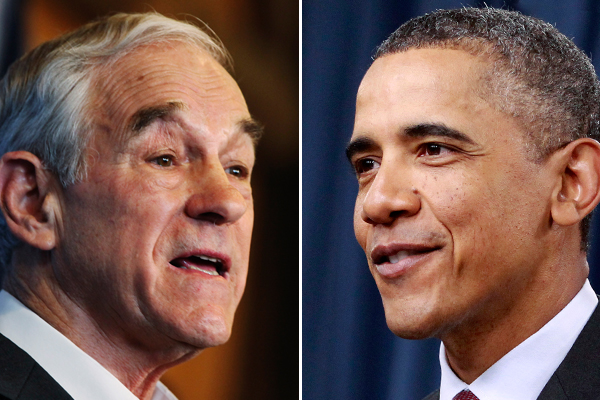
Ron Paul and Barack Obama (Credit: Reuters/Shannon Stapleton/AP/Haraz N. Ghanbari)

It’s rather sad that nearly every article written by a non-libertarian about Ron Paul begins with a disclaimer that the writer is not endorsing Paul for president. Yet, with a virulent case of Ron Paul Derangement Syndrome plaguing partisan Obama loyalists, it bears repeating if only to preempt future mischaracterizations and slander: I am not endorsing Ron Paul for president.

That said, I believe the argument being forwarded by progressive-minded Paul supporters is significant because it embodies a calculating pragmatism that highlights uncomfortable truths both about liberal priorities and about presidential power.

To review the basic Paul profile: When it comes to government social spending and regulation, Paul is more antithetical to progressive goals than any candidate running for the White House. This is indisputable. At the same time, though, when it comes to war, surveillance, police power, bank bailouts, cutting the defense budget, eliminating corporate welfare and civil liberties, Paul is more in line with progressive goals than any candidate running in 2012 (or almost any Democrat who has held a federal office in the last 30 years). This, too, is indisputable.

In seeing Paul’s economic views, positions on a woman’s right to choose, regulatory ideas and ties to racist newsletters as disqualifying factors for their electoral support, many self-identified liberal Obama supporters are essentially deciding that, for purposes of voting, those set of issues are simply more important to them than the issues of war, foreign policy, militarism, Wall Street bailouts, surveillance, police power and civil liberties — that is, issues in which Paul is far more progressive than the sitting president.

There’s certainly a logic to that position, and that logic fits within the conventionally accepted rubric of progressivism. But let’s not pretend here: Holding this position about what is and is not a disqualifying factor is a clear statement of priorities — more specifically, a statement that Paul’s odious economics, regulatory ideas, position on reproductive rights and ties to bigotry should be more electorally disqualifying than President Obama’s odious escalation of wars, drone killing of innocents, due-process-free assassinations, expansion of surveillance, increases in the defense budget, massive ongoing bank bailouts and continuation of the racist drug war.

By contrast, Paul’s progressive-minded supporters are simply taking the other position — they are basically saying that, for purposes of voting, President Obama’s record on militarism, civil liberties, foreign policy, defense budgets and bailouts are more disqualifying than Paul’s newsletter, economics, abortion and regulatory positions. Again, there’s an obvious logic to this position — one that also fits well within the conventional definition of progressivism. And just as Obama supporters shouldn’t pretend they aren’t expressing their preferences, Paul’s supporters shouldn’t do that either. Their support of the Republican congressman is a statement of personal priorities within the larger progressive agenda.

Hence, we reach one of those impossible questions: From a progressive perspective, which is a more legitimate camp to be in? In terms of ideological allegiance to the larger progressive agenda, I don’t really think there’s a right or wrong answer. But in terms of realpolitik, there’s a strong case to be made that Paul’s progressive-minded supporters understand something that Obama’s supporters either can’t or don’t want to: namely, that a presidential election is a vote for president, not a vote to elect the entire federal government. As such, when faced with candidates whom you agree with on some issues and totally disagree with on other issues, it’s perfectly rational — and wholly pragmatic — to consider one’s own multifaceted policy preferences in the context of what a prospective president will have the most unilateral power to actually enact.

With Paul, it just so happens that most of the ultra-progressive parts of his platform (and legislative career) correspond to the presidential powers that are most unilateral in nature. As President Obama so aptly proved when he ignored the War Powers Act during the Libya conflict and started drone wars in various other countries, a president can start and end military conflicts with the stroke of a pen — and without any congressional check on power. Likewise, as President Obama showed when he assassinated American citizen Anwar al-Awlaki and then his family without so much as a single criminal charge, a president can now trample or expand civil liberties with the stroke of the same pen. The president also appoints the chairman of the Federal Reserve bank, which now unilaterally grants trillions of dollars in bailouts without intervention from Congress. And, as President Obama proved with his administration’s crackdown on California’s marijuana laws, a president has far more operational control over the drug war than the congressional committees charged with oversight.

By contrast, the policy areas where Paul is most at odds with progressives are the areas Congress has far more control over — specifically, budgets and regulatory statutes.

So, for instance, Paul’s radical proposals to eliminate major social programs are certainly objectionable, and, if he were president, those proposals would certainly have an impact on the overall political debate. But the Constitution mandates that the federal budget is the purview of Congress. That explains why the final budget so often looks so different from the budget initially proposed by the president — and why a President Paul wouldn’t be able to do to the budget what he could do unilaterally to, say, America’s war policy. Likewise, President Paul may want to get rid of civil rights and clean water regulations, and his executive power over appointments and agency rule-making could certainly do great harm to the enforcement of those important regulations. But again, unlike wars, civil liberties, bailouts and domestic police power, Congress has far more control over those regulatory statutes than any single president — and additionally, many of those statutes permit private legal action (suing, etc.) as an (albeit, imperfect) means of enforcement.

Of course, an Obama supporter might argue that the set of issues they can agree with Paul on are less monumental than the set of issues they agree with Obama on. But don’t mistake such a conversation-ending declaration as fact. On the contrary, it’s merely a subjective opinion — and a debatable one at that. Indeed, Paul supporters would make a compelling case that it’s exactly the opposite — that the progressive side of Paul’s program relates to more pressing issues than Obama’s progressive positions in this, the age of multitrillion-dollar bailouts, deficit-exploding defense budgets, assaults on the most basic tenets of the Bill of Rights and what the Pentagon now calls “the era of persistent conflict” (read: Permanent War). And they have a strong case to make that by virtue of the modern presidency Paul would be guaranteed to actually enact the progressive parts of his program, whereas the progressive parts of President Obama’s program are more a question of congressional politics (a good example of that truism was the healthcare bill, which went from a mildly progressive White House proposal to a public-option-free boondoggle for the insurance and drug industries by the time Obama and his lobbyist friends finished massaging it through Congress).

In holding this pragmatic view, it doesn’t mean Paul’s progressive-minded supporters believe in the reactionary tenets of Paul’s agenda (eliminating major social programs, opposing civil rights laws, ending all taxes, having a history associated with racist newsletters, etc.) any more than it means Obama’s progressive-minded supporters are thrilled with all of the president’s ultra-conservative actions (wars, mass killing of civilians, trampling of civil liberties, bank bailouts, a racist drug war, etc.). It only means that there’s a calculation at work — one that takes into account the realities of presidential power.

Is this calculation reasonable, or at least defensible within the progressive coalition? I’d say yes (even though, again, I’m not endorsing Paul). To paraphrase the most standard apologia Democratic partisans use to defend President Obama (one overused with regard to Obama, IMHO), a president is not a Superman or a savior — on the issues in which he doesn’t have unilateral control, he has to work with Congress and therefore isn’t always the sole “decider” of policy outcomes. That’s especially the case at a moment when Washington is more gridlocked than ever.

Faced with that reality, and sick of a political system that is paralyzed by the Manichaean blood sport of red-versus-blue, many voters of all stripes are focusing primarily on the issues that the president has total control over. These issues, after all, are hardly insignificant — and they are the ones a presidential election can instantly change.

Paul’s progressive supporters seem to understand that truism, while many Obama supporters find it too inconvenient to acknowledge. That’s fine. In fact, that’s what democracy is all about — the freedom to make your own choice. But don’t think the choice being made by Paul’s supporters is so obvious a progressive litmus test when the same reductionism used to tar and feather those supporters (“they’re racist because of his newsletters!”) could be used against Obama backers (“they’re baby killers because of the president’s wars!”).

Despite media hype and activists’ glib talking points, such election choices between imperfect candidates are not so simple, nor should they be when a truly informed vote means factoring in the unspoken nuances of presidential power.

David Sirota

David Sirota is a best-selling author of the new book "Back to Our Future: How the 1980s Explain the World We Live In Now." He hosts the morning show on AM760 in Colorado. E-mail him at ds@davidsirota.com, follow him on Twitter @davidsirota or visit his website at www.davidsirota.com.

Obama: Born in Kenya? (No)

Updated: Right-wing hacks are again insisting that the president was born overseas, but say they aren't birthers

President Obama (Credit: AP/Pablo Martinez Monsivais)

[Correction Appended] One of the Breitbart dopes has a SCOOP: Some sort of ancient press release says Barack Obama was born … in Kenya. IMPEACH. Retroactively install John McCain, we have so much Iran bombing to make up for.

This particular dope — Ben Shapiro, former boy-pundit Joel Pollak, some guy — says he is totally not a birther, at all, whatever gave you that idea, but it is very important that this forgotten old publicity pamphlet from a literary agent for a book project that never happened be unearthed and heavily hyped now, because the president was not properly “vetted” in 2008. (The idea that the president is a secret radical whose secret radicalism was not properly explored by the mainstream media is a stupid conspiracy theory that is almost as ridiculous as birtherism, by the way. We have proof that the president is not a secret radical leftist, and it is “his entire political career including his first term as president of the United States.”)

But what does producing this old booklet (that Obama did not write) with a factual error have to do with “vetting,” exactly? Well, Pollak explains that it fits a “pattern in which Obama — or the people representing and supporting him — manipulate his public persona,” by which he means “this is pointless bullshit that we’re publishing to stir up the birthers and look it worked plus we got a big Drudge link.”

Regardless of the reason for Obama’s odd biography, the Acton & Dystel booklet raises new questions as part of ongoing efforts to understand Barack Obama–who, despite four years in office remains a mystery to many Americans, thanks to the mainstream media.

IMPORTANT NEW QUESTIONS ARE BEING RAISED. This editing error that Obama had nothing, personally, to do with is part of a pattern of Obama deceiving people by allowing them to believe insane things about him.

Now, coincidentally, the Arizona secretary of state is playing the “I’m not a birther but on the other hand let’s indulge the birthers” game. The president might not be eligible to be on the Arizona ballot, because of a petition, according to Ken Bennett, an American state’s No. 2 elected official. Vetting is so fun!

So, on the one hand, we have Barack Obama’s birth certificate(s), two newspaper announcements, a couple of witnesses, and nearly every single other newspaper and media account up to the point at which the birther conspiracy was invented circa late 2007. On the other hand, we have an author’s bio he didn’t write from 1991, and a petition. Obviously there is much more “vetting” to do, before we finally find the one piece of secret buried evidence that proves that it was a horrible accident that a majority of voters picked the socialist Muslim in 2008. Wake up, sheeple, etc.

[Correction: I mistakenly attributed the Big Government story to Ben Shapiro, but it was written by Joel B. Pollak. I apologize to Ben.]

Continue Reading Close
Alex Pareene

Alex Pareene writes about politics for Salon and is the author of "The Rude Guide to Mitt." Email him at apareene@salon.com and follow him on Twitter @pareene

Obama’s broken immigration promise

ICE said it would target dangerous immigrants, but it's actually deporting a higher percentage of non-criminals

A man in Ciudad Juarez, Mexico, stands next to the border fence as two U.S. law enforcement officers look on from the U.S. side of the fence. (Credit: AP/Raymundo Ruiz)

The Obama administration claims that it is deporting record numbers of illegal immigrants while focusing on those with criminal records. But new data from Immigration and Customs Enforcement shows that the number of deportation orders has declined dramatically since last summer and non-criminals comprise a growing percentage of those expelled from the country.

That wasn’t supposed to happen under a policy of “prosecutorial discretion” announced by ICE director John Morton last June. The goal of the policy, announced with much fanfare in the Spanish language media, was to spare “longtime lawful residents” from deportation and to focus on criminals.

Since then, the adminstration has deported many fewer non-criminal aliens. But non-criminals remain the vast majority of those deported. And those with no criminal record now actually comprise a slightly larger percentage of those forced to leave the country than they did before Morton’s announcement.

In the three months before the policy was announced last summer ICE filed for deportation proceedings against 61,192 people of whom 15 percent had criminal records. In the first three months of 2012, ICE sought 37,659 deportations orders, 14 percent of which involved people with criminal records.

“The agency continues to be headed in the opposite direction of its stated goals,” said Susan Long, co-director of the Transactional Records Access Clearinghouse at Syracuse University, which collected the data from ICE via a Freedom of Information Act request.

The goal of prosecutorial discretion, Long said in a conference call with reporters, “was to target and bring before the court those with more serious criminal history. As yet we’re not seeing any change. They have not turned the ship around.”

The administration implemented prosecutorial discretion in response to complaints that young people with no criminal records continue to face deportation. But the new data will come as no surprise to student groups such as United We Dream, National Immigrant Youth Alliance and DreamActivist, which continue to highlight the cases of law-abiding young people facing deportation.

Rep. Luis Gutierrez, D-Ill., has championed the case of a South Carolina man, Gabino Sánchez, a married father of two, who was arrested for driving without a license last year and now faces deportation.

“Gabino Sánchez has lived and worked and raised a family here for more than a decade and it is not in anyone’s interest to have him deported,” Rep. Gutierrez told Fox News Latino on Tuesday after a deportation hearing in North Carolina.  ”I do not understand why ICE has not followed President Obama’s guidelines and decided to move on from this case to go after someone else, someone who is a threat to his community or a serious criminal.”

In response to the TRAC findings, Gutierrez  said, “The president should make sure the Department of Homeland Security is actually following its own rules and he should proclaim proudly and loudly that he will not deport another DREAMer or anyone else who fits the prosecutorial discretion criteria.”

Continue Reading Close
Jefferson Morley

Jefferson Morley is a staff writer for Salon in Washington and author of the forthcoming book, Snow-Storm in August: Washington City, Francis Scott Key, and the Forgotten Race Riot of 1835 (Nan Talese/Doubleday).

Colorado congressman: “Obama’s not an American”

A congressman renews the GOP's big lie, and reveals the party's true ideal: Male, rich, straight, white

Mike Coffman (Credit: AP/Ed Andrieski)

Twenty-four hour news cycles are messy and chaotic, almost never fully summarizing the zeitgeist of the moment. But today is one of those rare days where the news cycle perfectly embodies the tectonic shifts in American politics — and the friction that comes from such shifts.

In the last day, we’ve learned that America has reached a demographic tipping point. For the first time in history, there are more minority births than white births in the United States, meaning we’re closer than ever to becoming a majority minority nation.

At almost exactly the same time these numbers were being released, a top Republican lawmaker, U.S. Rep. Mike Coffman, R-Colo., was making national headlines with a leaked audio recording of him publicly declaring that the first African-American president is “not an American.” Here’s the audio and full quote from Coffman’s remarks at a Republican fundraiser:

“I don’t know whether Barack Obama was born in the United States of America. I don’t know that. But I do know this, that in his heart, he’s not an American. He’s just not an American.”

Coffman has since issued a non-apology apology, saying that while he misspoke in questioning Obama’s birth certificate, he stands by his “not an American” declaration because Obama doesn’t “share my belief in American Exceptionalism — his policies reflect a philosophy that America is but one nation among many equals.”

It’s a deft misdirect — caught on tape making a nakedly demagogic play to White America’s reflexive fears of the “other” (in this case, denigrating a minority president as literally the “other” — i.e., a non-American), Coffman is pretending he was merely voicing his disagreement with Obama’s foreign policy. But don’t be fooled: The nation’s shifting demographics, as epitomized by today’s census numbers, is exactly what this is all about.

Coffman is running in a newly redrawn suburban Denver congressional district — one that is expected to be among the most contested in the 2012 election. Following the larger Republican strategy of racial fear-mongering, he’s spent the last year following in the footsteps of his anti-immigrant predecessor, U.S. Rep. Tom Tancredo, championing legislation to repeal parts of the Voting Rights Act and prevent non-English ballots and end birthright citizenship for immigrants.

Put Coffman’s record together with his attack on Obama (an attack that has become all too common among top GOP leaders), add in the fact that his GOP neighbor U.S. Rep. Doug Lamborn recently made headlines calling the president a “tar baby,” and remember the GOP’s successful opposition last week to a high-profile civil unions bill. It becomes clear that even in the swingiest of swing states, the national Republican Party sees its path to victory as one that eschews inclusiveness and equal rights, and instead stirs fears and resentment over the quickly changing definition of Americanness.

Ultimately, that’s what all the debates over almost every policy really comes down to. We can tell ourselves we’re fighting over taxes or contraception or abortion or gay rights or immigration or food stamps — and at one level, we most certainly are. But when policy disagreements become a justification for Republicans to claim an opponent isn’t a fellow countryman, it’s clear what we’re really fighting over is the root idea of “American.” Looked at this way, almost every policy battle has been transformed into a proxy in a Republican war to define “American” as white, straight, male and wealthy — an us-versus-them war being waged ever more intensely in 2012 because changing demographics threaten to define the term on far different terms.

We can thank today’s news cycle for making that war so crystal clear; at least it’s now painfully obvious what this moment’s political conflict is truly all about.

Continue Reading Close
David Sirota

David Sirota is a best-selling author of the new book "Back to Our Future: How the 1980s Explain the World We Live In Now." He hosts the morning show on AM760 in Colorado. E-mail him at ds@davidsirota.com, follow him on Twitter @davidsirota or visit his website at www.davidsirota.com.

More Rev. Wright hate porn!

"The Defeat of Barack Hussein Obama" was designed to turn on one wealthy right-winger – and even he rejected it

Jeremiah Wright (Credit: AP/J. Scott Applewhite)

On the one hand, it’s almost funny. Fred Davis, the man who created hilariously bad ads for losing 2010 Republicans — Carly Fiorina’s “Demon Sheep” and Christine O’Donnell’s “I am not a witch” — now wants cranky conservative billionaire Joe Ricketts to spend $10 million on an advertising campaign to take down Barack Obama. He’s teamed up with Whit Ayers, one of his collaborators on Jon Huntsman’s spectacularly terrible presidential run. Halfway through their description of “the Ricketts plan,” they describe themselves as “pirates.” Ay, matey, but are they after Obama’s booty – or Ricketts’?

Davis, Ayers and friends should remember that Obama sent in special ops to take out Somali pirates in 2010. These pirates’ fate might be similar. Politically, of course. I’m not suggesting anyone use violence against them. And they’re not suggesting anyone use violence against Obama, of course — although their pitch is chock-full of eliminationist rhetoric. From its title, which promises to “stop [Obama's] spending for good,” to its description of being “locked, loaded and ready” to “hit Barack right between the eyes” and bring about “his demise,” the memo the New York Times released today is right-wing hate porn, designed for maximum titillation to Ricketts, its intended audience. It may not have worked on Ricketts, whose PAC disavowed the plan Thursday afternoon after a day of negative publicity. But will it work on anyone else?

I doubt it. The 54-page PowerPoint is certainly a quick, fun read, a guide to the profiteering right-wing id. I loved the idea that they wanted to unveil the whole campaign in Charlotte during the Democratic convention: I can’t think of anything that would get the oft-divided Democratic Party fired up better than right-wingers with flyover Rev. Wright hate porn. Although the plan is supposedly designed to demonstrate Obama’s “incompetence,” it’s hard to see what Wright’s views have to do with Obama’s competence – unless you’re of the opinion that nothing says “incompetence” like a black man having something to do with another black man. The writers reassure Ricketts they’ve minimized the risk of being charged with racism by lining up a “highly literate” (that must have been hard) black spokesman, Larry Elder, whom they’re paying $25,000 to serve as frontman. (If I were Larry, I’d talk to an employment discrimination lawyer: I think a white guy would get more than $25,000 to front a $10 million ad campaign. Not to mention to sell his soul.)

Can the Wright fear-mongering work? I think it mainly plays with people who wouldn’t vote for the president, anyway. I’m one of the few liberals who wrote with concern about the Wright revelations back in 2008. I didn’t want to believe that Obama looked the other way as Wright preached the unredeemable evil of the United States (and most white people), along with self-defeating theories of black difference and downright lies about genocide. But I never believed Obama shared those opinions. I assumed he admired Trinity’s social work and political connections. I didn’t think he spent a whole lot of time in its pews or listening to Wright’s views. Still, I thought it was fair to look at what Obama’s ties to Wright told us about his politics – and like most people, I quickly decided: not much.

Four years later, independents are able to see that Obama has in fact been a fairly hawkish president, whose foreign policy certainly didn’t come from the Jeremiah Wright hymnal. In fact, his expansion of drone warfare, with its inevitable civilian casualties, is precisely the kind of thing Wright and other foreign policy critics think can result in “chickens coming home to roost.” And it’s not like the media ignored Wright, either. Remember that whole race speech candidate Obama had to make in March 2008 – against the advice of strategists who worried it would backfire?

The notion that the Wright mess didn’t get adequate attention comes down to one fact: that John McCain wouldn’t greenlight a lurid strategy to blacken Obama (literally and figuratively) with scary ads about Wright. For that, McCain earns derision from his former campaign advisors: They call him “a crusty old politician who often seemed confused, burdened with a campaign just as confused.”

What is Mitt Romney saying about the so-called Ricketts plan? He told reporters this morning he hadn’t had time to read the papers (typical Romney bravery), although he’d already done his own Wright-baiting in a February interview with Sean Hannity. By this afternoon, the Romney campaign released a statement disavowing the proposal (and Romney himself then told the conservative Townhall site that he would “repudiate” the Super PAC’s ad strategy). Even Ricketts did the same, in a statement from his PAC saying “he is neither the author nor the funder of the so-called Ricketts Plan to defeat Mr. Obama that The New York Times wrote about this morning…. [I]t reflects an approach to politics that Mr. Ricketts rejects and it was never a plan to be accepted but only a suggestion for a direction to take.” (Jeff Zeleny of the Times later Tweeted that a reference on page 46 of the plan suggests that it had received tentative approval at a meeting in New York.)

You can decide whether or not you believe that. I think it’s good news that even Joe Ricketts can be shamed out of such a crude and racialized appeal. That doesn’t mean we won’t see such appeals in the months to come, just that they probably won’t come with a prominent billionaire’s name on them.

Continue Reading Close
Joan Walsh

Joan Walsh is Salon's editor at large.

Jon Huntsman for New York City mayor?

Yes, please. It would be very funny to see him lose

Yes, Jon Huntsman should definitely run for mayor of New York, because I never tire of watching Jon Huntsman get rejected by voters. The best part of a Jon Huntsman campaign is when his well-heeled supporters very sincerely and tragically argue that the fact that no one wants to vote for Jon Huntsman is a sign that the Republic itself is in peril. They would get so sad and melodramatic when he got 10 percent of the vote.

Now, there is no evidence that Jon Huntsman is planning for run for mayor of New York City, but one of his annoying daughters tossed this one out there last night:

Why not? I mean sure he has never lived in New York and has no connection to the city, but why not?

Of course, now that this idea is floating around, very rich and well-connected morons just might set about trying very hard to make it a reality. Jon Huntsman is a creature of the sort of oblivious center-right rich folk who bankrolled the hilarious failed New York campaigns of Harold Ford Jr. and Reshma Saujani. They would like very much to see another one of their class be the mayor of their city, after Bloomberg ends his term (if he ends his term). The Republicans have essentially no candidate. (I still wouldn’t put it past Police Commissioner and professional harasser-of-minorities Ray Kelly to mount a run, but at the moment he’s sounding disinclined to.) And Jon Huntsman is the sort of nationally prominent “independent” candidate all three major New York newspapers would love (the Daily News would love him the most, obviously, but the Post would love him because he is secretly not actually that moderate).

Jon Huntsman — whose tax plan called for the complete elimination of taxes on capital gains and dividends, as well as the elimination of the Earned Income Tax Credit, the Reagan-era tax benefit for poor people that used to be the sole form of welfare that conservatives supported, and who also wholeheartedly supported the Paul Ryan plan to fix the deficit by eliminating Medicare and not making rich people pay taxes — was of course beloved by the press and labeled a reasonable moderate when he ran for the 2012 Republican presidential nomination. He was mistaken for a political moderate primarily because he does not believe that God created cavemen and dinosaurs at the same time, roughly 4,000 years ago. Huntsman, who supports the complete repeal of Dodd-Frank and is strictly antiabortion and anti-gay marriage and anti-healthcare reform and pro-gun, is now essentially a symbol of the dignity and sagacity of the “radical center,” even though he is a conservative Republican.

So obviously New Yorkers would be thrilled to vote for this guy. I endorse this.

Continue Reading Close
Alex Pareene

Alex Pareene writes about politics for Salon and is the author of "The Rude Guide to Mitt." Email him at apareene@salon.com and follow him on Twitter @pareene

Page 1 of 199 in 2012 Elections