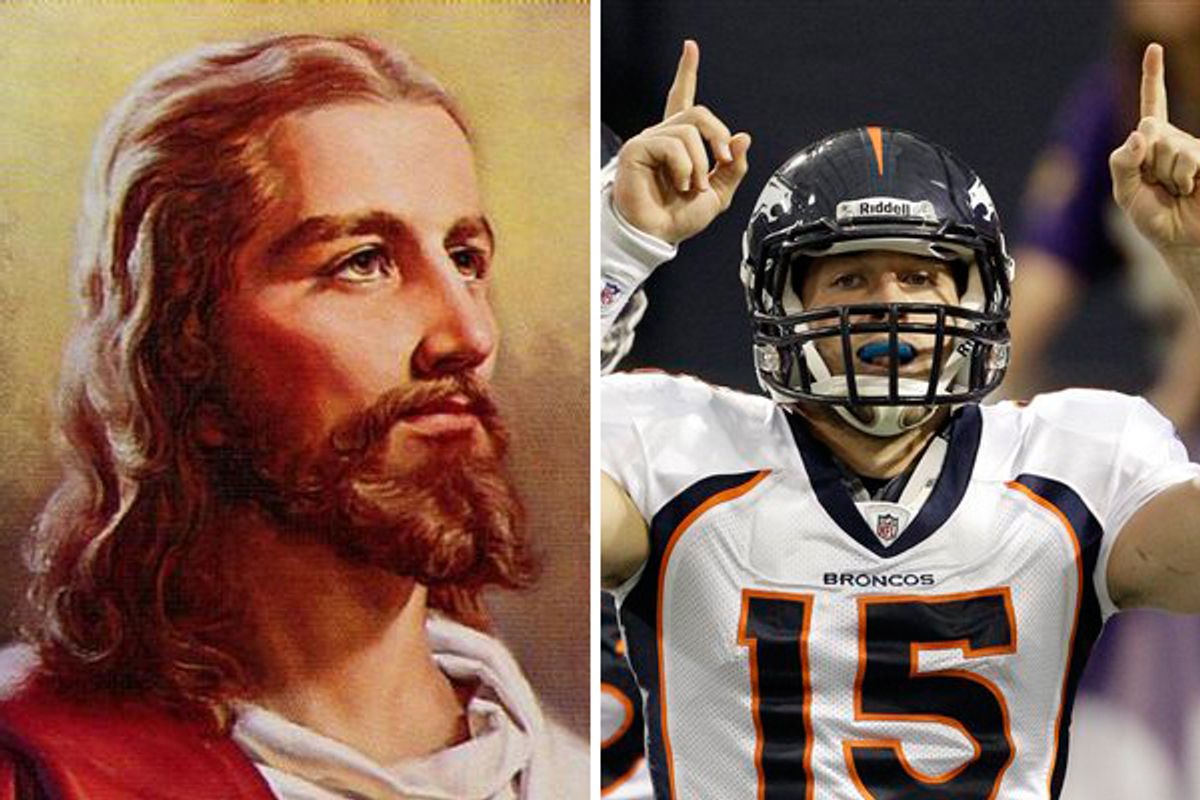
For football fans, the playoffs are always momentous. But one of this weekend’s games, between the Denver Broncos and the New England Patriots, is especially significant. For among the questions that will be answered will be one that has long puzzled mankind: Does God exist?
In an attempt to answer that question, the tortured French philosopher Blaise Pascal came up with something called “Pascal’s wager,” also known as “Bet on God.” Pascal’s argument went something like this: Man cannot know for sure whether or not God exists, but he has nothing to lose and everything to gain if God does exist, so he should “bet on God.”
It wasn’t exactly the most overpowering argument for the existence of a supreme being ever made, but it is one that millions of atheists, agnostics and other non-believers have been forced to take seriously since Tim Tebow pulled on a Denver Broncos’ uniform.
The devout Mr. Tebow has been the worst thing to hit non-believers since the Spanish Inquisition. Tebow throws passes that make Anthony Weiner’s look accurate. His noodle-armed play at the quarterback position has taken the league back 60 years, to the leather-helmet era when completing a pass was like throwing a no-hitter. “This is what I see, and what troubles me. I look on all sides, and everywhere I see nothing but obscurity. Nature offers me nothing that is not a matter of doubt and disquiet.” Pascal said that, but it could have been Broncos coach John Fox commenting on the location of one of Tebow’s deep balls.
And yet, this son of Southern Baptist missionaries, star of a notorious antiabortion Super Bowl ad and warrior of Christ, keeps winning. Winning in the last second. Winning because other teams would make unthinkable mistakes. Winning against all odds.
This has been weird and unnerving all year, and the fact that Tebow passed for 316 yards and averaged 31.6 yards per pass last week, in what was obviously a divine reference to John 3:16, made it even more so. But it was still possible for a heretic to chalk it all up to mere chance – until last week’s wild card game. Tebow was facing the Pittsburgh Steelers, the No. 1 defense in the league. There was no chance in hell – pardon the expression – that Tebow was going to beat the Steelers. But he did – and he beat them by throwing the ball.
The Vegas odds on God existing suddenly jumped 30 points.
Thanks to Tebow, the non-faith of millions is hanging by a thread. And if he manages to beat Tom Brady and the Patriots in Foxboro, the issue will be resolved once and for all. Pascal’s bet will be paid by the Man Upstairs, and all those who pick the Pats will find themselves descending into the Lake of Eternal Fire.
So it’s with considerable trepidation that I’m putting my money, and the fate of my potentially immortal soul, on the Patriots.
Here’s why I’m violating Pascal’s wager and betting against God. Tebow may be under divine protection, but he’s gotten a lot of help from mere mortals on earth. Like Steelers’ defense coordinator Dick LeBeau, who was so worried about the Broncos’ running game that he crowded the line of scrimmage with not just eight but sometimes nine players, leaving his cornerbacks one-on-one with the Broncos’ receivers, with no safety help. Playing without safety Ryan Clark, the Steelers’ corners, especially Ike Taylor, had a bad day. Tebow made some excellent throws, but on a number of plays his receivers were so open he could have hit them with a Nerf ball.
To which, defenders of the faith will say, “So what? The Steelers have a good secondary. The Patriots’ secondary is so bad, playing them is like cheating against yourself in the old Foto-Electric Football game, where if you lay the ‘slant pass’ offensive card on top of the ‘off tackle run defense’ card you’re guaranteed a 60-yard gain every time. How are these human colanders going to stop the Broncos?”
The answer is: They aren’t. Tebow, who is actually looking a little more like an NFL quarterback, will complete some passes, and the Broncos should be able to run effectively as well. But the Patriots will not make the Steelers’ mistake and bring their safeties up on every play: They’ll make Tebow work his way down the field. The Broncos will score points against the horrendous New England defense, but not enough to keep up with the great Tom Brady (whose monster season got lost in this all-time Year of the Quarterback) and his insanely good inside passing game. The Patriots’ two tight ends, Rob Gronkowski and Aaron Hernandez, are unstoppable, combining for a laughable 169 catches, 2,237 yards, and 24 TDs. Combine them with slot man Wes Welker, the baddest white boy in the league, and the Broncos just won’t be able to score enough points to keep up.
I better be right. If I’m not, I’ll see some of you downstairs.
Patriots, 31-17.
49ers vs. Saints
While the Broncos-Patriots game will resolve the existence of God, the 49er-Saints game will answer another philosophical conundrum: Can an immovable object stop an irresistible force?
The Saints are the irresistible force. They are one of the greatest offensive football teams in history. Their quarterback, Drew Brees, just shattered one of the sport’s most venerable records, Dan Marino’s single-season passing yardage mark. They have, as the announcers used to intone ad nauseam about my team, the 49ers, back in the Montana-Young days, “so many weapons.” They were already unstoppable with Brees passing to Marques Colston, Devery Henderson, Robert Meachem and his monster tight end, Jimmy Graham, and a potent rushing attack led by Pierre Thomas and Chris Ivory; the addition of Darren Sproles, the tiny all-purpose back who is quicker than any player in football, was almost L.A. Lakers-like in its unfairness. They averaged more than 34 points a game and were successful on third down a mind-numbing 56.7 percent of the time – another NFL record. Watching Brees in the second half of the wild card game against the Lions last week, it appeared that on every play he had his choice of a 20-yard completion, a 30-yard completion or a 40-yard completion. It’s an offensive juggernaut comparable to the “greatest show on turf” Los Angeles Rams. The Saints are the hottest team in football, winning their last eight regular season games before beating the Lions.
Standing in their way is one of the league’s stoutest defenses, led by the best linebacker in football, Patrick Willis, his almost equally talented inside-backer clone Navorro Bowman, the indefatigable defensive lineman Justin Smith, killer rookie pass rusher Alden Smith, and a young, ball-hawking secondary. All of them hit hard, they rarely miss tackles, and they are extremely well-coached and disciplined. It is next to impossible to run on them. Their only weakness is that they occasionally give up the long pass, a vice that could quickly prove fatal against Brees and company.
In addition to their league-best kicking game, the 49ers will have one huge advantage: They will be playing on natural grass at Candlestick Park, which will slow down the speedy Saints. But nothing can consistently stop an offense like New Orleans’. To win, the hit-and-miss 49ers offense, which has stumbled repeatedly in the red zone this year, will have to score more points than it normally does. That means that Alex Smith, the consummately-jerked-around 49ers quarterback who has had a heartwarming renaissance this year under certain Coach of the Year Jim Harbaugh, will have to play at the top of his game, as will tight end Vernon Davis and wide receiver Michael Crabtree. If running back Frank Gore, who despite gaining 1,200 yards has had a strange, up-and-down season, returns to his unique form, hurling himself into the tiniest cracks, disappearing in a forest of huge bodies and suddenly exploding out of them, the 49ers just might be able to score enough points to beat the Saints. That is a big “if”: contrary to national media commentary, the 49ers’ offensive success this year has been due as much to Alex Smith as Gore. Opposing teams have routinely stacked the box against the run, forcing Smith to audible to pass plays on first down.
All year, the 49ers offense has been a step off, whether due to play calling or execution or breakdowns on the offensive line. But they have the talent to put together a complete game. To win this game, they will have to.
My brain says Saints, but as a lifelong 49ers fan I’ve got to stand behind the red and gold. 49ers, 30-28.
Packers vs. Giants
The Green Bay-New York Giants game poses another philosophical question: What is the sound of one loss clapping? The Packers are the defending champions. They went a league-best 15-1 behind quarterback Aaron Rodgers, whose spectacular play led many experts to acclaim him not only as the best quarterback in the game today, but the greatest ever to play the game. And yet, when they lost to the mediocre Kansas City Chiefs 19-14, corrosive doubts appeared. The Packers’ weaknesses – a shaky defense, an inconsistent running game and occasional difficulties in pass protection – were ruthlessly exposed by the Chiefs, who played aggressive bump-and-run coverage, pressured Rogers off the edges and managed to put up enough points to win.
Those doubts, combined with the fact that the Giants are peaking at the right time, has made this game much more intriguing than it would have been two months ago. The Giants are one of those teams nobody wants to play: After surviving a rash of injuries, they had to make it into the playoffs the hard way, dispatching the Jets and Cowboys to make the wild card round then soundly defeating the tough Atlanta Falcons to make it into the final eight. With their ferocious pass rush, led by Jason Pierre-Paul, Osi Omenyiora and Justin Tuck, they have the ability to force Rodgers out of the pocket. On offense, quarterback Eli Manning is having a superb year, his wide receivers are extremely nasty and the Godzilla-like running back Brandon Jacobs, who sometimes seems to be running through Tokyo Harbor, returned to form against Atlanta, smashing linebackers like toy replicas of skyscrapers. Green Bay’s defense gives up a lot of yards (though only an average number of points, largely because they lead the league in takeaways), so if the Giants can avoid turnovers, they should be able to score points.
But the doubts about the Packers are overblown. Their defense did not have the year it did last year, but it still has plenty of talent, including first-ballot Hall of Famer Charles Woodson and ferocious linebacker Clay Matthews. And then there’s No. 4. The combination of that one Packers loss and Drew Brees’ record-setting season led everyone to get an instant case of amnesia and forget just how extraordinary a year Aaron Rodgers had. Confronted with Brees, Rodgers must feel a little like a guy who wins the Pulitzer Prize and the National Book Award, only to discover that his roommate is placing his Nobel trophy on the fireplace. It won’t matter: Rodgers will slice and dice the Giants’ tough defense, and the Giants won’t be able to score enough points to keep up. Packers, 28-21.
Ravens vs. Texans
The question posed by the last of the four games, between the Baltimore Ravens and the Houston Texans, is a faceoff between what the mystic sage William Blake called “innocence and experience.” (OK, this particular philosophical conundrum is a stretch, but give me a break — it isn’t easy coming up with these labored allegories.) All other things being equal, do you put your faith in a naive youth, who has little experience but carries no baggage, or in a veteran who has been through the wars but has been wounded by criticism? Is the fresh-faced kid more likely to come through, or the sadder but wiser adult?
I’m referring to the duel between much-maligned Baltimore quarterback Joe Flacco, and rookie Texans QB T.J. Yates. Football games are always duels between quarterbacks, but this particular one-on-one matters more than most because of the eight playoff teams, these two are the most like each other. Both have powerful defenses. The Ravens (you have to love a football team named after a morbidly heavy-handed Edgar Allen Poe poem) have the great running back Ray Rice. The Texans counter with another great running back, the eccentric running back Arian Foster.
(Since theology plays such a large role in these playoffs, Foster is worth a brief digression. He was not, unfortunately, named after Arius, founder of Arianism, the most important Christian heresy: If he had been, he and Tebow would have been on opposite sides of the Christological questions debated at the Council of Nicaea in 325 AD. But their trademark poses do constitute a theological throw-down. Tebow’s famous “Thinker” pose is a prayerful Christian attitude. By contrast, the little bow that Foster takes after scoring is derived from eastern religions. “It’s a Hindu greeting that means ‘I see the God in you,’” Foster said. “It’s a Namaste. It means respect. It’s me paying my respect to the game of football.” Unfortunately, since their teams are both in the AFC, the world will not be able to witness the clash of religious gestures that would take place if Tebow and Foster scored in the same game.)
In any event, the two teams are mirror images of each other, which puts the focus on the quarterbacks. And unfortunately for Joe Flacco, many observers have failed to see the god in him. Like Alex Smith and Mark Sanchez, he has been damned with faint praise as a “game manager,” when not being outright excoriated. The criticisms are largely unjustified, but Flacco will have to win this game to quiet them.
He will. Old age and treachery will defeat youth and beauty. Ravens, 24-14.
Coming on Sunday: Analysis of the weekend’s games, plus specious comparisons between football and quantum mechanics!
[UPDATED BELOW]
You don’t need to be an evangelical Christian to care about the future of Tim Tebow. I’m a lapsed atheist myself. But with the resurrection of quarterback Peyton Manning in Denver, I wonder most about the future of the spiritual scrambler, who led the Broncos to the playoffs last year.
The Broncos signing Manning to replace Tebow is a no-brainer. He may be diminished by age and injury, but he is also the best quarterback of our time, not because he is a brilliant coach’s puppet (Tom Brady) or an on-field, off-field brute (Ben Roethlisberger) but by virtue of a fierce work ethic and a concentrated intelligence that is contagious and inspirational. Whatever is left at age 35 of him will make the Broncos better.
Through 14 years and two Super Bowls with the Indianapolis Colts, there was something reassuringly manly about Manning, his cool leadership, his laconic but friendly demeanor, his thoughtful professionalism, that evoked my role models on the Encore Westerns channel like Marshal Dillon and Wagonmaster Flint. (Something went out of American life when the legend of the western hero was replaced by the myth of the sports idol.)
Tebow also evoked the TV cowboy for me, those boyish enthusiasts, Rowdy Yates and Deputy Johnny McKay, still learning but eager to make things happen. Tebow, in his second year at Denver last season, was rough edges and a wonk’s nightmare – his various quarterback ratings and statistics were low – but he did make things happen, as a team leader and a fearless runner when he couldn’t pass, which was often. He became a fan favorite because he tried so hard, often succeeding in the clutch toward the end of games, and a cultural phenomenon for bringing extreme praying to the mainstream tent. He was always ready to take a knee for God.
“Tebowing” became a something of a joke, which was unfair. He wasn’t cool about his Christianity, like so many athletes, including Jeremy Lin. He lived it. But his retrograde beliefs grated on most sports commentators, who tend to find it easier to understand the more traditional jock outlets of driving drunk and assaulting women.
Tebow was a quarterback whose arm, accuracy and game smarts were not considered elite — yet he somehow won anyway. God forbid it was the confidence he got from his faith. But isn’t sports about teaching kids that you can make it if you try hard enough?
Assuming that Tebow will not be kept on in Denver to make Manning even better (as running back or tight end, for example), it figures that he will soon be dealt off. The Miami Dolphins would be a good fit. Tebow’s success at the University of Florida makes him a local hero, and the large Jewish population might give him the chance to refine his other controversial skill, performing circumcisions. He needs to sharpen the technique he practiced at his father’s evangelical ministry in the Philippines.
In Miami, Tebow can mix a little profane with his sacred, hanging out with the Heat basketball star LeBron James, dubbed by author Scott Raab as “The Whore of Akron” for leaving Cleveland to take his talents to South Beach, an American Sodom that could use a missionary like Tebow.
A more serious issue for the NFL is what to do about the defensive unit of the New Orleans Sinners, who, under the supervision of a seasoned, respected coach, instituted cash bounties for knocking opponents out of the game. A good, hard hit that put a rival player on a stretcher might be worth $1,000. As it turned out, this was not aberrant behavior in the National Football League, although it was against the rules, and, I thought, against the spirit of the game.
It may also turn out that the neck injury that kept Manning out of football last season was originally suffered in a game against New Orleans. Could he have been a targeted hit? How much to sack him, to knock him out of the game, to end his career? Just for money, a victory and bragging rights? Doesn’t seem very manly. Football is supposed to have the madcap gallantry of a World War I cavalry charge, not the mean cowardice of a drone attack.
The best we can hope for is that the thuggish Saints coach and the wimps who didn’t have the moral courage to stand up to him are suspended for the season, one less concern as Manning revives his exemplary career in Denver and Tebow, wherever in God’s name he ends up, finds spiritual satisfaction.
UPDATE: So Tebow is going not to the Miami Dolphins but the New York Jets. New York will still give him a large circumcision roster for his shaky arm and a Sodom for his faith-healing, but it will also test him cruelly. It might seem that New York fans would mock his kneeling ways and his anti-abortion stand, but they will also forgive anyone who wins. Will the temptations of the Big Apple be Tebow’s downfall? I hope not. Lord knows the Jets need that mindless confidence that only faith supplies.
And as to the New Orleans Saints: the League stood tall, suspending not only the defensive coach, but the head coach, and penalizing the franchise. There may be further penalties for the players involved. One should not have expected less, of course, as football faces lawsuits and moral indictments for its long failure to deal with head traumas.
Continue Reading
Close
Roger Goodell, the commissioner of the National Football League, argued on “60 Minutes” last Sunday that the NFL is one professional organization designed to appeal to the economic interests of the little guy: Its revenue-sharing model, he said, gives a fighting chance to squads from Green Bay and Buffalo as well as to those from large media markets like New York, Los Angeles and Boston.
On the eve of the Super Bowl, Goodell was touting the familiar idea that the sport’s biggest game is a boon to economic development. But with the cost of a ticket now averaging $3,982 and 30-second television spots selling for $3.5 million, the Super Bowl can appear to be more an occasion for ostentatious excess than an engine of development.
This year’s Indianapolis Super Bowl Host Committee, which has a budget of $25 million, predicts the game will inject anywhere from $150 million to $400 million into the local economy, according to Dianne Boyce, communications director for the host committee.
Amid the continued economic uncertainty, this may sound like a lot of money. But for a major metropolitan city, the impact will likely be short-term only.
Consider last year’s game at Cowboys Stadium in Arlington, Texas. The North Texas Host Committee’s executive summary from April 7, 2011, summed up its belief that the game was an unprecedented economic catalyst for the region, declaring grandly:
“North Texas will forever celebrate Super Bowl XLV, the most impactful event in the region’s history and the most important sports event in the world in 2011.”
But the Dallas News reported last February that the “Super Bowl was not a rising tide that lifted all boats … Hotels and restaurants that were part of official NFL activities, or apt to attract A-listers, reported full rooms and brisk business. Other food sellers and hoteliers said great expectations faded as the week wore on and the hoped-for masses failed to materialize.”
According to Bureau of Labor Statistics data for Dallas-Fort Worth-Arlington, a small portion of steady job growth in the 10 months that followed could be attributed to the game. The Dallas Business Journal reported last week that unemployment in Dallas has dipped from 8.5 percent last January to 7.1 percent. But Bill Lively, the president and CEO of the 2011 North Texas Super Bowl, conceded in an interview the 2 million-plus population of Dallas made it unlikely that the game would be responsible for extended increases in employment.
To Lively, the game served an important community function: unifying three important regions of Texas. The cooperation between Fort Worth, Dallas and Arlington was a “real triumph” that catapulted a city to greatness. He hopes that the Super Bowl will return to the area soon.
Duane Dankesreiter, the vice president of the Dallas Regional Chamber of Commerce, also stressed the secondary benefits of hosting the big game. “The global exposure of an event of that size is tremendous. It gave us an opportunity to introduce North Texas to millions of people and to spread the word about what a great place DFW is to live and work,” he said.
But the Super Bowl did not figure in the city’s long-term economic planning, says Daniel Oney, who works in the Dallas Office of Economic Development. He told me that his office did not engage in broader strategic thinking about hosting it.
“I’m not aware of anything we did to support or hinder the Super Bowl,” he said.
Dennis Coates, a professor of economics at University of Maryland with a specialty in sports, said that all evidence from “benefits, employment, tax revenue generation and so on … indicates that proponents wildly exaggerate the impact of the Super Bowl.”
Mark Rosentraub, a professor of sports management at the University of Michigan, urges the public to “resist trying to make the argument that there are any meaningful or long-term economic effects” from hosting a Super Bowl.
The Dallas Host Committee did boast of a $7.15 million surplus from last year’s game. Texas journalist Scott Nishimura reported in the Fort Worth Star-Telegram that the windfall was redirected toward charity and a new Super Bowl bid, rather than broader economic development. According to the committee, the funds supported:
the NFL Youth Education Town (YET) center for at-risk youths, which is being built in Arlington as the league’s “legacy” project for the area; the North Texas Food Bank; the Tarrant Area Food Bank; and the NFL’s Slant 45 service projects in North Texas. The YET center, scheduled to open early next year, will receive half the surplus beyond the $2 million reserve; the food banks will get 20 percent each; and Slant 45 will get 10 percent.
Like Dallas, Indianapolis is relying on the hope that the secondary perks of the game will translate into future business. Boyce has told me and other journalists that the “NFL estimates that over 60 percent of those people are corporate decision makers, so those are key people who, if they come to Indianapolis and have a positive experience, will come back.”
For Indianapolis restaurateurs and business owners, the hope is that the economic surge crosses class lines this year. That forecast is more plausible in Indianapolis, where the events are centralized in the city, whereas the commerce generated by last year’s game was spread across three localities of metropolitan Dallas. But in Indianapolis, Boyce said that there is no comprehensive economic strategy for channeling the short-term economic gains into the long-term development of the city.
The economic benefits of this year’s Super Bowl will not be tallied until after the Lombardi Trophy is awarded on Sunday. But don’t be surprised if they are modest.
Continue Reading
Close
Most Americans won’t need a justification to watch Sunday’s game, but if you’re a Salon reader you might think, even in passing, that celebrating the holiest day of violence, consumerism and class warfare on your couch is a betrayal of your values or a waste of your time. You might even imagine that it would be better to take a hike, read a book or meditate.
Not this Sunday, buster. It’s an election season. You need to watch this game to fully understand how jobs, religion, leadership and healthcare dominate every American contest.
1. Joe Hill will be playing: Where else will be you be able to watch more than 100 young men, most of them African-American, working for high wages in a totally unionized shop? True, their jobs are dangerous (more on that later) and relatively short-term (typically three or four years), but they are also high profile. They can lead to TV gigs, even political office. Buffalo Bills quarterback Jack Kemp became a Republican congressman and vice-presidential candidate. The former New England Patriots running back and ESPN analyst Craig James is currently running for the Republican nomination for Senator from Texas, although to less than universal acclaim.
Fans tend to fixate on the money and glamour of the football job, so that when this past season was threatened by labor-management strife, it was easy for National Football League lackeys to frame the confrontation as “millionaires versus billionaires” so the rest of us thousandaires wouldn’t stand with the workers against the bosses.
Even with a progressive attitude, watching the Super Bowl, which seems to float on rivers of oil — think car ads — and beer, is not exactly like holding a OWS-style general assembly in the red zone. Nevertheless, it’s a terrific visual of the American class divide. In their skyboxes, usually in jacket and tie, eating, drinking and high-fiving — or scowling — are the one-percenters who own the team, which is usually not their only source of income.
Below them, on the field, are their employees (many of them temporary one-percenters, given the median league salary of at least $560,000), using up the capital of their bodies. If you want to root for the Patriots or the Giants, fine. I’ll be rooting for the working class.
2. Tim Tebow will not be playing: Thank God. The season’s most hyped player — the NFL published its first magazine last month with Tebow on the cover — has the looks, personality and backstory of the clean-living, principled, athletic role model we’ve been told we need to help raise our children. Born in the Philippines to Baptist missionaries who refused to abort him despite his mother’s illness, Tebow led the University of Florida to two national championships and became the first sophomore to win the Heisman Trophy, college football’s top individual prize. He also refused to be considered for Playboy’s annual all-American team because the magazine’s values conflicted with his Christian beliefs.
Tebow was a star attraction of the 2010 Super Bowl — in which he didn’t play. (He was still in college.) He appeared in a commercial for Focus on the Family in which he tackled his mother. The ad generated intense controversy because of the group’s stand against abortion and same sex marriage. Neither issue was explicitly mentioned in the commercial, which marked the first time CBS had broken its rule against ads from advocacy groups.
This past season, as a Denver Bronco rookie quarterback, Tebow carried his team to the division playoffs despite his shortcomings as a passer and field tactician. As the saying goes, all he could do was win. He was tough, determined, inspirational and a fine runner. Although he was careful to note that God did not care who won, he prayed publicly so incessantly it was celebrated and mocked as Tebowing.
While his aggressive evangelism turned off some people, no one could deny his confidence and fierce competitiveness on the field, and his humility and niceness off it. Also, he was white (as are most fans, coaches and team executives) in a predominately black sport, a declared virgin in a world where the macho, and sometimes felonious, “playas” get an inordinate amount of attention and criticism. So why was there so much gasbagging about his evangelical faith? Why was he called “polarizing”?
Tebow is too true to be good. His religious principles may eventually even get in the way of money-making. Playing for a higher team, he is a threat to owners who can’t buy him off (although he has plenty of commercial endorsements, thank you — and Republican presidential contenders are lining up).
He may also disrupt the fantasies of fans.
Dan Levy, writing in Bleacherrport.com, put it well: “Because his faith is so prevalent and because his beliefs have become so much of who he is on and off the field, it’s nearly impossible to separate the two. Can you blindly root for Tim Tebow on the football field without, in turn, tacitly rooting for him in life? And does rooting for him in life — even if that simply means rooting for the underdog to succeed — include implicit approval of his beliefs? Are Broncos fans able to parse the player from the man, the quarterback from the evangelist?”
If he were playing Sunday, it undoubtedly wouldn’t be the Super Bowl, but the Tebowl.
3. JoePa will be there: Once held up as the gold standard of college football coaching, now as the hero of a classical tragedy, the late Joe Paterno will be represented on Sunday by three players and his successor as head coach at Penn State. They will be reminders of what Paterno really represented beneath the iconic image.
The three players, almost a thousand pounds worth of them, are Jimmy Kennedy, a 302-pound defensive tackle, and Kareem McKenzie, a 330-pound tackle — both Giants — and Rich Ohrenberger, a 300-pound guard for the Patriots, who is on injured reserve. Boston College with six players in the Super Bowl and Rutgers with five lead this year’s honors list of colleges that serve as NFL minor league feeder teams, but Penn State has been a perennial supplier of meat on the hoof. No wonder the school has been dubbed Linebacker U.
Paterno became head coach in 1966, the year before the first Super Bowl. At least one player he coached has been in every one of the 46 Super Bowls. He produced several hundred pro players. At the start of this past season, there were 36 Nittany Lions on NFL rosters.
In other words, Penn State was a football factory as well as a research university, which made Paterno the Geppetto of those over-sized puppets, even while he was touted as a classics scholar (he identified with Aeneas) and a philanthropist — he donated $4 million to Penn State. (How does a coach get that kind of dough?)
His successor will be Bill O’Brien, the current Patriots offensive coordinator. Though he graduated from Brown, as did Paterno, O’Brien has no connection to the Penn State program, which has angered some people, reassured others. A number of former players have threatened to sever their ties with the university because the school went “outside the family” for a new coach, an act seen as a total repudiation of the Paterno era. Others felt that a rigorous cleansing was necessary. After all, Paterno had apparently known for almost 10 years that Jerry Sandusky, once his main assistant and presumed heir, was an alleged child molester. Paterno tossed the matter upstairs and continued to devote his attention to Aeneas and linebackers, while Sandusky allegedly raped more little boys.
Paterno’s powers of concentration or expedience or denial were extraordinary enough, it seems, to qualify for presidential nomination. In his last interview, he implied that he probably couldn’t fully process the tale he was told about Sandusky sexually assaulting a young boy in the football team’s shower-room because he knew nothing about male-on-male rape.
4. You can occupy the Super Bowl: One of the Penn State trustees who voted to fire Paterno, Kenneth C. Frazier, said this: “[E]very adult has a responsibility for every other child in our community. We have a responsibility for ensuring that we can take every effort that’s within our power not only to prevent further harm to that child but to every other child.”
Frazier, of course, was referring to the lack of leadership — the lack of humanity — at Penn State that allowed fealty to an institution and the power it offers to trump individual responsibility. It was an it-takes-a-village-to-raise-a-child sort of statement. It’s worth keeping in mind as you watch the Super Bowl, because the subject Frazier raised goes far beyond the charges against Sandusky or the lack of leadership Paterno and others exhibited in the case. It includes our neglect, denial and often encouragement of all the blows to the head that every football player — from peewee to pro — routinely suffers.
Watching those hits, hearing them lauded, feeling them vicariously is the guilty pleasure of football, as marketed by the NFL. Players who can deliver such hits and those who can absorb them, shake them off and play on are extolled as true warriors, as gladiators, as real men. More and more of those “real men” are now being diagnosed with dementia and other conditions caused by the traumas first suffered by Peewee brains.
The “concussion discussion” started with retired NFL players pleading with the league and the players’ union for financial help with their medical bills. It has since trickled down to college, high school and youth football as it becomes ever clearer that all those little insults to the brain that begin so early add up to catastrophe in middle age.
So if you believe in taking responsibility for “every other kid,” go organize in your community against helmet-wearing tackle football — at the very least until high-school age. (If you let your own kid play peewee football, you should be charged with child abuse.) It’s hard to go up against Jock Culture, which you’ll be watching in its full power and glory on Sunday. Then again, it’s hard to go up against the banks and the war machine, too. It’s time, in other words, to occupy football.
And if you need a pep talk before you get started, here’s one from Tim Tebow, who marked his eye-black with the numbers of biblical quotations until it was banned by the NCAA last year. (The NFL also bans unapproved logos.) I approve one of Tebow’s – Hebrews 12:1-2. “Let us run with patience the race that is set before us.”
To stay on top of important articles like these, sign up to receive the latest updates from TomDispatch.com here.
Continue Reading
Close
“The truth is,” Nick Hornby wrote in “Fever Pitch,” his book about his obsession with Arsenal and British football, “for alarmingly large chunks of an average day, I am a moron.”
That’s a wonderful sentence by one of my favorite writers, but if Hornby is only a moron for only large chunks of the average day, he is doing a lot better than I am. I can honestly report that for the last few months I have been an absolute idiot for all but very small portions of the day.
Some football (American football) fans mistakenly assume that the season goes in a straight line, starting in August with pre-season games (wherein five of your team’s 10 best players will suffer season-ending injuries) and ending in February with the Super Bowl. But the true fan, the addicted and obsessive, the kind friends and spouses ought to be worried sick about, knows that the season doesn’t end. There is no start, there is no finish. It just is, and, like life, it ends when you do. This is why, when the New York Giants beat the Green Bay Packers in the divisional playoff a few weeks ago in the Frozen Tundra of Lambeau Field (it was colder in my Manhattan apartment that day than it was in Green Bay, Wis.) and qualified for the NFC Championship game (which they won … no, let me put that a better way: WHICH THEY WON!!!) my wife looked at me and said, “Hey, you can relax now. They won the game.”
But I could not relax. I never can. There is never any respite.
The second the game ended and the Giants won, I had to begin worrying about the NEXT game. (I bet even the team’s offensive and defensive coordinators gave themselves a few hours before they started contemplating schemes for the following Sunday.) And, as soon as the Giants finished off the 49ers in San Francisco the following week, I began worrying about the next game, Super Bowl MLCCDIXXIV or whatever number it is, next Sunday against the New England Patriots.
I don’t know what it is like for most football fans, but for me a season isn’t about exultation or grief — it’s about anxiety. The anxiety soars right before kickoff, lasts throughout the game, subsides a bit after the game, but then begins to climb the following morning. It’s like an airplane taking off, experiencing hours of gut-churning turbulence, and never quite landing.
The Giants-49ers game went into overtime. The game had a 6:30 p.m. time (well, that’s a Network TV 6:30 p.m. — you have to tack on an additional 15 minutes for the National Anthem and plane flyover and Bud Lite commercials). I almost always take half an Ambien on Sundays, especially winter/football Sundays, but with my favorite team fighting for their lives, I knew I would need a whole one. Not knowing the game was going into overtime, I mistimed the whole drug-dropping and wound up doing dishes at 1 in the morning. And already I was worrying. There was no time to celebrate. I worried about Bill Belichick, football’s own Dr. Strangelove, and Tom Brady and how to stop both Bob Gronkowski and Wes Welker; I worried about Gisele Bundchen and the fact that, since the Giants had experienced a spectacular season that was completely unforeseen, they were going to end up with an abysmally low first-round draft pick. Yes, they had won but there was more work to be done.
And that’s what I mean about the season never ending. A team plays its first games in September and, if they’re good and if they’re lucky, is still playing in January and February. But it doesn’t stop there. Just when you think you can exhale and knock off for a few months, you have to worry about the draft, about players being re-signed or getting traded or quitting or shooting themselves in the leg at 5 in the morning at some disco that’s less than a mile away from your house that you never even knew existed. You worry about your quarterback going skiing and tearing his Achilles’ tendon or about Victor Cruz, the Giants exciting new wide receiver, destroying his ACL salsa-ing on “Dancing With the Stars.” Being a fan means nonstop, all-year, around-the-clock worrying — it means worrying when you’re watching baseball in July. ESPN, even in the off-season (ha! Like there is an off-season), airs a show about the NFL every weekday and somehow, when nothing is happening, when there is no news to report, somehow manages to fill an hour. In February comes the NFL Scouting Combine, where fresh-out-of-college football players gather to get weighed, measured, taped, have their intelligence tested, get grilled about their dreams, hopes, fears and drug use and sexual preferences. In April comes the NFL Draft — I will watch a lot it — where teams pick their stars, pleasant surprises and disappointments of the future. Then come the mini-camps and pre-season, and then the teams make their cuts, whittle themselves of their veterans who can no longer do it and of their kids who never would. And then the real season begins. And on and on and on.
It brings to mind Joni Mitchell singing that we’re captive on the carousel of time. But Joni Mitchell is Canadian and probably likes hockey. Football is a roller-coaster ride that never ends, the kind that you think will fly off the rails and land you into the face of a mountain.
The day after the Giants beat the 49ers, I woke up and my very first thoughts were about the Giants, about the game they’d played in rain-soaked San Francisco, and about how they’d beaten the Packers in Green Bay the week before and the Falcons in Atlanta the week before that. As the day wore on, the Giants weren’t off my mind for a minute. As a matter of fact I think I can say that lately the average minute of mine can be broken down this way:
15 seconds: being happy the Giants won and are in the Super Bowl
40 seconds: worrying about the Super Bowl, about the 2012/2013 season and beyond
5 seconds: other shit
The last time the Giants were in the Super Bowl was in 2008. My wife was very pregnant at the time but she and I had a deal, a deal we’d worked out in advance of even conceiving: She could not go into labor during the Super Bowl. If she did so, she would have to go to the hospital with one of her sisters … or maybe the taxi driver could help her along. Well, she and the fetus agreed to this and the Giants won. Even then, right after the game, she asked me what was wrong. I believe I said something like, “I don’t think they’re going to be able to repeat next year and I’m still not a Tom Coughlin fan.” (Our baby came along a few weeks later — my wife was late and had to be induced — and I somehow resisted the impulse to name our daughter Eli or Plaxico.)
So there is little joy in the Mudville of the true football fan. For every minute of exultation, if you are lucky enough to be able to exult, there comes about two hours of dread.
If you, the reader, do not believe me then I ask you to do this: Go to a sports bar in Pittsburgh when the Steelers are playing, or to one in Boston when the Patriots are playing, or in Philly when the Iggles are playing. If the home team loses, look at the players on the field congratulating the winning team, patting their helmets and shaking hands. Quite often, players on the losing team will be … smiling. That’s right. Smiling. They just lost a game and they’re already over it. Now look at the fans in the bar and tell me how many smiles you see.
I’m convinced that fans take the game more seriously than the players do, and it might be because of this: The players are paid with money but the wages of fandom is fear. Money you save or squander, but anxiety is forever.
At my Super Bowl party this year, the choice of wings will be: mild, spicy, five-alarm and Ativan. Guess which ones I’m going for.
Continue Reading
Close
Just when it looked like the NFC and AFC championship games were going to last until the Super Bowl, two fatal blunders brought them to an abrupt close. The stunning conclusions to two of the most tense, evenly matched conference championship games in recent memory were a painful reminder that although football is a team game, one miscue by a single player can wipe out thousands of hours of collective blood, sweat and tears.
It will be a sad and lonely night for Baltimore Ravens’ kicker Billy Cundiff, whose shanked chip-shot 32-yarder gave the AFC championship to the New England Patriots. Kickers must have strong mental constitutions: in a sport where bonds between teammates are cemented in blood and pain, they are not always regarded as full-fledged comrades to begin with, and so when they screw up, it’s even harder for them to deal with. The mantra “short memory,” which defensive backs are constantly shouting at each other, applies in spades to kickers. Cundiff could use a tall glass of Milk of Amnesia.
It must have been an especially bitter defeat for the Ravens because they had played the Patriots to a standstill. In fact, they would have won the game had receiver Lee Evans been able to hold onto a pass in the end zone for another split-second, before New England backup defensive back Sterling Moore poked it out. On a night when Tom Brady had a subpar game – “I sucked pretty bad today,” he said – Baltimore had a golden opportunity to make it to the Super Bowl. The opportunity, for aging legends like Ray Lewis and Ed Reed, may never come again.
But the biggest goat horns belonged to San Francisco 49er return man Kyle Williams, who made not one but two critical mistakes that basically cost the 49ers the game. His first miscue took place midway through the fourth quarter, with the 49ers leading the New York Giants 14-10 and about to get the ball back. It was not only a game-changing play, it was one of the weirder instant replays I’ve ever seen.
As a Steve Weatherford punt landed in front of him and began bouncing toward him, Williams was torn between trying to field it, saving valuable yards of field position, and playing it safe by getting away from it. His indecision only lasted half a second, but it cost him and his team dearly. The ball ticked almost imperceptibly off his knee, and the Giants recovered it as he froze, desperately trying to look like he just happened to be walking by the bank when the vault exploded and a large wad of banknotes flew into his unwilling hands. The officiating crew on the field ruled that it was 49ers ball; the Giants challenged the call. The slow-motion replays were inconclusive, leading 49er fans like me to briefly hope that a saving cloud of epistemological murk had descended, a Nietzschean universe in which there were no facts, only interpretations. But then perspectivism was refuted: A regular-speed replay from a different angle clearly showed the ball touching his knee.
That was odd enough – normally the full-speed shots are more ambiguous, not less — but the really odd thing was Williams’ reaction. If he knew that the ball had touched him – which he may not have – did he really think he could get away with feigning innocence? The all-seeing eye of Sauron was going to find him out and shoot him down. His nothing-to-see-here, keep-moving reaction was understandable, but it somehow seemed like trying to hide under the bed when a drone has launched a missile at you.
That mishandled punt led to a Giants touchdown. And then, in overtime, Williams fumbled while returning another punt. The Giants recovered and kicked the winning field goal.
Williams’ 49er teammates all told him to keep his head up, that he hadn’t lost the game. Quarterback Alex Smith said that the real reason the 49ers lost was that they couldn’t convert on thirddown: They were an abysmal one for 13, and that one was a meaningless quasi-Hail Mary at the end of the first half that the Giants conceded. The solidarity Williams’ teammates showed was admirable, and in the great scheme of things they’re right that one player doesn’t lose a game. If the 49ers’ mediocre wide receivers had ever gotten open, if the 49ers’ coaches had stayed with what had been an effective rushing attack toward the end of the game instead of inexplicably deciding to pass on every down, if they had overcome their aversion to calling screens and swing passes, Williams’ boo-boos might not have mattered.
But those flaws are integral to the 49ers. All year long, they struggled to convert thirddowns and score in the red zone. Alex Smith has taken most of the blame for these failings, and he deserves some of it. But so do his receivers. And so do the 49er coaches, who have devised a highly creative running game but whose passing schemes are strikingly ineffective.
The 49ers lived all year on great defense – this year’s version is right up there with the great defenses in the glory years led by Ronnie Lott – and above all by not making mistakes. They tied an all-time NFL record for the lowest number of turnovers, with 10. But this means they have no margin for error. Until they put some electricity in their passing game, they have to play flawless football to beat a first-rate, well-rounded team like the Giants. And that isn’t going to happen every time.
I was bummed that Alex Smith’s redemption story did not have a Hollywood ending. Although he didn’t have a great game – the fact that his 97.6 quarterback rating was higher than Eli Manning’s 82.3 shows how little those ratings can mean – he played well enough this year to have convinced all but the most obdurate that he is not the 49ers’ problem.
Still, even taking into account how bad the 49ers’ receivers are compared to the Giants’ lethal trio of wideouts, the contrast between Manning and Smith in this game was striking.
Manning simply played at a higher level. Under heavy pressure in the second half, he managed to find open receivers time and again, whether on outlet patterns or downfield. His accuracy was remarkable for a game played in terrible weather. And even when he was being smashed to the ground, he kept his poise. No quarterback in the league is playing better than he is right now.
All four teams were remarkably closely matched; both games could have gone either way. But in the end the two best teams from each conference are going to the Super Bowl. And just as the matchup between the Giants and the 49ers became more intriguing after Alex Smith won last week’s legendary shoot-out with Drew Brees, so the matchup between the Patriots and the Giants has become a lot more interesting after the Patriots showed they could actually play defense against the Ravens. Defensive tackle Vince Wilfork had a monster game, and the Patriots’ secondary managed to hang in there against Anquan Boldin and Torrey Smith. Also, Brady is not going to lay an egg two games in a row.
It’s a case of the team with the mojo going against the team with the maestro. With considerable hesitation, I’m going with the maestro. Patriots 24, Giants 21.
A personal postmortem, now that my team has been eliminated. Defeat is bitter wormwood. I’d forgotten how bitter.
It has been many years since I’d really felt anything, good or bad, about the 49ers. The team sucked and I got used to being disappointed. The glory days felt like they took place in another lifetime – and in a way they did. I shut my expectations down. And my emotions.
Then this amazing season reawakened something. And when the 49ers pulled off that victory for the ages last week against the Saints, it all came back. I felt the delirious joy I, and the city, felt the first time, and every time, the 49ers won the Super Bowl. I remembered the shouts of joy echoing across rooftops on Nob Hill, and the old black man on the corner of Broadway and Columbus doing a funny little dance and saying to everyone who went by, “Who said Joe ain’t bad?” Like a woman who can only remember the joy of giving birth and has blocked out the excruciating pangs of labor, I conveniently forgot the agony of all the losses – Billy “White Shoes” Johnson’s last-second catch in Atlanta, the Don Beebe dagger, Roger Craig’s fumble against the Giants, the phantom pass-interference call against Eric Wright against the Redskins.
But when the 49ers walked off the field Sunday with their heads down, in front of a sad, silent crowd, 30 years’ worth of bad old memories came rushing back. As I drove through the empty streets, the city’s collective sorrow seemed almost tangible, like the weeping sky. It, and I, had gone from ecstasy to misery in one week. I wondered for a moment if it was worth it.
But I only wondered that for a moment. This had been a wondrous season, a gift. Yes, it ended in heartbreak. But I would rather feel heartbreak than nothing. In sports, as in life, it’s better to have loved and lost than never to have loved at all.
Continue Reading
Close