The Story You Missed

Afghanistan: “The tide of war is receding”

The reporter who cost Gen. McChrystal his job talks about al-Qaida myths, Karzai's weirdness, and endless war

  • more
    • All Share Services

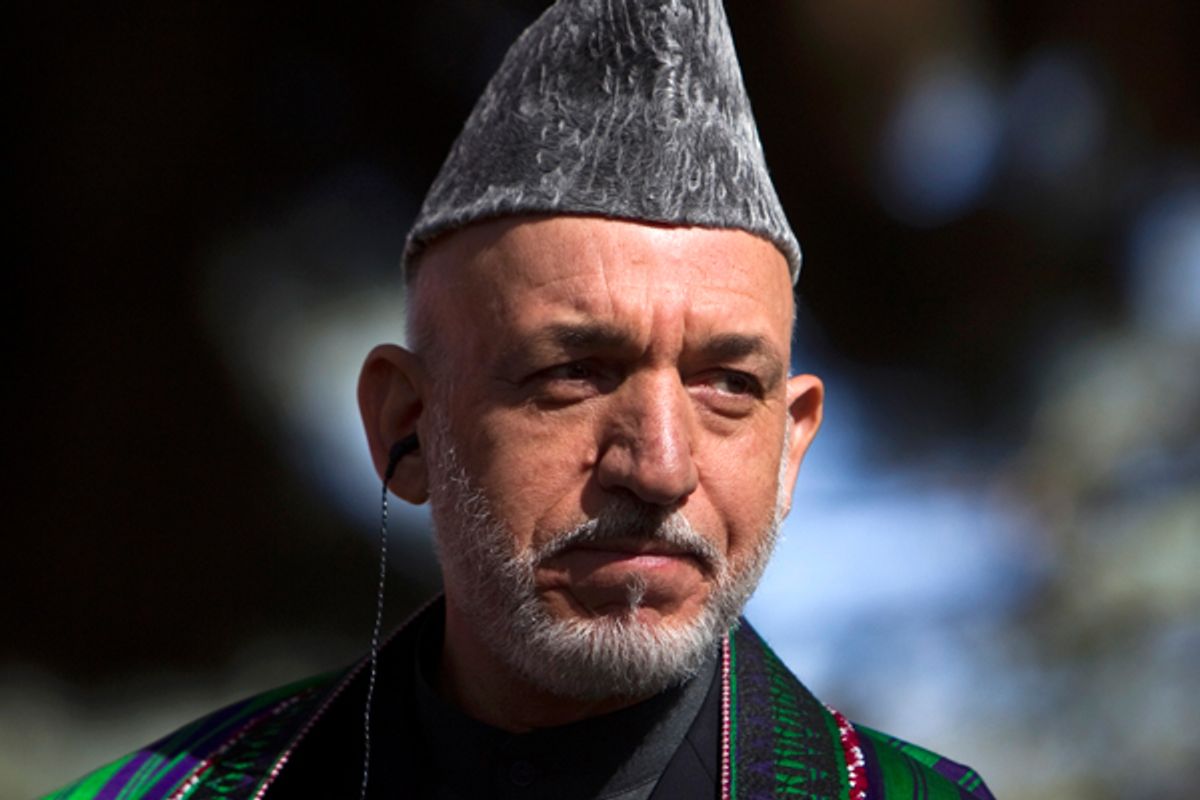
Afghanistan: Afghan President Hamid Karzai (Credit: Reuters/Ahmad Masood)

Glenn Greenwald wrote recently about how reporter Michael Hastings’ new book on Afghanistan exposes some of the pathologies of national security journalism as it is commonly practiced today. But the new book, “The Operators: The Wild and Terrifying Inside Story of America’s War in Afghanistan,” also contains lots of interesting reporting on the recent history of the war, particularly the period between 2009 and 2010 when Gen. Stanley McChrystal was in charge. McChrystal, of course, resigned in June 2010 after the publication of a Rolling Stone article by Hastings that contained sundry damaging material, including quotes from McChrystal aides mocking the White House.

I spoke to Hastings about the American relationship with Afghan President Hamid Karzai, the effort to arm Afghan militias around the country, and recent reports of negotiations with the Taliban.

There’s a section in the book where you quote a German expert questioning McChrystal on why a 45-minute talk he gave on Afghanistan mentioned al-Qaida only once. From all the time you spent with the military brass, what’s your sense of how they conceive of what this war is about?

That’s the big lie: that what we’re doing in Afghanistan makes us safer from al-Qaida. That’s the rub. Besides that McChrystal talk in which he didn’t discuss al-Qaida, there are a couple other telling moments. After Sen. Lindsey Graham was briefed on the strategy that McChrsytal wanted, he was terrified that they weren’t mentioning al-Qaida enough. He encouraged them to mention it more and keep hammering  away on it. Then when Petraeus took over the war in summer 2010, military sources told me that in his morning briefings no one would ever mention al-Qaida, or at least very rarely. There’s a famous number that Gen. Jones, the former national security adviser to Obama, put out, which is that there are less than 100 al-Qaida members in Afghanistan.

So the U.S. military leadership is conceiving of this primarily as a fight against the Taliban?

Yes. Counterinsurgency is allegedly concerned with setting up a stable government in Afghanistan. It’s nation building. It’s not fighting terrorists.

On that point, you go into some colorful details about the American relationship with President Hamid Karzai. What did you find in your reporting?

Well, we’ve had U.S. officials come out and say that Karzai uses drugs, and that he is possibly manic depressive. The American ambassador to Afghanistan put that out there. We also know that Karzai had no interest in counterinsurgency. And McChrystal’s people referred to Karzai as “the man in the funny hat” and they called his hat “the Gray Wolf’s vagina.” This is the level of respect that Team McChrystal was showing to our great Afghan friend and ally. Our strategy is based on having this strong, credible partner, but at the same time Karzai is being undermined by everything American officials working with him say. So how does that work? It doesn’t.

It became very explicit that what McChrystal was trying to do was to make Karzai a real commander in chief.  But the idea that the mission of the United States military is to transform an Afghan politician into some kind of Winston Churchill-like figure is laughable.

The Afghan Local Police program has been getting a lot of attention as a key part of what the U.S. is doing now. Can you first explain what this program is?

The military describes it as like a neighborhood watch program for Afghanistan. Of course, it’s a neighborhood watch program where our Special Forces gives everyone in the neighborhood an AK-47. The idea is that the each local community will set up their own small militia; the rationale is that these local groups of armed men will be able to defeat the Taliban in a decentralized way. Many Afghans fear that it’s just giving guns and training to warlords. Of course, funneling millions of dollars of weapons into the hands of people that want to be local militia commanders is not necessarily a recipe for stability – certainly not in the short term. In the long term, it could lead to stability, or it could lead to a more intensive civil war.

You delve into the case of Abdul Razzik. Can you explain who he is and what he represents in terms of what the U.S. is doing?

Razzik is a young Afghan commander who has become our up and coming warlord star in southern Afghanistan. The Americans were for a while split on him because he does have various credible human rights complaints against him and he does have connections to the drug trade. But at the end of the day, the calculation that was made was that Razzik picks up the phone. That means, when the military wants something done, Razzik is a can-do guy. He is not afraid to knock heads or detain the Taliban and torture them. So any concerns or lip service toward human rights quickly become trumped by trying to get some local stability.

There’s talk now, including from Hillary Clinton, about some kind of negotiations – or the possibility of negotiations — with the Taliban. There have been many rounds of these sorts of reports. What do you make of this talk based on your experience in Afghanistan?

I think negotiations are the only way out and we’ve known this for years. Who are the players in these negotiations? The ISI and Pakistan, the Taliban, Karzai, and these other warlords all have to get on the same page. So the question is, what is the United States’ role? We’ve struggled to figure it out. One of the reasons is that so few of our resources have been devoted to a diplomatic solution, despite the lip service to the line that “There’s no way to kill your way out of this fight.” This will be a lengthy process, and the scandal is that we’re really only now starting it seriously.

At the end of the book you say that you think the bin Laden killing marks the beginning of the end of the war. But Gen. John Allen, the head of the war now, recently said that U.S. troops could be in the country beyond 2014. What’s your assessment about where this is going?

It’s amazing to see Gen. Allen and the Pentagon try to hold on and keep this war going on as long as they can. I’ve gotten flack for this, but I believe President Obama when he says the tide of war is receding. I think that’s a very significant statement. I certainly don’t see us reescalating in Afghanistan. The question is, how long will it take for them to wind the war down? One thing to keep in mind is that the government there is going to be so addicted to the American tax dollars and training, they’re not going to be able to kick us out like the Iraqis did. There’s also the focus on counterterrorism operations in Pakistan. So I think we’re going to see a robust Special Forces and training presence in Afghanistan for years to come.

But as long as there are not 200 or 300 or 400 American soldiers dying every year and we’re spending $20 billion per year instead of $120 billion per year, experience seems to show that the American public will tolerate that kind of long-term presence.

Justin Elliott

Justin Elliott is a reporter for ProPublica. You can follow him on Twitter @ElliottJustin

A Mormon “frontlash” for Romney?

The Republican front-runner is benefiting from LDS voters in Nevada; we look at Mormon voting patterns

  • more
    • All Share Services

A Mormon Three-year-old Dean Call holds a sign as Mitt Romney speaks during a campaign rally in Columbia, S.C., on Jan. 11, 2012. (Credit: Brian Snyder / Reuters)

A poll out of Nevada this week showed Mitt Romney winning 45 percent of those Republicans likely to attend Saturday’s caucuses. And the internals of the poll showed Romney’s base: 86 percent of Mormon likely caucus-goers support him.

That’s a significant number, especially given that Mormons, who represent 7 percent of the state’s population, made up a quarter of caucus-goers in 2008, according to the Las Vegas Review-Journal.

It’s worth remembering here that Nevada is considered a swing state and Romney could benefit from what Ed Kilgore calls a Mormon “frontlash” in a general election contest against Barack Obama. In the primary, Kilgore points out, Mormons “will also matter on February 28 in Arizona (6% LDS), and in later caucuses in Idaho (27% LDS) and Wyoming (11% LDS), right down to heavily-Mormon Utah, which ends the whole nominating process on June 26.”

To learn more about Mormon voting patterns, I spoke with Quin Monson, a professor of political science at Brigham Young University.

The polls out of Nevada are saying Romney will win 86 percent of Mormon caucus-goers. Does that high number surprise you? 

Well, based on 2008 results both in Utah and Nevada, that doesn’t surprise me. It was similar — about 9 out of 10 Mormons in Utah supported Romney. And that was about the same number in the entrance polls in 2008 in Nevada.

What do you think the dynamic is here — is this a solidarity vote?

There are a lot of things going on. One, Mormons are overwhelmingly Republican. A recent Pew survey shows that and there’s other data that I have that show the same thing. So it’s a choice among Mormon Republicans of which candidate to go for, and I think there is a sense of solidarity with Romney. It’s not unlike Catholics and John F. Kennedy in 1960. In that context, Catholics felt like they were a bit of a beleaguered minority, sort of beginning to be better accepted in American society but still viewed with some suspicion. And they saw Kennedy in part as representing their group and representing it well. I think Mormons see Romney in the same light. Even some people in the church that don’t necessarily agree with him — either because they’re more conservative or more liberal than Romney — appreciate that he’s kind of taking one on the chin for his religion at some points. It seems to get linked to him in so many ways that even Mormon Democrats will speak in favorable terms of him and have admiration for the fact that he’s had to put up with so much.

In terms of party identification among Mormons, why is it so overwhelmingly Republican?

The first thing to say is that it wasn’t always that way. When you go back in time, you don’t have a lot of national data but you have data from Utah, which is a reasonable measure. Utah was even more heavily Mormon the further back in time you go. Utah voted for Lyndon Johnson and had a Democratic governor and state Legislature in the ’70s. So it wasn’t that long ago that it was a fairly balanced place politically. Go back even further and it was heavily Democratic. At the time of statehood in 1896, the Republican Party was the anti-Mormon party.

So what happened?

Well, I think the New Deal brought some conservatives over to the Republican side. What really happened mostly was the 1960s happened. And Roe v. Wade happened. There was a shift in American culture, and then the national parties shifted. The parties were divided internally on social issues in the ’50s and ’60s. I don’t think civil rights was as big a deal for Mormons as other issues, abortion and gay marriage in particular. The parties into the ’70s took more clear and opposing positions on social issues, and Republicans ended up taking positions that side more consistently with the church. I don’t think the church changed. The parties changed, and that left more Mormons feeling at home with the Republican Party.

Everyone is expecting the presidential election this year to be primarily about the economy. Are Mormons somehow naturally in sync with the GOP on economic issues?  

I do think there’s a natural affinity. There’s a lot of emphasis among Mormons on self-reliance, and that plays right into how some people would view American exceptionalism or perhaps rugged individualism. There is a communitarian element to Mormon theology, but I don’t know that that has been emphasized in modern times. Early on, when Mormons had problems with their neighbors in places like Missouri and Illinois it was in part because their sense of communitarianism conflicted with the surround community. And then later in Utah, there were some experiments in communitarian living. But the faith is much more focused now on self-reliance; there is an emphasis on helping your neighbor, but mostly  in the context of your Mormon congregation. But that emphasis doesn’t include government most of the time; government is left out of the rhetoric. What’s in the rhetoric is that individuals should become self-reliant, should get an education, should provide for their families, and so on.

Turnout among Mormons is also expected to be high in Nevada and elsewhere. Is this because of the Romney candidacy?

There is a consistent historical pattern in Mormons being slightly higher in political participation and slightly more civically engaged in measures of community service and other things. Some of that is because there is a lot asked of Mormons within their own congregation. On the other side of the coin, Utah political participation has  declined — turnout is very poor. That’s a function of the fact that there is not a lot of political competition in Utah; there’s a sense that things are over before they even happen. Utah used to be at or near the top in political participation 20 years ago, and now we’re at or near the bottom.

There is a clear encouragement from the church — official statements read over the pulpit — about two things. One is political neutrality in partisan elections: Members are always reminded not to use church facilities or lists and so on. And then, two, that members should be involved and vote. Those statements are typically read a couple weeks prior to a major election. In the Romney case, and in a place like Nevada where you have a sizable Mormon population, even though there is no official action by the church, there is a strong social network that could lead to Mormons being mobilized by each other.

Obviously we see Romney will get lots of support from the Mormon community. But on the other side of it, is there any way to quantify how much anti-Mormon sentiment might hurt him?  

I’ve done some work with some colleagues on this to attempt to measure the affect of framing Romney as a Mormon. And it does have a clearly negative effect. What we’ve done is create little vignettes in national surveys in which we write biographical statements about Romney and add different pieces of information in. Sociologists talk about a social contact hypothesis, where contacts with a group you’re unfamiliar with helps you to become less fearful and more understanding, and to like them more. That would lead you to believe that if people know a Mormon, they might be resistant to a negative message about Romney being a Mormon.

What we find is that people who know a Mormon really well — a family member or close friend — clearly resist any kind of negative information about Romney and his religion. Because they know otherwise. People that don’t know a Mormon at all are strongly affected by that information, but you can also counter it with positive information and they’ll take that into account. What’s really interesting is that people who know a Mormon in passing — maybe a guy at the office — react strongly to the negative information and you can’t counterbalance it with positive information. We think that has something to do with the fact that Mormons are, in fact, a little different. And if you know one in passing you know enough to know that that person is a little different, but you don’t know enough to know that, although they’re different they’re probably just fine.

I’m asking you to speculate, but do you think in a general election context Romney would be helped or hurt by being Mormon?

If Mormons made up 25 percent of the population, I’d say it would really help him. But Mormons are at best 2 percent of the population. I think on balance it’s probably not going to be helpful. The reason I think he has a chance is that it’s not going to be the focus of the conversation for most of the time. I think that’s why Romney doesn’t bring it up and when it is brought up he quickly tries to move on to something else. If it becomes central to his campaign for some reason, I think it will be to his detriment. I would look for an attempt by — not directly from the Obama campaign — but from surrogates or others, to raise questions about Romney’s Mormonism. If it continues to be a kind of sideshow and the main issue is the economy, then I don’t think his Mormonism does a lot of damage.

Continue Reading Close
Justin Elliott

Justin Elliott is a reporter for ProPublica. You can follow him on Twitter @ElliottJustin

How Bradley Manning’s fate will be decided

The soldier accused of giving files to WikiLeaks will likely face a court-martial -- we explain how it works

  • more
    • All Share Services

How Bradley Manning's fate will be decidedArmy Pfc. Bradley Manning is escorted by military police from the courthouse after the sixth day of his Article 32 hearing at Fort Meade, Maryland, December 21, 2011. (Credit: Benjamin Myers / Reuters)

This week, Bradley Manning came one step closer to being tried for allegedly leaking a trove of secret American cables to WikiLeaks when a military officer made the formal recommendation that Manning should face a court-martial on 22 criminal charges.

One of the counts, aiding the enemy, carries the possibility of the death penalty, but prosecutors have already said they will not seek it in Manning’s case.

The recommendation this week was made to Maj. Gen. Michael Linnington, commander of the Military District of Washington, who is what is known as the convening authority in the case. The military justice system has important differences from the civilian system, so I spoke to Eugene R. Fidell, who teaches military justice at Yale Law School, to explain the basics.

We’ve now had the investigating officer as well as another officer this week recommend a court-martial to the Military District of Washington commander. What’s the next step?

A convening authority, which is a general officer, will decide whether to refer the case to a court-martial. There’s no designated time frame for this, but I think it will be in the next couple of weeks. A court-martial is a military criminal court that will have serious punishment powers. There will be a military judge presiding over it, who is a uniformed lawyer. There’s a prosecutor. There’s defense counsel. Unless Manning waives the jury, there will be a jury of at least five people.

Who makes up the jury?

The jury is selected by the convening authority. It’s not random selection. The general will select the members; it’s supposed to be a blue ribbon group. They are supposed to be the best qualified people with respect to education, experience, judicial temperament and so on. Because Manning is an enlisted man, he has a right to enlisted representation on the court. That means that at least one-third of the jury would have to be enlisted men or women.

In the civilian trial setting, there’s usually a lot of argument over who sits on the jury. How does that work in a court-martial?

The same thing happens. There’s an opportunity for the lawyers on both sides to question the jurors — who are actually called “members” in a court-martial — to determine whether they are capable of acting impartially. Each side has a right to challenge a member not only for cause, but also peremptorily, in other words for no reason.

To convict a defendant in a non-capital case requires only a two-thirds vote of the members. How the vote breaks down depends on how many members there are. The minimum is five, but there’s something called the numbers game that the lawyers on both sides are aware of. That is, that you want to use your right to challenge a member in order to manipulate the size of the court to maximize the chances of either conviction or acquittal, depending on your perspective. The number slightly tweaks the percentage. Two-thirds of five members is four, meaning the government would need 80 percent to convict. Two-thirds of six members is also four, which means the government would need only 66 percent to convict.

What about the judge — how is he or she different than a judge in a civilian case?

Once the case is referred to a court-martial, and a judge is assigned, the convening authority’s power becomes subject to review, and a judge sort of takes charge of the case. Until that happens — until the case is referred to trial — the convening authority really rules the roost.

The big difference as compared to a civilian federal judge is that a military judge doesn’t have life tenure. The judge in an Army court-martial is guaranteed tenure for only three years, which in my opinion is inadequate. Individually the judges may be perfectly independent, but in terms of the structural protections, the U.S. system is highly deficient in this area.

So the concern is that these judges might be worried about their later career and that affects how they hear cases?

Yeah, that’s the theory. Three years is shorter than any comparable criminal court in this country.

Turning to the trial itself, are the rules different than in a civilian court?

No, the rules are essentially the same as a federal district court. The rules of evidence are a virtual carbon copy, the rules of how people conduct themselves, and so on. Courts-martial are also open to the public, except to the extent that classified information is involved. Even then, only the bare minimum needed to protect the information is closed to the public.

If Manning is ultimately found guilty, how does the sentencing work? 

If there is a jury, the jury will do sentencing. Remember, he can waive the jury. But he can’t waive only on sentencing; he would have to waive it on guilt-or-innocence and sentencing together. If he waives the jury, the judge will decide both guilt or innocence and determine the sentence. If Manning goes with a jury, the sentence is determined by the jury. And anything in excess of 10 years has to be decided by a three-fourths vote. If it were a capital case — which it’s not — there would have to be 12 members of the jury and they would have to be unanimous.

What about appeals — can he appeal if he is found guilty?

The first level of review after a case is tried and there is a sentence is to the convening authority. He or she can disapprove the conviction, can cut the sentence and so forth. He or she can overturn the result of the trial. After the convening authority acts, it goes automatically to the Army Court of Criminal Appeals, which is made up of military officers who sit in northern Virginia. There are lawyers on both sides, and briefs are filed, and there may be oral argument. Then they will issue a decision. From there, assuming the case is affirmed, Manning would have the right to petition for discretionary review by the U.S. Court of Appeals for the Armed Forces. That’s a civilian court of five judges who sit in Washington, D.C., with proceedings open to the public. If they granted review, there would be an oral argument, and the case would result in a decision. If that court grants review, then the case becomes eligible for review by the Supreme Court. The Supreme Court can refuse to hear it, but at least Manning would have the right to ask the Supreme Court for review.

Continue Reading Close
Justin Elliott

Justin Elliott is a reporter for ProPublica. You can follow him on Twitter @ElliottJustin

Obama’s not-so “dangerous” Pentagon cuts

Republicans pounced on Obama's proposed military cuts as endangering America, but, historically, the plan is modest

  • more
    • All Share Services

Obama's not-so Leon Panetta and President Obama (Credit: AP/Haraz N. Ghanbari)

In a presentation at the Pentagon Thursday, President Obama announced the results of a “comprehensive defense review” and some hints about how a proposed $487 billion in cuts over the next decade might be made.

Republicans quickly blasted Obama’s initiative as “dangerous,” with columnist Charles Krauthammer calling the plan “a road map to American decline.”

But are the proposed cuts really all that drastic? For an answer to that question and an explanation of how cuts might — or might not — ultimately be made, I spoke to Bill Hartung, director of the Arms and Security Project at the Center for International Policy.

Can you give the quick broad overview of what Obama actually announced yesterday in terms of the size of the military and its budget?

Going back to when Bob Gates was still secretary of defense, they started out talking about cuts of less than $100 billion over five years. At the meeting this week they talked about $487 billion over 10 years. But that’s against what the Pentagon would like to spend, not against what they’re spending now; and they had quite ambitious plans for increases. As President Obama pointed out, this new plan would basically slow the rate of increase. Given that we’re at the highest spending level since World War II, there shouldn’t be as much of an uproar as there has been in Congress. I think a lot of it is just turf wars protecting bureaucracies and contracts.

What is the current level of spending and how will the announcement this week affect it?

We’re in the range of $530 billion per year for the Pentagon itself. That’s not counting the wars, which are now around $120 billion extra per year. We had been up around $700 billion for the two things combined, but now we’re drifting down because of the pullout from Iraq. The announcement this week centered on the same cuts number they have been talking about for a while. It’s in line with what was required under a deal struck with Congress last summer as part of increasing the debt ceiling. This proposal is looking at, “how do we have to change missions, force structure, and strategy?” They said they were going to get rid of Cold War-era weapons systems and they are going to focus on cyber-security and drones and advanced communications. But particular details of what’s being cut will be revealed when the budget comes out in a few weeks.

The plan was criticized pretty widely by Republicans in Congress as “dangerous.” Is this something that Congress will have to approve?

The budget will get slugged out year to year. So Obama can say, “This is what we’d like over 10 years,” but that to some degree is just a wish and a promise. There will be push-back, especially from some of the conservative Republicans. People like Buck McKeon, chair of the House Armed Services Committee, have been very active pushing against cuts. Democrats with defense plants and military bases in their district will also want to protect their piece of the pie, as well.

Why is Obama doing this?      

I think the primary reason for the initiative is the budget deficit. There’s a sense that you can’t really slash domestic programs and rearrange Medicare — and possibly even Social Security — if the Pentagon is not at least on the table. That was recommended by the president’s deficit reduction commission led by Alan Simpson and Erskine Bowles. It seemed like it was sort of getting lost, but when the deficit fight heated up and there were promises made when the debt ceiling was lifted over the summer, it became almost a necessity for Obama to come up with a plan along these lines. There’s an understanding that the military budget can’t go up forever. It had gone up 12 years in a row going back to the late 1990s. That had never happened before, even during Vietnam or Korea. There would be five or six years of increases and then the budget would start going down.

Are the numbers they are talking about significant? Or is it more of a trimming?

I’d like to see them go to about double the current plan. That would still be quite a bit smaller than reductions done after Vietnam or the Cold War. With Iraq and Afghanistan winding down, with the deficit problem, with the recent extraordinary increases in the military budget, it would be reasonable to cut deeper. I think there’s room to do that without major changes to U.S. commitments around the world. The industry is going to see Obama’s initiative as a big deal because they were basing their plans on certain levels of growth. So there will be trimming of certain weapon systems; there will be reductions in numbers of troops; and they will probably change the benefits for troops and retirement money and so on.  If you’re a beneficiary of this money, it seems like a big deal. But if you look at it historically and in terms of the defense needs of the country, I think we could go a lot further.

Where does Mitt Romney stand on this?

He’d like to go higher than where we are now. Of course he doesn’t explain how he’s going to pay for this if he’s also trying to reduce the deficit and not raise taxes. He has talked about 4 percent of gross domestic product as a constant level of spending on the Pentagon; that would be almost like an entitlement program, where the Pentagon would get a set amount regardless of what’s going on in the world. Four percent of GDP would be about $30 billion a year more than what we’re spending this year, and perhaps an extra $1 trillion or more over the next 10 years. He also wants to increase shipbuilding and has talked about taking military action against Iran.

Continue Reading Close
Justin Elliott

Justin Elliott is a reporter for ProPublica. You can follow him on Twitter @ElliottJustin

Reporter recounts massacre revealed by WikiLeaks

U.S. troops "executed" five children and five other civilians in Iraq in 2006, a new cable reports

  • more
    • All Share Services

Reporter recounts massacre revealed by WikiLeaksRelatives mourn near the bodies of children, reportedly killed in a March 15, 2006 U.S. raid in the village of Ishaqi.

This week, a State Department cable released by WikiLeaks brought renewed attention to a disputed killing of several civilians in the Iraqi town of Ishaqi on March 15, 2006.

The cable contains a copy of a letter of inquiry by a U.N. investigator outlining allegations that U.S. forces had handcuffed and then “executed” 10 people in the home of Faiz Harrat Al-Majma’ee. The soldiers then called in an airstrike that destroyed the house, it alleges.

The U.S. military has maintained that nothing improper happened, but to this day has refused to comment in detail about the case.

Beyond the primary question about what happened that day and whether it was an unjustified massacre or a case of collateral damage, the incident has political ramifications. As the AP reported Friday, Iraqi politicians said this week the incident could have an impact on any agreement to allow U.S. forces to stay in the country beyond Dec. 31.

As the AP noted, “Whether U.S. forces in Iraq will continue to have legal immunity from prosecution if they stay is one of the major stumbling blocks in the ongoing negotiations, as Washington will not allow the military to remain without it.”

A Pentagon spokesman said this week, “We’ve already investigated these allegations, and there is no new information.”

To learn more, I spoke to journalist Matthew Schofield, who has been covering the incident since he first wrote about while on assignment in Iraq in 2006. He is currently an editorial writer at the Kansas City Star, a McClatchy paper, but he wrote a news article on the WikiLeaks cable this week.

I know there are competing accounts, so can you explain what do we know — or think — happened in this incident in 2006?

What we know happened — what everyone agrees on — is that U.S. troops went to a house in Ishaqi, Iraq, in March of 2006. In one official U.S. version, the troops were looking for an al-Qaida-affiliated terrorist, or, in another official account, someone who had shot at U.S troops. When they approached the house in the early morning hours, there was a gunfight. Neighbors talked about this. In the U.S. version, in the course of the gunfight, the people in the house were killed, the house was destroyed at the same time, and they were able to detain the person they were looking for. In the account the neighbors told, as well as the report of a U.N. investigation on this, the house was standing when the soldiers went inside and was destroyed sometime later.

The bodies of the dead were found against one wall in one room, all handcuffed in white plastic handcuffs according to neighbors. The coroner we talked to after the incident said that the people who died were killed by gunshots to the upper chest and head. It didn’t necessarily look execution-style — the shots were not all to the same place in the head, or anything like that — but it looked like they were from fairly close range. His guess was that the bullets were from an M-16. The Iraqi police investigators, who had been trained by U.S. forces, said in their report that these had been execution-style killings by American forces.

Who was killed exactly?

There were five children under the age of five, the youngest being five months old. Then there was a mother, her sister, the grandmother and a visitor — four women in all. The father, in his 20s, was killed as well.

What about the question of an alleged airstrike on the house?

The house was certainly rubble after the raid — that’s clear. When it collapsed is the question. The neighbors said that after the U.S. troops left, an airstrike was called in. At the time, they said it was helicopters. U.S. forces maintained that it collapsed during the firefight. I couldn’t get to the site when I was in Iraq because at that time we couldn’t get far out of Baghdad very safely. We relied on a stringer who we had worked with quite a bit in the past. He took a satellite phone and we did phone interviews with the coroner and the police and others.

What has the military said about the incident over the years?

The initial reaction was always that “this can’t be true.” In June 2006, the U.S. military finally said that nothing untoward had happened in Ishaqi. But there were questions about the military investigation. They weren’t on the ground for a particularly long time. Again, we were not there when the investigation took place, but neighbors told us afterwards that investigators were on the scene for a total of 30 to 45 minutes. The military maintained that it had been thorough. Some Iraqi government officials have long maintained anger over the incident.

How did you end up covering the incident?

It was an almost insanely violent period. So we were trying to do some in-depth coverage of what was going on, a sort of day-in-the-life piece, instead of just letting the violence roll. On the day we had settled on this idea, news of the Ishaqi incident was released. We got a press release from the U.S. military that talked about five people who had been killed in collateral damage. So we started looking into it. After our stringer talked to the neighbors, he told us, ‘Look, the version I’m getting doesn’t jibe with the version you’re getting from the military.’ He said it’s not five people, it’s at least 10. After I went to the military with this, they then came back and acknowledged the higher body count was accurate.

What did we learn from the cable just released by WikiLeaks?

One, it shows different sources of information than what I was dealing with. It shows that officialdom was concerned about this. They were not admitting they were concerned when we were on the story back then. They gave much more credence to the story than they had suggested to the press at the time. Behind the scenes, there was a great deal of concern over what exactly had happened there.

The cable outlines pretty much exactly what the worst-case scenario was when we were reporting on it. I didn’t really pursue the worse-cast scenario because I didn’t believe it was possible. We looked into it and we reported on the allegations at the time, but we were always looking for other explanations, for other ways this could have happened. This cable seems focused on that worst-case scenario, which I found fascinating.

So what happened with the U.N. investigation? It was essentially stymied?

Yes, it died. They sent questions out to the United States, and there was no response. They have said there was frequently no response from the United States on these matters. They sent questions to the Iraqi government, and they said these things also just tended to vanish because Iraq was a mess at the time. The investigator, Philip Alston, who is the U.N.’s special rapporteur on extrajudicial, summary or arbitrary executions, told us this week that they just had nowhere left to go after these nonresponses.

So this incident has really never been addressed by the U.S. military in a comprehensive way?

It has not. The military has always been dismissive of this case. It may well be that it should be dismissed. But there’s enough smoke there that it deserves a very thorough investigation. These are very disturbing allegations. The Iraqi cops who investigated this had U.S. training; they were not anti-American. They had respect for the training they had gotten. There has been and continues to be a desire for concrete answers.

Continue Reading Close
Justin Elliott

Justin Elliott is a reporter for ProPublica. You can follow him on Twitter @ElliottJustin

Obama’s escalating war in Yemen

As its government teeters, the impoverished and chaotic Gulf nation is the focus of a U.S. bombing campaign

  • more
    • All Share Services

Obama's escalating war in YemenPresident Barack Obama discusses the continuing budget talks, Tuesday, July 19, 2011, in the the briefing room of the White House in Washington. (AP Photo/Pablo Martinez Monsivais)(Credit: Pablo Martinez Monsivais)

The Obama administration has in recent months intensified its bombing campaign in the unstable Gulf nation of Yemen, where Islamic militants have been the target of U.S. airstrikes for several years.

Just this month, a U.S. drone strike against militants in southern Yemen reportedly killed at least 50 people — many of them civilians. Meanwhile, the Wall Street Journal quoted unnamed U.S. officials this week saying that the Yemen-based al-Qaida in the Arabian Peninsula was “placing a higher priority on attacking the U.S. and Western targets overseas.”

All of this is occurring against a backdrop of civil unrest and fighting in Yemen, where the regime of President Ali Abdullah Saleh has been trying to violently suppress opposition protesters for months. For an update on the situation in Yemen and the U.S. military campaign there, I spoke to Gregory Johnsen, a respected Yemen analyst and a Ph.D. candidate in Near Eastern studies at Princeton.

There’s a Wall Street Journal piece this week saying unnamed U.S. officials are worried about al-Qaida in the Arabian Peninsula staging attacks outside of Yemen. What’s your read on how much of a threat this group is?

With regards to the Wall Street Journal story, I’m not sure how much of that is new. Al-Qaida in the Arabian Peninsula has for quite some time been really explicit in talking about targeting both Western and Yemeni government interests within the country as well as going after regional targets — as well as of course going after the United States, as was shown on Christmas Day 2009 and in the parcel bomb plot last year.

The situation right now is very murky. There has been a great deal of fighting in the southern province, Abyan, which has been going on throughout most of the summer. There’s a group that calls itself Ansar al-Shariah, or the supports of Shariah (Islamic law), that have been fighting with the Yemeni military in the capital of the province. There have also been a number of U.S. airstrikes targeting these militants. The belief is that Ansar al-Shariah is affiliated with or linked to al-Qaida, but most of that comes from a single interview, so we don’t have a lot of information to back it up. Al-Qaida itself has not put out a great deal of publication materials since the protests in Yemen really got started. So at the moment we have a lot more questions than we have answers.

Do we know how many people there actually are in this al-Qaida in the Arabian Peninsula group?

A couple years ago, the foreign minister of Yemen came forward with the idea that there were 300 individuals in the group. Since he said that, many in the media have picked up on that and run with it, but I think it was really just his best guess. This year, for example, the Yemeni government has announced it has killed 200 or 250 members of al-Qaida since the fighting began earlier this spring. And we see on the ground that there are still people fighting for the organization and carrying out attacks in Abyan. So we don’t have a very good sense of the numbers.

My reading of the situation is that al-Qaida in the Arabian Peninsula has actually gotten stronger in recent years, largely because of U.S. airstrikes. The U.S. has managed to kill some key mid-level commanders, but many of these individuals have been replaced quite quickly. And as the U.S. has killed them, there has been a significant amount of what’s often referred to as collateral damage. That is, innocent women and children or unaffiliated civilians who are killed in these airstrikes. That tends to not only fit into al-Qaida’s argument that Yemen is a legitimate theater of jihad, but also the people that have died tend to have brothers and uncles and cousins. We’re seeing more and more people becoming radicalized.

Who exactly is being killed by all this American bombing? Is it clear to anyone what’s really happening?

It’s not at the moment. The problem is that the town of Zanjubar, where a lot of the fighting is going on now, has many internally displaced people. We’ve seen some video coming out of the city but it’s really hard to confirm. There aren’t a lot of journalists working on the ground. And the Yemeni government has of course sort of eroded away in the face of the protests in the last couple months, so it’s hard for international journalists to work on the ground. Most of what has come out is either official statements by the Yemeni government or very sketchy unverified reports that are being passed through several intermediaries.

How intense is the American military campaign?

We know that the U.S. is certainly carrying out air and drone strikes. We know that the U.S. tried to kill Anwar al-Awlaki, the Yemeni-American cleric, on May 5, and they missed. We know another individual who is on the FBI’s Most Wanted list was targeted about a week ago, and they missed him as well. We’re not always sure who is doing the bombing. There have been a number of instances where the Yemeni government falsely claimed to have carried out an air raid on a particular militant hideout. For instance there was a case where the militants had taken over a police station in a particular town, and the government claimed it had carried out an air raid on the station. It later turned out that it had actually been U.S. missiles that were fired. So it’s become very difficult for outsiders to piece together what’s going on because there is a lot of misinformation.

Earlier this month, President Saleh appeared on TV in a badly burned state from Saudi Arabia, a few weeks after a bombing at his palace. With all the protests and fighting, what’s the state of the regime right now?

Essentially the military has switched. Large portions of it have defected and have joined what’s broadly being called the protest movement. The other half of it — the Republican Guard and other parts that are commanded by Saleh’s relatives — remain loyal to their commanders. This is the standoff. The government doesn’t have a great deal of control over large portions of the country. It’s only really in some urban areas where the Saleh government continues to carry out attacks against protesters.

Taking a step back, what we have is a very large anti-Saleh coalition made up of different interest groups within Yemen. Many of them have been opposed to one another but are currently being held together in an alliance against President Saleh. It’s a very fragile, creaky alliance. There’s a lot of bad blood and mistrust among the various actors. It’s a very tense political stalemate while the president is out of the country. Everyone is sort of waiting around to see what happens next.

What role is the Obama administration playing besides the bombing?

The criticism that a lot of people have is that the U.S. is only looking for someone who is willing to partner with them to attack al-Qaida. Officially the U.S. has come out and said it’s time for President Saleh to step down and it would like to see a very orderly political transition. But this has been difficult. There was a Gulf Cooperation Council proposal that was put forward three times during the spring. President Saleh each time said he would sign it; each time he balked at the last minute and did not sign. I think it’s become clear that Saleh isn’t going to step down unless he’s really forced out. What we’re seeing is that the U.S., as well as Saudi Arabia, either doesn’t have or isn’t using the proper amount of leverage with which to force President Saleh out. So now we have a situation where the country is crumbling: There are very severe problems with water shortages, with electricity, with gas shortages. The U.S. can fire as many missiles as it wants to against militants, but the situation in Yemen and the situation combating al-Qaida is not going to get any better until there’s some kind of political transition. But we haven’t seen the kind of creative diplomacy that would require — either from the U.S. or from Yemen’s neighbors.

Continue Reading Close
Justin Elliott

Justin Elliott is a reporter for ProPublica. You can follow him on Twitter @ElliottJustin

Page 1 of 2 in The Story You Missed