New Mom Confessions

Attachment parenting dropout

I was eager to be a crunchy mom who swaddled her baby and breastfed. But even I couldn't take this much sanctimony

  • more
    • All Share Services

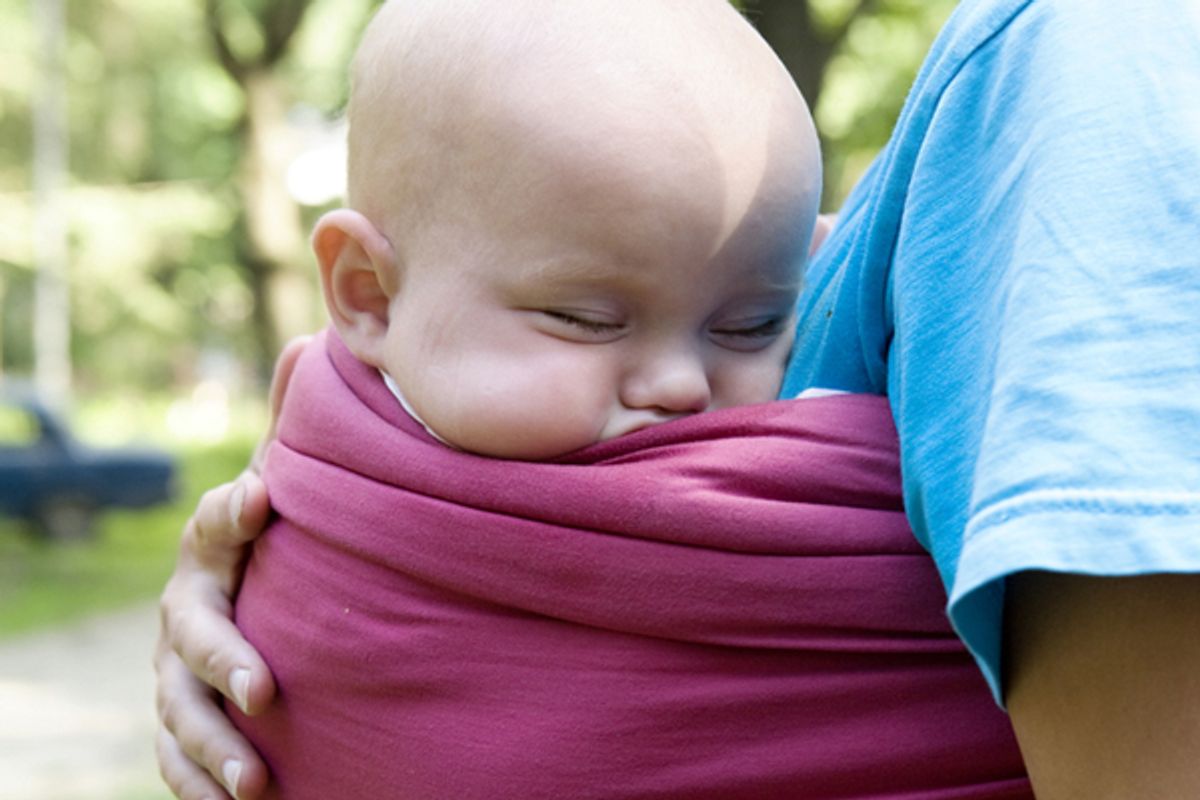
Attachment parenting dropout (Credit: Elena Rostunova via Shutterstock)

I’m a crunchy person up to a point. I trek to the farmers market every weekend to fill up my recycled-plastic shopping bags with kale and purple cauliflower, but I’ve never made my own reusable fabric toilet paper squares. I’ve sworn off disposable plastic water bottles, but I periodically take my compact fuel-efficient car through the McDonald’s drive-thru for a Snickers McFlurry.

When my daughter was born, I decided I’d be the kind of mother who emphasized bonding and nurturing touch over schedules and order. I pored over attachment parenting manuals and message boards. Versed in the lingo of my new way of parenting, I set out to find like-minded mom friends, the kind of ladies who knew the virtues of calendula.

I sprung for a six-week session of holistic infant care classes. The instructor, a soft-spoken doula, ranked among the hippiest hippies I knew, and that’s saying something, since I spent two years living in a Berkeley cooperative. In her ankle-length broomstick skirt, the doula purred out instructions on infant massage and optimal co-sleeping arrangements to a small klatch of mothers and their newborns. It was a relief to find women with whom I could trade tips on swaddling and adjusting our ring slings. The mothers and I got along so well that a few of us continued to gather in a park every week after the class ended. Throughout the spring, we’d take over a sun dappled lawn and let our exclusively breastfed babies dine al fresco.

Within that pacific collective of mothers, I met a woman I’ll call Milo Flynne’s Mom, a woman who seemed to have lost her name the day she hypnobirthed her son. Her outgoing voice-mail message chirped, “You’ve reached Milo Flynne’s Mom and I’m busy attachment parenting, baby-wearing and breastfeeding right now!” Milo Flynne’s Mom always smiled, even when covered in spit up, even when she hadn’t slept in a week, even when new motherhood was turning her insides to mulch. She’d just cock her chin up and recite her mantra: “I’m honored to be married to the most amazing husband in the world, and practicing attachment parenting with our adventurous freedom fighter of a son, Milo Flynne.” I cherished my freedom fighter, too, but I wanted her to admit she was also having bad days. I certainly was having them.

By the time Milo Flynne’s Mom became convinced her craniosacral therapist could cure colic by adjusting the tides of Milo Flynne’s cerebrospinal fluid, I was cluing in to the fact that I might be even less crunchy than I thought. It’s not that I didn’t value the burgeoning bond between my daughter and me, but I couldn’t quite get behind the implied virtue and superiority in attachment parenting circles. None of the other moms were as devoutly natural as Milo Flynne’s Mom, but I was on the far right of this spectrum. If Milo Flynne’s Mom was cultivating a community herb garden in Vermont, then I was a Texan with a concealed weapon permit.

Milo Flynne’s Mom and I did a good job of muffling our mutual disdain, but as our children grew, so did our differences. I tried to cloth diaper my daughter, but found that all that sorting, soaking, hosing and fluffing was getting in the way of my Words With Friends habit, one of the few vestiges of my nonmaternal life that I’d been able to maintain. Milo Flynne’s Mom ostensibly forgave me my disposable diapers, but when changing her son near me, she’d coo to Milo Flynne, “Cloth diapers are sooooo much easier than people realize, you lucky fluffy-bottomed boy!”

When the time came to introduce my daughter to solid foods, I did some research and decided on a moderately priced brand of jarred organic baby food that I could order in bulk online, and I planned to mash up soft fruits and veggies for her when they were available. In contrast, Milo Flynne’s Mom founded a homemade, organic, non-GMO, gourmet-baby-food-making school out of her apartment. While I admired her opportunism in charging clueless new parents $60 to learn how to push the “puree” button on their blenders, I hated that she couched it in judgment of “lazy” parents who would just pop the lid of a “junk food” jar, “lazy” parents like me.

During our group’s summer meeting, I whipped out a canister of store-brand cheesy poofs for babies, perhaps the most delicious snack food on the planet for parent and child alike. While offering my cheese-powdered fingers to my daughter to gum, I noticed Milo Flynne’s Mom staring at us and pooping an organic brick. She fished a reusable snack bag from her Fair Trade hand-woven satchel. “Baked kale?” she offered. But what I heard was, “Have you read the ingredients in those things?” All I knew was that they contained cheese and awesomeness, and are the most exquisite “sometimes food” created since Cookie Monster started eating veggies. But as was my way, I said nothing.

At the end of summer, I went back to my teaching job and made the difficult transition to being a working mother. My daughter was only in day care part time, though I worked full time. I wanted to minimize our hours apart, but I usually ended up having to work all weekend to make up for my days home with her. I longed to be able to afford not working like Milo Flynne’s Mom. I started to seriously consider putting on my own baby food seminars just to clear a little cash.

I continued to meet the crunchy moms on the lawn most weeks, sometimes rushing to the park straight from picking my daughter up from day care. One crispy fall afternoon, I dashed up with my baby tucked under my arm like a football and unfurled my blanket just a few minutes before the end of the gathering. I hugged my baby in close, trying to ignore that she smelled of the treacly perfume of her day care teacher, and listened to the mothers chat about working. One said, “I miss my job, but I don’t know what I’d do for childcare.” Milo Flynne’s Mom chimed in, “I like working too, but I won’t leave my baby with strangers,” then shot me an accusing glare.

In hindsight, maybe it was a coincidence that she looked my way, but I didn’t give her the benefit of the doubt. I was as defensive as Milo Flynne’s Mom was devout. Maybe I shouldn’t blame her. After a woman has a baby, she is broken down, hazed and then rebuilt in the form of a mother. We were all thin-skinned, sometimes sanctimonious, desperately insecure and prone to flattering ourselves with comparisons to our peers. Then again, she was especially annoying.

I left the lawn, mostly unnoticed. As I buckled my confused baby in her seat, I whispered to her, “Sugar, don’t worry about it. That lawn is covered in pesticides. Let’s go eat some cheesy poofs and watch ‘Yo Gabba Gabba.’”

JJ Keith lives in Hollywood, CA with her husband and two toddlers. She's a freelance writer and blogger, and is working on a memoir, "Behind the Green Apron," about being a disgruntled, underemployed barista to the stars.

Hot, naked and pregnant

How a nude photo shoot at nine months changed the way I see my own body -- and my role as a "mommy"

  • more
    • All Share Services

Hot, naked and pregnant (Credit: Loskutnikov via Shutterstock)

I’m standing in front of my house in a light rain, in the altogether, eight-and-a-half months pregnant, while a photographer snaps photos. I’m tucked into the hedge, hoping the neighbors don’t have a view from their windows. I’ve never been so happy to be naked.

A year earlier, I had tumbled into a mid-life crisis. I had one child who was nearly three, and my husband and I were planning for a second. This had always been our intention, and I approached this second foray without much anxiety. But when my younger sister called to tell me she and her boyfriend were going to London, something inside my head was knocked loose. “Damn,” I thought. “I’m going to be a MOMMY.”

Yes, I know what you’re thinking: You’ve been a mommy for three years. Get over it.

But it wasn’t the prospect of becoming a parent that freaked me out. I loved my little boy and wanted to add another goofball to the family. What threw me into a tizzy was the prospect of being a mommy and all the cultural baggage that came along with it. With one child, you could be that interesting woman with the cute kid who still retained a modicum of cool. But the second child would define you. This is faulty logic, I know, but I believed it nonetheless: A mommy is invisible. A mommy has bad jeans and a minivan. Twenty-five-year-old boys would never check me out. I would never take off to London on a whim.

Our culture certainly didn’t help these insecurities. “Mommy” is used to denigrate female parents. Professional women planning to have children are on the “Mommy track.” When we write about our experiences, we are “Mommy bloggers.” When we differ about parenting, we engage in “Mommy wars.” When we get into a little erotica, it becomes “Mommy porn.” Once identified as a “mommy,” we’re identified as little else.

No matter that I was never that cool or adventurous in the first place. I was the high school valedictorian, the Goody Two-Shoes. I’d had two boyfriends and married one of them. I always win “I’ve Never” because, really, I’ve never. But now I had no chance to be cool. Any possibility was off the table. I considered getting a tattoo or tarting up my wardrobe, but then I realized that doing these things to avoid being a mommy cliché was a cliché in and of itself.

Eventually, I realized I needed to get over myself. The demands of parenting a small child did not leave time to wallow, and at lucid moments I recognized that I would not have young kids forever. I would be able to go to London someday, and I didn’t have to drive a minivan. But my mommy fears still nagged.

A year later — pregnant as can be and irreversibly a mommy — I learned that a favorite local photographer was looking for models for a project on pregnant women. It was an appealing proposition, but there was a catch: She wanted nudes. I dismissed the idea; I couldn’t do a nude photo shoot. But I also realized I did not want to be the type of person who would say no to this.

This is how I found myself in my yard in the nude. I had spent an hour posing with my clothes on — the black bike shorts and black tank that had become my uniform in those sweltering final weeks. The photographer, Ellen, posed shots of me contemplating my belly on the back deck, family portraits in front of a nearby dilapidated barn, and shots of my boy and me frolicking in the neighboring cemetery. We chatted while she clicked away: about pregnancy, our kids, our town, and her work, and I tried not to think about where this was leading.

Eventually it started to rain and we ducked into the front yard, sheltered by a tall hedge. I ignored my misgivings, summoned a little confidence, and shed my clothes.

All along, I hadn’t been sure I could strip. I may not be the person so neurotic she changes in the bathroom at the gym, but I’m also not the woman who wanders around the locker room stark naked. I’ve often struggled with my weight, and I fight the urge to hide my body: too much belly, too much breast, flab and curves where I don’t want them.

But pregnancy gave me a freedom with my body that I didn’t have before and haven’t had since. At nearly nine months, my body was supposed to look like this. I was supposed to have an enormous belly, giant breasts, and a little something extra in the back. I could have done without the tree-trunk thighs, but I could live with those, too. Much to my surprise, revealing this body felt fine. So did the rain on my skin — it was awfully hot being pregnant in June.

Once Ellen began shooting, I adopted a strategy of “don’t look down.” It was best to ignore the absurdity of standing in our tiny front yard, separated from the sidewalk and street by only a hedge. As the shoot progressed, I felt an amazement that I could do this, that I was doing this. I can still see it in the small, pleased smile I’m wearing in the photos. It is equal parts relief, surprise and satisfaction.

Looking at the photos now, years later, I feel a bittersweet pang for those last few days when we were just three, before we became something new. I’m gobsmacked not only by the size of my belly and breasts but also by my nerve.

Later that day, after Ellen left and I had dressed, my husband observed, “Now you’ll never have to get a tattoo.” I’m grateful for that. And I’m grateful that the postman didn’t choose that moment to deliver the mail.


Continue Reading Close

Megan Rubiner Zinn lives in Western Massachusetts with her husband and two sons. Her work has appeared in Jezebel, the Daily Hampshire Gazette (Northampton, MA), VisualThesauraus, and her blog, life in the little city.

My pregnancy rebellion

I was fed up with rules that mark the beginning of an identity loss for mothers. So I took a stand, in an odd way

  • more
    • All Share Services

My pregnancy rebellion (Credit: Shutterstock)

I did a bad, bad thing the other day: Visibly pregnant, I went to a beauty salon and had my hair dyed. That may not seem like a big deal to those unfamiliar with American pregnancy culture, but to see the faces of the other women in the salon you would have thought I had walked in the door with a joint and a half-empty handle of vodka.

I considered explaining to them that I had researched the topic thoroughly and found that modern hair dye chemicals likely pose little risk to a fetus in the third trimester. I considered mentioning that, just to be extra cautious, I was getting a semi-permanent color to limit my exposure to ammonia fumes. Instead, I buried myself in a copy of Us Weekly and tried to ignore the whispers of the other patrons.

I never thought I would be the type of person who would risk public scorn to get her roots touched up. I’ve grown increasingly granola-y over the past few years, and my forays into investigative journalism have made me wary of certain chemicals in cosmetics and other personal care products. These days, I consider myself dressed up if I leave the house wearing deodorant, let alone mascara. But that was before I was initiated into the world of upper-middle-class American pregnancy with all its hysteria and paranoia, and began feeling the urge to rebel.

This is a world where having a baby can feel less like participating in an ancient biological process and more like taking on a high-stakes independent research project. The goal of said project? To produce the most intelligent, healthy and successful offspring possible, preferably one who will attend an Ivy League school. The women in this circle — highly ambitious and well-educated themselves — consume massive amounts of pregnancy and parenting literature long before they conceive, paying particular attention to creating the ideal womb environment for their future prodigies.

It’s a club whose membership comes with an ever-growing list of things to avoid for fear of harming the developing fetus. In addition to the usual suspects — alcohol, caffeine and soft cheeses, to name a few — there are nail salons, antiperspirants and all but the most natural (and expensive) makeup. And, of course, hair dye. The complete list would likely be several hundred items long.

Some of these recommendations are based on sound scientific evidence, and some are not. That doesn’t necessarily mean the assumptions behind them are incorrect; researching the link between a particular substance and its effect on a fetus is a tricky business. There are strict ethical guidelines surrounding the use of pregnant women as study subjects, and animal experiments don’t always translate to humans. Long-term data on the effects of low-dose exposure to a substance over time is expensive to gather and difficult to analyze. Wary of lawsuits, the pregnancy press and medical professionals alike shy away from espousing the safety of products and behaviors that are even remotely controversial.

Unwilling to accept this vagueness when it comes to their pregnancy, many women take a “better safe than sorry” approach and avoid certain things altogether. And why not? Unless the mother is avoiding some nutrient essential for proper fetal development, the worst-case scenario is inconvenience. Besides, when it comes to things like hair dye and makeup, isn’t there a feminist in all of us who cheers at the thought of escaping the death grip of the beauty industry, if only for a few months?

But there’s something else going on here, too, and it ain’t pretty. More and more, when I see my peers wearing their sacrifices on their organic cotton sleeves and foundation-free faces, I see how pregnancy can mark the beginning of an identity loss that is never fully recovered. For me, and I suspect many other women as well, the pressure to strip a personal routine down to its barest incarnation seems to come with a parallel pressure to strip one’s concept of self to only one’s role as an expectant mother.

The thing is, I’m not just an expectant mother. I’m a journalist who doesn’t want to worry about sweat stains around my armpits when I’m interviewing a source. I’m a wife who likes to feel feminine when I go out to dinner with my husband, and sometimes that means wearing makeup — not the natural kind. When I grab a cup of chai with my non-pregnant girlfriends, I want to be able to focus on the conversation and not the fact that my grays make me look about a decade older than they are. These roles and the others that comprise my identity are not dependent on the beauty products I use, but they are supported by them.

I realize that I will not be able to fully comprehend how all-consuming motherhood can be until I give birth to my own child later this spring. But I hope that even in my most absorbed moments, I will be able to hold onto the conviction that while being a mother may be my most important role at the time, it is not my only role, and that is OK. And I take comfort in the fact that when I finally meet my son face-to-face, he will be greeted by a mother with lovely, shiny chestnut hair.

Continue Reading Close

Marie C. Baca is a San Francisco Bay Area-based journalist who has written for the Wall Street Journal, ProPublica and California Watch. Follow her on Twitter @mariecbaca

Was I selfish to have fertility treatments?

As the mother of twins, I know people suspect I had help getting pregnant. But why am I so self-conscious about it?

  • more
    • All Share Services

Was I selfish to have fertility treatments? (Credit: Franz Pfluegl via Shutterstock)

When I found out I was pregnant with twins, one of my first thoughts was, “Great. Now everyone’s going to wonder if I had fertility treatments.”

And they do: People ask all kinds of probing questions — from the sometimes innocent, “Do twins run in your family?” to the blatant, “Was it natural?”

And it wasn’t. Our twins were the result of ovulation stimulation drugs and an IUI (intrauterine insemination).

But the question I started asking myself was: Why should I care if people suspected or knew I needed “help” getting pregnant? Especially in an age in which so many women seek medical intervention when they have trouble conceiving. And especially at a time when twins are becoming the new normal: Recently, the CDC reported that 1 in every 30 babies born in the United States today is a twin.

Part of my self-consciousness came from the fact that infertility treatments are an intimate affair. Your private parts are prodded, your internal organs scrutinized, and your bodily fluids drawn. Nobody looks at one little baby and thinks, “Gee, wonder how that thing got made?” whereas multiples beg the question: How exactly did that happen? I wasn’t crazy about my reproductive process being speculated upon or, more to the point, given any thought at all.

But there was more to it than that.

Was I simply ashamed that I couldn’t get pregnant on my own? Did I feel inadequate or even “broken,” as a friend of mine who recently had IVF said she did? Not really. There were times when my husband and I felt frustrated and angry at our inability to conceive, but I never worried that other people would judge me for something beyond my control. Nor do I have any religious or ethical qualms about responsibly administered fertility treatments (i.e., the kind carefully monitored so as to avoid higher-order multiples). No one has ever scolded me for going against “God’s plan,” but if they did, I would politely tell them I disagree. To me, assisted fertility is no more “playing God” than administering CPR.

It is, however, a choice. And in the eyes of many people it’s a selfish one. Just read the comments thread under any story on this topic. And this, I realized, was at the heart of my reluctance to let people know how my twin daughters came to be. I worried they would think I’d acted selfishly. On some level, I wondered if they were right.

Having infertility treatments is selfish, the argument typically goes, because the world population is burgeoning. Meanwhile, there are thousands of children out there in need of good homes. So why don’t infertile couples (or “these women,” as it’s more typically put, as if their partners are merely being dragged along for the ride) just adopt?

Back when we were in our 20s, my husband and I always said we’d adopt if we weren’t able to get pregnant on our own. If it wasn’t meant to be, it wasn’t meant to be. But when I was just shy of 30, the desire to have a baby kicked in, and it kicked in hard. I wanted to experience pregnancy, and both of us wanted the experience of creating and nurturing a person who was genetically linked to us. It was a primal and surprisingly powerful urge.

By that time we’d learned that “just adopting” is anything but simple. Fees and expenses can run anywhere from $5K-$50K and whether you adopt domestically or internationally, the process can take years, and can be a roller coaster of anticipation, disappointment and complex legal issues. In addition, adopted children are more likely to have special healthcare needs, developmental delays and mental health issues.

So when making a baby on our own proved challenging, we didn’t say, “Guess we’ll just adopt.” We went to a fertility clinic, got tested, and talked over our options with the doctor. They were confident that they could help us, and we agreed to give it a shot. This was what we wanted.

Our insurance required that we try the least invasive approach first: ovulation stimulation drugs, with careful monitoring to try to prevent a multiple pregnancy. We were fortunate that our route to conception was a relatively simple one. On our third attempt, I was pregnant. And we were thrilled — in spite of being taken aback by the fact that there were two babies on the way.

Now, our daughters are 5 years old, and we can’t imagine life without them. These days, I don’t much care if people think I was selfish to have undergone treatment to help conceive them. I honestly don’t think my choice was any more selfish than anyone’s choice to have a child.

One woman I spoke to recently on this topic put it perfectly. Like many women who struggle with infertility, she was asked by friends if she considered adoption before getting infertility treatments. She said to me, “I always wanted to ask them, the ones who were parents, in particular: Did you consider adopting before you went and tried to have a baby on your own? And if you didn’t, why should I?’”

Why, indeed, should infertile couples be automatically expected to adopt? Why should the onus be on them to make this noble and unselfish choice, when the desire for a biological child is something shared equally by fertile and infertile couples?

Yes, my husband and I would probably have pursued adoption if we had exhausted the possibilities for having our own children, provided we could muster the financial and emotional resources to do so. Adoption is a wonderful avenue for building a family. But the technology was there for us to conceive a child — and, as it turned out, children — of our own. We had every right to use it.

Continue Reading Close

Jane Roper’s memoir of twin pregnancy, parenting and clinical depression, "Double Time," will be published in May by St. Martin’s Press. She blogs at Baby Squared on Babble, and lives in the Boston area.

I was a drunk mom

After my son was born, I told myself I was just trying to unwind. But the truth was much darker than that

  • more
    • All Share Services

I was a drunk mom (Credit: Vladislav Gajic via Shutterstock/iStockphoto)

It’s winter 2009. I’m in a liquor store. My 6-month-old son scans the rows of bottles with his big eyes. He says, Tat-tat-tha-tha under his breath. It feels like I’m holding mine, but I let myself relax since I haven’t been in this particular location before, a wonderland of color and crystal. Usually, I make this errand run a quick in-and-out. Maybe I’m being paranoid, but I think people tend to notice the stroller.

Five months ago, I started drinking again after being sober for three years. Since then, I’ve developed so much paranoia. I feel watched all the time, even in the dark. Walking home, I stay behind buildings, in alleyways, like a criminal, pushing the stroller as I take my discreet sips from a bottle of wine I’ve stored on the bottom of the diaper bag. I know I’m the worst of all villains: a mother who drinks. A mother who endangers her child. Part of me drinks to forget this.

We don’t like to think about drunken moms. But the subject came up recently with the tabloid story of 10-month-old baby Lisa, who disappeared in Kansas, Mo. Earlier this month, it came out that her mother, Deborah Bradley, was in a drunken blackout on the night of the baby’s disappearance. Bradley defended her drinking as “having grown-up time” and went on to say, “There’s nothing wrong with me doing what I want to do after dark.” I have no idea if Bradley’s consumption had anything to do with what happened to her daughter — but I know that story gave me chills.

I relapsed a month after giving birth to my son. We were having a party to celebrate his arrival in the world and people brought over alcohol. That night, I picked up a glass of bubbly and gulped it like it was ginger ale. “It’s a special occasion,” I said to my partner, who knew of my past as an alcoholic. One of our friends told him to chill, that all parents drank because babies were hard to deal with. The friend even brought up that joke about unpublishable books for children: Mommy drinks because you cry.

“Exactly. Baby cries, I drink,” I said. “Besides, I’m just going to have one glass.”

I had five or six, in secret. At one point, I tiptoed tipsily up to my son’s nursery to show him off, sleeping, to a happy guest, but I felt embarrassed to touch the baby with my drunken fingers. “Let’s just watch him,” I said, and as we stared and oohed, I marveled at how easily I just annihilated these years of sobriety. Then again, I was just celebrating. It was just that one time.

Except it wasn’t. As a new mother I was thrust into the daily routine of thankless tasks: changing, feeding, bathing, napping, burping, bouncing, dressing, undressing, changing, napping, feeding … It was so repetitive, and though I was so busy, it felt like I had too much time. Time with the baby kept stretching, and it dawned on me that this was for life, that I always had to be there for this tiny person. I became obsessed with the thought that I couldn’t just get up and go, slam the door behind me and come back when I felt like it. So I left the best way I knew how: I started drinking again.

I had to develop a routine. During the day, I would take my son for walks and I would go to different liquor stores close to where I lived and buy a bottle of wine and a mickey of vodka. Outside, I’d look at other moms and we would smile at each other passing with our strollers. I had a bottle of wine in my diaper bag and a mickey of vodka behind the lining of my purse. A plastic bag on the bottom of the stroller with a couple of empties that needed to be thrown out. Did other moms have the same cargo? I mean, how did they deal with the tiresome nature of motherhood? But their smiles looked genuine, and they often walked in pairs. I didn’t. I was lonely, afraid to make mommy friends because I worried that my secret would come out.

I had an inkling I wasn’t the only one. For example, I was aware of the alcohol-friendly parties a distant friend, Tamara, threw where mommies brought their babies for a play date while they shared a bottle of wine or two. “Everybody needs a break from diapers, don’t they?” Tamara wrote in her evites. Mommies and drinking — it was almost a trend. I justified my drinking when I saw media coverage of cool blogs like Vodka Mom, Mommy Needs A Cocktail, where mommies would defiantly share charming stories of boozing up after a day with a baby. I’m just part of a movement, I’d think, and stop to get my baby’s bottle and take a discreet sip out of the mickey as I hid behind the stroller canopy. I chose to ignore the fact that some of these famous drunken mommies got sober too, and the fact that I actually never went over to Tamara’s because I couldn’t possibly share a bottle of wine. Share? What’s that?

I was much more serious about my drinking. After a whole day with my son, after he and my partner would go to sleep, I’d dive deep into my closet, where I’d fish out my liquid treasures and I would begin the best part of my daily routine. My partner was an early sleeper, but if he wasn’t in bed yet, I’d keep my bottle on the deck in the potted plants with wild meaty leaves and clusters of thin trunks in which you could easily hide a 750ml or even 1 L. I’d drink on the deck when (officially) going out for a cigarette. I picked up smoking, too, mostly because the smell masked what was really on my breath.

Usually, I had a two-hour window, from 9 till 11 p.m., when I would feel invincible and interesting and very drunk. I’d watch TV shows on my computer, chat with people online, call old friends to drunkenly give them reports on the wonders of motherhood. I would listen to sad songs on YouTube and feel as if everything related to me. Then I would pass out on the couch. I’d usually come to around 1 or 2 a.m., still half in the bag but well enough to crawl back into bed. When my son would wake up, I’d give him a bottle I’d prepared earlier. I’d change him around 4 or so when I was just arriving at the first throes of hangover. But some nights I wouldn’t wake up. My son would wail and my partner would try to wake me, but I’d stay unconscious. Thankfully, being a crafty drunk mom, I would’ve had stocked up on infant formula and pumped enough ahead of time so he’d be able to feed while mommy slept off the effects of booze.

As a drunk mom, I became knowledgeable about how alcohol could interfere with nursing. My nine-to-11 time slot was very deliberate. I wouldn’t breastfeed my son after drinking, and I became an expert in milking myself and bought three different breast pumps. I regularly checked charts online to figure out how much time I needed off before breastfeeding. I didn’t drink every night either, because I tried to maintain the illusion that I wasn’t that bad. Sober, I’d breastfeed morning till night, exhilarated that I could sustain my son’s life with my own body. I felt pure. Godly. Why do I even drink? I’d think and swear it all. Except that the next day it would be gloomy outside and I’d find myself going for a walk to the liquor store again.

I started going out of my way, because I believed people were onto me. I worried the cops would stop me and ask to see the diaper bag. A panhandler in front of my regular liquor store started greeting me with “How’s it going today?” I avoided that place and, in my head, developed a map that plotted out all the liquor stores within a 10-kilometer distance. As I walked, I imagined the points on the map lighting up in red. I walked so much I developed cramps in my calves.  When I’d get to a store, I’d get two bottles, telling the cashiers I was having a party, telling myself that it was for later so that I wouldn’t have to make this humiliating trip again. I’d never save the bottle for later. Which is why sometimes I wouldn’t breastfeed for two days in a row. My partner and my sister filled in when I was too incapacitated to do my job as a mother, using formula and breast-pumped milk. My sister wrote me a letter begging me to stop, just like in one of those “Intervention” shows, and my partner threatened to kick me out of the house more than once, but nothing was stopping me. I was so angry at them for being mad at me; the only thing I could do was drink more.

What began to stop me were the stairs. Especially the tall, narrow stairs that led to my son’s nursery and down from the nursery. I imagined myself on my way up to the nursery, drunkenly tripping, falling with the baby my arms. Or on the way down, letting him slip out of my arms, tumbling, crashing … splat. Coming out of blackouts in the middle of the night, I’d fall into nightmares about those stairs. I kept telling myself that it was just the question of time before I missed a step. I did my best to never carry my son after I was drinking, but I worried that I’d lose my inhibitions. I’d get some drunken inspiration to parade with him up and down the stairs like a maniac. I drank over those fears too, but as my son started getting older and more mobile, more squirmy, I could no longer ignore the fact that by drinking I was condemning us both for certain injury or death. The nightmares would become reality.

I got sober four days after my son turned 1, after months of secrets, tears, paranoia and a stint in rehab. After my partner temporarily but definitely kicked me out of the house, and after I went back to the 12-step program. The shame has never left me, but I’m slowly getting over it.  The only thing that remains from that period is that I still I look at other moms on my walks now. Healthy-looking yoga ones and the ones like rock stars with tattoos and lipstick, and the sporty ones that wear no makeup, and I wonder how many of them are carrying empties on the bottom of their strollers. Do they think it’s normal to unwind with a glass of wine after a difficult day with a baby and if yes, how many out of those unwind to the point of blacking out? Maybe none. Maybe I was truly alone.

A few nights ago my son was up half of the night. He was chattering and crying and giggling and at one point literally stood on his head in the crib with little, chubby feet above the edge, against the wall. He was shouting about heffalumps, asking if they lived in the closet and demanding to have them put in a heffalumps-destroying machine. I put the heffalumps in the heffalumps-destroying machine while trying to stifle laughter. I felt drunk but from exhaustion. I finally calmed him down by patting him on the back, for what seemed like hours. He fell asleep holding onto my other hand and smiling. And I kept thinking what it would be like if I had been passed out somewhere.

When people ask me why I relapsed after giving birth, I have a hard time pinpointing exactly, but I know I had this illusion that I had a way out from being a mother, that this was my well-deserved grown-up time. In the end, I was lucky my maternal instincts were stronger than the desire to check out and that I don’t need to drink over the fact that it’s so hard sometimes — because I will miss out on all the parts that make it beautiful, too, if I do.

Continue Reading Close

What shocked me about breast-feeding

I was doubtful about reports of its glory, but it didn't matter what I thought -- my son reached for the bottle

  • more
    • All Share Services

What shocked me about breast-feeding

“You’ll breast-feed?” people often asked me, though it would have been easy to mistake the question for a statement. You will breast-feed, seemed to be the message I got from co-workers, friends and even an eccentric old man with a penchant for photographing breast-feeding women and their babies. The question was slightly infuriating, as if I might not have come across the resounding message that “breast is best” in the stockpile of pregnancy books and magazines scattered throughout the house.

The truth was I’d always intended on breast-feeding my baby, knew that nutritionally there was no match for breast milk, but mind and body were not on the same page of this particular parenting manual. It was just that, well, I was uncomfortable with the idea of another human being feeding from me. If I said that breast-feeding conjured an image of lactating farm animals and how I was reluctant to be milked or suckled, I would likely be beaten down by the lactation advocates and the battalion of advice givers who think their word is The Word when it comes to parenting. (You know the type.)

But I promised myself I’d try my best for the first few months of my baby’s life, regardless of how I thought breast-feeding would make me feel. I knew it was only the beginning of countless lessons in putting my child’s needs before my own, and at 30 years old, I was finally ready to relinquish some of my own desires for that of another.

What I hadn’t anticipated was how bewildering it would be. When the nurse held my son — red-faced, wrinkled and still wet from delivery — to my breast and pushed my nipple inside his tiny pink mouth I feared he might suffocate. Neither of us knew what we were doing, and together we fumbled. Any position I tried felt awkward and clumsy and entirely wrong. What I quickly learned is that although breast-feeding is one of the most natural things in the world, as natural as sex and eating, it is very much a learned skill. (Think back to your first sexual experience, and you will likely cringe at the awkwardness of the moment, at your utter lack of knowledge. Even eating comes with a learning curve; as humans, we are first nourished with liquids and gradually introduced textures as teeth emerge and bite reflexes are mastered.) My point? It takes time for mothers to learn to feed their babies, to know how much, or even when. Babies can’t always latch properly. Mom’s milk refuses to come in, and even when it does, baby starts to lose weight. Mom’s boobs become engorged. The list goes on and on.

My problem was that everyone failed to tell me how excruciating it could be. After being pulled on and sucked for 20 to 30 minutes every two hours, my nipples were soon raw, bleeding and cracked. In the shower I shielded my breasts from the stream of water spitting down on my body, and after would carefully dab Lanolin ointment on my tender nipples to prevent further cracking. Even light fabrics grazing across my breasts caused a grating, irritating sensation that made wearing shirts and bras almost unbearable. Going topless from time to time would have been my saving grace, but then there was the spillage factor to consider. My breasts rained milk from dusk to dawn and all through the night, and a “no touch” rule was strictly enforced upon my husband in case my breasts “think” a hungry baby might be in the vicinity.

Through all this my breasts, sadly, became mere shadows of their former perky selves, and I found it best, if not absolutely necessary, to keep them contained lest I frighten anyone (husband, mostly) with their curious resemblance to a sweet old orangutan mother. But then one day, just after I’d resigned myself to wearing push-up bras for the rest of my days here on earth, they were gone, simply gone — suckled away, I suppose, by that insatiable appetite of his. Sweet old orangutan boobs suddenly seemed like a sweet deal, I thought, as I rummaged through my drawer for something resembling a training bra.

As the months passed I grew accustomed to it all, the endless tugging on my weary nipples, the mysterious case of the disappearing rack, the spontaneous leakage that occurred at the most inconvenient of times. There was something about the two of us tucked away somewhere quiet, somewhere private, where we stared at each other like star-crossed lovers, existing solely in the moment. It tugged at a part of me that hadn’t existed before baby. He needed to be nourished, and only I could provide him with what he wanted. It was as if we hovered in some peculiar time warp where everything stopped while he could refuel in body and I in mind.

Eventually, though, it became time to introduce a bottle, either formula or breast milk. I had been warned that if I waited too long, my son would likely reject it. Pumping hadn’t worked for me, and so after eight months, I decided to give formula (gasp!) a try. Inwardly my mind screamed “But breast is best!” while another part of me knew that it was time to get off the high horse and just give him the damn bottle already.

I finally justified the decision by reminding myself I’d already breast-fed twice as long as I’d anticipated. Besides, this formula thing was kind of an experiment; I was convinced he wouldn’t like its artificial taste — not after the rich, milky goodness that came right from Mom’s breast. Surely he would spit it out and look at me with disgust in his eyes, as if to say, Stewie Griffin-like, “Lois, what in the deuce is this? Do you think I’m stupid? Feed me the real stuff, woman. From your boob!”

But that isn’t what happened. Not at all. He reached for that bottle and sucked it back like a cold beer on a hot day. He smiled at it and sucked at it furiously until he’d slurped every last drop. All of a sudden that bottle was his new best friend and Mom was cast aside, the old friend he didn’t have time for anymore.

This was the moment I was supposed to feel free, wasn’t it? I’d expected a battle — a long, drawn-out struggle between baby’s need for breast milk and mama’s desire to take back ownership of her body. After all the endless tugging and pain and embarrassing wet spots, I should have felt overjoyed. And I did — for just a moment.

But then came disappointment. Outrage followed (what were they putting in that stuff, anyway? Crack for babies?), and then anger at everyone who’d suggested I try. Then anger at myself for having listened. I worried my milk would dry up and that revelation made me angry at myself all over again. Most of all, I was heartbroken. The fact that he could abandon our moments with such ease crushed me. I had not realized until then: I absolutely loved breast-feeding our son.

Whoa.

In that moment, I was aware of both the cruelty and beauty of motherhood, of the mysterious bond that had already emerged from such a young relationship, created in utero and continued into the world. I knew it was the first of many heartaches. That this was only the beginning of an inevitable end, in which a son, forever a child in his mother’s eyes, leaves her for the great big world beckoning to him: new friends, a career, a partner. A new life. One without her. One without me. Panic! It is all I can do in these moments to keep from crying out, from holding him close and refusing to let him go.

There is still one feeding left, first thing every day. In the early morning light, when night gives way to day and the tall pines outside my bedroom window begin to take shape, I carry my son to bed and nestle him close, marveling, still, at all the delights and revelations he has brought.

I just didn’t see this one coming.

Continue Reading Close

Liisa Allen is a writer whose essays have appeared in The Globe and Mail. When she's not writing about breastfeeding or her brief foray into reality television, she plugs away at her first novel and contemplates the merits of starting a blog. Her website is liisaallen.com.

Page 1 of 5 in New Mom Confessions