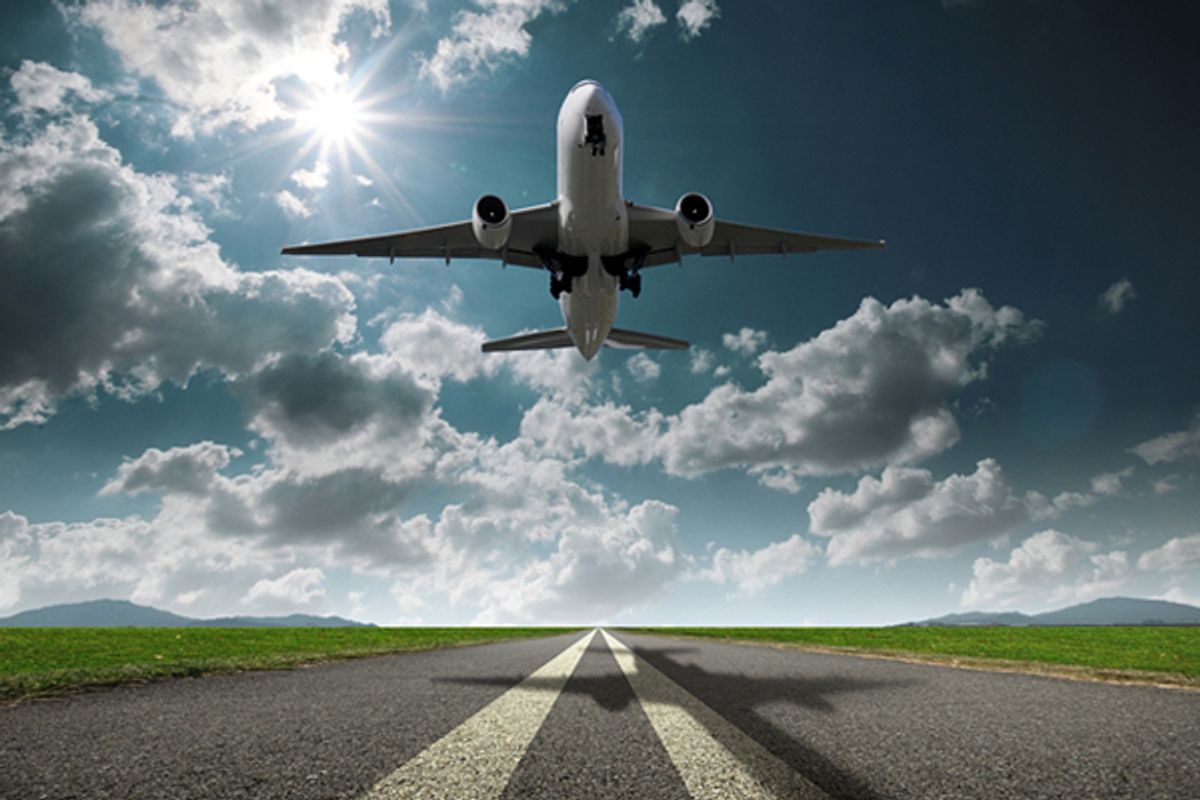
You wouldn’t believe how long my flight was!
No, I wouldn't. And you probably didn't climb at 45 degrees or drop hundreds of feet either. We love to exaggerate
(Credit: graph via Shutterstock) People love embellishing the sensations of flight. They can’t help it perhaps — nervous fliers especially — but the altitudes, speeds and angles they perceive often aren’t close to the real thing.
During turbulence, for example, people believe that an airplane is dropping hundreds of feet at a time, when in reality the displacement is seldom more than 20 feet or so — barely a twitch on the altimeter.
It’s similar with angles of bank and climb. A typical turn is around 15 degrees, and a steep one might be 25. The sharpest climb is about 20 degrees nose-up, and even a rapid descent is no more severe than 10 degrees nose-down.
I can hear your letters already: You will tell me that I’m lying, and how your flight, was definitely climbing at 45 degrees and banking at 60.
And you’re definitely wrong. I wish that I could take you into a cockpit and demonstrate. I’d show you what a 45-degree climb would actually look like, turning you green in the face. In a 60-degree turn, the G forces would be so strong that you’d hardly be able to lift your legs off the floor.
Also routinely exaggerated are the flight times between cities.
“Oh my god, when I flew from New York to Sydney it took, like, 35 hours.”
Actually it takes about 20 hours. Six hours to the West Coast, then another 14 or so from there. Maybe less, depending on winds and weather.
In his book “The Second Plane,” Martin Amis claims that it takes 10 hours to fly nonstop from Washington, D.C., to London-Heathrow. It does not. Neither does it require another 10 to reach Kuwait City from there. Those legs are about seven hours and six hours, respectively.
In the January 2012 issue of Harper’s magazine, a memoir by Alexandra Fuller describes it taking 12 hours to fly from Wyoming to Mexico City, via Dallas. “Having flown twelve hours through the Christmas midnight.” Really? Twelve hours to go 1,500 nautical miles? That’s an average of 125 miles per hour. Even a four-seat Cessna can beat that.
(Somewhat offsetting this gaffe, in the same issue of Harper’s, as part of his “Easy Chair” essay, the great Thomas Frank gives a rare shout-out to the ’80s punk-pop band the Dickies.)
Of course, maybe it depends how we define a flight. Is it merely the time spent in the cabin, or the journey in full, curbside to curbside: the time checking in, waiting in the security line, connecting between flights, and so forth? Some people obviously include the whole shebang, but I don’t think that’s fair. Too many variables. A 10-hour layover at the airport in Dubai might add to your travel time, but that’s not flying.
At least by my definition, no flight anywhere lasts longer than approximately 18 hours. That being the length of Singapore Airlines’ nonstop between Singapore and Newark, the longest scheduled flight in the world. They use an Airbus A340 decked out in an all-business class configuration.
On one hand 18 hours sounds excruciating, but knowing that airline’s reputation for service and the over-the-top amenities found on its planes, I suspect many passengers are sad when it’s time to land.
- – - – - – - – - -
GO-AROUNDS
Numerous readers have written to ask what I think about the recent Popular Mechanics story on the findings pertaining to the 2009 Air France disaster.
I normally don’t have nice things to say about aviation coverage in the media, but this story, written by Jeff Wise, was excellent. It was the best analysis of the accident that I have seen. (Caution: The version that ran in Huffington Post wasn’t nearly as good.)
What I especially appreciated is that he didn’t go hunting for a single tangible cause or try to explain the unexplainable. Why did the crew become so disoriented and react the way it did? Nobody really knows. We can’t know.
One of the article’s more interesting aspects pertains to the design of the Airbus sidestick controllers. Unlike conventional steering columns, which are physically connected and move in unison, the Airbus sidesticks feature asynchronous loading, meaning that inputs made on the captain’s side are not seen or felt on the first officer’s control, and vice versa. Only when contradictory inputs are made does this system register an alarm. While there are valid engineering and human-factor reasons for this design, in the Air France cockpit that night, when all hell was breaking loose, it’s possible that the pilot in the left seat simply didn’t recognize that his colleague in the right seat was inadvertently flying the airplane into a stall.
- – - – - – - – - – - -
Do you have questions for Salon’s aviation expert? Contact Patrick Smith through his website and look for answers in a future column.
Patrick Smith is an airline pilot. More Patrick Smith.
Behind the underwear bomb
The latest airplane terror plot wouldn't have been foiled without airport security -- but not the kind we all know
Travelers line up at a TSA checkpoint at Los Angeles International Airport.
(Credit: Reuters/Danny Moloshok) Another deadly plot taken down in the planning stages. This time, thanks to the work of a CIA double agent, officials were able to infiltrate a Yemen-based al-Qaida plot to destroy a U.S.-bound jetliner using a nearly undetectable underwear bomb.The moral of the story: Airport security works!Am I being facetious? Not necessarily. It depends on your definition of airport security.
In my mind, the key to keeping airplanes safe is, and always has been, stopping acts of sabotage while they are still in the planning stages. Here in the age of the TSA checkpoint, with its toothpaste confiscations and obsession with pointy objects, we tend not to think this way, preoccupied instead with a kind of airport Kabuki — the tedious, fanatical screening of passengers and their carry-ons. Real airport security takes place offstage, as it were. It is the job of the folks at the CIA and the FBI, working together with foreign authorities. And while TSA has an important role here too, we can do without the spectacle of airport guards rifling through innocent people’s bags in a pathological hunt for what are effectively harmless items.
Continue Reading ClosePatrick Smith is an airline pilot. More Patrick Smith.
Letter from Mumbai
Could this long-winded carpet merchant really mistake me for a wealthy customer, ready to whip out my credit card?
(Credit: Patrick Smith) Flying from Europe to India, we pass overhead Odessa, Ukraine. Odessa, they say, is home to the most beautiful women in the world. Then across the Black Sea to Azerbaijan and the gorgeous barren landscapes of Georgia. Next comes the ink-dark Caspian, and then the long desolate outback of northwestern Iran. (The controllers down in Tehran are courteous and professional, their English impeccable — easier to understand than most Scottish controllers.)
From there it’s directly overhead the apocalypse of Karachi, followed by a turn southbound, out across the Arabian Sea toward Mumbai.
Continue Reading ClosePatrick Smith is an airline pilot. More Patrick Smith.
Revere Beach reveries
It was my perfect beach: Sand, clean water to swim in, and situated right below the approach to Logan Airport
A smiley-face balloon floats over Revere Beach in Revere, Mass. (Credit: AP) Sometimes when I hear the whine of jet engines, I think of the beach.
I don’t expect that to make sense to you — unless, like me, your childhood was defined by an infatuation with jetliners and summers spent at a beach that sat directly below an approach course to a major airport.
That would be Revere Beach, in my case, just north of Boston, in the mid- to late 1970s.
Then as now, the city of Revere was a gritty, in many ways charmless place: rows of triple-deckers and block after block of ugly, two-story colonials garnished in gaudy wrought-iron. (Revere is a city so architecturally hopeless that it can never become gentrified or trendy in the way that other Boston suburbs have.) Irish and Italian families spoke in a tough, North Shore accent that had long ago forsaken the letter “R.” Shit-talking kids drove Camaros and Trans-Ams, the old-country cornuto horns glinting over their chest hair.
Continue Reading ClosePatrick Smith is an airline pilot. More Patrick Smith.
Beware the “office” romance
Do pilots and flight attendants really stay in separate hotels on layover? Plus: Do pilots bring their own food?
(Credit: Xavier Marchant via Shutterstock) Why can’t commercial jets be fitted with an exclusive side entrance into the cockpit, making it impossible for a potential skyjacker to gain access?
I am asked this all the time. It presents a number of complications.
First, you can’t simply cut a hole into the side of a plane and add an extra door. Doing so would require a large-scale and extremely expensive structural redesign. And in most cockpits there simply isn’t room for such an addition.
Presumably, too, you’d need to add a lavatory to the cockpit. And what about rest facilities? Long-haul flights carry augmented crews that work in shifts, and the off-duty pilots require a suitable place to relax or sleep. You’d be doubling or tripling the size of the average cockpit, which in turn would take up space already used for galleys, storage and passenger seats.
Continue Reading ClosePatrick Smith is an airline pilot. More Patrick Smith.
The things I carry
All those gadgets, chargers, adapters and cords are supposed to make my life easier. I'm not so sure
(Credit: Patrick Smith) The scourges of modern-day air travel.
I can think of a few: TSA, delayed flights, garbage in your seat pocket. Screaming kids and misdirected luggage. “CNN Airport News.”
Or, how about the blizzard of cardboard placards that hotel chains insist on littering their rooms with? I spend a quarter of my life in hotel rooms, and I resent having to spend the first five minutes of every stay gathering up an armful of this diabolical detritus and heaving it into a corner where it belongs. Attention, innkeepers: This is fundamentally bad business. One’s first moments in a hotel room should be relaxing. The room itself should impart a sense of welcome. It shouldn’t put you to work.
Continue Reading ClosePatrick Smith is an airline pilot. More Patrick Smith.
Page 1 of 89 in Ask the Pilot