2012 Elections
Capitalism’s real “risk-takers”
Workers, not Romney's bailed-out Wall Street CEOs, are the ones actually putting their livelihoods on the line
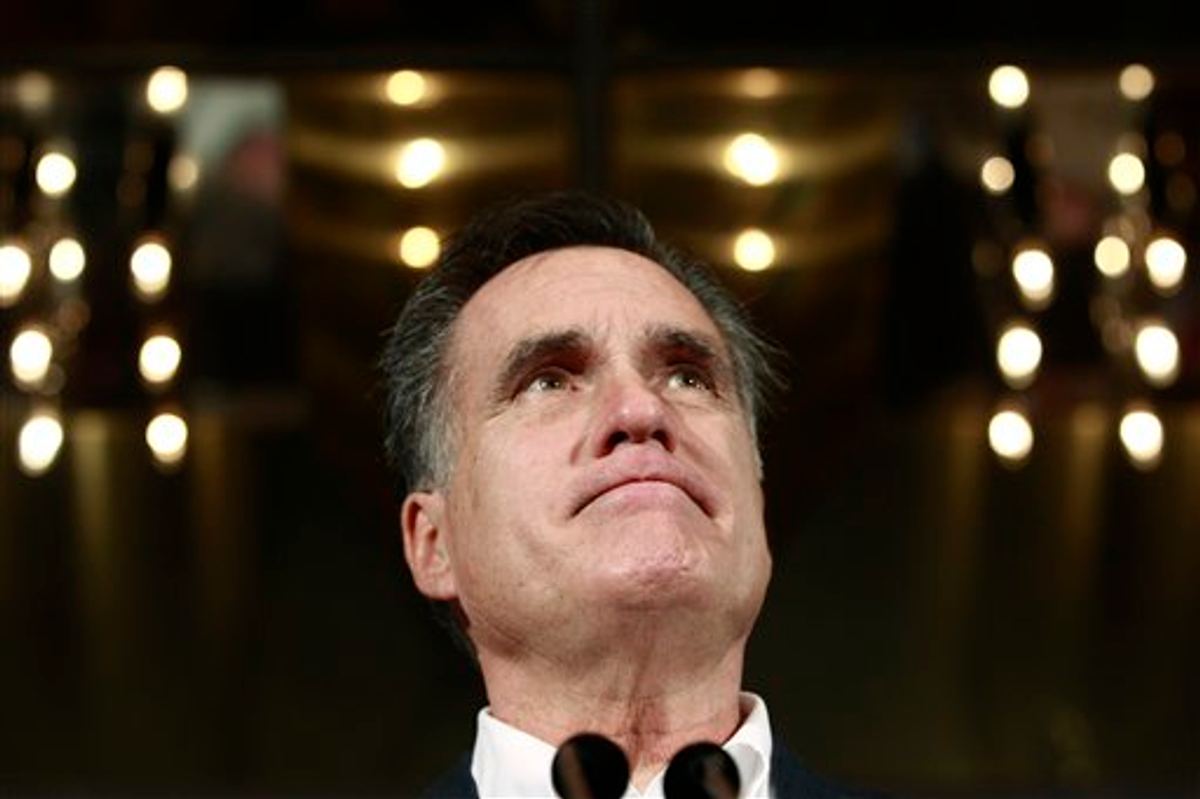
(Credit: AP Photo/Charles Dharapak) Mitt Romney is casting the 2012 campaign as “free enterprise on trial” — defining free enterprise as achieving success through “hard work and risking-taking.” Tea Party favorite Sen. Jim DeMint of South Carolina says he’s supporting Romney because “we really need someone who understands how risk, taking risk… is the way we create jobs, create choices, expand freedom.” Chamber of Commerce President Tom Donahue, defending Romney, explains “this economy is about risk. If you don’t take risk, you can’t have success.”
Wait a minute. Who do they think are bearing the risks? Their blather about free enterprise risk-taking has it upside down. The higher you go in the economy, the easier it is to make money without taking any personal financial risk at all. The lower you go, the bigger the risks.
Wall Street has become the center of riskless free enterprise. Bankers risk other peoples’ money. If deals turn bad, they collect their fees in any event. The entire hedge-fund industry is designed to hedge bets so big investors can make money whether the price of assets they bet on rises or falls. And if the worst happens, the biggest bankers and investors now know they’ll be bailed out by taxpayers because they’re too big to fail.
But the worst examples of riskless free enteprise are the CEOs who rake in millions after they screw up royally.
Near the end of 2007, Charles Prince resigned as CEO of Citgroup after announcing the bank would need an additional $8 billion to $11 billion in write-downs related to sub-prime mortgages gone bad. Prince left with a princely $30 million in pension, stock awards, and stock options, along with an office, car, and a driver for five years.
Stanley O’Neal’s five-year tenure as CEO of Merrill Lynch ended about the same time, when it became clear Merrill would have to take tens of billions in write-downs on bad sub-prime mortgages and be bought up at a fire-sale price by Bank of America. O’Neal got a payout worth $162 million.
Philip Purcell, who left Morgan Stanley in 2005 after a shareholder revolt against him, took away $43.9 million plus $250,000 a year for life.
Pay-for-failure extends far beyond Wall Street. In a study released last week, GMI, a well-regarded research firm that monitors executive pay, analyzed the largest severance packages received by ex-CEOs since 2000.
On the list: Thomas E. Freston, who lasted just nine months as CEO of Viacom before being terminated, and left with a walk-away package of $101 million.
Also William D. McGuire, who in 2006 was forced to resign as CEO of UnitedHealth over a stock-options scandal, and for his troubles got pay package worth $286 million.
And Hank A. McKinnell, Jr.’s, whose five-year tenure as CEO of Pfizer was marked by a $140 billion drop in Pfizer’s stock market value. Notwithstanding, McKinnell walked away with a payout of nearly $200 million, free lifetime medical coverage, and an annual pension of $6.5 million. (At Pfizer’s 2006 annual meeting a plane flew overhead towing a banner reading “Give it back, Hank!”)
Not to forget Douglas Ivester of Coca Cola, who stepped down as CEO in 2000 after a period of stagnant growth and declining earnings, with an exit package worth $120 million.
If anything, pay for failure is on the rise. Last September, Leo Apotheker was shown the door at Hewlett-Packard, with an exit package worth $13 million. Stephen Hilbert left Conseco with an estimated $72 million even though value of Conseco’s stock during his tenure sank from $57 to $5 a share on its way to bankruptcy.
**
But as economic risk-taking has declined at the top, it’s been increasing at the middle and below. More than 20 percent of the American workforce is now “contingent” — temporary workers, contractors, independent consultants — with no security at all.
Even full-time workers who have put in decades with a company can now find themselves without a job overnight — with no parachute, no help finding another job, and no health insurance.
Meanwhile the proportion of large and medium-sized companies (200 or more workers) offering full health care coverage continues to drop – from 74 percent in 1980 to under 10 percent today. Twenty-five years ago, two-thirds of large and medium-sized employers also provided health insurance to their retirees. Now, fewer than 15 percent do.
The risk of getting old with no pension is also rising. In 1980, more than 80 percent of large and medium-sized firms gave their workers “defined-benefit” pensions that guaranteed a fixed amount of money every month after they retired. Now it’s down to under 10 percent. Instead, they offer “defined contribution” plans where the risk is on the workers. When the stock market tanks, as it did in 2008, the 401(k) plan tanks along with it. Today, a third of all workers with defined-benefit plans contribute nothing, which means their employers don’t either.
And the risk of losing earnings continues to grow. Even before the crash of 2008, the Panel Study of Income Dynamics at University of Michigan found that over any given two-year stretch about half of all families experienced some decline in income. And the downturns were becoming progressively larger. In the 1970s, the typical drop was about 25 percent. By late 1990s, it was 40 percent. By the mid-2000s, family incomes rose and fell twice as much as they did in the mid-1970s, on average.
What Romney and the cheerleaders of risk-taking free enterprise don’t want you to know is the risks of the economy have been shifting steadily away from CEOs and Wall Street — and on to average working people. It’s not just income and wealth that are surging to the top. Economic security is moving there as well, leaving the rest of us stranded.
To the extent free enterprise is on trial, the real question is whether the system is rigged in favor of those at the top who get rewarded no matter how badly they screw up, while the rest of us get screwed no matter how hard we work.
The jury will report back Election Day. In the meantime, Obama and the Democrats shouldn’t allow Romney and the Republicans to act as defenders of risk-taking free enterprise. Americans need to know the truth. The only way the economy can thrive is if we have more risk-taking at the top, and more economic security below.
Robert Reich, one of the nation’s leading experts on work and the economy, is Chancellor’s Professor of Public Policy at the Goldman School of Public Policy at the University of California at Berkeley. He has served in three national administrations, most recently as secretary of labor under President Bill Clinton. Time Magazine has named him one of the ten most effective cabinet secretaries of the last century. He has written 13 books, including his latest best-seller, “Aftershock: The Next Economy and America’s Future;” “The Work of Nations,” which has been translated into 22 languages; and his newest, an e-book, “Beyond Outrage.” His syndicated columns, television appearances, and public radio commentaries reach millions of people each week. He is also a founding editor of the American Prospect magazine, and Chairman of the citizen’s group Common Cause. His widely-read blog can be found at www.robertreich.org. More Robert Reich.
Romney releases birth certificate
Trump goes on another birther rant; and Mitt misspells "America." Wednesday's top political stories
FILE - In this Feb. 2, 2012 file photo, Donald Trump greets Republican presidential candidate, former Massachusetts Gov. Mitt Romney during a news conference in Las Vegas. Romney is set to clinch the Republican nomination for president Tuesday with a win in the Texas primary, a feat of endurance for a candidate who came up short four years ago and watched this year as voters flirted with a carousel of front-runners before eventually warming to him. (AP Photo/Julie Jacobson, File)(Credit: AP) - Mitt Romney may just win this thing: Surprising no one, the candidate officially captured the last of the 1,144 delegates he needs to secure the GOP nomination last night in Texas, despite months of punditry about the possibility that the race could go all the way to the GOP convention.
But maybe Romney shouldn’t even bother. As Reuters reports astrologists foresee that Obama will be reelected. Still, it may not easy: “The ingress of Saturn into Scorpio may trouble him,” one said. “It won’t cost him the election, but it may indicate difficulties in the first half of his second term.”
Continue Reading CloseAlex Seitz-Wald is Salon's political reporter. Email him at aseitz-wald@salon.com, and follow him on Twitter @aseitzwald. More Alex Seitz-Wald.
Florida purging voter rolls
Governor Rick Scott moves forward with a plan to disqualify thousands of mostly Hispanic and Democratic voters
Rick Scott (Credit: Reuters/Brendan McDermid) Hated Florida Governor Rick Scott has a great idea: A big, massive purge of the state’s voter roll right before a sure-to-be-close presidential election. The governor ordered his secretary of state to compile a list of registered voters who might not be citizens, based on an unreliable and out-of-date state motor vehicle administration database. The secretary of state made a list and then realized the list was not actually very useful or accurate. Then he resigned, and now Scott is just purging away.
Continue Reading Close
Alex Pareene writes about politics for Salon and is the author of "The Rude Guide to Mitt." Email him at apareene@salon.com and follow him on Twitter @pareene More Alex Pareene.
Mitt Romney: Politics “like a sport”
What makes Mitt tick? The nominee says he likes politics because "I can't compete in competitive sports very well"
Republican presidential candidate and former Massachusetts Governor Mitt Romney gestures as he leaves a campaign event in Hillsborough, New Hampshire May 18, 2012. (Credit: Reuters/Jessica Rinaldi) Mitt Romney may have unintentionally opened a window onto his somewhat obscured motivations for running for president in an interview with the Wall Street Journal’s Peggy Noonan today, explaining that he likes sports, but isn’t very good at them, so he does politics instead.
Asked about whether he likes “the game” of politics, the presumed GOP nominee replied, “I like competition, and I think the game [of politics] is like a sport for old guys. I mean, you know, I can’t compete in competitive sports very well, but I can compete in politics, and there’s the — what was the old ABC ‘Wide World of Sports’ slogan? ‘The thrill of victory and the agony of defeat.’ The only difference is victory is still a thrill, but I don’t feel agony in loss.”
Continue Reading CloseAlex Seitz-Wald is Salon's political reporter. Email him at aseitz-wald@salon.com, and follow him on Twitter @aseitzwald. More Alex Seitz-Wald.
Trump insinuates self into Romney campaign
How a toxic attention-seeker (not Newt) will likely end up speaking at the RNC
Businessman and real estate developer Donald Trump (L) greets Mitt Romney after endorsing his candidacy for president at the Trump Hotel in Las Vegas, Nevada February 2, 2012. (Credit: Reuters/Steve Marcus) So. Donald Trump again? Are we really doing this again? I guess we are!
There were stories, recently, in the usual places, about how Trump was being seriously considered for a major speech at the Republican Convention. I did not dwell on the story much, because I assumed that these rumors were a product of Donald Trump’s prodigious vanity and powerful imagination. Ha ha ha, sure, the Republicans will definitely want the stupid make-believe TV mogul who pretends to fire people for a living, at their big party.
Continue Reading Close
Alex Pareene writes about politics for Salon and is the author of "The Rude Guide to Mitt." Email him at apareene@salon.com and follow him on Twitter @pareene More Alex Pareene.
“Battlefield Earth”: Romney vs. the Psychlos
The GOP's standard bearer calls L. Ron Hubbard's bizarro sci-fi epic his favorite novel. Is that cause for concern?
Republican presidential candidate and former Massachusetts Governor Mitt Romney reads a book to children in Manchester(Credit: Brian Snyder / Reuters) There’s a scene near the end of “Battlefield Earth,” Scientology founder L. Ron Hubbard’s 1982 science fiction epic, that may explain a bit of why Mitt Romney has said (most recently this week) that it’s his favorite novel.
Our hero, Jonnie Goodboy Tyler, has just finished taking down the Psychlo empire, which has ruled Earth for the past millennium and has dominated most of the known 16 universes for going on 300,000 years. Now Jonnie has to negotiate with the alien powers who are jockeying to fill the power vacuum left behind, and things aren’t looking so good for the human race.
Continue Reading CloseDaniel Oppenheimer's book "Turncoats: The Journey from Left to Right and How It’s Transformed America," a political and intellectual history of six prominent American intellectuals who journeyed from the left to the right of the political spectrum, will be published by Simon and Schuster More Daniel Oppenheimer.
Page 1 of 202 in 2012 Elections