Afghanistan
Rethinking the Taliban
Don't confuse them with al-Qaida. It's time to start negotiating our way out of Afghanistan
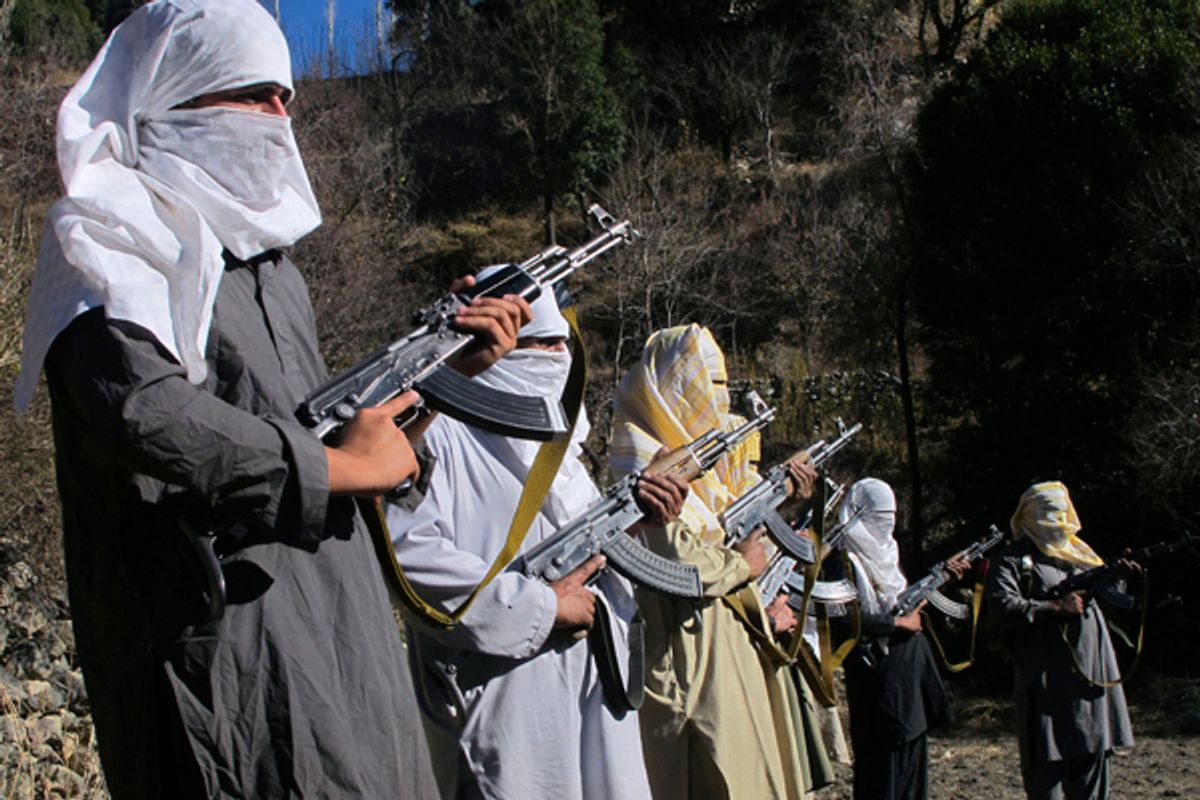
Ready to talk? (Credit: AP/Ishtiaq Mahsud) Soon after 9/11, President Bush ensured that al-Qaida and the Taliban were conflated in the American imagination. “If any government sponsors the outlaws and killers of innocence, they have become outlaws and murderers themselves,” he said in his speech announcing strikes against Afghanistan.
Now the United States faces the opposite problem: decoupling the Taliban from what remains of al-Qaida. Vice President Joe Biden was guilty only of being impolitic when he conceded in December that the Taliban per se are not America’s enemies. Thankfully, reports of low-level talks between the Taliban and the U.S. and/or the Afghan government are now as plentiful as heroin poppies. But these preliminary, scattered negotiations are not enough; the United States needs to dialogue with the Taliban to extricate itself from Afghanistan.
Of course, negotiating with the Taliban is unseemly. For one thing, the group is a horrible combination of medieval and modern Islamist brutality. Its marriage of totalitarianism and an extreme interpretation of Islam has made the Taliban among the most notorious human rights abusers in the world. And, of course, it has killed scores of Americans and Afghan civilians. For another thing, the United States and its allies have declared their commitment to improving the welfare of the people of Afghanistan. “The oppressed people of Afghanistan will know the generosity of America and our allies,” Bush declared in that same October 2001 speech. Peacemaking with the Taliban will mean abandoning Afghanistan at least in part to the Taliban. Americans can eventually leave the Taliban behind; the Afghans who oppose them cannot.
Nonetheless, it has become clear to most experts that the Taliban and the United States must meet at the negotiating table. After a decade of fighting, the Taliban has demonstrated both its resilience and its deep support in the Pashtun community. “It is manifestly obvious that the Taliban can’t be defeated,” says Anatol Lieven, author of “Pakistan: A Hard Country.” Extending a policy of refusing to talk with the group only consigns Afghanistan to a state of permanent war, he says. That war has devastated Afghans and cost the lives of more than 1,000 American soldiers.
It is unclear how much power the Taliban would have in a post-American Afghanistan. The Taliban has not made its positions clear, although it has relinquished its refusal to talk until all foreign troops have left Afghanistan. Lieven believes “there is no chance of the Taliban conquering the whole of Afghanistan” once the coalition leaves; he believes not even the Pashtun cities will be re-Talibanized. The Taliban’s role in Kabul would be limited. “The best thing for Afghans — and for the Americans — is a peace settlement with a limited Taliban role,” Lieven says.
Not everyone is as sure about the Taliban’s limited abilities. John R. Schmidt, a Pakistan expert formerly with the State Department, says he worries about the re-Talibanization of Afghanistan. “Remember that before 9/11 the Taliban had brought 90 percent of the country under its control,” he says. Still, even Schmidt agrees that talks must take place between the U.S. and the Taliban. “Nobody thinks the Taliban can be defeated” in a reasonable time frame, he says. “If we don’t talk, we preclude the possibility of a political settlement.”
The latest news is that the Taliban are getting more serious about negotiating, setting up an office in the Gulf state of Qatar. At this point, the position of the Americans is unacceptable to them: keeping bases as well as American soldiers in Afghanistan. Lieven suggests those positions be modified to focus on a) the complete exclusion of al-Qaida members; b) the Taliban’s recognition of the Afghan constitution, or at least its renegotiation; and c) a crackdown on the heroin trade. These compromises would maintain essential American interests while being more palpable to the Taliban.
Perhaps, then, the most important question is when an American government will be willing to be honest with the American people and tell them the Taliban are here to stay in Afghanistan. Only then can Afghanistan look forward to a measure of peace and stability. With the Taliban a permanent presence, however, nobody should have any illusions about how pretty the peace will be.
Jordan Michael Smith writes about U.S. foreign policy for Salon. He has written for the New York Times, Boston Globe and Washington Post. More Jordan Michael Smith.
Memorial Day’s lessons in amnesia
If nothing else, the holiday allows us to reflect on our commitment to forgetting bloody conflicts
(Credit: Carly Rose Hennigan via Shutterstock) It’s the saddest reading around: the little announcements that dribble out of the Pentagon every day or two — those terse, relatively uninformative death notices: rank; name; age; small town, suburb, or second-level city of origin; means of death (“small arms fire,” “improvised explosive device,” “the result of gunshot wounds inflicted by an individual wearing an Afghan National Army uniform,” or sometimes something vaguer like “while conducting combat operations,” “supporting Operation Enduring Freedom,” or simply no explanation at all); and the unit the dead soldier belonged to. They are seldom 100 words, even with the usual opening line: “The Department of Defense announced today the death of a soldier who was supporting Operation Enduring Freedom.” Sometimes they include more than one death.
Continue Reading CloseTom Engelhardt, co-founder of the American Empire Project, runs the Nation Institute's TomDispatch.com. His latest book, "The United States of Fear" (Haymarket Books), has just been published. More Tom Engelhardt.
Where the wounded are
Wars don't just cause casualties among soldiers, they drain medical staff. I traveled to see the costs firsthand
A soldier is prepared for an operation at Landstuhl Regional Medical Center. (Credit: Reuters/Kai Pfaffenbach) The weather’s getting warmer in Afghanistan and the war there is heating up again. That means – as it has meant every year for more than a decade — that the pace will quicken at the Landstuhl Regional Medical Center in Germany. More casualties will be brought to this largest American military hospital outside the United States. The Critical Care Air Transport teams and their C-17 Globemasters will fly in from “downrange,” as they call the Afghan battleground, and the injured will be brought by ambulance bus from nearby Ramstein Air Force Base to the hospital front door.
Continue Reading CloseMichael Winship is senior writing fellow at Demos and a senior writer of the new series, Moyers & Company, airing on public television. More Michael Winship.
NATO invites Pakistan to summit
A sign that Islamabad is ready to reopen its western border to NATO troops on their way to Afghanistan
Oil tankers, which were used to transport NATO fuel supplies to Afghanistan, are parked at a compound in Karachi, Pakistan, Tuesday, May 15, 2012. NATO on Tuesday invited Pakistani President Asif Ali Zardari to the alliance's summit in Chicago, after signs that the country could be moving to reopen its Afghan border to NATO military supplies. (AP Photo/Shakil Adil)(Credit: AP) ISLAMABAD (AP) — NATO on Tuesday invited Pakistan’s president to the upcoming Chicago summit on Afghanistan, the strongest sign yet that Islamabad is ready to reopen its western border to U.S. and NATO military supplies heading to the war in the neighboring country.
Pakistan blocked the routes in November after American airstrikes killed 24 of its troops on the Afghan border. The attack sent ties between Washington and Islamabad to new lows, threatening regional cooperation needed for negotiating an end to the Afghan war.
Continue Reading CloseAfghanistan, I can’t quit you
My mom pushed me to join the Marines. Now that she's gone, I'm still drawn to war zones
A child flies a kite in Kabul on Tuesday Mar. 27, 2012. (Credit: Geoffrey Ingersoll) The heat. That’s what I remember most. Shimmery and bright. Blinding. Stifling. Heeee-eeaat.
The kind that’s not just on you, wrapped around you, but balled up and pulsing inside you — a desert blanket with teeth. It’s a type of heat that makes your skin cry and your eyeballs sweat, even in the shade; heat like a predator you can’t run away from.
I notice it right as I get off the plane — not just the degrees but also the dust. Dust you can smell, kicked up by a thousand years of struggle. In a region this old, I’m sure each breath carries a dose of unintended history: Inhale, Alexander the Great; exhale, the Ottoman Empire; inhale, the USSR; exhale, the Taliban.
Continue Reading CloseGeoffrey Ingersoll is a freelance journalist, documentarian, writer, photographer, and veteran of Operation Iraqi Freedom. He is the recipient of the Sam Stavisky Award for Combat Reporting. More Geoffrey Ingersoll.
What Obama didn’t mention in Kabul
Just outside the Afghan capital, the Taliban is in control and preparing for a wider war
President Barack Obama addresses troops at Bagram Air Field, Afghanistan, Wednesday, May 2, 2012. (AP Photo/Charles Dharapak)(Credit: AP) MAHMUD RAQI, Afghanistan — The office of Kapisa’s governor sits high on a hilltop overlooking the provincial capital, Mahmud Raqi. It has a beautiful view of the river below and the mountains, trees and fields that stretch into the distance.
Beneath the tranquil surface, however, lies a grim truth. Just outside town roadside bombs are planted to target NATO convoys.
Page 1 of 122 in Afghanistan