Stop Online Piracy Act

Reid bows to online protest

Protest against SOPA derails the Senate bill favored by the majority leader

  • more
    • All Share Services

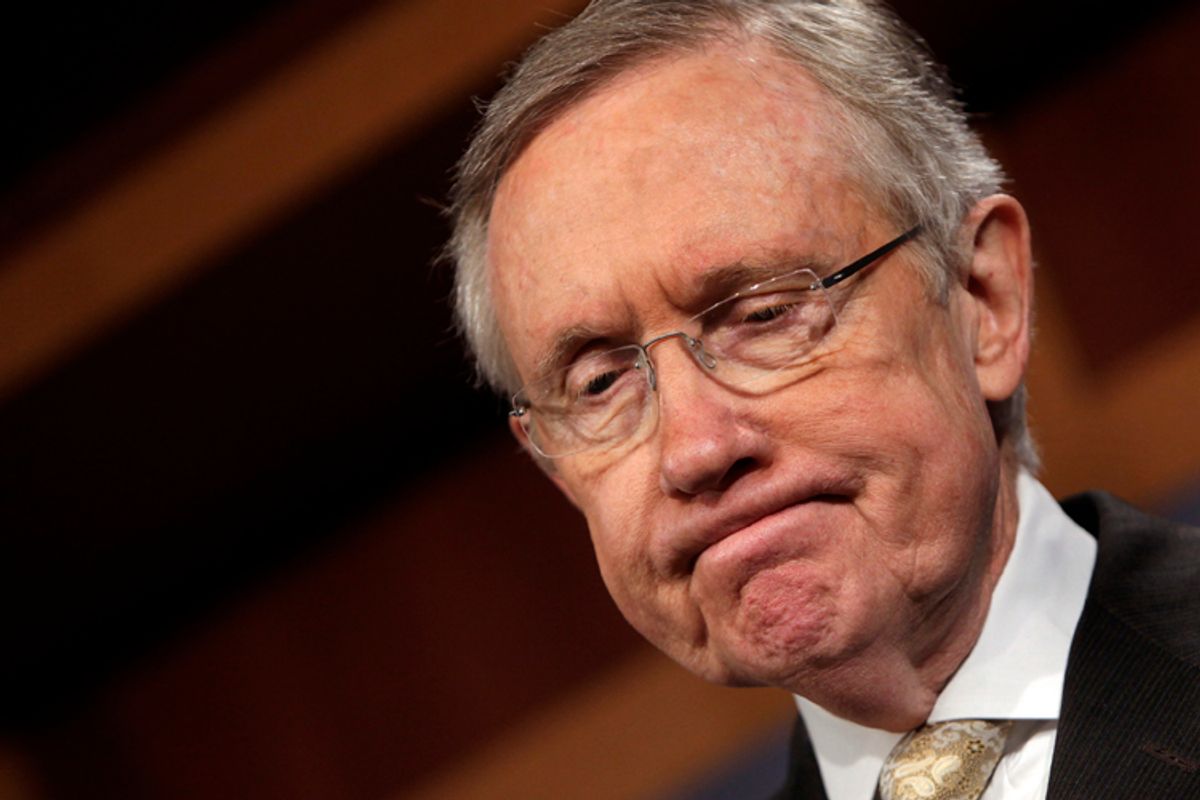
Reid bows to online protest Foiled by the internet(Credit: Yuri Gripas / Reuters)

After Wednesday’s one-day  blackout of Wikipedia, Craigslist and scores of other sites to protest the House of Representatives’ Stop Online Piracy Act and its Senate companion, Protect IP Act; after Google’s collection of a reported 7 million petition signatures; after seven co-sponsors of the Senate bill repudiated it and dozens of other rejected it, attention turned to Senate Majority Leader Harry Reid, a supporter of the legislation. What would he do in response to the historic digital outcry?

On Friday morning, Reid settled the matter. “In light of recent events,” read a statement sent out by his office, “I have decided to postpone Tuesday’s vote on the PROTECT I.P. Act.”

The move by Reid to hit pause on the bill, known as PIPA, is a big deal — not least as an acknowledgment that online protest is shaping his agenda.

“To me, it was a day for the history books,” Sen. Ron Wyden said in an interview with Salon on Thursday night. “In terms of communicating with government, America is never going to be the same. This showed that you can literally have millions of people being able to weigh in directly with their legislators when they feel that they haven’t been listened to.”

Wyden has a unique perspective. It was the Oregon Democrat who was holding up the bill that the Senate was scheduled to vote on Tuesday of next week. Backers of PIPA needed 60 votes to advance a motion to proceed and break Wyden’s hold. As recently as Tuesday of this week, the bill’s supporters looked to be in a strong position.

Objections to the bills from the tech community had not swayed the bill’s sponsor, Sen. Patrick Leahy, chairman of the Judiciary Committee, or the majority leader.

“Leahy and Reid don’t care about statements and speeches,” said one Senate aide. “They care about pushing the levers of power. And the Internet stepped up and said, ‘That’s not how you pass legislation anymore.’”

The untold story here is that SOPA, the original target of the online community, had derailed PIPA, a bill with a longer pedigree and, according to online observers, a less aggressive approach. “PIPA is terrible,” says Electronic Frontier Foundation senior staff technologist Peter Eckersley. “SOPA is ghastly.”

After SOPA’s introduction in the House in October, Judiciary Committee Chairman Lamar Smith, Republican of Texas, put on a hearing that was ostensibly intended to give the bill a once-over. The proceedings were comically stacked with Google’s policy counsel, Katherine Oyama, serving less as a technical witness and more of a punching bag for complaints about the search engine giant. That a congressional hearing on a critical piece of legislation could be so vapid infuriated the tech community. In response, technologists rallied around American Censorship Day, and found a champion in Rep. Darrell Issa, chairman of the House Oversight Committee, who suggested an alternative bill. Republicans and Democrats alike condemned the superficial consideration of the bill.

The House meltdown sent PIPA’s backers on the Senate side scrambling to separate themselves from the mess. A two-page fact sheet circulated in the Senate making the case that the House’s bill “differs from the PROTECT IP Act” in several key ways.

  • SOPA applies to sites that merely “facilitate infringement,” for example; PIPA targets those solely dedicated to breaking copyright.
  • SOPA threatens to ensnare sub-domains in website takedowns; PIPA understands that one music blog hosted on Blogger.com does not implicate the whole site.
  • SOPA might violate due process; PIPA requires that any efforts to take down advertising or payment systems of infringing sites be routed through the courts. And so on.

“Much of what has been claimed about the Senate’s Protect IP Act is flatly wrong,” Leahy declared on the eve of the blackouts, “and seems intended more to stoke fear and concern than to shed light or foster workable solutions.”

And if Leahy still felt confident of the bill’s passage at the time, it was probably justified. As of last week, PIPA had attracted 41 co-sponsors.

Wyden attributed that more to effective industry lobbying, than senatorial deliberation.

“It’s the content industry lobbyists who are best known in the Senate,” he said. “They’ve always had their way here. It picked up all these sponsors because the content industry worked so cleverly to tell everybody, ‘This is non-controversial. Nobody is in favor of piracy. This is practically a gimme.’ When people hear that, and that powerful industries are for it, often all the implications don’t get thought through. We heard from senators who said, ‘I had no idea that this would do this kind of damage to the Internet, to cybersecurity, and the like.’”

But if the online protests got all the attention this week, equally noteworthy was the reaction of people who had written the bill. They went back to the drawing board — behind closed doors.

The Motion Picture Association of America made little pretense about the fact that it was instrumental in writing the bill. The OpenCongress blog pointed to a New York Times story in which an MPAA executive declared, “We will come forward with language that will address some of the legitimate concerns” about the bill.

This week, MPAA Chairman Chris Dodd came out and talked about tweaking PIPA as doing “the hard work of legislating,” sounding much like the Democratic senator from Connecticut he until recently was. (Hollywood, for the record, made noises about dropping its traditional support for Democrats, perhaps not noticing that far more Republicans than Democrats withdrew their support from PIPA in the wake of the protests.)

PIPA’s proponents seemed to be misunderstanding the argument that its opponents were making. They don’t reject what’s in the bill. They reject the bill’s very existence. ”

“We’re fundamentally saying, kill PIPA, kill SOPA, nuke the bills,” said David Moore, executive director of the Participatory Politics Foundation and program manager of OpenCongress. “Then we’ll talk.”

Why is  PIPA so irredeemable? For one thing, say its critics, the congressional copyright crackdown assumes facts about digital piracy not yet in evidence. If online piracy is truly so massive a problem for the U.S. economy, doesn’t it require more methodical study in Congress, with input from a wider range of experts?

For another, they’re not willing to concede that the Senate Judiciary Committee, so diligently cultivated by the MPAA over the years, should be the be-all and end-all when it comes to conversations about fostering profitable digital content circa 2012. Or that law enforcement should be the go-to response framework.

Other committees might deserve a crack at developing legislation.

“How do we get our content industries to migrate to business models that get creators paid in the Internet era?” Eckersly asked. “You don’t need to fight a crazy global war against piracy to have a YouTube or an iTunes.”

This tectonic shift of the ground under PIPA has some people searching for ways to reframe the situation in the dynamics Washington knows so well. It’s Hollywood vs. Silicon Valley. It’s MPAA vs. Google. Dodd, for example, breezily explained the reported removal of domain name filtering from PIPA — one of the provisions that technology types found most egregious for its targeting of the Internet’s core infrastructure — as “something the Google crowd didn’t want to have done.”

Via Twitter, media mogul Rupert Murdoch, a PIPA backer, blamed ”Silicon Valley paymasters who threaten all software creators with piracy, plain thievery.”

The revealing assumption: Congress must be taking its marching orders from someone with a ton of money. But that’s revisionist. All signs indicate that Google was ready to accommodate itself to some form of  PIPA. The company’s blacking out of its logo this week was attention-getting, no doubt. But a close watching of how this has all played out over the last two months suggests that Google was jumping in front of a parade that was already well on its way.

“If it was Hollywood vs. the tech companies,” says Art Brodsky of the advocacy group Public Knowledge, “it would have been over a long time ago, because the tech lobby is terminally weak and disorganized.”

The truth is that the bulk of those objecting to the bill were millions of Americans who use Internet utilities such as Google and Wikipedia and Craigslist.

That said, PIPA is still alive. In his statement, Reid praised Leahy for the work that he’s done thus far on the bill.

“I encourage him to continue engaging with all stakeholders to forge a balance between protecting Americans’ intellectual property, and maintaining openness and innovation on the internet,” Reid wrote.

But it does look like PIPA won’t go ahead without fundamental rethinking. Is it naive to see the events this week as evidence that a networked populace might really have the ability to upgrade its country’s politics?

“Everybody retains their constitutional right to be foolish,” says Wyden. “But I hope so.”

Nancy Scola is a New York City-based political writer whose work has appeared in the American Prospect, the Atlantic, Columbia Journalism Review, New York Magazine and Salon. On Twitter, she's @nancyscola.

Protest drags down Europe’s SOPA

Hollywood heads for another defeat as the online world rejects an anti-counterfeiting proposal

  • more
    • All Share Services

Protest drags down Europe's SOPAInternet activists protest against the international copyright agreement knon as ACTA, (Credit: AP)

“I will not take part in this masquerade,” wrote the European Union’s special rapporteur for the Anti-Counterfeiting Trade Agreement, as he tendered his resignation last month. Since then, opposition to the international pact on so-called intellectual property has swelled. The popular fervor that thwarted the Stop Online Piracy Act in the United States has gone global.

Thousands marched in the streets of Europe last weekend, with protests reported in Budapest, Paris, Prague, Vilnius, Transylvania and beyond. Bulgaria has pulled out of the process of signing ACTA, as the agreement is known. Latvia has called for greater consultation. Poland has suspended its involvement. And Germany is holding off, as are the Czech and Slovak governments.  Hollywood had expected a neat and tidy ending to the years-long negotiation of a new global copyright regime. What it has gotten is something as complex as a Fellini film.

How did we get here? In 2007, the United States, along with Japan, Switzerland, Canada, Australia, New Zealand, Singapore, Korea and the 27 EU member countries began, in near total secret, to work out a policy on piracy and bootlegging that would stand separate from existing international trade bodies. The hope was to synchronize enforcement against counterfeit goods, from knockoff Viagra to black-market electronics to faux Nike sneakers.

But as the world has gotten a peek at ACTA over the years, it’s how the agreement would govern the Internet that has gotten the most attention. The agreement has raised concerns that travelers will have their laptops and MP3 players searched at border crossings for illicit copies of movies or music, or that Internet service providers will be forced to crack down on customers suspected of using their bandwidth to trade files.

“I don’t know where it comes from and how it originated,” said Lithuania’s justice minister, “but I don’t like that this treaty was signed skillfully avoiding discussions in the European Union and Lithuania.”

In real part, where it has come from is Hollywood, as well as the movie industry’s baby brother, the U.S. recording industry. Over the years, those industries have pursued two tactics in their copyright crackdown, one local, one global. Domestically, the Motion Picture Association of America has pushed SOPA and its companion, the Protect IP Act. Globally, there is ACTA. That international agreement could get done on the world stage not only what MPAA has achieved in Washington, but some of what it hasn’t been able to push through in the United States

Both at home and abroad, critics have argued that Hollywood’s vision of an Internet — one where it is empowered to hunt down violators — cares far more about protecting copyright than it does about protecting the public’s ability to freely associate and communicate online. But as unsettling as that might sound to those of us in the United States, it can be downright terrifying in places where fears of totalitarianism and surveillance are fresh and real. Culture doesn’t always translate, on-screen or off. Secretive cross-border agreements hit the ear differently in Vilnius, or Berlin, or Warsaw. Add to that the fact that the Internet is seen as a refuge, a place where the people stand a chance of countering the shadowy ways of government, and the resistance to ACTA we’re seeing in Europe isn’t surprising.

ACTA’s negotiators, for their part, reject the way that the agreement has been framed. Existing trade agreements like the World Trade Organization’s TRIPS agreement pre-date the Internet, they point out. Karel De Gucht, the European Commissioner for Trade, insists that ACTA’s real target is “large-scale illegal activity, often pursued by criminal organizations.”

But, as with SOPA and PIPA, the issue here isn’t just the substance of the policy. It’s who was writing it, and how they were doing it. For a long while, the little that was known about the drafting process came through a WikiLeaks leak. In that vacuum of information, the focus turned to what looked for all the world like Hollywood’s hijacking of what may well be a necessary global conversation about counterfeit goods.

“Unfortunately for these guys,” wrote Public Knowledge’s Harold Feld, “whenever there is an international trade agreement negotiation, Hollywood jumps in, takes over, and starts driving the crazy train off a cliff by demanding all kinds of nonesense [sic] in the name of ‘stopping piracy.’”

If ACTA is SOPA and PIPA writ international (and it is, in spirit if not in enforcement mechanisms), then what is fascinating to notice here is how the catalyzed reaction against ACTA across Europe mirrored that inter-government agreement: It has been a networked response. Surely, there have been major players. The hacker collective Anonymous has played a role. So has the Pirate Party, a tech-minded political party that started in Sweden and has spread across Europe. But there are millions more individuals who have made themselves heard. Anti-ACTA sentiment has spread nearly virally across the continent.

The Internet is beginning to level the political playing field. The Motion Picture Association of America boasts offices in 30 countries around the globe. That has long been to its considerable advantage. But, as with SOPA and PIPA, Hollywood’s political arm is finding that the kids and not-so-young people rallying online and in the streets are proving to be, in the aggregate, at least, formidable foes.

And each of those rallies, each public demonstration — in Budapest or Prague or New York City – over a copyright bill makes it harder to believe Hollywood’s long-told tale: that the only ones who don’t want their copyright regime are hardcore digital pirates driven by a desire to get music and movies for free. It’s getting difficult to ignore the fact that this particular story might be a little more complicated than that. There’s more to the free flow of online information than piracy. That much this winter’s wired political protests have made plain.

Continue Reading Close

Nancy Scola is a New York City-based political writer whose work has appeared in the American Prospect, the Atlantic, Columbia Journalism Review, New York Magazine and Salon. On Twitter, she's @nancyscola.

Where does the anti-SOPA movement go next?

Challenging the kings of copyright requires a new vision of the public domain

  • more
    • All Share Services

Where does the anti-SOPA movement go next? (Credit: Salon)

The last few weeks have witnessed a remarkable convergence of conflicts over copyright: the arrest of Megaupload mastermind “Kim Dotcom” in New Zealand, an unprecedented show of unity among Internet giants such as Wikipedia and Google to fight anti-piracy legislation in Congress, and similar protests in Poland against new copyright measures.  In a world wracked by recession, war and revolution, a topic oft-dismissed by journalists as “arcane” — copyright — has surged to the top of the political agenda.

Indeed, supporters of anti-piracy legislation in Congress have confessed their ignorance of how copyright and the Internet work, saying the details were best left to the “nerds.” Lawmakers soon heard from the nerds, though, as an online insurgency spread to thwart the Stop Online Piracy Act, galvanizing opposition across the political spectrum in a novel way, from the Creative Commons left to right-wing blogs such as RedState. The campaign epitomizes a promising new turn in American politics, as critics of intellectual property law finally find an audience and, more important, the makings of a political constituency.

It was not always so, to say the least.  Advocates of stronger copyright won an almost unbroken string of legislative and political triumphs since the early 1970s. A burst of piracy in the late 1960s, stimulated by the ease of recording on magnetic tape and the appearance of bootlegs of Bob Dylan and the Beatles, prompted Congress to extend protection to sound recordings in 1971.  Thus began a continual expansion of the powers of copyright, with the term of protection extended from a maximum of 56 years to the life of the author plus 50 years in 1976, and another 20 years added in 1998.

Entertainment industries argued they needed protection.  In a deindustrializing economy, they were job creators, net exporters of American goods.  Disney reps in the early 1980s warned Congress that movie piracy would undercut jobs and tax revenue. With trademark bombast, Hollywood lobbyist Jack Valenti declared in 1982, “We are going to bleed and bleed and hemorrhage, unless this Congress at least protects one industry that is able to retrieve a surplus of trade and whose total future depends on its protection from the savagery of this machine.”  (He was lobbying against the dreaded VCR.)

Meanwhile, opponents of stronger copyright had little to offer.  Most were tape duplicators, who built their businesses on copying records and making mixtapes.  These “pirates” urged Congress and state legislatures not to extend the length of copyright or bolster the power of rights-holders, but lawmakers paid them little attention.

Only with the rise of a new generation of copyright critics in the 1990s did a credible resistance emerge.  Academics such as Lawrence Lessig, Kembrew McLeod and Siva Vaidhyanathan pointed out how excessive copyright protections allow corporate behemoths to push around small competitors while stifling creativity, such as mashups and sampling in hip-hop.

At first, this critique remained limited to a small constituency of tech activists, artists and academics.  But Duke law professor James Boyle offered a prescient diagnosis of the movement’s problems in 1997, when he urged an “environmentalism for the net.” Environmentalism became one of America’s most vital and broad-based new political movements in the late 20th century, but its influence was initially limited.  Scientists and nature lovers worried about environmental degradation, but they faced a difficult challenge persuading others that individual issues — a dam in a public park, suburban sprawl, pollution — were connected in a way that demanded broad public concern.  The idea of the environment encompassed many issues that were different but related.

Critics of copyright, Boyle suggested, needed to theorize about the public domain in the same way nature lovers conceptualized the environment. They needed a framework to explain how intellectual property affected the people as a whole, and not just the librarians, musicians or teachers who might run up against the limits of copyright.  For instance, a handful of polluters might benefit richly from easing clean air standards, while exposure to carcinogens hurts the broader population in a diffuse and indirect way.  Similarly, lawmakers were reforming copyright law at the behest of those who stood most to profit from it — entertainment industries — but at the cost of impoverishing a public domain that most people thought little about.

The last decade reveals how an anti-copyright movement emerged along the lines laid out by Boyle. Efforts to curb copying on the Internet sparked a new consciousness that copyright was not merely an abstract or remote issue, relevant only to lawyers and movie studios, but a palpable everyday concern.  The Recording Industry Association of America stirred outrage by picking on 12-year-old girls and college students for file-sharing, but such indignation only pointed the way to a more comprehensive awareness of the public domain.

The assertion of powerful resistance to SOPA may signal the moment when a new American constituency begins to question copyright. Members of Congress who are normally happy to give Hollywood whatever it wants began to abandon the legislation, as voters roared their opposition and sites such as Wikipedia coordinated an effective blackout.  Critics of SOPA succeeded in changing the subject from property rights and stealing to a discussion of sharing and freedom, reviving the old idea that citizens had an interest in a vibrant and free public sphere above and beyond protecting the profits of rights-holders.

Why the (seemingly) sudden change?  Wikipedia, no doubt, offers a model of nonprofit public service and “peer production” that stands in stark contrast with the self-serving image of a pirate. “Imagine a world without free knowledge,” the site said, emphasizing the social good of sharing information. And it cannot be stressed enough that today’s conflict over copyright has broken down as a battle between different sectors of big business, with Google and Facebook squaring off against companies like Disney, which favor the strongest possible property rights.  The tech-vs.-content divide makes this struggle different from earlier legislative fights, when opponents of pro-copyright measures had few friends with deep pockets.

Where the debate goes from here is hard to say, but the broad alliance between academics, bloggers, big tech and everyday Internet users has already achieved an unprecedented victory by rolling back proposed anti-piracy laws.  The recent arrest of Megaupload’s Kim Dotcom, however, threatens to complicate the picture.  With his flashy cars and lavish lifestyle, Dotcom represents perhaps the worst-case scenario for free information — a handful of individuals getting ridiculously rich off other people’s work.  In fact, he may resemble too closely the older image of the sleazy record execs who lived the high life by exploiting artists.  This is certainly not the image that advocates of sharing and free expression want as their poster child.

For such an anti-copyright movement to succeed, though, the focus must remain on free speech, not on the profits of Disney or Dotcom. Free culture could just be a case of “new boss, same as the old boss,” if a new breed of middlemen at file-sharing sites were able to profit from trafficking in other people’s work.  Sharing is one thing, but when money changes hands it is quite another; few people think that inserting a photo of Richard Nixon or Newt Gingrich into my blog post is hurting anyone, since the original photographer or website that hosted the image is no worse off, and I am not trying to make money by blogging. Fair use may protect such practices, though that protection is by no means certain — copyright trolls such as Righthaven enjoy a brisk business threatening websites with infringement lawsuits in order to force them into out-of-court settlements.  The anti-copyright movement must fight to preserve the zone of noncommercial copying and sharing that fair use is meant to protect from such attacks.

It must also offer solutions.  There must be a way of reconciling practices such as sampling and file-sharing with copyright law that is not solely designed to enhance the power of rights-holders.  Creative Commons already offers licenses that creators can use to selectively permit copying and sharing of their work, while YouTube has developed a kind of “opt out” model that removes copyrighted material when rights-holders object (but still hosts a vast number of unlicensed TV clips, concert recordings, and so on).

American history also offers guidance for policy. For instance, Congress forged a novel compromise between songwriters and record companies when it considered how to regulate sound recording in 1909.  Composers and music publishers wanted to license their songs individually, charging whatever the market would bear, while labels wanted a free supply of songs to record on piano rolls, wax cylinders and discs.  The solution — known as a compulsory license — balanced both interests by making record companies pay composers a flat royalty for each copy (i.e., recording) of a song they produced.  Thus, performers and labels could choose whatever songs they wished to record without the burden of negotiating a price for each song individually, and composers were ensured an income from the sale and enjoyment of their works.

Lawrence Lessig and others have called for a similar compromise for file-sharing.  In this way, we could look at file-hosting services such as Megaupload and Rapidshare as a kind of radio.  DJs do not have to call up Moon Unit to get permission every time they want to air a Frank Zappa song; instead, they pay for blanket licenses from composers’ organizations such as ASCAP and play whatever they like.  Likewise, file-hosting services could negotiate a formula to compensate for the copyrighted content users upload and download. Such an arrangement would raise issues of privacy and fairness, but a blanket license scheme offers one possible way for Internet users to go on freely sharing and creators to be paid.

Critics such as Boyle and Lessig have never been truly anti-copyright; they simply believe the law has become too skewed in favor of rights-holders.  In the 1970s, for instance, record industry lobbyists rejected a compulsory license for recordings, which could have set a flat price for using copyrighted sounds in mixtapes and samples.  The result was a process for obtaining permissions that is so cumbersome and costly that many musicians choose not to use samples. With an eye toward innovation and compromise, we could create a system that facilitates sharing, copying and free exchange without shortchanging artists or surrendering to the interests of big business.  A new movement must sustain a vision of sharing that serves the public good if it is to succeed in changing the conversation about copyright. Thwarting quick passage of SOPA was just a start.

Continue Reading Close

Alex Sayf Cummings is assistant professor of History at Georgia State University. His book on music piracy and intellectual property law is forthcoming from Oxford University Press, and he is a co-editor of the blog Tropics of Meta.

The SOPA battle in a wider war

Defending the interests of the big Internet firms is only one part of the war for intellectual freedom

  • more
    • All Share Services

The SOPA battle in a wider warWhat does the "Irvine 11" have to do with SOPA?(Credit: AP/Damian Dovarganes)

The Internet blackouts to protest the pending Stop Online Piracy Act and Protect Intellectual Property Act legislation currently working their way through the U.S. House and Senate have ignited a much-needed discussion of the question of censorship in the United States — though the discussion ought to go much further than it has so far.

One of the most striking things about the debate around SOPA and PIPA, in fact, is that the question of censorship has drawn as much attention as it has partly because it is a byproduct of a battle pitting one set of American corporate interests against another: those who generate “content” against those who maintain the electronic infrastructure in which creative material (copyrighted and otherwise) can be produced, disseminated and accessed.  Or, to be slightly more reductive about it, the struggle pits Hollywood (the Motion Picture Association of America, the Directors Guild, American Federation of Musicians, etc.) against Silicon Valley (Google, eBay, Facebook, Yahoo, etc.).  It’s little wonder that the Electronic Frontier Foundation went so far as to say that SOPA finally gives Hollywood “a chance to break the Internet,” since that is how the legislative campaign is being pitched.

Ordinarily these kinds of arguments between powerful interests might simply be read by the rest of us with a sense of philosophical detachment — even, perhaps, as compelling evidence of the ongoing contradiction between what Marx once distinguished as the means and the relations of production, or in other words the gap that sometimes opens up between sheer technological capabilities and the social systems in which they are embedded, which, at pivotal moments (including our own), seem to impede technological innovation.

But in this case one set of corporations has been able to develop an alliance with those who advocate for free speech as a matter of intellectual and political principle rather than simply as a matter of corporate interest.  And, indeed, even if, say, eBay’s credentials for (let alone commitment to) fighting censorship and advocating free speech are, to say the least, highly debatable, this battle among corporate titans does indeed have implications for the rest of us.  At some point, the requirements of certain forms of commercial freedom actually do blend with those of intellectual and cultural freedom more generally.

That detestable — and yet so easily bandied-about — word, “content,” which is at the center of this debate, refers to the products of human creativity, and, for better as well as for worse, the Internet has become one of the main structures for the creation and dissemination of creative energies in our age, so anything that might interrupt or cut off altogether the flow of that energy is, or ought to be, cause for concern.

The consensus among critics of SOPA is that, even if the intention (which is, of course, hard or even impossible to actually scrutinize) of the legislation is not, in itself, to impose a censorship regime, that will be the end result. As Rebecca MacKinnon argues, the legislation would allow the attorney general to generate a blacklist of sites to be blocked by Internet service providers and search engines, without a judicial order, much less a trial. SOPA would allow companies to sue service providers for hosting material that supposedly infringes copyright, even if they do so unknowingly. This would force ISPs and websites to monitor user activity, which is to say, to censor it, necessarily erring on the side of caution. As CNET notes, the language of the bill could be used to blacklist the next YouTube or Wikipedia — not to mention already existing sites like WikiLeaks.

What is missing from much of the salutary anti-censorship activism around SOPA and PIPA, however, is a sense of where the legislation fits in amid other recent efforts in the U.S. to curtail freedom of speech and intellectual freedom more generally.

For legal efforts to curb intellectual freedom are an ever-present — indeed, even a mounting — threat.  And what is at stake in these efforts is far more than merely “content” and the rights or legal obligations of Internet giants like Twitter and YouTube: It is the very freedom of expression that is vital to our intellectual as well as cultural life.

Probably the most visible recent examples of these legal efforts are the ever more persistent attempts by American supporters of Israel to use legislation, legal procedures and government bureaucracies to suppress free and open debate about Israel/Palestine on campuses across the country by, among other things, attempting to falsely conflate principled criticism of Israeli policy with anti-Semitism.

This effort has led, most recently, to the filing of a lawsuit against the University of California at Berkeley, and lobbying the U.S. Department of Education to open a formal investigation of the University of California at Santa Cruz, as well as undertaking a similar investigation at Barnard College in New York.  Yes, the Berkeley lawsuit was recently dismissed by a judge, as was the Barnard investigation. These are  welcome signs of judicial independence.

But other lawsuits that aim to chill open debate on campus, most notoriously in the trial of 11 U.C. Irvine and U.C. Riverside Muslim students who were found guilty of engaging in a campus protest, have been successful. No doubt other such attempts will be made in the future. This bundle of efforts is only the most recent incarnation of a variety of ideological projects over the past several years to impose different kinds of censorship on college campuses — which are, inevitably, key nodes for the production and circulation of ideas in the country.

Perhaps the most visible of those efforts was the campaign David Horowitz led in the early- to mid-2000s to impose state monitoring of universities, including intruding into such pedagogical matters as text assignments and course syllabi, and even coercing instructors into teaching specific points of view — all under the Orwellian banner of “student rights.”  At one point, up to a dozen state legislatures were considering the Horowitz package.

At the federal level, legislation calling for the same top-down monitoring was (with the help of neoconservative and pro-Israel lobbyists) actually pushed through the U.S. House of Representatives in the form of HR 3077, which was designed to establish government monitoring of federally funded international studies programs at universities across the country, to check that their programs and curricula reflect “national needs related to homeland security.”

Some may take solace from the collapse of the Horowitz campaign and the demise of HR 3077. That would be premature, if not unwise. As more recent events attest, the same will to use the law to censor and silence dissenting viewpoints has not been abandoned — it has merely shifted form.

What these disturbing events have in common is the turn to legislation, to use the bureaucracy and the law on behalf of powerful interests who seem to have something to fear in the kinds of open exchange that are inseparable from a democratic society. It is important for those who are against SOPA and PIPA to see the connection of their cause in the commercial realm with the wider suppression of intellectual and cultural freedom that is taking place as we seem to hear what the poet William Blake once referred to as “mind-forg’d manacles” clamping shut all around us.

Continue Reading Close

Saree Makdisi is a professor of English and Comparative Literature at UCLA and the author of, among other books, "Palestine Inside Out: An Everyday Occupation." Follow him @sareemakdisi on Twitter.

Internet blackout!

Why did Wikipedia go dark? Because the Stop Online Piracy Act goes way too far

  • more
    • All Share Services

Internet blackout! (Credit: Salon)

“The Net interprets censorship as damage and routes around it.”

It’s been more than 18 years since John Gilmore offered up his famous explanation of why the Internet is the most powerful tool for free speech ever invented. That’s long enough for an entire generation of Wikipedia-using, Etsy-shopping, Reddit-browsing and Facebook-sharing Internet users to be born, raised and apply to college. But as some members of that generation may discover on Wednesday, when they log on to their favorite website and discover it dark and silent, Gilmore’s insight has rarely been more relevant than it is today.

Some very well known and highly popular websites, including Wikipedia and Reddit, effectively turned themselves off today, acting in protest of proposed congressional legislation that they believe poses a stark, existential threat to the core architecture of the free and open Internet.

In other words, the operators of these websites have decided that two bills currently under consideration in the U.S. Congress — SOPA, the Stop Online Piracy Act, in the House; and, in the Senate, PIPA, the Protect Intellectual Property Act — represent “damage.” And so they’re routing around it, by any means necessary, including, ironically, purposely damaging themselves, albeit temporarily.

Judging by the outraged reaction of the interests pushing the legislation, the “blackout” was already working before it officially began. On Tuesday, Lamar Smith, the House Republican who is the chief sponsor of SOPA, dismissed Wikipedia’s protest as “a publicity stunt.” Former Democratic Sen. Chris Dodd, now president of the Motion Picture Association of America, went much further, calling it an “irresponsible response,” “an abuse of power” and “a dangerous and troubling development.”

That, people, is the sound of political heat. Several months ago, few Americans knew or cared about SOPA. Bipartisan support suggested the measure would sail through Congress. But a drumbeat of alarm raised by technology companies, major Internet players and a legion of critics dramatically changed the political dynamic — to the point that the Obama White House even bestirred itself this weekend and announced, “We will not support legislation that reduces freedom of expression, increases cyber-security risk, or undermines the dynamic, innovative global Internet.”

How, you might well ask, does legislation that is purportedly aimed at stopping the wanton piracy of movies and music and commercial software and anything else that can be copyrighted, threaten to eviscerate “the dynamic global Internet”? The owners of intellectual property undoubtedly exaggerate the financial cost of online piracy, and they are almost certainly foolish to think that their Neolithic business models will be rescued by tighter enforcement, but there’s little question that rampant abuse of intellectual property is indeed flourishing online. Don’t the injured parties have a basic right to seek redress?

The problem is that the proposed solution goes way too far, completely upsetting the trade-off that currently exists between a little bit of anarchy and a whole lot of incredibly valuable innovative online services. In their haste to tighten the screws, the special interests behind SOPA are handing governments and private actors a club that packs much too powerful a wallop.

Right now, under the terms of the Digital Communications Millennium Act (DCMA), if an IP owner sees something on, let’s say, YouTube or that constitutes a violation, the injured party can send a takedown notice for that item specifically to the operators of the website in question. It’s not an ideal solution, but it’s been in place for about 10 years, and during that period an incredible ecology of Internet services has emerged. There is no question that videos are posted to YouTube every single day — probably every single second — that embody some form of copyright violation, but many would argue that the sum value of what YouTube has to offer society represents a net gain.

Under SOPA, as originally envisioned, a single perceived violation could get an entire website shut down, or just as effectively, choked to death; SOPA includes provisions through which a single allegation of abuse could result in the cessation of payment processing or advertisement delivery to a website. Cut off the finances, and you kill the site.

The Electronic Frontier Foundation (which, incidentally, was co-founded by John Gilmore way back in the day) offers a good example of how this could work in theory, as applied to Etsy, the popular online markeplace for handmade goods.

[Etsy] has over 800,000 active “shops”… — far too many for Etsy to monitor manually. Further, because of the eclectic nature of goods listed, it’s difficult to technically filter through the objects listed.

All that means that it’s not feasible for Etsy to proactively prevent listings that may be perceived to violate US copyright or trademark law. That’s a problem, because under SOPA, anybody who is a “holder of an intellectual property right harmed by the activities” of even a portion of the site, could serve Etsy’s payment processors with a notice that would require them to suspend Etsy’s service within 5 days. That means that a trademark violation in one of the storefronts could lead to payment suspension across the entire site.

If a site like Etsy is forced to proactively review every single item its sellers put up for sale, then Etsy no longer has a business model that will work. And the same would be true for Facebook, or YouTube, or any other site that incorporates user-generated activity as part of its business plan. Suddenly, we’re back to the old model, with that familiar centralization of authority and control and disenfranchisement of the masses.

It’s very easy to imagine a nightmare scenario, in which a government or private actor uses the pretext of a copyright violation to shut down a critical source of information. David Sohn and Andrew McDiarmid of the Center for Democracy and Technology cut directly to the heart of the matter in the Atlantic:

To protect themselves, platforms of all kinds would be pressured to actively monitor and police user behavior. This new de facto duty to track and control user behavior would significantly chill innovation in social media and undermine social websites’ central role in fostering free expression. It would also set the dangerous international precedent that governments seeking to block online content — be it infringement, or hate speech, or political dissent — should look to online communications platforms as points of control.

There are two visions of the future battling for supremacy here. In one scenario, top-down order and control are restored, and the disruptive chaos of the Internet is repressed. In another, society accepts some messiness in return for unleashing the amazing collective power of the digitally networked masses. As political support for SOPA and PIPA in their current forms has evaporated over the past week, it’s been quite clear which side is winning.

No wonder Chris Dodd is so angry. The Internet is treating him like damage, and routing around it.

Continue Reading Close
Andrew Leonard

Andrew Leonard is a staff writer at Salon. On Twitter, @koxinga21.