
Gender

The anger of the male novelist

Do female writers really have it easier than men? Perhaps the issue is being framed wrong by everyone

  • more
    • All Share Services

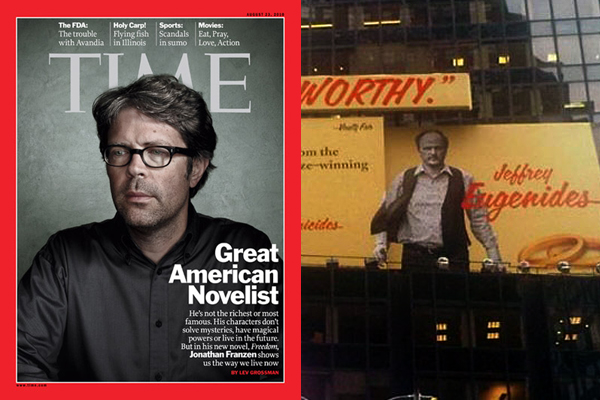
The anger of the male novelist Jonathan Franzen and Jeffrey Eugenides (Credit: Time/Adweek.com)

When I read the final paragraph of Teddy Wayne’s essay, “The Agony of the Male Novelist,” I couldn’t help but think about the ecstasy of the male porn star. While male porn stars earn a fraction of what female porn stars earn, they still get to deliver the money shot at the end of a scene.

It is rather difficult to have a reasonable, rational conversation about matters of (in)equity, whether we’re discussing race, gender or sexuality. These issues are the kind where we are so deeply entrenched in our positions we can’t or won’t consider other viewpoints. When someone like Jennifer Weiner points out an inequity in, say, the media coverage of male and female writers, there’s always going to be (and rightly s0) an alternative perspective, but then there’s also going to be someone who will say, “Such is not the case with me, so you must be wrong.” Sometimes, it would be nice to be able to say, “There is a problem that demands attention,” without being shouted down, condescended to, derided or ignored.

In many realms, systemic, pervasive inequalities exist. Publishing is certainly one of those. The correct response to Weiner pointing out that disparities still exist when it comes to mainstream media coverage is not to say, “I’m a man and I am not getting media coverage either.” Making that kind of statement completely misses the point far more than, say, “Jennifer Weiner’s attack on the New York Times.”

When I write about race, gender, inequity and publishing, I am rarely writing about myself. I am not lamenting a lack of opportunities for my own writing. I’m not shaking my fists at the sky wondering when my novel will sell. Thus far, things are going reasonably well for me. There is plenty I want that feels out of reach, but I don’t think The Man is holding me down. When I do want to complain, I go drinking with my friends. I say this to make it clear that in discussing these fraught topics I am, more often than not, looking at historical patterns that are deeply embedded within our culture. We’re still talking about an issue Francine Prose, for example, eloquently addressed in Harper’s in 1998 when she wrote “Scent of a Woman’s Ink.” Personalizing these discussions, as Wayne clearly does, is not necessarily effective. There will always be exceptions (alas, the midlist male novelist) but we cannot ignore the complex reality of the rules to which these exceptions apply.

I’ve read Wayne’s essay several times now and, given the overall tenor and some of the assertions, I want to believe he’s writing satirically, or to deliberately provoke, or that he’s communicating from an alternate reality where “The Help” is “feel-good fare.” I worry such may not be the case.

Weiner is right to point out that there is a real problem with critical media coverage for female writers. She is right to point out that commercial fiction, particularly commercial fiction that deals with the lives of women, does not garner critical respect, attention or acclaim and that our culture tends to look down on women’s stories.

Teddy Wayne is right, too. It is not financially sustainable be a midlist novelist without gainful employment. It is hard to garner critical attention when you’re a midlist novelist, and sometimes, yes, it is particularly hard for a midlist male novelist who writes about masculine topics. Wayne is also very, very wrong to suggest that women have it better in publishing. On the whole, gender disparities exist in terms of who is being published, where and how books are promoted, how those books are covered by mainstream media, and which books receive coveted accolades.

Here’s the truth. In this day and age, the publishing climate is rather untenable for all writers — men, women, writers of color, straight writers, queer writers. Getting your foot in the door doesn’t even mean what it once did. You may get a book deal, but then what happens? What’s an advance, again? Most publishing contracts don’t come with the necessary publisher support to adequately promote a book. It’s difficult to get books reviewed in major publications. Contemporary writers will probably agree that we’re all in this together — mired in the same depressing circumstance, quietly seething about our relative obscurity. Once in a while, we look up and see the bright twinkling star of a prominent, critically acclaimed novelist like Jonathan Franzen or Jeffrey Eugenides wearing his magnificent vest high above Times Square, and think, “When will it be my turn?” Most of us grudgingly accept that our turns may never come for any number of reasons that have little to do with the quality of our writing. The pill is bitter and it is lodged in our collective throats. Teddy, we hear you.

What most writers have in common is desire. We want and want and want and want. We want to write well and prolifically. We want a great book deal that comes with the kind of advance that will allow us to quit our jobs so we can write full time. We want a great editor who becomes our best friend. We want the book that got us the great book deal to become a bestseller. We want critical acclaim and reviews in all the major publications. We want our publisher to send us on a 30-city book tour where we are met, at every turn, by adoring fans holding out their hands. And in the hands of those adoring fans, we want to see our books, open and ready for us to sign. We want to be on the cover of Time magazine with the headline “Great American Writer.” We want the billboard in Times Square. All we want is everything.

Both Teddy Wayne and Jennifer Weiner have expressed their desires, the things they want, as they’ve engaged in this ongoing, necessary discussion about gender, equity and publishing. They both have certain trappings of success. They both want more.

Wayne suggests that because Weiner has achieved a great deal of commercial success, she shouldn’t “complain” — as if he is the arbiter of what she’s allowed to complain about (because he too has it pretty good). Let’s not overlook that it is insulting to suggest that by bringing attention to this problem, Weiner is complaining.

Undoubtedly, Weiner has achieved a level of success most writers, male or female, only dream of. She is a New York Times bestselling author. She has made a great deal of money from her books. She has a very committed fan base. She had a television show on ABC Family. Her books have been made into mainstream movies. Still, she wants more. Do we condemn her for that desire? Is there such a thing as wanting too much? Is it really our place to suggest she should shut up and be happy with her royalty statements? Despite the millions of books she has sold, Weiner cannot parlay her commercial success into the critical reception and media coverage she seems to so eagerly want. Her frustration is palpable, but I credit her for doing something productive with that frustration. At least we’re having this conversation when, historically, few successful writers have had a visible enough platform to bring attention to gender inequalities in publishing and the mainstream media coverage of contemporary fiction.

I don’t agree with everything Jennifer Weiner has to say about this issue. Nonetheless, when Weiner published her updated data on January 17 about the media coverage of contemporary writers, I appreciated the hard numbers she shared. This data (as well as the data VIDA shared last year) grounds the conversation in reality rather than in the wild speculation often shrouding these debates. Weiner’s data set is also incomplete. As others have noted, we need more context to truly make sense of these numbers that consistently demonstrate that books written by men receive more media coverage and critical attention than books written by women. We need to know the gender breakdown of the books published in the same time periods to determine the true disparities.

The incomplete data does not mean we should dismiss Weiner’s findings. Men wrote approximately 60 percent of the books reviewed in the New York Times last year. Overall, the disparity was not as pronounced as I expected, but it could be better. I very much disagreed with Weiner’s hyperbolic assertion that the “disparity between men and women who get that coveted two-reviews-plus-a-profile is still shocking.” The disparity (10 men versus 1 woman) is significant and worth examining, but we’re talking about such rarified air that it’s difficult to make broad conclusions.

What often gets overlooked in this conversation, particularly where Weiner is concerned, is that she shouldn’t be looking for the kind of coverage Franzen gets. She should be looking at the kind of coverage commercial male writers like James Patterson or John Sanford or Clive Cussler receive. There are all kinds of conversations to be had about how fiction is categorized and marketed, but for now, the publishing industry has decided Weiner writes commercial fiction, and as such, there’s a better data set she should be studying. When trying to compare the media coverage of commercial fiction versus literary fiction, the numbers are always going to skew poorly. At some point, the critical establishment decided it wasn’t interested in commercial fiction. I don’t know if that’s ever going to change.

That said, Weiner is not wrong in pointing out that there is a serious problem — and that the problem reflects many of the inequalities women face in society. She is not wrong to insist that we need to talk about this problem — last year and this year and next year and every year until more parity is achieved. Whether you agree or disagree with Weiner, she certainly deserves more respect than she is afforded by most of the people who write about her and her refusal to stop talking about this problem. We only need to look at the first line of Wayne’s essay to get a good sense of the overall attitude people have about Weiner’s perspective. Gender inequity in publishing is, I am guessing, not a favorite topic of Weiner’s. I follow her on Twitter. Her favorite topic is “The Bachelor.” She may well have a chip on her shoulder and a certain amount of self-interest in wanting commercial and critical success. But let’s not pretend Teddy Wayne isn’t walking around with a chip on his shoulder, too. When a man has the kind of confidence to believe he should receive significant coverage in prominent venues, people generally don’t bat an eye. When a woman like Jennifer Weiner has that kind of confidence, she is ridiculed and belittled. Gender troubles are part of a vicious cycle.

The real problem here is that Wayne’s argument lacks supporting evidence. Instead, he relied on anecdotes and empty but seductive rhetoric, which is not enough to support his alternate reality and the somewhat galling assertion that, “For the majority of male literary authors — excluding the upper echelon of Franzen, Jeffrey Eugenides, Don DeLillo and their ilk, plus a few younger writers like Chad Harbach who have scored much-ballyhooed advances — it’s actually harder than it is for women to carve out a financially stable writing career.”

Anecdotes are not enough to support the speculation that women’s book clubs skew heavily toward female writers. How does Wayne know what women’s book clubs are reading? Anecdotes are not enough to justify the reasoning that because women are buying 80 percent of fiction, they must be using that buying power to buy books by women. It’s simple math and common sense — if women buy 80 percent of all fiction, the publishing industry hasn’t entirely collapsed and men are still publishing books, that means women are supporting a diverse range of writers — including the poor, beleaguered male novelist.

Anyone who looks at the media coverage of contemporary writing can easily see that male novelists, even midlist male novelists, receive consistent coverage. On the O Magazine website right now, a story called “11 Books You Never Thought You’d Read (but Will Fall in Love With Instantly)” includes seven books written by men and four written by women. In December, Lev Grossman, on his blog for Time, wrote about seven books he’s looking forward to in 2012. All seven were written by men. Male novelists, many of them midlist, are covered regularly on sites like Salon, Slate, the Daily Beast and in other prominent venues. I could do this all day. There aren’t a lot of scraps for writers in the mainstream media (which is what we should really be talking about), but of the scraps we have, plenty go to men.

What Wayne is truly lamenting in his essay is the agony of the midlist writer, not the agony of the male midlist novelist. And there’s a difference. He is lamenting that he does not have what he so desperately wants. Framing his discussion, such as it were, within the context of gender was short-sighted and gratuitous — and at times dismissive and insulting. His lament is one shared by many talented writers who toil in relative anonymity — who get a “good” book deal and enjoy some of the trappings of success but are still left wanting, wanting so very much. For whatever reason, Wayne chose to close his argument with an unfortunate pornography metaphor, and I’ll do the same. The female porn star may outearn male porn stars, and she may be in greater demand. But while she’s cleaning off the sting of that scene-ender, he’s on an L.A. freeway heading home. That’s nice work if you can get it.

Roxane Gay lives and writes in the Midwest.

“Mad Men”: Joan did the right thing

Her shocking decision caused the web to explode. But feminist or not, it was the smart call

  • more
    • All Share Services

Christina Hendricks and Gary Basaraba in "Mad Men"

It occurred to me, days into being haunted by the most recent “Mad Men,” that there was some oblique foreshadowing to Joan’s terrible choice. “Why do they get to decide what’s going to happen?” That’s what Pete Campbell demanded several weeks ago in an episode titled “Lady Lazarus.” “They just do,” Harry Crane responded.

Campbell, frustrated at his inability to pull off a longer-term affair with Beth Dawes, was talking about women as sexual gatekeepers. Despite having all the trappings of privilege and power in his world, Pete is not only unsatisfied, he’s enraged by the belief that this erotic capital somehow makes women more powerful than men.

But we’re talking about a man who blackmailed a scared au pair into having sex with him – rape, to my mind – and, when he showed up at Beth’s home with her husband after she rejected him, seemed to be trying for a repeat. In Pete’s turn this week as Joan Harris’s pimp, stacking the deck to make her choice all but inevitable, he is trying to restore a sexual order where women have very little decision at all. No wonder the selling point of the Jaguar is whether you can truly own something beautiful — this episode is all about men trying to own women.

This is entirely in character for Pete – and also for the morally weak men of Sterling Cooper Draper Pryce, prostitution-client and client-bedder Don Draper included. But I’m disturbed by the suggestion in many reactions – including in Salon’s excellent recap – that we should be disappointed in Joan as a character. Nelle Engoron argues that “seeing Joan allow her body to be used in this fashion is worse because of what it suggests about her character. We’re not long past the time when all women who gained a position of any power were accused of sleeping their way into it. To literalize that degrading accusation in Joan renders her less than we’ve always thought her to be.”

But in striking a deal that involves an ownership stake in the company that seems to matter more to her than her own family, Joan doubly takes possession of the means of production. It’s not “empowering,” and it’s a partly coerced decision – she’s not even given accurate or full information about the partners’ response, who were in turn misled about her position, and she believes they think she’s a whore anyway — but it’s a rational choice that will give her much more autonomy than anything else available to her.

As Amanda Marcotte put it in the comments of her excellent video recap, “this episode really exposes how people see sex work, especially the perplexing … belief that selling is worse than buying … or pimping. Which is pure, unadulterated misogyny.” It’s true that Joan has plenty to offer the firm beyond her gorgeous breasts, but after 13 years and one brilliant but unappreciated turn as a script reader, the men at the firm still see her as either the seductress or the tough mom figure. (Peggy managed to de-sexualize her image, but she has become professionally invisible at the company.) Meanwhile, after an on-again, off-again relationship with Roger that definitely was on the prostitution spectrum regardless of her feelings for him, Joan has clearly come to believe that she can’t rely on him either emotionally or financially.

Most relevant of all is the fact that finally taking the respectable route of marriage – itself traditionally transactional — has failed Joan. It has not protected her in any sense – not from sexual or emotional harm, or from her “honor” being besmirched, or from financial instability. The men at SCDP seem to feel like they vaguely need to put up a fight not because Joan is a human being who should be in charge of her own bodily autonomy, but because of a chivalric urge that either puts women on a pedestal or concedes them as the property of another man, as Don Draper tries to do by saying Joan is married. Of course, not only does he know full well that her marriage is over, he’s been an active perpetrator of the undermining of marriage as an institution of either protection or respect.

Yes, Don is trying to change with his marriage to Megan, in which he not only has been faithful (so far as we know) but also no longer holds all the cards. In this week’s episode, Michael Ginsberg’s awed declaration that Megan Draper comes and goes as she pleases echoes Pete’s bitterness about women calling the shots. For a brief minute there, Megan seemed to be pulling off a rare balance for the office – a conventionally beautiful and sexually confident woman whose ideas are actually taken seriously. But she only got there by marrying well, and while she may be wielding a lot of power in the relationship now, she still essentially serves at Don’s pleasure. Joan, on the other hand, owns something that will last as long as the firm does.

Continue Reading Close
Irin Carmon

Irin Carmon is a staff writer for Salon. Follow her on Twitter at @irincarmon or email her at icarmon@salon.com.

Male grooming: The movie

From beard contests to ball cream, Morgan Spurlock's "Mansome" goofs through modern-day male narcissism

  • more
    • All Share Services

Male grooming: The movieJack Passion in "Mansome"

American men are bewildered about their place in the cosmos, or so we have been told repeatedly over the last 20 years. They don’t know whether to thread their eyebrows or wield a welding torch, and end up trying to do both at once (which is inadvisable). As comedian Adam Carolla laments in a scene from Morgan Spurlock’s documentary “Mansome,” the old-time certainties of gender identity have melted away: Women are flying fighter jets and men work at the hair salon; there are no longer “chick jobs and guy jobs.”

I get that Carolla is just cracking wise, from inside the bubble of his own lame version of post-rockabilly guy-shtick — he is interviewed inside a garage, with what looks like an orange Camaro behind him in the middle distance — and that if you brought up the fact that those old-time “chick jobs” paid 40 to 80 percent less than “guy jobs,” he’d get all irritated with you for being a drag. He’s still an idiot, though, even if he’s an idiot in quotation marks. That’s kind of the problem with “Mansome,” which tries to tackle the enormous subject of contemporary male vanity as an assemblage of whimsical anecdotes, which are often entertaining in themselves but studiously avoid any semblance of intelligent analysis or historical understanding.

It’s pointless to come down too hard on a film like “Mansome,” because like all Spurlock’s work (including “Super Size Me” and “Where in the World Is Osama bin Laden?”) it’s driven by a good-hearted frat-boy humor that seems fundamentally sincere. It’s more first-person journal and travelogue than it is cultural archaeology, and as such it’s basically OK. Spurlock gets to interview some of his celebrity pals about their attitudes toward masculinity and grooming: Paul Rudd is slightly ill at ease, Judd Apatow is charming, and Zach Galifianiakis steals the show, of course. (When asked to rate his looks on a scale of 1 to 10, Galifianakis responds confidently that some people find him “a strong 2.”)

Spurlock documents his own decision to shave off his trademark porn-star ‘stache, thereby reducing his 5-year-old son to torrents of tears. (It was definitely a mistake, Morgan.) He meets various kooky characters who have some tangential relationship to his theme, including a California suburbanite named Jack Passion who describes himself as a professional “beardsman,” meaning he travels the world exhibiting his Hagar-the-Horrible facial thatch in competitions. (Anthrax rhythm guitarist Scott Ian responds: “Beard and mustache competitions, for want of a better word, are kind of gay.” I laughed, and I know that’s wrong.) Then there’s the elegantly coiffed and tailored Manhattan clothing buyer who describes himself as the “dictionary definition of a metrosexual,” perhaps making up for his teen years as a Sikh immigrant outcast in middle America. And the entrepreneur who has introduced a lotion-y product called Fresh Balls: The Solution for Men. (Yes, it is what you think it is.)

In fairness, Spurlock is at least half aware that all the jokes and episodes of “Mansome” never add up to anything, except perhaps the conclusion that neither male narcissism nor male grooming is anything new, but that they have been coded in different ways at different times. Masculinity is no less a troubled construction than is femininity, and it’s just as easily whipped about by the tides of commerce and fashion. The aristocratic dandies of the 18th century make Spurlock’s New York Sikh metrosexual look like a shoeless Dust Bowl farmhand, and every Important Man of the 19th century, regardless of background or affiliation — King Leopold II! Karl Marx! The pioneering Ambrose Burnside! — had his own tonsorial signature that required extensive maintenance.

Now, I’m not denying that there’s something specific and contemporary about the version of male narcissism wrought by consumer capitalism, with its tendency to turn things once seen as immutable, such as gender or sexual identity, into fluid and exchangeable commodities with no fixed meaning. (Speaking of Karl Marx, it was he who wrote that, under capitalism, “all fixed, fast frozen relations, with their train of ancient and venerable prejudices and opinions, are swept away … All that is solid melts into air, all that is holy is profaned.”) It was to address that question on a pop-sociological level that the term “metrosexual,” first introduced to America a decade ago in this Salon article by Mark Simpson, was originally invented. (Simpson’s coinage was instantly stolen by marketers, of course, and turned into a pretty-boy Frankenstein monster who was, in turn, burned by the resentful villagers.)

Some of that big-picture stuff comes up almost by accident in “Mansome,” but Spurlock doesn’t even pretend to pay attention. He’s just a guy! He’s confused like the rest of us! He makes his little boy cry and watches pro wrestler Shawn Daivari (a Minnesota native who plays the anti-American “heel” called Sheik Abdul Bashir) shave his back all the way down to his butt crack. He sticks for far too long with an embarrassing framing device in which Jason Bateman and Will Arnett go to a spa and engage in uneasy homoerotic banter. He chops up the movie into irrelevant chapters about beards, mustaches, hair and so on, as if those things were unrelated. When he goes to get his own hair cut, it’s at some pseudo-old-fashioned place in downtown Manhattan where the wood fixtures are way too polished and the barbers are conspicuously overdressed. It’s kind of endearing and kind of asinine.

“Mansome” is now playing in Atlanta, Boston, Chicago, Cincinnati, Dallas, Detroit, Houston, Los Angeles, Minneapolis, New York, Philadelphia, Portland, Ore., San Francisco, Seattle and Austin, Texas, with more cities to follow.

Continue Reading Close

“The Avengers” and Hollywood’s gender wars

Despite the success of the "Hunger Games," this summer's blockbusters are aimed squarely at male action fantasies

  • more
    • All Share Services

I don’t think I’m breaking any news if I tell you that “The Avengers,” Joss Whedon’s ensemble action-adventure that unites an entire posse of Marvel Comics superheroes, will be far and away this weekend’s No. 1 film at the box office. (In fact, “Avengers” is already the eighth-highest grossing film of 2012, with more than $260 million in global revenue before its North American release.) Or that a large majority of those ticket buyers will be teenage boys and young men. Like most summer “tent-pole” productions — those designed to support franchises, and ensure the financial future of major studios — “The Avengers” is aimed squarely at guys under 35, long the demographic, psychological and economic bulwark of the movie industry. In the weeks ahead, we’ll see a whole bunch more male-centric, big-budget releases: “Battleship,” “The Dictator,” “Men in Black III,” “Prometheus,” “The Amazing Spider-Man” and “The Dark Knight Rises,” potentially the biggest of all.

All this is standard operating procedure in 21st-century Hollywood, where the industry is dominated by post-boomer males reared on the comic books, TV shows and blockbuster movies of the ’60s, ’70s and ’80s, and the audience is understood in almost Pavlovian terms as a slavering horde of permanent adolescents. Audience familiarity and “pre-awareness” are greatly prized, so nearly all these guy-oriented movies derive from superhero comics or video games or other decades-old pop franchises. (It is, of course, possible to go too far into the pop-culture past. Let’s observe a moment of silence, once again, for “John Carter.”) We can certainly argue about which of these movies create an interesting twist on existing formula and which are cynical crap, but I don’t think we can argue that it makes much difference to the bottom line. “The Avengers” will make a kazillion dollars, and so did “Transformers: Dark of the Moon.” The differences between the two are mostly a matter of fine-grained detail; they’ve both got cartoonish male bonding, a lot of stuff blowing up, and hot-chick eye candy.

If you’re female and you’re interested in any or all of the above pictures, by the way, I apologize for making it sound as if you don’t exist. But in marketing terms, you don’t. There’s no end of paradox in Hollywood’s patronizing attitude toward female viewers, especially given the long-held marketing truism that in a date-night situation, the woman’s vote typically holds more sway than the man’s. (It’s a standard sitcom joke, right? She persuades him to go see “The Notebook,” and he has to pretend he didn’t cry at the end.) But broadly speaking, women are supposed to be satisfied with the mid-budget, low-prestige romantic comedies made on the Hollywood margins, many of which are so phoned-in and formulaic — hello, Garry Marshall! — they make Michael Bay look like Fassbinder. (Actually, Michael Bay is kind of like Fassbinder. But let’s not get distracted.)

Of course, the Hollywood suits have no objection to making enormous piles of money off female moviegoers, whom they rediscover every few years. (See also: “Ghost,” “Pretty Woman” and the careers of Meg Ryan and Hugh Grant.) But even enormously profitable franchises like “Sex and the City” and “The Twilight Saga” exist in a sort of pink-hued ghetto, and are widely understood both inside and outside the industry as being silly and second-rate. As opposed to the movies about muscular guys in colored costumes who fight evildoers from outer space, which attract the biggest budgets, the biggest stars and the highest possible production values. When feminist critics argued, for example, that “Sex and the City 2″ received far more scathing treatment from male reviewers than did guy-oriented movies that were every bit as wretched, I at first resisted. I now think they were correct: Critics make allowances for dumb, macho action movies, because they conform to unconscious norms and expectations, in a way they don’t for silly, superficial “vagina movies.” I have long contended that if you construct a Venn diagram showing the best of the (universally derided) “Twilight” movies and the worst of the (universally praised) “Harry Potter” movies, there’s way more overlap than fans of the latter would easily admit.

All of this reflects deeply ingrained social and cultural ideas about gender, which are present in people of both sexes. Maybe men’s preference for violent action yarns and women’s preference for sappy love stories — and our tendency to understand one as more “serious” than the other — are hard-wired in some biological way, although that falls a long way short of scientific truth. But despite the torrent of male-centric franchise flicks we’ll see this summer, and next summer, and for all the summers into the foreseeable future, the tide in the Hollywood gender wars has begun to shift, slightly but perceptibly. As I said earlier, “The Avengers” will be No. 1 this coming weekend. But the top-grossing film for the preceding six weeks was a female-oriented picture: Four weeks of “The Hunger Games,” followed by two weeks at the top for surprise hit “Think Like a Man,” whose principal audience was not just women but African-American women, who make up about 6 percent of the United States population. (Clearly a lot of other people went to see it too.)

Those six weeks aren’t statistically meaningful by themselves. But when added to the big numbers rolled up last year by “The Help” and “Bridesmaids,” and the $1.7 billion taken in so far by “The Twilight Saga” around the world, they begin to suggest the contours of a new reality, one in which films aimed at girls and women are high-end blockbusters on an equal footing with guy-flicks. This year, “Hunger Games” will be somewhere near the top in global box-office returns, alongside “The Avengers” and Chris Nolan’s final Dark Knight film. While I don’t think “Hunger Games” is likely to be remembered as a cinematic breakthrough, it’s an important movie in other ways. Its canny blend of science fiction, action flick and love story nosed it out of the pink ghetto in various ways; it was presented by industry insiders as a high-stakes gamble and a worthy successor to the Harry Potter franchise, and male critics were mostly respectful, not reacting as if they were being flooded with icky estrogen. If the film’s audience was predominantly female, the film’s ethos — the cultural narrative surrounding it — was more butch.

Maybe it’s coincidental that two of the biggest female-oriented films we’ll see this summer — Pixar’s animated “Brave” and “Snow White and the Huntsman,” with Kristen Stewart and Chris Hemsworth — are genre-mixing action pictures with independent-minded heroines. But when it comes to the sluggish, reactionary and massively over-thought process of making Hollywood movies, I don’t believe in coincidence. Some of you with long cultural memories may be wondering whether this could mark the beginning of a long-arc trend that brings us back to big-budget Hollywood movies that aren’t so niche-marketed and gender-specific, that are meant to appeal to all ages and both sexes. One answer to that question is “Hey, Tim Burton and James Cameron and Peter Jackson,” and another answer is “only sort of.” In the meantime, it’s business as usual: “Battleship,” which is based on “the classic Hasbro naval combat game,” will open directly opposite “What to Expect When You’re Expecting,” which is based on a series of lecturey and divisive pregnancy advice books. I honestly can’t decide which one to see first.

Continue Reading Close

The myth of the “morning-after abortion pill”

There's a reason why people mistake emergency contraception and abortion: The right intentionally confuses the two

  • more
    • All Share Services

The myth of the (Credit: Shutterstock/Salon/Benjamin Wheelock)

It started around February, when Republicans were still eager to talk about contraception. The Obama administration, or so Mitt Romney charged in Colorado, was forcing religious institutions to provide “morning-after pills –in other words abortive pills — and the like, at no cost.”

It was, of course, a lie. Romney was conflating two different pills: emergency contraception, known as the morning-after pill, which prevents a pregnancy; and chemical abortion, or mifepristone, which ends a pregnancy of up to seven weeks’ gestation and isn’t covered under the new guidelines. Since both pills were marketed in the U.S. around the same time, even some pro-choicers have gotten confused. But Colorado happens to be the epicenter of people confusing them on purpose. It’s the birthplace of the Personhood movement and home to Focus on the Family, both of which have strategically called emergency contraception “abortion” on the scientifically unproven basis that they could block a fertilized egg from implanting.

There are a host of ironies here. Obama has earned the renewed support of reproductive-rights advocates by requiring health insurers to cover contraception, but the Center for Reproductive Rights is still taking him to court – with oral hearings being held this week before a New York federal court -– for overruling the FDA’s recommendation to lift the prescription requirement on emergency contraception for women under 17. That litigation has been winding its way through the system for over a decade, throughout the Bush-era politicization of the FDA, eventually resulting in a federal judge concluding that “the FDA repeatedly and unreasonably delayed issuing a decision on [the emergency contraception pill] Plan B for suspect reasons.” The FDA was ordered to explain why Plan B shouldn’t be available over the counter for girls 13 and up. When the Obama administration overruled the FDA’s recommendation to make it over the counter, U.S. District Judge Edward Korman suggested the Center for Reproductive Rights reopen its case.

“It seems to me that what we’re going through is a rerun of what happened before,” Korman remarked, referring to politics trumping the recommendations of medical professionals.

The Obama administration’s unspoken but unmistakable fear was of an election-cycle attack line that Michele Bachmann would use anyway: That teenage girls would be able to get Plan B from “the grocery store aisles next to bubble gum and next to M&Ms.” That was, in fact, an echo of the language President Obama himself used to invoke a highly unsupported bogeyman: that “a 10-year-old or 11-year-old going to a drugstore would be able to, alongside bubble gum or batteries, … buy a medication that potentially if not used properly can have an adverse effect.”

But there is another twist, so far mostly overlooked: Emergency contraception won’t be covered by insurance for everyone, since it’s available over-the-counter for those who can show I.D. proving that they’re 17 or older. They’ll still have to fork over around $50 a pop. But as long as girls 16 and younger need a prescription for the morning-after pill and they have insurance, it will be fully covered — effectively free. The same goes for women older than 17 who decide to jump through the hoops of getting a prescription, either for over-the-counter Plan B or the prescription-only generic and Ella versions.

As much as pro-choice advocates want to lift the barriers that make emergency contraception hard to get — because it’s more effective the faster you use it — one of those barriers, the prescription requirement, also mitigates another, the high cost. Said Adam Sonfield, a senior public policy associate at the Guttmacher Institute, of this catch-22, “It presents a tradeoff between cost and access.”

– – — – — – — – — – — – — – — – — – — – — – — – –

Part of the reason people get confused about emergency contraception and abortion is because lots of people are confused about the basic biology of pregnancy: specifically, that it doesn’t necessarily happen instantaneously and that sperm can live in the body for several days, during which time a woman can ovulate and an egg can potentially be fertilized and implant. Regular use of hormonal contraception prevents ovulation and the chance for fertilization; emergency contraception essentially works the same way except that it’s taken after sex, by which point ovulation may have already happened. But according to recent studies, there is no evidence that taking emergency contraception after ovulation and fertilization will stop the egg from implanting.

But the misinformation and misunderstanding have created a contradictory public health picture when it comes to emergency contraception. In some ways, it’s become more accessible. In 2010, the U.S. approved a longer-acting French variant of Plan B, known as Ella, and there are scattered experiments in convenient delivery, from a birth-control vending machine at Shippensburg University in Pennsylvania to a new bike messenger service in London, both of which caused minor news sensations. The annual “Back Up Your Birth Control” campaign has been promoting the line “EC=BC,” emphasizing that emergency contraception is birth control, not abortion — just in case that is a barrier for women who are considering taking it. And the Center for Reproductive Rights’ petition did manage to lower the age restriction from 18 to 17.

But there are more disturbing suggestions that misinformation is triumphing. A recent Boston Medical Center study found that many pharmacists were still often misinformed about the age requirement and were even more likely to wrongly refuse emergency contraception to 17-year-olds in low-income neighborhoods, where the rate of unintended pregnancy is higher. In Honduras, the Supreme Court upheld the criminalization of emergency contraception, which means women who use it could be jailed. Personhood initiatives, which oppose the morning-after pill, have so far failed in Colorado, Mississippi and Oklahoma, but they’ve introduced false doubts by providing even more opportunities for pundits and candidates to say “the morning-after abortion pill.”

It’s a problem that dates back decades: When, throughout the ’90s, the U.S. considered approving a French chemical abortion pill known as RU-486, it was widely called the “morning-after abortion pill,” including, often, in the New York Times. The distinction wasn’t pressed by the pro-choice community itself.  “At the time, the prevailing medical wisdom was that there is a continuum rather than a bright line between EC and mifepristone,” said Gloria Feldt, who was president of Planned Parenthood at the time, with the benefit providing more options for women who did not wish to be pregnant. “It was also assumed that a formulation of mifepristone would eventually be made for use as a true ‘morning-after’ pill.” The widespread belief, she recalled, was that a chemical abortion pill would “solve all the abortion debate problems and guarantee privacy.”

Another problem was that although doctors and non-professionals had been giving women high dosages of regular birth control pills for decades as a form of emergency contraception, the science of exactly how emergency contraception worked remained unclear. The medical definition of pregnancy remains “implantation of a fertilized egg,” but let’s say you believe, as the Catholic Church does, that fertilization itself creates a human life. Anti-choice advocates obsess over what would happen if a woman who took emergency contraception did happen to ovulate anyway and an egg potentially was fertilized, which is enough reason for some of them to call postcoital contraception “abortion.” They have claimed that hormonal contraception makes the lining of the endometrium inhospitable to a fertilized egg, constituting “murder.” Even the official packaging for Plan B, the single-step version of emergency contraception, suggests that “in addition” to blocking ovulation and fertilization, “it may inhibit implantation (by altering the endometrium).”

Except that we now know it doesn’t, even if you walk down the path of remote maybes, which requires you to believe that a zygote, which may not implant for unknowable reasons, has the same rights as a living woman who doesn’t want to be pregnant. As Princeton’s Kelly Cleland pointed out recently, “The science has evolved considerably in the last 13 years. Newer evidence, published since the Plan B label was approved, provides compelling evidence that levonorgestrel EC (LNG EC) works before ovulation, but not after.” The International Consortium for Emergency Contraception and the International Federation of Gynecology & Obstetrics also note that two new studies have shown conclusively that if a woman has ovulated and an egg has been fertilized, it’s too late for emergency contraception to work. They recommended that the language on the product labeling be changed.

Of course, scientific evidence has rarely had much place in this debate. In the meantime, even the most non-ideological news sources keep making the mistake alongside the ideologues. Last week, a furor erupted after the Associated Press reported that “Women seeking to take emergency contraception like the so-called ‘morning after’ pill would have to do so in the presence of a doctor under a bill before the Alabama legislature.” That is, until Erin Gloria Ryan from Jezebel read the actual bill and saw that it was, in fact, a law meant to limit chemical abortion, not emergency contraception. (A spokesperson for the AP said a correction was being prepared). “The confusion over this issue is probably one of the reasons emergency contraception hasn’t had as positive an impact as hoped when it comes to lowering the abortion rate,” wrote Amanda Marcotte at RH Reality Check. “If women think it is some kind of abortion-ish thing, they probably think taking it is a big deal, instead of thinking of it more like taking the pill, since it’s basically the same thing.”

But talk about moved goalposts. If ’90s-era advocates had hoped that the ability to end a pregnancy in the safety of your home with RU-486 — the actual abortion pill, not the morning-after one — would defuse the abortion debate, their more recent counterparts hoped to take it to the next technological level by providing “tele-med” abortions. They would involve doctors seeing a woman over webcam with a nurse practitioner physically present, helping women in remote areas with ever-dwindling options for safe abortions to access them. But four states have already passed requirements meant to undercut these options by forcing a doctor’s presence, and the bill the Associated Press misreported was aiming to add Alabama to the list. All in all, there have been fewer gamechangers, and more cases of one step forward, two steps back.

Continue Reading Close
Irin Carmon

Irin Carmon is a staff writer for Salon. Follow her on Twitter at @irincarmon or email her at icarmon@salon.com.

A “Hunger Games” sequel wish list

Hollywood needs more women directing big franchise films. Here are nine who'd do a great job on this one

  • more
    • All Share Services

A Jennifer Lawrence in "The Hunger Games"
This originally appeared on Scot Mendelson's Open Salon blog.

The Playlist doesn’t break news all that often, merely seeing fit to be a one-stop shop for the movie news that everyone else breaks during the day (I don’t mean that as an insult, the Playlist is the site I go to if I only have time to surf one movie news site in a given day). So it’s somewhat of a big deal that the Playlist broke a pretty major story last week, confirming that director Gary Ross will not be back to helm the second and/or third films in the “Hunger Games” franchise. There had been rumblings all week about contract negotiations, and Ross has now politely passed. The site chalks it up to Ross’ lack of desire to stay in the same universe for the next several years combined with a somewhat low-ball offer from Lionsgate. Whatever the case, Ross is gone and the hunt for a new director is on.

While editing my “John Carter” obituary a few weeks ago, I removed a large paragraph dealing with the trend of giving young white male filmmakers with barely a feature credit to their name the keys to $100 million-$300 million franchise films while seasoned pro women and/or minorities remain noticeably absent from the “wish list” (yes, I was glad to see F. Gary Gray on the Marvel wish-list for “Captain America 2″). And while I wouldn’t consider “The Hunger Games” a “female film,” it would be a great opportunity to make a point that female directors can indeed handle the kind of big-scale filmmaking that studios are all too willing to offer to mostly untested male directors as a matter of course. So, perhaps arbitrarily, perhaps to prove a point about how inaccessible the wish list is for female directors, here are nine directors who happen to be women who also belong on the wish list as Lionsgate hunts for a second director. These are in alphabetical order, with the exception of the final entry who would be my top choice.

Kathryn Bigelow

Duh. In fact, she’ll probably make the wish list as a token nod to gender diversity, and all she had to do was become the first female in history to win a best director Oscar. I don’t really have to explain this pick. She’s been directing hard action pictures for 30 years. She’s helmed the likes of “Near Dark” (a dusty vampire thriller that still holds up 25 years later), “Point Break” (which is really better than its camp-fueled reputation), the underrated “Blue Steel,” “Strange Days,” “K19: The Widowmaker,” the two-part guns-ablaze sixth-season finale of “Homicide: Life on the Street,” and of course the Oscar-winning “The Hurt Locker.” If Lionsgate wants instant critical respectability without breaking a sweat, Bigelow will be at the top of the list, regardless of gender.

Niki Caro

“North Country” is the definition of the kind of movie they just don’t make anymore. As recently as 2005, Warner Bros. gave Caro the reins to an all-star drama detailing a landmark 1984 sexual-discrimination/harassment suit. Lead Charlize Theron and supporting actress Frances McDormand both justifiably received Oscar nominations for the little-seen October 2005 release. The picture is a straight-up social issues drama, filled with character turns from Richard Jenkins, Sean Bean, Sissy Spacek, Woody Harrelson and then-unknowns Amber Heard, Michelle Monaghan and Jeremy Renner. In 2005, it was one of any number of big studio dramas battling it out for Oscar glory. Today, it would be a front-runner purely by virtue of its existence. Caro’s picture personifies the sort of high-quality big-studio adult drama that is all but an endangered species, and she also helmed the dynamite “Whale Rider” back in 2002 as well. If every studio release were at least as good as “North Country,” I imagine most of us wouldn’t feel the need to constantly whine about the state of studio movies these days.

Catherine Hardwicke

Yes, “Red Riding Hood” was an entertaining whiff. I like it even while admitting it’s pretty bad (it’s certainly never boring and Gary Oldman is a hoot). But go back and watch the first “Twilight.” Here’s a dirty secret: It’s actually pretty good. It’s light on its feet, quirky, self-deprecating and utterly aware of its melodramatic nature. Unlike the self-serious sequels, which treat their respective source material like holy tombs (and probably would have cut “vampire baseball” out of fear of irreverence), the first “Twilight “is genuinely fun, willing to change little details and add character beats to keep the film engaging. Kristen Stewart is quite compelling as a more self-aware Bella while Robert Pattinson is allowed to be just a little goofy in the opening act (his biology class freak-out is pretty hilarious). Most important for the purposes of this current franchise, the supporting characters are wonderfully fleshed out and brought to life, giving the film a pulpy lived-in quality that none of the sequels can match (Bella’s friends are actually charming and have their own lives). Point being, if you’re among the many critics who wished that even a few of the supporting characters were a little more fleshed out in the first “Hunger Games” installment, why not bring on someone who knows how to build an aggressively lively supporting cast, one that arguably superceded the stars in at least one film? She wouldn’t be my top choice, but there would be some poetic justice to it nonetheless.

Mary Harron

Has any movie made in the early 2000s, save perhaps ”Requiem for a Dream,” aged as tragically well as ”American Psycho”?  The film got mixed reviews in its day, with many critics unable to look past the grotesque subject matter (and the even more grotesque source material) to notice that the film’s sex and violence were all but beside the point. Christian Bale turns in what will probably be the best performance of his career (certainly Patrick Bateman is as defining a turn as Robert De Niro’s Travis Bickle) in a brutal satire of the 1980s “greed is good” corporate mind-set that tragically proves even more topical today as the ghosts of Reagan came back to haunt us in the guise of George W. Bush and corporate giants like Goldman Sachs. Had the film been better received in its time, perhaps Harron wouldn’t have just now helmed a theatrical follow-up, the upcoming ”The Moth Diaries” (she directed an HBO Bettie Page biopic in 2005). Not to repeat a theme (and it won’t be the last time I bring this up), but had “she” been a “he,” Harron probably would have a half-dozen features to her name by this point.

Patty Jenkins

She was supposed to be the mold-breaker. Hired late last year to direct Marvel Comics’ “Thor 2,” Jenkins was supposed to become the first female director to helm a mega-budget comic book tent pole (Lexi Alexander’s “Punisher: War Zone” cost just $30 million). But the rather mysterious “creative differences” excuse sent her packing, replaced by longtime television director Alan Taylor (director of the heartbreaking “Homicide: Life on the Street “series finale and the “Mad Men” pilot), which in turn led to a national grumbling among feminist film pundits and a very pissed-off Natalie Portman. Jenkins’ career is a perfect demonstration of the gender disparity in Hollywood. In an age where Marc Webb is handed the reins to “The Amazing Spider-Man ” after directing one moderately successful low-budget romantic comedy (“500 Days of Summer”), Jenkins has barely worked since directing the Oscar-winning “Monster” nine years ago. She recently won an Emmy for directing the pilot for AMC’s “The Killing,” but that’s pretty much all she’s done since 2003. If you haven’t seen “Monster” in a while, it’s a pretty great movie, and it’s certainly more than just Charlize Theron’s deservedly-Oscar-winning star turn (Christina Ricci is just as good). Call it poetic justice or merely good sense, but Lionsgate would be wise to snap up Jenkins and give her the keys to an even bigger franchise.

Mimi Leder

In the late 1990s, Mimi Leder was on her way to becoming one of the biggest female directors in modern history. But while male directors get whiff after whiff until their eventual “comeback film” (think Scorsese in the 1980s, from “Raging Bull “to “Goodfellas”), Leder was out after just one high-profile miss. Never mind that “The Peacemaker” was a frighteningly ahead-of-its-time action drama (and a painfully underrated one at that), never mind that “Deep Impact” was at the time the highest grossing film in history directed by a woman.  The critical and artistic disaster of “Pay It Forward” pretty much killed everyone involved, ending the film careers of Helen Hunt and Haley Joel Osment while fatally damaging Kevin Spacey’s prestige. Leder hasn’t directed another theatrical feature since that 2000 disappointment (she helmed the 2009 Morgan Freeman/Antonio Bandaras direct-to-DVD action flick “Thick as Thieves”).  She just started preproduction on a remake of “All Quiet on the Western Front,” which, if it comes to pass, will be her first theatrical release in 12 years. If you want a female director who knows how to craft top-notch action, why not hire Leder?

Lynne Ramsay

In a gender-neutral world, Lynne Ramsay would be on all of the wish lists right now. After all, she made a splash last year with the fantastic “We Need to Talk About Kevin,” coaxing a career-peak performance from Tilda Swinton and crafting a powerful psychological horror drama that defies easy description or even common interpretation. It’s a powerful and gripping picture, her third feature no less. If “Chronicle’s” Josh Trank can end up with a dozen high-profile choices after making one terrific film, then Ramsay deserves her pick of the litter as well. Of course, the fact that Trank made his mark with a superhero deconstruction and was then offered a bunch of comic book superhero films is in itself a sign of Hollywood’s lack of imagination, which is why Debra Granik (who would also be on various wish lists in a just world) won’t be on this list. There is no escaping the several similarities between “Winter’s Bone” and “The Hunger Games” and I’d argue that choosing the helmer of the former is every bit as lazy as choosing Jennifer Lawrence to basically reprise her Oscar-nominated character in the first place. But Ramsay would be an inspired and outside-the-box choice, and arguably someone who can bring suspense and intensity to a franchise that lacked requisite tension the first time around.

Jennifer Yuh

With all the seemingly justified hubbub about Brenda Chapman getting canned from Pixar’s “Brave” last year, no one seemed to notice that Dreamworks (who hired Chapman to direct “The Prince of Egypt” 14 years ago) gave one of its prize franchises to a South Korean female director who promptly knocked it out of the park. I assume you don’t need me to remind you how much I loved “Kung Fu Panda 2.” It was my favorite film of 2011 and a splendid action dramedy that absolutely stands with “Toy Story 2,” “The Dark Knight” and “X2: X-Men United” on the list of all-time great genre sequels from the last 15 years.  The only reason she isn’t my top pick is because I wouldn’t want her taking the “Chasing Fire” gig to stand in the way of her directing “Kung Fu Panda 3.” But she absolutely deserves a spot on every genre wish list from now until she retires.

And my personal pick…

Kasi Lemmons

Yes, it would be groundbreaking/cool/etc. if the reins to today’s biggest new franchise were handed off to an African-American woman. But it would also be just-plain-cool if “Chasing Fire” were handed to the person who happened to direct “Eve’s Bayou” and “Talk to Me.” She directed three features between 1997 and 2007 (the middle one being the not-that-great “The Caveman’s Valentine” in 2001, which still featured a fine star turn from Samuel L. Jackson). But “Eve’s Bayou” is a terrific period drama that features one of Jackson’s best performances, period. ”Talk to Me” is a fine and thoughtful biopic about 1960s Washington, D.C., radio DJ Ralph “Petey” Greene (played by Don Cheadle), which features strong supporting work from Chiwetel Ejiofor (his pool hall conversation with Cheadle is the stuff of acting-class gold), Taraji P. Henson and Martin Sheen (even if Sheen’s best scene ended up on the DVD deleted scenes reel). I don’t pretend to know why she has worked so little in the last 15 years, but her lack of output has always (to me) personified the difficulty that minority and female filmmakers face in terms of having a steady output of movies even after they’ve had one or two successes.  Tokenism and/or affirmative action accusations aide, Lemmons has made two awfully good films and deserves a shot at the big leagues at least as much as the likes of Josh Trank and Marc Webb.

OK, your turn to pick.  Who would you want to see helm the next “Hunger Games” film?  It doesn’t have to be a woman or a minority, but try to be a little creative.

Continue Reading Close

Scott Mendelson is a blogger for Open Salon.

Page 1 of 77 in Gender