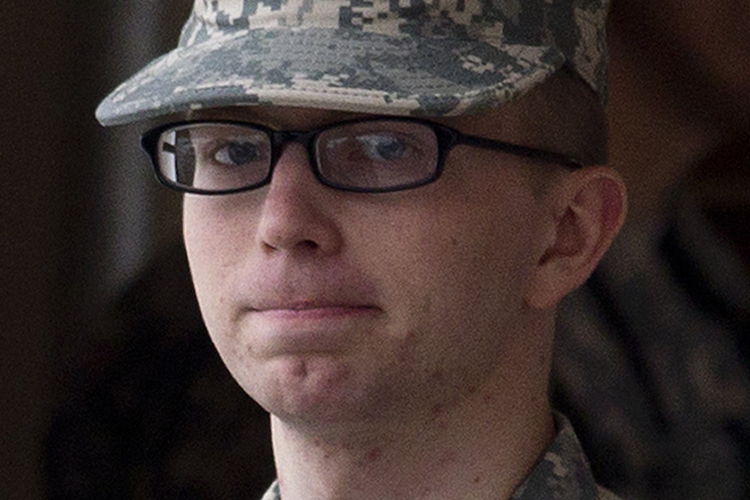

Bradley Manning
How Bradley Manning’s fate will be decided
The soldier accused of giving files to WikiLeaks will likely face a court-martial -- we explain how it works
Army Pfc. Bradley Manning is escorted by military police from the courthouse after the sixth day of his Article 32 hearing at Fort Meade, Maryland, December 21, 2011. (Credit: Benjamin Myers / Reuters) This week, Bradley Manning came one step closer to being tried for allegedly leaking a trove of secret American cables to WikiLeaks when a military officer made the formal recommendation that Manning should face a court-martial on 22 criminal charges.
One of the counts, aiding the enemy, carries the possibility of the death penalty, but prosecutors have already said they will not seek it in Manning’s case.
The recommendation this week was made to Maj. Gen. Michael Linnington, commander of the Military District of Washington, who is what is known as the convening authority in the case. The military justice system has important differences from the civilian system, so I spoke to Eugene R. Fidell, who teaches military justice at Yale Law School, to explain the basics.
We’ve now had the investigating officer as well as another officer this week recommend a court-martial to the Military District of Washington commander. What’s the next step?
A convening authority, which is a general officer, will decide whether to refer the case to a court-martial. There’s no designated time frame for this, but I think it will be in the next couple of weeks. A court-martial is a military criminal court that will have serious punishment powers. There will be a military judge presiding over it, who is a uniformed lawyer. There’s a prosecutor. There’s defense counsel. Unless Manning waives the jury, there will be a jury of at least five people.
Who makes up the jury?
The jury is selected by the convening authority. It’s not random selection. The general will select the members; it’s supposed to be a blue ribbon group. They are supposed to be the best qualified people with respect to education, experience, judicial temperament and so on. Because Manning is an enlisted man, he has a right to enlisted representation on the court. That means that at least one-third of the jury would have to be enlisted men or women.
In the civilian trial setting, there’s usually a lot of argument over who sits on the jury. How does that work in a court-martial?
The same thing happens. There’s an opportunity for the lawyers on both sides to question the jurors — who are actually called “members” in a court-martial — to determine whether they are capable of acting impartially. Each side has a right to challenge a member not only for cause, but also peremptorily, in other words for no reason.
To convict a defendant in a non-capital case requires only a two-thirds vote of the members. How the vote breaks down depends on how many members there are. The minimum is five, but there’s something called the numbers game that the lawyers on both sides are aware of. That is, that you want to use your right to challenge a member in order to manipulate the size of the court to maximize the chances of either conviction or acquittal, depending on your perspective. The number slightly tweaks the percentage. Two-thirds of five members is four, meaning the government would need 80 percent to convict. Two-thirds of six members is also four, which means the government would need only 66 percent to convict.
What about the judge — how is he or she different than a judge in a civilian case?
Once the case is referred to a court-martial, and a judge is assigned, the convening authority’s power becomes subject to review, and a judge sort of takes charge of the case. Until that happens — until the case is referred to trial — the convening authority really rules the roost.
The big difference as compared to a civilian federal judge is that a military judge doesn’t have life tenure. The judge in an Army court-martial is guaranteed tenure for only three years, which in my opinion is inadequate. Individually the judges may be perfectly independent, but in terms of the structural protections, the U.S. system is highly deficient in this area.
So the concern is that these judges might be worried about their later career and that affects how they hear cases?
Yeah, that’s the theory. Three years is shorter than any comparable criminal court in this country.
Turning to the trial itself, are the rules different than in a civilian court?
No, the rules are essentially the same as a federal district court. The rules of evidence are a virtual carbon copy, the rules of how people conduct themselves, and so on. Courts-martial are also open to the public, except to the extent that classified information is involved. Even then, only the bare minimum needed to protect the information is closed to the public.
If Manning is ultimately found guilty, how does the sentencing work?
If there is a jury, the jury will do sentencing. Remember, he can waive the jury. But he can’t waive only on sentencing; he would have to waive it on guilt-or-innocence and sentencing together. If he waives the jury, the judge will decide both guilt or innocence and determine the sentence. If Manning goes with a jury, the sentence is determined by the jury. And anything in excess of 10 years has to be decided by a three-fourths vote. If it were a capital case — which it’s not — there would have to be 12 members of the jury and they would have to be unanimous.
What about appeals — can he appeal if he is found guilty?
The first level of review after a case is tried and there is a sentence is to the convening authority. He or she can disapprove the conviction, can cut the sentence and so forth. He or she can overturn the result of the trial. After the convening authority acts, it goes automatically to the Army Court of Criminal Appeals, which is made up of military officers who sit in northern Virginia. There are lawyers on both sides, and briefs are filed, and there may be oral argument. Then they will issue a decision. From there, assuming the case is affirmed, Manning would have the right to petition for discretionary review by the U.S. Court of Appeals for the Armed Forces. That’s a civilian court of five judges who sit in Washington, D.C., with proceedings open to the public. If they granted review, there would be an oral argument, and the case would result in a decision. If that court grants review, then the case becomes eligible for review by the Supreme Court. The Supreme Court can refuse to hear it, but at least Manning would have the right to ask the Supreme Court for review.
Justin Elliott is a reporter for ProPublica. You can follow him on Twitter @ElliottJustin More Justin Elliott.
Doubling down on 9/11
A decade after the attacks, our national security regime continues to grow ever more punitive and secretive
Army Pfc. Bradley Manning (Credit: AP Photo/Cliff Owen) By now, you’d think we’d be entering the end of the 9/11 era. One war over in the Greater Middle East, another hurtling disastrously to its end, and the threat of al-Qaida so diminished that it should hardly move the needle on the national worry meter. You might think, in fact, that the moment had arrived to turn the American gaze back to first principles: the Constitution and its protections of rights and liberties.
Yet warning signs abound that 2012 will be another year in which, in the name of national security, those rights and liberties are only further Guantanamo-ized and abridged. Most notably, for example, despite the fact that genuinely dangerous enemies continue to exist abroad, there is now a new enemy in our sights: namely, American oppositional types and whistleblowers who are charged as little short of traitors for revealing the workings of our government to journalists and others.
Continue Reading CloseKaren J. Greenberg is the director of the Center on National Security at Fordham University Law School and author of "The Least Worst Place: Guantanamo's First 100 Days." More Karen Greenberg.
Obama’s unprecedented war on whistleblowers
From Manning to Kiriakou, critics are aggressively targeted as the White House turns a blind eye to abuses
Former CIA officer John Kiriakou and Bradley Manning (Credit: AP) On January 23rd, the Obama administration charged former CIA officer John Kiriakou under the Espionage Act for disclosing classified information to journalists about the waterboarding of al-Qaida suspects. His is just the latest prosecution in an unprecedented assault on government whistleblowers and leakers of every sort.
Kiriakou’s plight will clearly be but one more battle in a broader war to ensure that government actions and sunshine policies don’t go together. By now, there can be little doubt that government retaliation against whistleblowers is not an isolated event, nor even an agency-by-agency practice. The number of cases in play suggests an organized strategy to deprive Americans of knowledge of the more disreputable things that their government does. How it plays out in court and elsewhere will significantly affect our democracy.
Continue Reading ClosePeter Van Buren spent a year in Iraq as a State Department Foreign Service Officer serving as Team Leader for two Provincial Reconstruction Teams (PRTs). Now in Washington, he writes about Iraq and the Middle East at his blog, We Meant Well. His book, We Meant Well: How I Helped Lose the Battle for the Hearts and Minds of the Iraqi People (The American Empire Project, Metropolitan Books), will be published this September. More Peter Van Buren.
Manning, Washington’s favorite scapegoat
The only civilian casualties D.C.'s warmongers ever talk about are the hypothetical ones "caused" by WikiLeaks
Army Pfc. Bradley Manning is escorted from a security vehicle to a courthouse in Fort Meade, Md., Monday, Dec. 19, 2011, for a military hearing (Credit: AP/Patrick Semansky) Who in their right mind wants to talk about, think about or read a short essay about… civilian war casualties? What a bummer, this topic, especially since our Afghan Iraq and other ongoing wars were advertised as uplifting acts of philanthropy: wars to spread security, freedom, democracy, human rights, gender equality, the rule of law, etc.
A couple hundred thousand dead civilians have a way of making such noble ideals seem like dollar-store tinsel. And so, throughout our decade-long foreign policy debacle in the Greater Middle East, we in the U.S. have generally agreed that no one shall commit the gaucherie of dwelling on (and “dwelling on” = fleetingly mentioned) civilian casualties. Washington elites may squabble over some things, but as for foreigners killed by our numerous wars, our Beltway crew adheres to a sullen code of omertà.
Continue Reading CloseChase Madar, is a lawyer in New York, a contributor to the London Review of Books and Le Monde diplomatique and the author of a new book, The Passion of Bradley Manning (OR Books). More Chase Madar.
The Army is reading your Bradley Manning tweets
Military public affairs officials in WikiLeaks case use software that specializes in tracking Twitter
A sketch of Private Bradley Manning during his Army Article 32 hearing. (Credit: Reuters) (UPDATED BELOW)
Politico’s Josh Gerstein reports on the extent to which the Army’s public affairs office is interested in public and media opinion of the Bradley Manning case, noting that P.R. staffers prepared daily summaries of the coverage of the ongoing legal proceedings. This bit jumped out at me:
Continue Reading CloseThe Army used a commercial service called VOCUS to track traditional and social media coverage of Manning’s hearing. The Pentagon pays close attention to the volume of tweets about the U.S. military during high-profile incidents, like the Air Force One flyover that distressed New York City residents in 2009 …
Justin Elliott is a reporter for ProPublica. You can follow him on Twitter @ElliottJustin More Justin Elliott.
Manning is charged with aiding terrorists
Pre-trial hearing for the WikiLeaks suspect reveals the government's prosecution strategy
Army Pfc. Bradley Manning on trial(Credit: AP/Patrick Semansky) The pre-trial hearing for Pfc. Bradley Manning, accused of releasing classified information to WikiLeaks, concluded with the government revealing in its closing argument for the first time the enemy, which they believe Manning’s actions aided: the terrorists.
Calling what Manning did a “six month-long enterprise of indiscriminately harvesting information,” Capt. Ashden Fein stated in the prosecution’s closing argument that Manning had actual knowledge that what he gave to WikiLeaks would end up in the hands of the enemy and that enemy was Al Qaeda, Al Qaeda in the Arabian Peninsula (AQAP) and similar enemies.
Continue Reading CloseKevin Gosztola is a civil liberties blogger for Firedoglake More Kevin Gosztola.
Page 1 of 2 in Bradley Manning