Bridesmaids

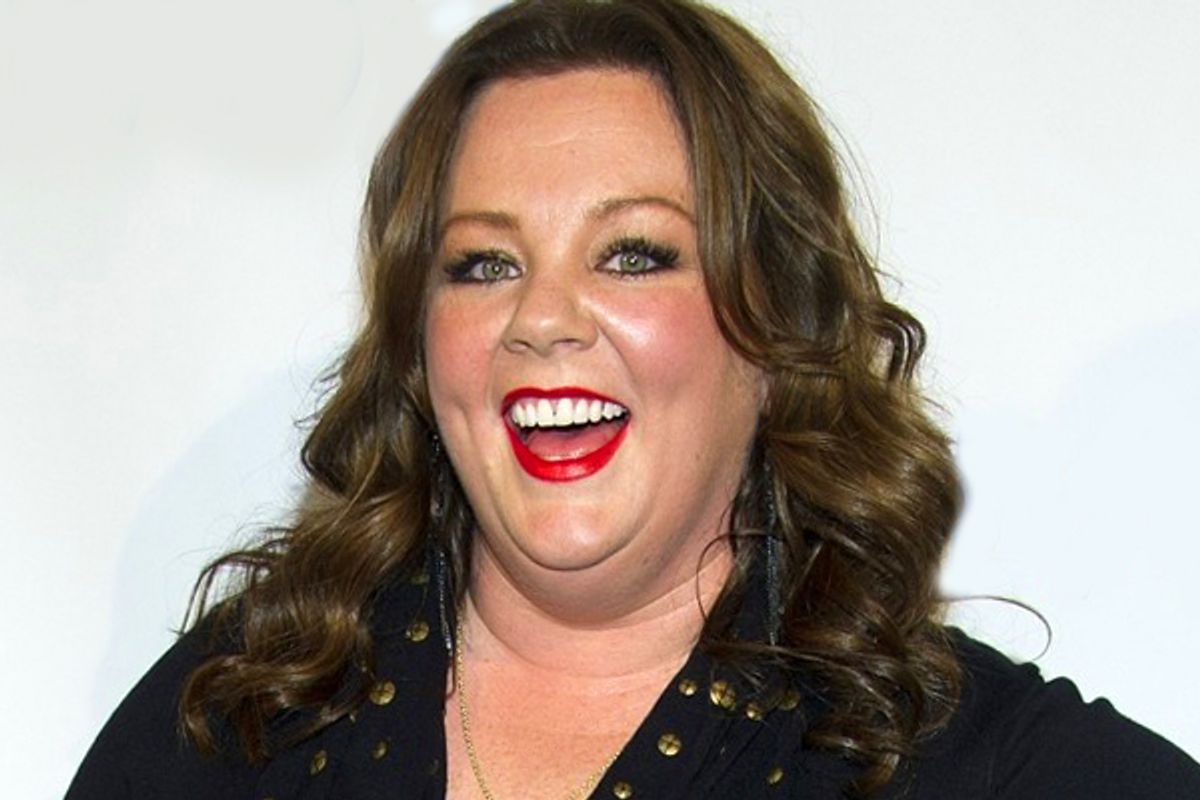
Melissa McCarthy’s great big win

The "Bridesmaids" star and best supporting actress nominee proves success doesn't always come in a size zero

  • more
    • All Share Services

Melissa McCarthy's great big winMelissa McCarthy (Credit: AP)

Melissa McCarthy doesn’t get small parts. She stars in a sitcom about characters who met at Overeater’s Anonymous. She does “Saturday Night Live” sketches that involve guzzling bottles of ranch dressing. As a result, she has faced her share of cruelty and stereotyping – most notably in 2010, when Marie Claire blogger Maura Kelly wrote a piece on “Mike and Molly” and declared herself “grossed out,” not just by the idea of “fatties” kissing, but frankly by them “doing anything” at all.

But along the taunt-strewn way, audiences and critics began to take serious notice of a very funny actress. When “Bridesmaids” became a massive hit last spring, its success was fueled in no small part by McCarthy’s fearlessly brash performance. (Once you know that McCarthy based her character on Guy Fieri, the entire thing gets that much more fantastic.) It wasn’t just the ferocious comic energy that McCarthy put into using a sandwich as a sex prop or defecating into a sink that made her so instantly indelible. It was the way she gave Megan such a convincing heart. In a sea of poop jokes, she emerged as the most real character in the whole movie, the one you’d want in your own entourage.

And just as the long, golden popcorn days of “Bridesmaids” began to fade and her ride at the top seemed close to an end, McCarthy bested a posse of multiple-award winners — Laura Linney, Amy Poehler, Tina Fey, Edie Falco and Martha Plimpton — to win the Emmy for best actress in a comedy. Strutting onstage with the jokey props of a tiara and bouquet, she gushed with the unguarded enthusiasm of a true beauty queen. “I’m from Plainfield, Ill., and I’m standing here and it’s kind of amazing,” she said tearily, before threatening to “carry around” her colleagues later in the evening. By fall, she was hosting “SNL” and gracing the cover of Entertainment Weekly, crowned yet again as the new “Queen of Comedy.”

So McCarthy’s latest coronation as a best supporting actress nominee should come as no great surprise. Yet that in no way detracts from the awesomeness of it. It’s a victory in a movie industry – and an awards system in particular – that is still dominated by a very specific physical type. The skinny kind. Though Gabourey Sidibe came close two years ago for “Precious,” you’d have to go all the way back to Kathy Bates in 1990 to find an Oscar-winning best actress who might ever have darkened the door of a Lane Bryant. In McCarthy’s category, there have been a handful of plus-size winners of late, including “Precious” costar Mo’Nique just two years ago. But though Jennifer Hudson was known for her big voice and frame when she collected her Oscar for playing the generously proportioned Effie in “Dreamgirls,” she’s since slimmed down enough to become a Weight Watchers spokeswoman.

It’s not that the award bestowers don’t love a big lady, or what passes for a big lady in Hollywood. It’s that they just don’t pay much mind to the authentic kind. Ten years ago, Renee Zellweger gained 30 pounds – and still looked like a pretty average-looking woman – on her way to an Oscar nomination for “Bridget Jones’s Diary.” A few years later, former model Charlize Theron bulked up and won the little golden man when she played serial killer Aileen Wournos in “Monster.” It’s not just the women, by the way; George Clooney added heft for “Syriana” and walked home a winner.

Looking at this year’s nominees, the disconnect between the larger-size characters they play and their considerably smaller real-life size is hard to ignore. This year’s single husky male nominee, Jonah Hill, has undergone a dramatic weight loss. Viola Davis packed on 25 pounds for her role in “The Help” – and still needed padding. Her costar and fellow nominee Jessica Chastain put on a mere 15 pounds, a feat she later complained was “a form of torture.” McCarthy, in contrast, seems remarkably untormented. Yes, she admits there are times she would “love” for someone to think she looks a tad “emaciated,” but as she declared in 2011, “I think the things that define me… are a lot more than those kinds of petty things.”

A person’s exterior is at once a “petty” thing and a primary one. It affects how the world treats her and how she chooses to respond in kind. And that McCarthy can be an Emmy-winning, Oscar-nominated, magazine cover-gracing, full-blown star without shrinking down to Keira Knightley proportions represents a consciousness shift not just in the culture at large, but in a business that associates success with being built like Jennifer Aniston. The nomination of McCarthy suggests that maybe the movies are finally acknowledging that human beings come in different sizes. (The fact that Rebel Wilson gets to be the bride in the forthcoming “Bachelorette” is an encouraging sign.) And though we’ll have to wait until Feb. 26 to learn if Melissa McCarthy will take home an Academy Award, her uncompromising rise to A-list status already makes her not just a winner, but, beautifully, a big one.

Mary Elizabeth Williams

Mary Elizabeth Williams is a staff writer for Salon and the author of "Gimme Shelter: My Three Years Searching for the American Dream." Follow her on Twitter: @embeedub.

The Oscars play it safe, nostalgic

Hollywood applauds itself -- but ignores great turns in edgy films like "Melancholia," "Take Shelter" and "Shame"

  • more
    • All Share Services

The Oscars play it safe, nostalgicJean Dujardin and Uggie in "The Artist"

As usual, it all went almost exactly as expected. This year’s Academy Award nominations went to a plethora of already much-accoladed movies and performances, with a rich dose of nostalgia and sentiment. Yet when Academy of Motion Picture Arts and Sciences president Tom Sherak and last year’s best actress nominee Jennifer Lawrence announced the contenders this morning, there were still a few gasps to be had.

The surprises started with the supporting performance nominations. Kenneth Branagh, Jonah Hill and Christopher Plummer (“Beginners”) all seemed likely nominees. But it was the sentimental inclusion of “Extremely Loud and Incredibly Close’s” Max Von Sydow, and left-field nod for Nick Nolte in “Warrior” that roused the crowd.

For the supporting actresses, there were even fewer surprises to be had, with the likes of Bérénice Bejo and Octavia Spencer once again going head-to-head. But the inclusion of this year’s comedic It girl, Emmy winner Melissa McCarthy, for her bawdy, ballsy turn in “Bridesmaids” was a nonetheless sweet moment – and a rare display of evidence that you don’t have to be a glamazon or Dame Judi Dench to be in the running for Oscar. And the best original screenplay nomination for “Bridesmaids” was another encouraging sign, proving at last that women can not only make successful movies involving explosive diarrhea, they can make Academy Award-nominated movies involving explosive diarrhea.

The biggest surprise of the morning might have been the best actor nominations for “A Better Life’s” Demian Bichir and “Tinker Tailor Soldier Spy’s” Gary Oldman — and with them, the shutouts of “Shame’s” Michael Fassbinder and “J. Edgar’s” Leonardo DiCaprio. Or it might have been the best picture nomination for “Extremely Loud and Incredibly Close,” a film that was neither a box office home run nor a critical one — our Andrew O’Hehir called it “unconvincing Hollywood mush” — but happened to feature beloved, Oscar-winning stars Tom Hanks and Sandra Bullock.

What didn’t make the cut this year? Alan Rickman’s heartbreaking swan song as Snape in “Harry Potter and the Deathly Hallows: Part 2.” Albert Brooks’ shockingly malevolent turn in “Drive.” Joseph Gordon-Levitt’s fierce, unsentimental cancer patient in “50/50.” Ellen Barkin’s nightmarish mother in “Another Happy Day.” Olivia Colman’s abused wife in “Tyrannosaur.” Charlize Theron’s overbearing novelist in “Young Adult.” The brilliant end-of-the-world duo of Michael Shannon’s enigmatic father in “Take Shelter” and Kirsten Dunst’s depressed bride in “Melancholia.” And with them, their ignored films.

In the second year of the wider best picture category — and after a few years of some truly bold, innovative movies getting Oscar recognition (“Slumdog Millionaire,” “The Hurt Locker,” “District 9,” “Black Swan,” “Inception”) — the 2011 contenders seem more like a big fuzzy blanket of sweetness and nostalgia. “Hugo,” “The Artist” and “Midnight In Paris” are all, literally, about men stuck in the creative past. They’re all lovely movies. The word we keep hearing is “homages.” But when the most transgressive things on nomination day are a nod for the dude from “Superbad” and a best song nomination for one of the “Flight of the Conchords” guys, it’s a great year for the Oscars, all right. As long as that year is 1925.

Continue Reading Close
Mary Elizabeth Williams

Mary Elizabeth Williams is a staff writer for Salon and the author of "Gimme Shelter: My Three Years Searching for the American Dream." Follow her on Twitter: @embeedub.

Early signs of a “Bridesmaids” bump

A veteran producer sees not just success for Kristen Wiig's blockbuster, but signs of a lasting legacy

  • more
    • All Share Services

Early signs of a Kristin Wiig in "Bridesmaids" and Viola Davis in "The Help"

Last week, the summer’s surprise blockbuster, “Bridesmaids,” was released on DVD, after a spectacular run both in the United States and abroad. The fortunes of the film, which starred a brace of funny women and dealt equally in fart jokes and friendship, were regarded as crucial to the future of women in entertainment.

Hollywood, perpetually on the verge of never making another movie for anyone but teenage boys, was in need of a slap in the face, reminding it that women buy tickets, fill theaters, tell friends they loved it — and know men who are occasionally eager to see the opposite sex portrayed compellingly on celluloid. “Bridesmaids” delivered a wallop, bringing in more than $280 million worldwide, and drawing an audience reported to be a third male, and largely over 30.

But has it actually whetted the film business’s appetite for more female-driven projects? Salon called Lynda Obst, producer of movies like “Sleepless in Seattle,” “Contact” and “How to Lose a Guy in Ten Days,” the television show “Hot in Cleveland,” the author of “Hello, He Lied” and all-around movie sage, to see what, if anything, has changed in her town this summer.

Did the success of “Bridesmaids” make a difference to your business?

Yes. It had the biggest impact of any women’s movie that I can remember in my career.

In your whole career, which began with “Flashdance” in 1983?

Yeah. It came at a moment when any movies for women, women’s comedies — forget dramas, there are no dramas for anybody — but women’s comedies, women’s thrillers were going to get put by the wayside forever. Women’s projects were dying everywhere. That’s why the opening of “Bridesmaids” was so critical for every woman in features, why its success was attended with such profound interest by every woman writer, producer and director in town.

The second important factor was that there were no stars in the movie and it wasn’t tracking in advance.

And that matters because it means that it was the material, not a movie star, that drew people to theaters?

Yes. Its success wasn’t automatic. A star opens a movie. Sandra Bullock opens a movie. But there was nobody in this movie who had ever been in a movie before, so it’s the hardest kind of movie to open.

It means that its success was due to the fact that people enjoyed it, and gave it good word of mouth once the movie started screening. Which leads us to the gigantic thing, which was the revelation that women can open a movie, and also, that this [women's movie] crossed over. Men came. It drew women of all ages and it drew guys and was a major hit. And not just domestically, which is part two of this gigantic thing, because the movie business right now is being driven by international box office.

Comedy doesn’t usually travel well. Movies that travel are movies with very little dialogue, usually dependent on action or family content or big international stars. But “Bridesmaids” did very well internationally. The concept was easy to understand in all languages. It gave us a clue as to what movies will work internationally with women in them. So what we learned is: Broad comedies will sell abroad, even with broads.

What are the immediate effects of this?

There are suddenly projects for women! I’m pitching one right now that is a female-based comedy and people are really responsive to it. And then my directing debut, which was dead in the water at New Line, went from having no momentum to having momentum, the weekend right after “Bridesmaids” opened. “Bridesmaids” meant that the idea of being able to make a movie about women was resuscitated.

Well, for now. What if the next female comedy flops?

If the next one flops, who knows? Two action movies flop and it means nothing; one women’s movie flops and it’s the end. But “Bridesmaids” was followed immediately by the success of “The Help,” which was terrific because that was driven by women too.

So what we’re finding in the American market is that younger male eyeballs are disappearing in large numbers, going to video games, going to the Internet. But women are going to the movies, if you make movies for them.

Now, does this mean we will stop making movies for the younger male quadrant? No, because the young male quadrant likes the same movies as international audiences — action movies, man movies.

Man movies?

“Ironman,” “Spider-Man,” “Batman.” Man movies.

Are studios pursuing women’s projects or are people just feeling like they can pitch them again?

I think the latter. But I think studios were suddenly receptive to them.

This is not the first time in recent memory that a woman’s movie has done well and studios have failed to notice in any permanent way. “The Devil Wears Prada,” your movie “How to Lose a Guy in Ten Days,” “Sex and the City” have all been big women-driven hits, and yet women’s movies were on the brink of extinction.

Studios have institutionally short memories when it comes to women’s movies. “Sex and the City II” did better internationally than it did domestically, which would have made you think that they would have noticed it. I mean, that’s what inclines Fox to make “Ice Ages”; sequels do so well internationally. But studios don’t seem to generalize by the same rules in women’s movies as they do for other movies.

Every time a woman’s movie does well, it’s a brand-new fact. Every time we rediscover the female audience, it’s astonishing.

So it’s possible that despite “Bridesmaids’” success, four years from now you and I will be having the same conversation about the death of women’s comedy?

Yes.

That’s depressing. But back to the success of “Bridesmaids.” There was a certain amount of social awareness around going to the movie. Because of the press it got, women seemed to be aware that going to see the movie was not just about enjoying it, but about sending a message to Hollywood. Do you think that had an impact on its box office?

Well, I know there was tremendous awareness in Los Angeles that we had to open this movie. I believe it happened in New York too, but I don’t know that that happened nationally.

What happened nationally was that there was a hunger for something for women to relate to, because there’s usually nothing out there for them. It’s what happens with an urban audience with Tyler Perry.

I had a sense from friends in other cities that they were going with their girlfriends and that they knew it was made for them.  It’s so rare that there’s a movie made for them. It generated such excitement.

You would think that that excitement alone would send a message that there is an eager audience out there for material about women.

Well, I think you can see a lot of that reaction on television. It is the year of women on television. Television is much more female-friendly than Hollywood. There are a tremendous number of female executives, and when they see something like “Bridesmaids,” it’s much easier to react fast to it, and there’s less institutional resistance. They love the zeitgeist.

But timing-wise, this season of television was already a done deal before “Bridesmaids” opened, so it can’t have been a reaction, can it?

Well, the [final] decisions about this current fall season were made at the upfronts, which roughly coincided [Editor's note: actually, directly coincided in mid-May] with the opening of “Bridesmaids,” so there actually could have been a connection.

But also, I have just been through the next season of creative development and let me tell you it’s just as female-friendly as the one that’s on air now. There are shows about women and girlfriends and not just couples. There is television about women, for women. Real women.

Continue Reading Close
Rebecca Traister

Rebecca Traister writes for Salon. She is the author of "Big Girls Don't Cry: The Election that Changed Everything for American Women" (Free Press). Follow @rtraister on Twitter.

Wiig rides “Bridesmaids” success into new role

The hero of 2011's female comedy hit scores a new triumph. Does this mean the "'Bridesmaids' effect" is real?

  • more
    • All Share Services

Wiig rides Wiig in "Bridesmaids."

According to Variety, “Bridesmaids” star and co-writer Kristen Wiig will begin filming “Imogene” — a “passion project” she’s been hoping to get off the ground for “more than two years” — in August. The film will mark Wiig’s first starring role since her major May hit, which smashed records by becoming both Judd Apatow’s best-performing film and the biggest-ever female-led, R-rated comedy.

Of “Imogene,” Variety writes:

Wiig will star as the title character, a moderately successful New York playwright who stages a fake suicide attempt to win back her ex-boyfriend, only to end up being forced into the custody of her gambling-addict mother. 

While Wiig certainly seems to be enjoying the spoils of her spring triumph, debate over whether the success of “Bridesmaids” will truly open doors for women in Hollywood is ongoing. Several of the wedding-themed movie’s stars have landed exciting deals since the film’s release, but the question of whether other women — not to mention projects that don’t boast the backing of big dogs like Judd Apatow — will truly find Hollywood more accommodating is largely unanswered.

“One never wants to be too reactive, but there are few door-openers like a box-office winner.” That’s what David T. Friendly — who produced “Little Miss Sunshine” — wrote in The Hollywood Reporter last month, in a piece about the so-called “‘Bridesmaids’ effect.”

Friendly continued:

[G]etting female-driven comedies to the big screen has been as hard as selling Disney an X-rated movie. And one has to wonder how many will get made without a champion like Bridesmaids’ Judd Apatow behind them. Sometimes edgy, female-driven material that winds up on the coveted Black List (or whatever list is in vogue at the time) is highly regarded but simply too uncertain a bet for the studios. Usually the pass would have sounded something like this: “It’s hilarious; I was cracking up. But I can’t get that made here. No one wants to see women do that!” … [However, i]f the Bridesmaids Effect really takes hold, imagine the possibilities.

Here on Salon, we recently interviewed Women and Hollywood blogger Melissa Silverstein (who was one of several women to make an early campaign out of getting people to theaters to support “Bridesmaids”). Silverstein said she was hopeful that the film might live up to its expectations, and trigger a serious industry sea-change — but also sanguine about the challenges female Hollywood stars still face:

The success of ‘Bridesmaids’ has clearly inspired Hollywood to think about funny women in a new way … [But] we have been in the desert for so long that we don’t even know what the promised land looks like. Women have been so beaten down that they are happy with one success and are looking to build from there. … If women could figure out how to band together and make more films a success, maybe the promised land will be in view sooner rather than later.

Continue Reading Close

Emma Mustich is a Salon contributor. Follow her on Twitter: @emustich.

“Bridesmaids” saves the chick flick. Now what?

As the comedy becomes Judd Apatow's top-grossing film, we talk to the writer who first rallied women to the theater

  • more
    • All Share Services

Since its opening in mid-May, Kristen Wiig’s “Bridesmaids” has gone from “social responsibility” — a film that female fans flocked to see, not only for its entertainment value, but also on principle — to box office triumph. Last week, it became Judd Apatow’s highest-grossing film ever, and now it’s surpassed “Sex and the City 2″ to become the biggest female-led R-rated comedy in cinema history (though “Bridesmaids” won the critical competition long ago, its more-than-respectable Metacritic score of 75 putting “Sex and the City 2′s” measly 27 to shame).

In an interview with Movieline published Tuesday, Paul Feig, the film’s director, said he thinks “comedy has changed in the last five years,” citing the rise of behavioral humor — and the simultaneous descent of the “joke”– as a stimulus for his film’s success. Asked whether he might consider making a “Bridesmaids” sequel, he said he’d be “very open” to the possibility — as long as the material was strong enough. (Feig has spoken out elsewhere about his “mission” to help direct the spotlight toward “funny women.”)

But what does the success of this film mean for women’s comedy in broader terms? Will it be easier for female-driven films to find support in Hollywood — and perform well at the box office — going forward? We emailed Women and Hollywood‘s Melissa Silverstein — whose early writing about “Bridesmaids” helped spur female audiences to support the film — to ask what she thinks.

“The success of ‘Bridesmaids’ has clearly inspired Hollywood to think about funny women in a new way,” Silverstein tells us. “It’s like a lock has been taken off the cabinet, and people are realizing that women can write, they can be funny, they can lead a film and that there is a market for female-led projects. Women producers, writers and directors and others have been beating their heads against a wall trying to get women’s films made, yet it took this film produced and directed by men to make Hollywood realize this fact … Hollywood is so brutal on women that the success of ‘Bridesmaids’ will need to be replicated continually or else women will be back in the dog house.

“I don’t think we would be having the same conversation about the film if it had not been produced by Judd Apatow and directed by Paul Feig,” she adds. “There was no big outcry for more female-led PG-13 musicals following the huge success of ‘Mamma Mia.’ That movie is not too far behind ‘Bridesmaids’ with a domestic gross of $144 million.

“But Judd Apatow is part of the club, and he is a golden boy, and they took a chance on this film because he wanted to produce it.”

Silverstein goes on to say that Feig is “the one standing up for the women and for reiterating that Hollywood should make more movies about women” — and that she admires him for it.

When I mention a particular line from a blog post she wrote on May 13 — “It’s fucked up that one FUNNY film has been put in this place where it could potentially lead women out of the desert into the promised land” — and ask what she thinks that “promised land” might actually resemble (and whether “Bridesmaids” has helped us reach it), Silverstein replies: “We have been in the desert for so long that we don’t even know what the promised land looks like. Women have been so beaten down that they are happy with one success and are looking to build from there. That’s why it was so interesting to see all the women working in Hollywood encouraging people to see ‘Bridesmaids.’ They wanted it to be a success because they knew that it could help them. That’s the point for me. If women could figure out how to band together and make more films a success, maybe the promised land will be in view sooner rather than later.”

Continue Reading Close

Emma Mustich is a Salon contributor. Follow her on Twitter: @emustich.

Why “Wonder Woman” can’t get off the ground

NBC passes on David E. Kelley's new take on the action heroine -- but don't worry, it's not the death of feminism

  • more
    • All Share Services

Why Adrianne Palicki as Wonder Woman

Just because the world may be ready to accept women as the stars of their own gross-out comedies doesn’t mean it’s gung ho to embrace them as superheroes. On Thursday, after years of back and forth speculation and months of hype, NBC officially nixed the David E. Kelley/ Warner Bros. TV reboot of “Wonder Woman.”

The project, like any reinvention of a beloved franchise, was plagued with skepticism from the start. Just imagine a legion of Comic Book Guys registering their disgust — and I include myself in that group  — and you get the picture. David E. Kelley? What could the man who gave us waifish hot mess Ally McBeal know of an Amazon princess? What could the miniskirt enthusiast understand of a superhero who quite literally wears the pants? The answer, apparently, is not a whole lot.

The Kelley-penned script, which reimagined Wonder Woman’s alter ego Diana Prince as a corporate executive, became a big-budget pilot earlier this year, and by that stage the series looked to be all but a sure thing. But while Kelley and company have been trying ever since to drum up Internet slavering with some seriously jugs-flaunting images of the titular heroine (“Friday Night Lights” star Adrianne Palicki) in all her heaving glory, the show’s pilot apparently failed to arouse interest within network suits.

In an interview with Vulture back in March, Kelley — whose new legal drama “Harry’s Law” NBC just picked up for a second season — said that, like just about everybody else in the world, he had doubts about his suitability for the project. “It’s not really what I do,” he said. “It’s not a genre that’s in my wheelhouse.” Eventually, though, intrigued by the dramatic possibilities of Wonder Woman’s likely “sense of social isolation … all the complications and potential layers to this superhero,” he put together a script — one interesting enough for Warner Bros. and DC to get behind.

So what went wrong, so late in the game? And let’s just get down to the inevitable question: In how many terrible ways has David Kelley once again killed feminism?

When a female-driven project flames out, it’s a given that it will raise concerns about the viability of similar efforts. Look no further than the high stakes surrounding Kristen Wiig’s “Bridesmaids” — a movie that even before its release was touted not just a summery laugh fest but also a litmus test for Hollywood’s capacity for feminism. In a man’s world, each heroine somehow becomes every heroine, a test balloon by which all future development deals are judged. Yet if “Bridesmaids” is the smash it’s shaping up to be, it won’t be because it’s a chick flick – it’ll be because it’s a really terrific piece of entertainment. Which is as it should be.

In a world full of successful men of the Spider, Super, Bat and Iron variety, there is something sad about the failure to launch just one butt-kicking woman. But just as the presence of a top-billed female in a script shouldn’t be an instant kiss of death, it likewise doesn’t automatically make the whole shebang a worthy endeavor either. Did NBC give a pass to “Wonder Woman” because of that tricky-to-sell second word of the title? Or did the network brass simply remember “The Cape”? (Making them, by the way, the only people in America who do.) 

The early and mostly negative buzz regarding “Wonder Woman” speaks far more to a network’s justifiable skittishness about bankrolling a potential bomb than it does to the sorry state of women in leading roles. The fact that the world badly needs more female protagonists doesn’t mean it needs more David E. Kelley-style ones. All the cleavage in the world can’t save an ill-conceived dream.

Lest you think NBC is putting the kibosh on all tough-girl reboots, this week it gave the green light to a new drama revolving around one of popular entertainment’s greatest socially isolated, complicated, layered crime busters ever. In her new series, Maria Bello will not be wearing sparkly bracelets or zipping around in a transparent airplane this fall. But as the brilliantly fierce Inspector Jane Tennison of a new imagining of “Prime Suspect,” she might yet prove, like Wiig and her “Bridesmaids,” that America’s ready for more female heroes. And they don’t need to be super. They just have to be great.

Continue Reading Close
Mary Elizabeth Williams

Mary Elizabeth Williams is a staff writer for Salon and the author of "Gimme Shelter: My Three Years Searching for the American Dream." Follow her on Twitter: @embeedub.

Page 1 of 2 in Bridesmaids