The human rights “success” in Libya
As was true in Iraq, those who prematurely claim success cause the war's aftermath - the key part - to be neglected
By Glenn GreenwaldTopics: Politics News
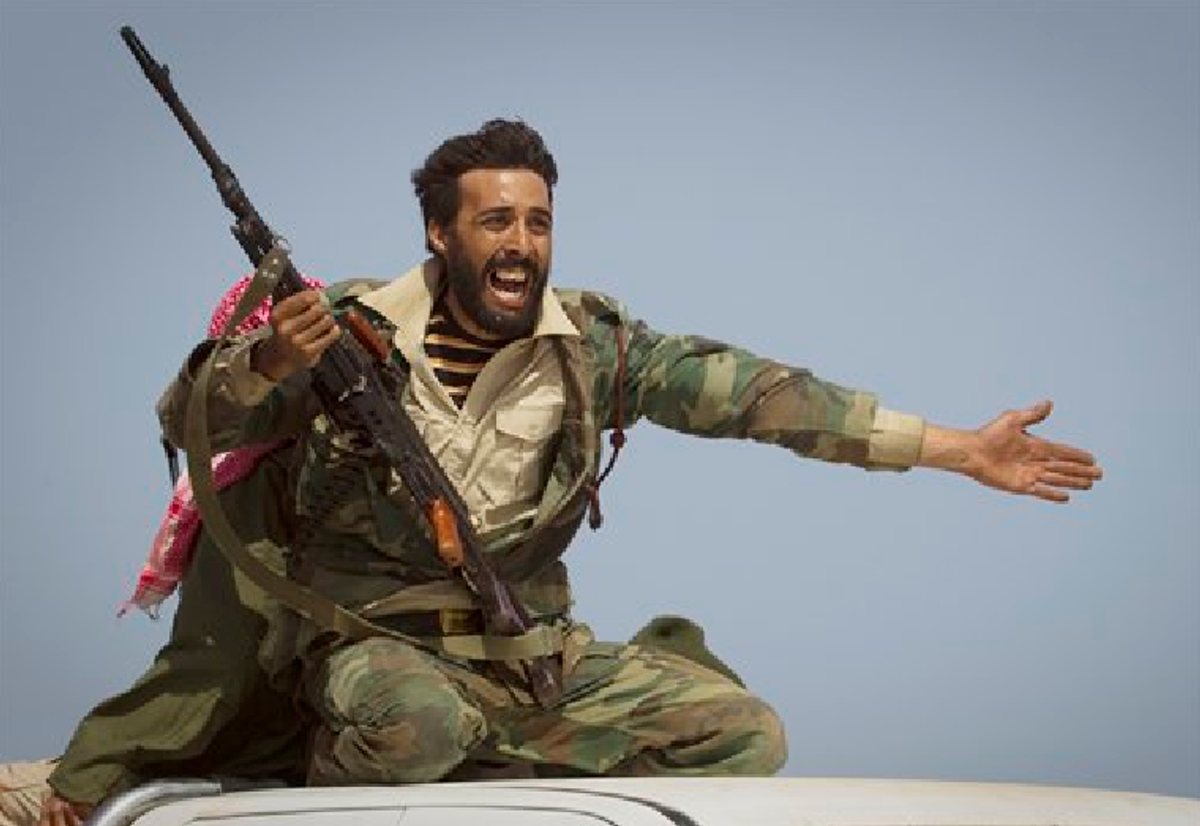
In this March 29, 2011 file photo, a Libyan rebel urges people to leave, as shelling from Gadhafi's forces started landing on the frontline outside of Bin Jawaad, 150 km east of Sirte, central Libya. (AP Photo/Anja Niedringhaus, File) It quickly became ossified conventional wisdom that NATO’s war in Libya to aid rebel factions in overthrowing Moammar Gaddafi was a clear human rights victory. But the reality in post-Gaddafi Libya has long been in tension with that claim, and that’s true today more so than ever:
Doctors Without Borders is halting work in detention centers in the Libyan city of Misrata because detainees are “tortured and denied urgent medical care,” the international aid agency said Thursday.
The agency known by its French acronym MSF said it has treated 115 people with torture-related wounds from interrogation sessions.
Some of the patients treated were tortured again after they were returned to detention centers, according to the agency.
“Some officials have sought to exploit and obstruct MSF’s medical work,” said Christopher Stokes, the agency general director.
“Patients were brought to us for medical care between interrogation sessions, so that they would be fit for further interrogation. This is unacceptable. Our role is to provide medical care to war casualties and sick detainees, not to repeatedly treat the same patients between torture sessions”. . . .
Navi Pillay, the UN High Commissioner for Human Rights, voiced similar concerns about torture in Libya.
This is not the first report of serious, systematic abuses in Libya. In July, Human Rights Watch accused NATO-backed rebels of widespread looting, arson and abuse of civilians. Throughout the latter part of 2011, there were numerous reports of black migrant workers being detained without charges, tortured and even executed en masse. In October, a U.N. report detailed widespread lawless detentions and torture; the same month, an Amnesty International report documented “a pattern of beatings and ill-treatment of captured al-Gaddafi soldiers, suspected loyalists and alleged mercenaries in western Libya. In some cases,” the report continued, “there is clear evidence of torture in order to extract confessions or as a punishment.” The incoming President of the U.N. Security Council, South African U.N. Ambassador Baso Sangqu, accused NATO of exceeding the scope of the U.N. Resolution on Libya and called for an investigation into human rights abuses by all sides, including NATO bombers and rebel forces.
The situation is quite redolent of the celebratory claim that Freedom was brought to Iraq by the U.S. invasion and overthrow of Saddam Hussein. Yesterday, the press freedom group Reporters Without Borders released its annual ranking of worldwide press freedom, and the Liberated and Free Iraq came in 152nd place (in 2002, the year before The Liberation, Iraq ranked 130th, albeit with fewer nations ranked). This week, Human Rights Watch issued a report detailing that “Iraq cracked down harshly during 2011 on freedom of expression and assembly by intimidating, beating, and detaining activists, demonstrators, and journalists” and that “Iraq is quickly slipping back into authoritarianism as its security forces abuse protesters, harass journalists, and torture detainees.” It further explained that “Iraq’s Shiite-led government cracked down harshly on dissent during the past year of Arab Spring uprisings, turning the country into a ‘budding police state‘ as autocratic regimes crumbled elsewhere in the region.” Indeed, reports of systematic human rights abuse and torture by the Malaki government have been legion for some time.
Obviously, the Gadaffi and Saddam regimes were horrible human rights abusers. But the point is that one cannot celebrate a human rights success based merely on the invasion and overthrow of a bad regime; it is necessary to know what one has replaced them with. Ironically, those who are the loudest advocates for these wars and then prematurely celebrate the outcome (and themselves) bear significant responsibility for these subsequent abuses: by telling the world that the invasion was a success, it causes the aftermath — the most important part — to be neglected. There is nothing noble about invading and bombing a country into regime change if what one ushers in is mass instability along with tyranny and abuse by a different regime: typically one that is much more sympathetic to the invading regime-changers.
That last point underscores the other key lesson from these types of invasions. They are almost always sold by appeal to human rights concerns — Iraqi babies pulled from incubators and Saddam’s rape rooms — but that is very rarely their actual objective. When the West invokes human rights concerns to justify an attack on a dictator whom it has long tolerated (and often even supported), that is rather compelling evidence that human rights is the packaging for the war, not the goal. The fact that it is not the goal means more than just another war sold deceitfully based on pretexts: it means that human rights concerns will not drive what happens after the invasion is completed. The material interests of the invaders are highly likely to be served, but not the human rights of the people of the invaded country. It is still early in the post-Gaddafi age, but those who supported the war in Libya — which (like the war in Iraq) included numerous people who did so out of a genuine, well-intentioned desire to see a vile tyrant vanquished — have a particular responsibility to ensure that the same tyranny is not replicated by the forces supported by the invading armies.
All of these points are particularly worth keeping in mind with the mounting sanctions regimes and other forms of attack aimed at the two countries that just so happen to be those which most thwart the interests of the U.S. and Israel in that region: Iran and Syria (indeed, some of the most vocal supporters of the Libya intervention are now calling on the same to be done in Syria). Obviously, the regimes in both of those countries are serious human rights abusers, but no more so (and, when it comes to Iran, less) than some of the U.S.’s closest allies in that region. Although it will be easy to sell, the U.S. is not interested in regime change in those two countries because of human rights or democracy concerns; its steadfast support for the regimes of Saudi Arabia, Bahrain, and other repressive tyrants conclusively proves that. That’s not an argument against opposing the regimes in Syria and Iran, but it is an argument for separating fact from fiction about what the real aims are. Convincing well-intentioned people to support a war in order to depose a wretched tyrant is an easy thing to do — alas, it’s probably too easy to do, since it’s usually what leads to great mischief, human suffering, and even more tyranny under a new name.
* * * * *
In that just-released Reporters Without Borders ranking, the United States — the Land of the Free — ranked 47th: tied with Romania and Argentina, just ahead of Latvia, and behind El Salvador, Tanzania, and Slovenia, among others. That 47th ranking is 11 spots below where the U.S. finished in 2008. The organization cited the many arrests of journalist covering Occupy Wall Street protests” as most responsible for this decline, and in prior years has cited U.S. treatment of journalists in war zones as well as the imprisonment of journalists at Guantanamo.
* * * * *
Foreign Policy asked nine people, including myself, to assess President Obama’s foreign policy after his first three years in office; the analyses can be read here (mine is the last one).
You Might Also Like
More Related Stories
-
Archbishop: "May a lesbian marry a gay man? My answer is 'yes'"
-
Meet America's most shameless defender of the 1 percent
-
Brazil lawmakers vote to lift ban on gay "conversion therapy"
-
Darrell Issa is terrible at his job
-
GOP has learned absolutely nothing from 2012
-
Dem Congressman to sue IRS over "social welfare" rules
-
Virginia man pleads guilty to forging Newt Gingrich primary signatures
-
Poll: Cory Booker has huge lead over likely Republican opponent
-
Karzai suspends peace talks with Taliban
-
Obama: NSA surveillance has saved lives
-
Obama mum on US arms to Syrian rebels
-
House passes sweeping anti-abortion bill
-
Here come the Edward Snowden truthers
-
R.I.P. Michael Hastings
-
How Obamacare shortchanges low-wage workers
-
Civil rights groups sue NYPD over Muslim spying
-
Bill Ayers: Obama has committed war crimes
-
How cash secretly rules surveillance policy
-
Kansas secretary of state compares immigration protesters to the KKK
-
SNAP out of it, conservatives!
-
Is Cindy McCain actually a gay "hero"?
Featured Slide Shows
Gripping photos: The people of the Turkey protests (slideshow)
close X- Share on Twitter
- Share on Facebook
- Thumbnails
- Fullscreen
- 1 of 11
- Previous
- Next
-
The protests take on a festive element as police forces move out of the park and square. Wearing a gas mask, this young man dances to traditional Turkish music in front of Taksim Square’s Ataturk Monument.
-
In Gezi Park since March 31st, this protester, originally caught off-guard by the Government’s teargas and water cannons, went out and bought a Russian army mask from WWII, preparing for what was to come.
-
This rambunctious boy seems to be enjoying the chaos. After taking this picture he threw a stone at the already destroyed building in the background.
-
Forming a line, the police face off directly with protesters in Taksim Square. After a while, they retreated and there was a general cheer – a back-and-forth dance that has been common since the beginning of this protest.
-
An elderly woman in Gezi Park reads the news. The tent community occupying the park was violently destroyed on June 16th.
-
Many different groups had set up booths to promote their cause in Taksim Square and Gezi Park. Standing in front of one, this man waves his flag while posing with conviction.
-
Many home-remedies are used to minimize the effects of tear gas. This woman has put a milky solution on her face, removing her mask after the tear gas dissipated. Before sunrise, the police came again for another round of teargasing.
-
People capitalize on the uprising -- selling flags, beer, gas masks, sky lanterns and spray paint to name just a few of the popular items.
-
On Monday morning, June 11, the police execute a strong offensive. Many plain-clothed police officers, like the ones seen here, clash with protesters in the side streets away from the main stand-off in Taksim.
-
The authorities seem to be most aggressive in the night, pushing protesters away from the square and park. After being teargassed this young woman catches her breath with other protesters on Siraselviler Street.
-
Recent Slide Shows
-
Gripping photos: The people of the Turkey protests (slideshow)
-
The week in 10 pics
-
Photos: Turmoil and tear gas in Instanbul's Gezi Park - Slideshow
-
10 summer food festivals worth the pit stop
-
- Share on Twitter
- Share on Facebook
- Thumbnails
- Fullscreen
- 1 of 11
- Previous
- Next
-
The week in 10 pics
-
10 summer food festivals worth the pit stop
-
The week in 10 pics
-
The week in 10 pics
-
9 amazing drive-in movie theaters still standing
-
The week in 10 pics
-
The week in 10 pics
-
The week in 10 pics
-
The week in 10 pics
-
The week in 10 pics
-
The week in 10 pics
-
Netflix's April Fools' Day categories
-
The week in 10 pics
-
The week in 10 pics
-
The week in 10 pics
Related Videos
More Related Stories
-
Archbishop: "May a lesbian marry a gay man? My answer is 'yes'"
-
Meet America's most shameless defender of the 1 percent
-
Brazil lawmakers vote to lift ban on gay "conversion therapy"
-
Darrell Issa is terrible at his job
-
GOP has learned absolutely nothing from 2012
-
Dem Congressman to sue IRS over "social welfare" rules
-
Virginia man pleads guilty to forging Newt Gingrich primary signatures
-
Poll: Cory Booker has huge lead over likely Republican opponent
-
Karzai suspends peace talks with Taliban
-
Obama: NSA surveillance has saved lives
-
Obama mum on US arms to Syrian rebels
-
House passes sweeping anti-abortion bill
-
Here come the Edward Snowden truthers
-
R.I.P. Michael Hastings
-
How Obamacare shortchanges low-wage workers
-
Civil rights groups sue NYPD over Muslim spying
-
Bill Ayers: Obama has committed war crimes
-
How cash secretly rules surveillance policy
-
Kansas secretary of state compares immigration protesters to the KKK
-
SNAP out of it, conservatives!
-
Is Cindy McCain actually a gay "hero"?
Glenn Greenwald (email: GGreenwald@salon.com) is a former Constitutional and civil rights litigator and is the author of three New York Times Bestselling books: two on the Bush administration's executive power and foreign policy abuses, and his latest book, With Liberty and Justice for Some, an indictment of America's
two-tiered system of justice. Greenwald was named by The Atlantic as one of the 25 most influential political commentators in the nation. He is the recipient of the first annual I.F. Stone Award for Independent Journalism, and is the winner of the 2010 Online Journalism Association Award for his investigative work on the arrest and oppressive detention of Bradley Manning.
Most Read
-
Why Sarah Palin actually matters again Joan Walsh
-
GOP plan to appeal to millennials: "Make abortion funny" Alex Seitz-Wald
-
Why didn't anyone help? Mary Elizabeth Williams
-
Lynda Obst: Hollywood's completely broken Lynda Obst
-
To my daughter on Father's Day: Sorry I used to be a sexist Mo Elleithee
-
Rahm Emanuel is losing control of his city Mark Guarino
-
The best of Tumblr porn Tracy Clark-Flory
-
TSA agent allegedly tells teenage girl to "cover herself" Mary Elizabeth Williams
-
Museum that discriminates against people says it is being discriminated against Katie Mcdonough
-
Study: Reading novels makes us better thinkers Tom Jacobs, Pacific Standard

Popular on Reddit
links from salon.com

318 points319 points320 points | 7 comments

67 points68 points69 points | 22 comments
From Around the Web
Presented by Scribol
-
Alaska Sen. Lisa Murkowski Becomes Third Republican Senator To Back Marriage Equality -
The First Time In American History A Congressman Vined His Vote -
Missing Michael Hastings -
Heritage Foundation Challenges CBO Immigration Reform Estimates With Controversial Study -
Exclusive: Confidential Administration Document Details Plan To Sell Obamacare Through Social Media
Donate
Blogroll
- Aaron Bady
- Adam Serwer
- Amy Davidson
- Andrew Sullivan
- Antiwar
- As'ad AbuKhalil
- A Tiny Revolution
- Blue Texan
- Black Agenda Report
- Charles Davis
- Chris Floyd
- Corey Robin
- Daily Doubter
- Daily Howler
- Daily Kos
- Digby
- The Dissenter
- Dissenting Justice
- Eschaton
- Eunomia
- Fire Dog Lake
- Foreign Policy's Stephen Walt
- High Clearing
- Hit and Run
- Hyphenated-Republic
- Jesus' General
- Juan Cole
- Julian Sanchez
- Lawyers Guns & Money
- Mark Adomanis
- Murtaza Hussain
- Naked Capitalism/Yves Smith
- National Review's Corner
- Newshoggers
- Outside the Beltway
- Pam's House Blend
- Prism Magazine
- Sadly, No
- Simon Johnson
- Stephen Bainbridge
- Talk Left
- Ta-Nehisi Coates
- Taylor Marsh
- Tbogg
- The Agonist
- The Moderate Voice
- The Unapologetic Mexican
- Tom Tomorrow
- Vast Left


Comments
706 Comments