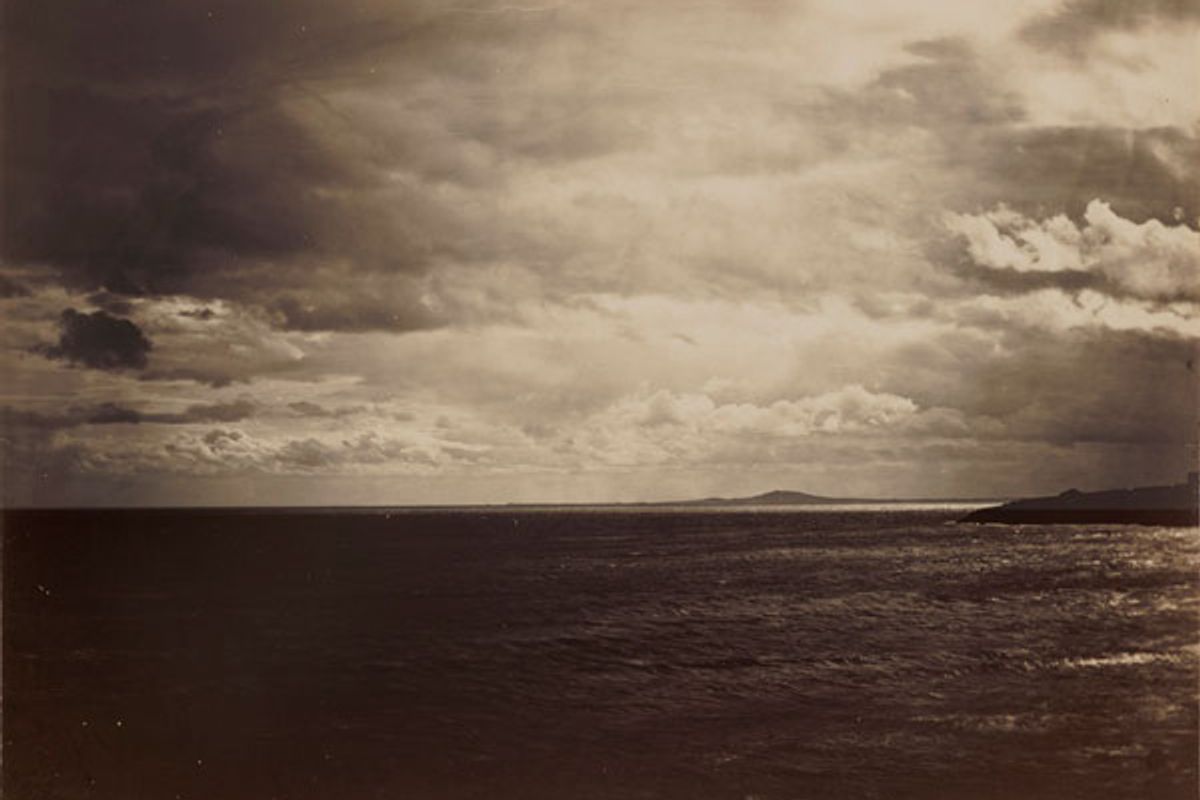
For the creative pioneers who embraced early photographic technology, producing "art" was very much a matter of trial and error. As Anne Havinga, Estrellita and Yousuf Karsh senior curator of photographs at the Museum of Fine Arts Boston, tells me, chemical treatments and exposure times were experimental and inexact; given the circumstances, "it was a miracle if they got anything at all."
When they did get something, the results were indeed miraculous, as you'll see if you click through the following slide show. Over the phone, Havinga described the processes used by these early photographers, and discussed some of her exhibition's highlights.
Why did you decide to run this exhibition now?
[Early photography] is an area that I am particularly interested in. The MFA has a very nice and growing collection; it's something we've been working on in recent years. It's not the largest or most extensive collection of early photography, but it is choice, and becoming more choice all the time, so we thought it would be great to show the riches that we have in this area now. The exhibition is being displayed thematically: portraits, architectural views, landscapes, still lifes. There will be a number of iconic images and works by very celebrated early photographers.
You know, the invention of photography really changed the course of the history of art. The amazing thing is that these early photographers were working with very rudimentary equipment; these were very simple box cameras that were big and unwieldy , and homemade-seeming recipes and solutions that they made in their kitchens or in a workroom. They had to follow those recipes painstakingly to have any kind of result; they had to estimate the exposure time dependent on the amount of sunlight that day. On top of it all, when they were using the cameras, they would look at their image in the viewer -- what we call the ground glass -- and they would see it upside down and laterally reversed. So they had to reverse it in their heads.
Was the process these photographers used similar in any way at all to the process used by photographers today?
One of the great reasons why photographers make pictures is to see how [something looks] as a photograph. A photograph is a two-dimensional rendering of the three-dimensional world; it flattens what you see. We contemporary people, having known modernism, often see planes of tone in these early photographs that we're not 100 percent sure the early photographers saw. But they must have been aware of them, because they seem to be so much part of many of the greatest early photographs -- planes of tone, of light and dark; the creation of an image that's not just about detail, but about tone, light and shadow.
Photography was invented at about the same time in France and England, where it was announced by two different people: Louis Daguerre (in Paris) and William Henry Fox Talbot. Daguerre was the first one to announce his discovery, in early January of 1839 -- and then Talbot, having heard that Daguerre had invented something rather similar-sounding to what he himself had done, rushed to make his own announcement. The photographs in our show were mostly made with Talbot's paper negative process; there's only one daguerreotype. [Paper] was ultimately the one that succeeded more, in part because you could create multiple prints, so it had more usefulness -- whereas daguerreotype was unique. With paper negatives, the prints were larger, so I'm sure that was also appealing. The daguerreotype basically became antiquated at some point, and the uses for paper photography multiplied. Our exhibition celebrates what people often call the golden age of early photography, which is the use of paper materials from the 1840s to the mid-1870s.
Were these photographers mainly wealthy people? Or people from all different levels of society?
Well, a lot of them were wealthy people who had the time and the resources to do things. The one daguerreotype we're showing is by someone called Girault de Prangey. He was a wealthy architectural historian who heard about the daguerreotype process and almost immediately went to learn it -- got himself taught the process, had a couple of cameras built, and took off for the Mediterranean to make some of the earliest pictures of the sites in that area. He made images that were surprising, because he framed them interestingly. He used the "close-up," which was actually an unusual idea at the time. He would photograph only part of a building; our picture is sort of the top section of a church in Athens.
With industrialization came great advances in transportation -- particularly train travel -- and so a number of other well-to-do photographers started to travel to distant places and bring back images of the exotic sites in places like Egypt, Jerusalem and Syria. We have one picture by a photographer who got to Mexico.
Gradually, glass negatives started to replace paper negatives, because they offered even more detail, and allowed you to shorten your exposure time. But if they were going to go with glass, these traveling photographers had to carry sheets of glass that were the same size as their prints. Which is amazing -- these are prints that are often 15 inches by 12 inches. They would bring sheets of glass that they had prepared; they would bring bottles of chemicals, too, because they had to treat the negatives before exposure, and then treat them again right after to secure the image. They had to bring a sort of makeshift darkroom -- it's incredible. We have one picture that was taken near the top of Mont Blanc, in the mid-1860s, by one of the Bisson frères -- an image that he had to make while dealing with the elements, the cold and snow. He made two unsuccessful trips before he actually succeeded in getting images. The diligence itself is just remarkable; the passion of these people is amazing.
How many of these works were conceived, at the time of their creation, as "art"? How many were done more commercially -- as portraits, for instance, or with the goal of simply depicting realistic scenes (i.e., photojournalism)?
Some of the greatest and most important photographers were artists, and brought an artistic vision to their work, so they were thinking of this as a tool for making expressive art. But the purposes for photography developed over time, portraiture being one of the most obvious (and we have a number of wonderful portraits in the exhibition). Then travel photography, like I was just mentioning, and the beginnings of photojournalism. There were also applications in the industrial context; for instance, we have a group of pictures made at the Sèvres porcelain manufactory [slide 11], because there were a group of artists involved in the making of the porcelain who were fascinated with photography. They realized they could make wonderful images that would promote the porcelains.
The exhibition focuses on work from England and France. What was going on in American photography at the time?
In America, the daguerreotype lasted for a longer period. It starts in America in the early 1840s, and there were several important daguerreotype studios. There was one very important one here in Boston, Southworth & Hawes, and we have an extensive collection of their work. Because Americans moved and traveled so much, and because the Civil War happened, there was a great need for portraits. So daguerreotypes and tintypes and ambrotypes -- there was a big business in that, all the way until the 1860s. It just went in a slightly different direction, and then paper photography also started to take over here in the U.S. We're focusing in this show just on the European photography, because it's so cohesive as a body of material.
I think people will be particularly interested in the Lewis Carroll photograph [slide 1]. What's the story behind it?
Well, first of all, that's our newest acquisition, so we're very proud of it. Lewis Carroll's work has a market beyond the photography world, so these images are expensive.
Carroll was interested in photography, just like he was interested in his writing, and he made a number of photographs of little girls, including the real Alice. This particular picture shows the young girl who was really his favorite model; he photographed her the most. Her name was Alexandra Kitchin; her nickname was Xie [pronounced "Ex-ee"]. She apparently took an interest in his photo-making, and was patient; she would sit for these long exposures, and enjoyed the whole process. He used to say, "If you want to make a great photograph, you just have to put Xie in front of the camera." She looks so sweet in this picture, reclining on that beautiful sofa with a book at her feet. It's really quite beautiful.
Are there any other photos you'd like to single out as particularly special?
Yes. Another photo from the same section of the exhibition is the Nadar portrait of Jean Journet [slide 7]. Gaspard-Félix Tournachon Nadar was the best-known portrait photographer in France at that time. Whereas other photographers who had very active businesses in making portraits for customers might work with teams of assistants, Nadar would take hours for a single portrait. It wasn't a quick one-off; he did it with great care. He photographed a lot of the most important people in arts and letters, and some friends. This particular picture is kind of unusual, because it's of a very bohemian friend, Jean Journet, who was a street preacher. He had been painted by people like Courbet, and was beloved in the circle of artists at the time. Nadar's picture makes him look like he's in the garb of a Spanish baroque painting -- and he's looking up, like he's receiving spiritual insight. It's rather special.
We also have an early Hill & Adamson. [Octavius] Hill and [Robert] Adamson were a team of British photographers who learned Talbot's process in the early 1840s, and made photographs of the fisher folk of Newhaven, and also of people around Edinburgh, where they lived. With their photos, there's less emphasis on detail, and much more light and shadow; you can really tell that there was a painter involved -- someone who was really thinking about the balance of light and shadow and the composition.
Actually, the Bisson Mont Blanc picture has a wonderful balance of light and shadow. It's almost divided into quadrants of light and dark. Some of these pictures have a formalism -- an abstract or formalist quality that seems almost modern to our eye.
The Gustave Le Gray seascape [slide 4] is special, too. Le Gray is one of the best known of these early photographers; this seascape in particular harks back to painting of the period. These early photographers had great difficulty recording the sky, because the sky was light and the clouds were moving and they had long exposure, so it would come out light in tone, or blotchy. They often painted out the sky so that it would appear just white in the background. But what Le Gray did was to sort of ingeniously piece in another negative of clouds, in a way that almost seemed deceptive. And this was a large print for his time -- these pictures caused quite a stir, because they were so evocative and magisterial and amazing.
"Silver, Salt, and Sunlight: Early Photography in Britain and France" will be on display at the Museum of Fine Arts Boston from Feb. 7 through Aug. 19, 2012.
Shares