Motherhood
A desperate housewife becomes “miracle” mom
Nevertheless, Marcia Cross doesn't want to be a role model for 40-something parents -- and shouldn't have to be
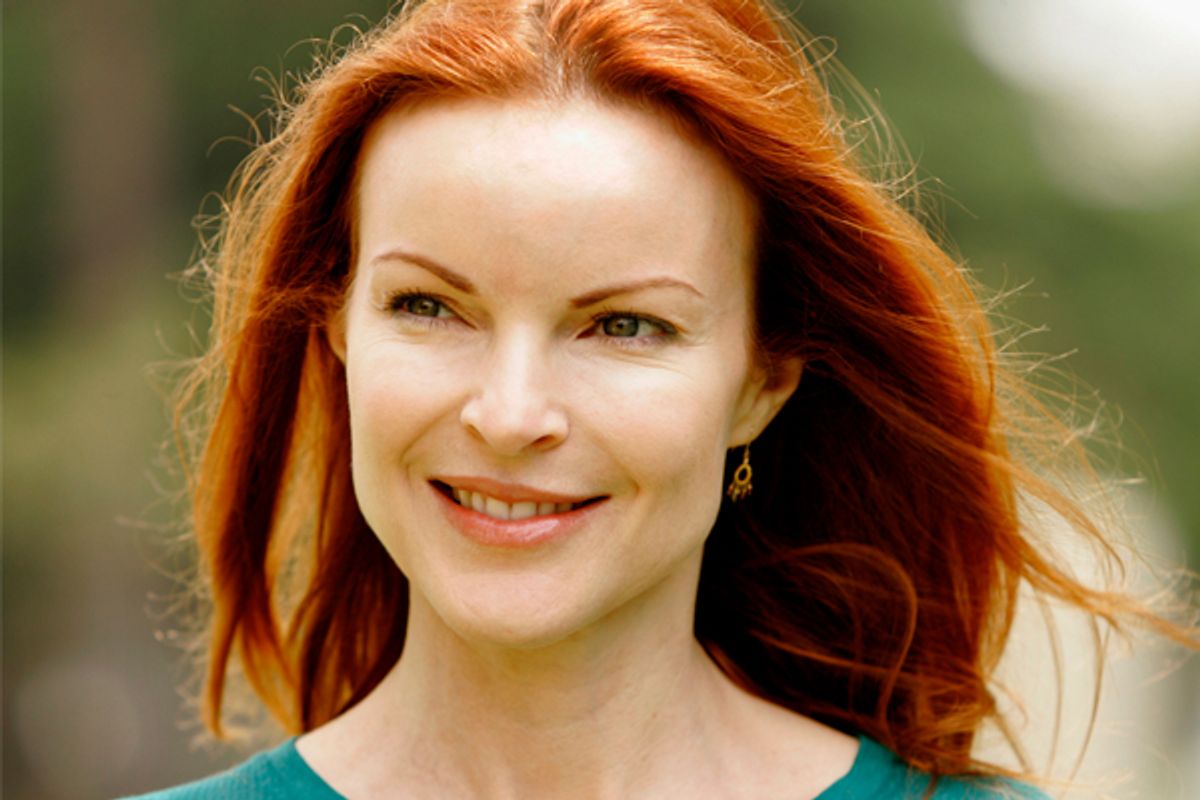
(Credit: Reuters/Mario Anzuoni) You don’t expect a woman who’s gained fame as a Desperate Housewife to be a role model. But the woman who has played the tightly wound Bree Van de Kamp would just like to clarify that, in her off hours, she is not about to be “the poster girl for older mothers.” In a frank new interview in the British women’s magazine Easy Living, the actress, who turns 50 in March, discusses the twin daughters she conceived at age 44 and advises, “Your forties is not the time to be thinking about getting pregnant.”
Cross began in vitro fertilization treatments “a week after” getting married in 2006 and, unlike plenty of would-be moms her age, conceived easily. But the pregnancy itself proved a tougher ride, as she found herself on bed rest in the midst of her shooting schedule, developed preeclampsia, and delivered daughters Eden and Savannah four weeks early via emergency C-section. So when asked about how it feels to be a beacon of hope to other aspiring 40-something parents, it’s no wonder that Cross says, “Are you kidding? It’s a miracle I have these two daughters.”
We live in a world where marriage and children simply don’t always drop into a lady’s lap at a conveniently fecund juncture. We also, for the lucky, healthy and well-insured, now have ever improving odds-boosters in the realms of fertility treatments and prenatal care. Is it any surprise that the number of women having children in their 40s has increased a whopping eight-fold in the last four decades? The technological options are seemingly endless. Angela Bassett and Courtney B. Vance are the parents of twins they had via a surrogate when Bassett was 45. Annie Leibovitz gave birth to her eldest child when she was 51, and had twins via a surrogate four years later.
But just because you might be able to have a baby while your peers are having hot flashes, does that mean it’s a great idea? In a provocative cover story last fall, New York magazine pondered whether reproductive science has gone too far, granting motherhood to women far beyond the natural span of their childbearing years. The response to the story – and the tales of couples enduring multiple rounds of IVF, of the risks to mother and child, and the implied rich-chick privilege of outfoxing the clock – was so strong that commenters are still hashing it out four months later. And just this past Friday, Dr. Oz devoted an entire show to the question “How Old Is Too Old to Have Kids?” Doctors debated the issue, pointing out both the ever improving possibilities for safe, healthy pregnancies for older women while also laying out the stark realities of the physical and financial toll of later age motherhood. For every Marcia Cross, who makes it through a bumpy pregnancy and can now say, “It worked out and I love being a mother,” there are women like the reproductively prolific 45-year-old Michelle Duggar, whose last child, Josie, was born premature at only 1 lb. 6 oz. Last month, Duggar lost another child five months into her pregnancy.
Motherhood isn’t something that a whole lot of women capriciously decided to give a go at 45, like they’re taking up Zumba classes. Deferred parenthood often comes as the result of life circumstance and the caprices of fertility. Yet the cold, hard truth is that the dream of parenthood doesn’t always come true for everybody. And that the possibilities for pain, loss and heartbreak tend to rise as the number of eggs decline. Biology can only be defied just so much. The odds get slimmer every month, and the world gets less kind about your choices and efforts.
But a few days ago, an over-40 pair of friends finally welcomed a long-hoped-for baby. Looking at photographs of the weary, elated face of the mom and the proud, awed new father holding, at last, his beautiful son, I remembered how much they’d endured to bring him into the world. I doubt they’d want to be anybody’s poster children, either. But I know they’d say it was all worth it.
Mary Elizabeth Williams is a staff writer for Salon and the author of "Gimme Shelter: My Three Years Searching for the American Dream." Follow her on Twitter: @embeedub. More Mary Elizabeth Williams.
Stop aiming for postpartum hot
Beyonce's lettuce diet is just the latest crazy move by a celebrity mom to get back into bikini shape
Beyonce (Credit: Reuters/Andrew Kelly) Dear New Celebrity Mom:
I understand your desire to get your famously hot body back. Even we mere mortals, who somehow managed to get impregnated despite never once making it to the Maxim 100, have gazed longingly at our pre-pregnancy pants, yearned to set our draw-stringed maternity clothes on fire, and gasped a “What the HELL?” when getting a load of our doughy postpartum selves in the mirror. And we never had to get in shape for a Victoria’s Secret show. We didn’t even coin the word “bootylicious” to describe our own assets.
Continue Reading Close
Mary Elizabeth Williams is a staff writer for Salon and the author of "Gimme Shelter: My Three Years Searching for the American Dream." Follow her on Twitter: @embeedub. More Mary Elizabeth Williams.
How I met my mother
After our dramatic fights, I swore I'd be a different kind of mom than my mom. I didn't realize how similar we are
A photo of the author with her mom and son. (Credit: Reyna Zack Photography/Melissa King via Shutterstock) I could say we didn’t get along, but that sounds benign. There are plenty of people I don’t get along with, but we’ve been able to opt out of each other’s lives. This was my mother, and though we both would have opted out if we could, we couldn’t — except for the brief year I went to live with my father, which was a mistake — and so we didn’t.
I wish I could tell you exactly why we didn’t get along. Maybe I resented my parents’ divorce, and because she screamed louder, I blamed her more. Maybe I blamed her for seeming to hate me. (I was what was called, back before all children were pathologized, a “difficult child.”) She felt mothers should be respected universally, and I felt like we should talk everything out. I wanted to be understood. She wanted me to understand that I wasn’t her friend, I was her daughter. When she hears my sister using the parenting language of today on her son – “I hear that you’re frustrated, because it’s frustrating to not be able to own a machine gun, but you just can’t have one” – she rolls her eyes and thinks back to the days when a kid who asked for something unreasonable could just be sent to his room.
Continue Reading CloseTaffy Brodesser-Akner has written for the New York Times, Los Angeles Times, Self, Redbook, and other publications. More Taffy Brodesser-Akner.
Finding my mother again
Years after she died, I came to understand the complicated woman I long mythologized, by becoming a mom, too
A photo of the author, as a baby, with her mother (Credit: Melissa King via Shutterstock) In the 15 years since my mother has been gone, she has become a mythical figure in my life. She was a woman to be revered, but also one so complicated and so different from me that I fear I’ll never stop struggling to make sense of her and to accept myself within the context of her shadow.
My mother was 37 years old, twice divorced and childless when she met my father. She had been living in Manhattan for 17 years, having grown up in Connecticut and gone to the Rhode Island School of Design to study painting. She had dozens of friends, went to parties and attended art openings. She smoked pot in the Village and spent Tuesday nights in smoky jazz clubs, sipping martinis and recrossing her legs.
Continue Reading CloseClaire Bidwell Smith is the author of the memoir, “The Rules of Inheritance.” She is a therapist specializing in grief, and lives in Los Angeles. More Claire Bidwell Smith.
Time magazine’s breast-feeding cover star: Is he doomed?
A provocative magazine cover doesn't mean the breast-feeding preschooler is in for a lifetime of "Got milk" jokes
The cover of Time magazine In the single, whipped-up day since Time magazine unleashed that cover story about crazed MILFs “driven” to “extremes” by attachment parenting, there’s been plenty of debate over its provocative image of blogger Jamie Lynne Grumet breast-feeding her almost 4-year-old son. And, as so often happens when adults see an image that unnerves them, that anxiety is projected onto kids. In this case, one kid in particular. Grumet’s.
Continue Reading Close
Mary Elizabeth Williams is a staff writer for Salon and the author of "Gimme Shelter: My Three Years Searching for the American Dream." Follow her on Twitter: @embeedub. More Mary Elizabeth Williams.
Their moms were crazy about me
My boyfriends' mothers just knew I was The One. Too bad their sons didn't agree
Judy’s warm brown eyes sucked me right in. Her son David and I had only been dating four months, but that didn’t stop me from falling for her hard. I was 30, and still reeling from my parents’ recent divorce and the fact that my mom had just moved five floors above me on the Upper West Side of Manhattan. I practically went from shaking Judy’s hand to curling up on her lap in a fetal position. I didn’t feel like a grown woman meeting my boyfriend’s mother. I felt like a kid calling shotgun, desperate to claim a seat at her table.
Continue Reading CloseKimberlee Auerbach Berlin’s memoir, "The Devil, The Lovers & Me: My Life in Tarot," was published by Dutton in 2007. She teaches memoir and humor writing for continuing education programs including Mediabistro, UCLA Extension, Gotham Writers’ Workshop and has a growing private client base. For more info: www.kimmiland.com.. More Kimberlee Auerbach Berlin.
Page 1 of 83 in Motherhood