Energy

If the Iranian powder keg explodes

Closing the Straight of Hormuz could ignite a war and a global depression. Oil's only one part of the picture

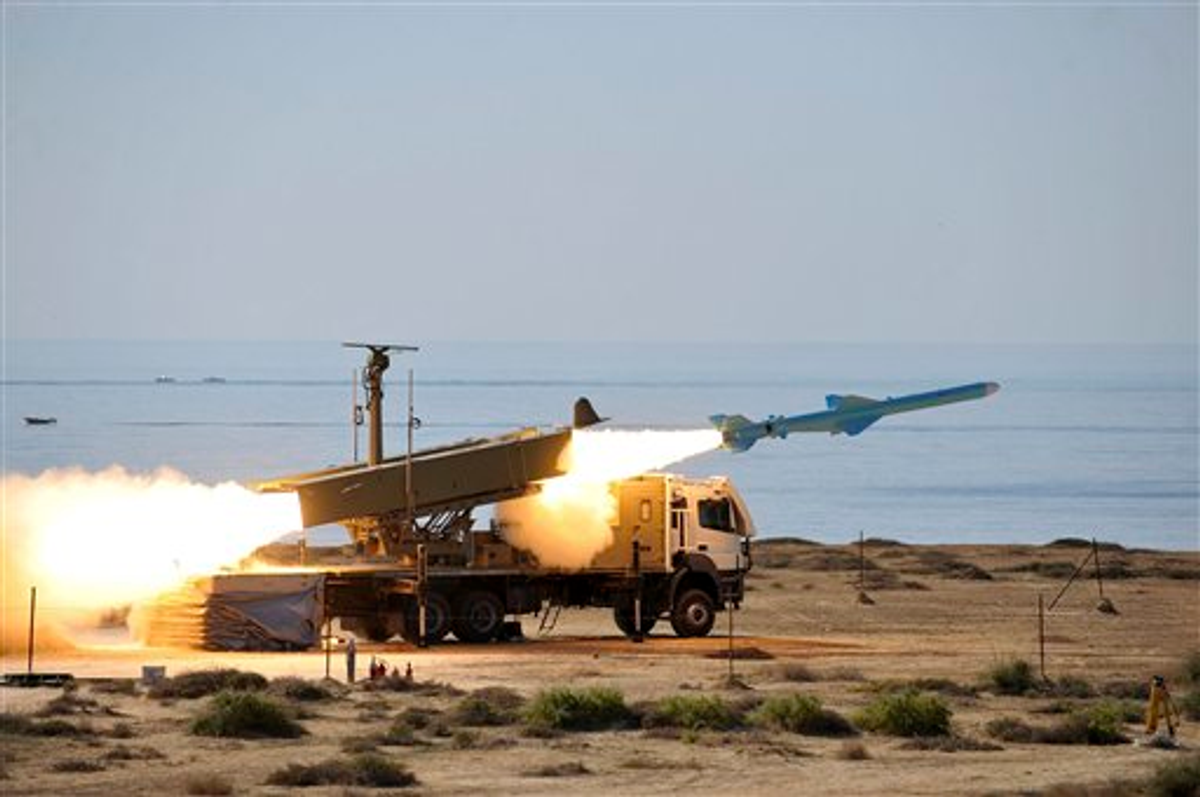
In this picture released by Iranian Students News Agency on Monday, Jan. 2, 2012, a missile is launched at the shore of sea of Oman during Iran's navy drill (Credit: AP Photo/ISNA, Amir Kholousi)
This piece originally appeared on TomDispatch.

Ever since December 27th, war clouds have been gathering over the Strait of Hormuz, the narrow body of water connecting the Persian Gulf with the Indian Ocean and the seas beyond. On that day, Iranian Vice President Mohammad Reza Rahimi warned that Tehran would block the strait and create havoc in international oil markets if the West placed new economic sanctions on his country.

“If they impose sanctions on Iran’s oil exports,” Rahimi declared, “then even one drop of oil cannot flow from the Strait of Hormuz.” Claiming that such a move would constitute an assault on America’s vital interests, President Obama reportedly informed Iran’s supreme leader Ayatollah Ali Khamenei that Washington would use force to keep the strait open.  To back up their threats, both sides have been bolstering their forces in the area and each has conducted a series of provocative military exercises.

All of a sudden, the Strait of Hormuz has become the most combustible spot on the planet, the most likely place to witness a major conflict between well-armed adversaries. Why, of all locales, has it become so explosive?

Oil, of course, is a major part of the answer, but — and this may surprise you — only a part.

Petroleum remains the world’s most crucial source of energy, and about one-fifth of the planet’s oil supply travels by tanker through the strait. “Hormuz is the world’s most important oil chokepoint due to its daily oil flow of almost 17 million barrels in 2011,” the U.S. Department of Energy noted as last year ended. Because no other area is capable of replacing these 17 million barrels, any extended closure would produce a global shortage of oil, a price spike, and undoubtedly attendant economic panic and disorder.

No one knows just how high oil prices would go under such circumstances, but many energy analysts believe that the price of a barrel might immediately leap by $50 or more.  “You would get an international reaction that would not only be high, but irrationally high,” says Lawrence J. Goldstein, a director of the Energy Policy Research Foundation. Even though military experts assume the U.S. will use its overwhelming might to clear the strait of Iranian mines and obstructions in a few days or weeks, the chaos to follow in the region might not end quickly, keeping oil prices elevated for a long time. Indeed, some analysts fear that oil prices, already hovering around $100 per barrel, would quickly double to more than $200, erasing any prospect of economic recovery in the United States and Western Europe, and possibly plunging the planet into a renewed Great Recession.

The Iranians are well aware of all this, and it is with such a nightmare scenario that they seek to deter Western leaders from further economic sanctions and other more covert acts when they threaten to close the strait. To calm such fears, U.S. officials have been equally adamant in stressing their determination to keep the strait open. In such circumstances of heightened tension, one misstep by either side might prove calamitous and turn mutual rhetorical belligerence into actual conflict.

Military Overlord of the Persian Gulf

In other words, oil, which makes the global economy hum, is the most obvious factor in the eruption of war talk, if not war. Of at least equal significance are allied political factors, which may have their roots in the geopolitics of oil but have acquired a life of their own.

Because so much of the world’s most accessible oil is concentrated in the Persian Gulf region, and because a steady stream of oil is absolutely essential to the well-being of the U.S. and the global economy, it has long been American policy to prevent potentially hostile powers from acquiring the capacity to dominate the Gulf or block the Strait of Hormuz.  President Jimmy Carter first articulated this position in January 1980, following the Islamic Revolution in Iran and the Soviet invasion of Afghanistan.  “Any attempt by an outside force to gain control of the Persian Gulf region will be regarded as an assault on the vital interests of the United States of America,” he told a joint session of Congress, “and such an assault will be repelled by any means necessary, including military force.”

In accordance with this precept, Washington designated itself the military overlord of the Persian Gulf, equipped with the military might to overpower any potential challenger.  At the time, however, the U.S. military was not well organized to implement the president’s initiative, known ever since as the Carter Doctrine.  In response, the Pentagon created a new organization, the U.S. Central Command (CENTCOM), and quickly endowed it with the wherewithal to crush any rival power or powers in the region and keep the sea lanes under American control.

CENTCOM first went into action in 1987-1988, when Iranian forces attacked Kuwaiti and Saudi oil tankers during the Iran-Iraq War, threatening the flow of oil supplies through the strait. To protect the tankers, President Reagan ordered that they be “reflagged” as American vessels and escorted by U.S. warships, putting the Navy into potential conflict with the Iranians for the first time.  Out of this action came the disaster of Iran Air Flight 655, a civilian airliner carrying 290 passengers and crew members, all of whom died when the plane was hit by a missile from the USS Vincennes, which mistook it for a hostile fighter plane — a tragedy long forgotten in the United States, but still deeply resented in Iran.

Iraq was America’s de facto ally in the Iran-Iraq war, but when Saddam Hussein invaded Kuwait in 1990 — posing a direct threat to Washington’s dominance of the Gulf — the first President Bush ordered CENTCOM to protect Saudi Arabia and drive Iraqi forces out of Kuwait. And when Saddam rebuilt his forces, and his very existence again came to pose a latent threat to America’s dominance in the region, the second President Bush ordered CENTCOM to invade Iraq and eliminate his regime altogether (which, as no one is likely to forget, resulted in a string of disasters).

If oil lay at the root of Washington’s domineering role in the Gulf, over time that role evolved into something else: a powerful expression of America’s status as a global superpower. By becoming the military overlord of the Gulf and the self-appointed guardian of oil traffic through the Strait of Hormuz, Washington said to the world: “We, and we alone, are the ones who can ensure the safety of your daily oil supply and thereby prevent global economic collapse.” Indeed, when the Cold War ended — and with it an American sense of pride and identity as a bulwark against Soviet expansionism in Europe and Asia — protection of the flow of Persian Gulf oil became America’s greatest claim to superpowerdom, and it remains so today.

Every Option on Every Table

With the ouster of Saddam Hussein in 2003, the one potential threat to U.S. domination of the Persian Gulf was, of course, Iran. Even under the U.S.-backed Shah, long Washington’s man in the Gulf, the Iranians had sought to be the paramount power in the region. Now, under a militant Shiite Islamic regime, they have proven no less determined and — call it irony — thanks to Saddam’s overthrow and the rise of a Shiite-dominated government in Baghdad, they have managed to extend their political reach in the region. With Saddam’s fate in mind, they have also built up their defensive military capabilities and — in the view of many Western analysts — embarked on a uranium-enrichment program with the potential to supply fissile material for a nuclear weapon, should the Iranian leadership choose someday to take such a fateful step.

Iran thus poses a double challenge to Washington’s professed status in the Gulf. It is not only a reasonably well-armed country with significant influence in Iraq and elsewhere, but by promoting its nuclear program, it threatens to vastly complicate America’s future capacity to pull off punishing attacks like those launched against Iraqi forces in 1991 and 2003.

While Iran’s military budget is modest-sized at best and its conventional military capabilities will never come close to matching CENTCOM’s superior forces in a direct confrontation, its potential pursuit of nuclear-arms capabilities greatly complicates the strategic calculus in the region. Even without taking the final steps of manufacturing actual bomb components — and no evidence has yet surfaced that the Iranians have proceeded to this critical stage — the Iranian nuclear effort has greatly alarmed other countries in the Middle East and called into question the continued robustness of America’s regional dominance. From Washington’s perspective, an Iranian bomb — whether real or not — poses an existential threat to America’s continued superpower status.

How to prevent Iran not just from going nuclear but from maintaining the threat to go nuclear has, in recent years, become an obsessional focus of American foreign and military policy. Over and over again, U.S. leaders have considered plans for using military force to cripple the Iranian program though air and missile strikes on known and suspected nuclear facilities.  Presidents Bush and Obama have both refused to take such action “off the table,” as Obama made clear most recently in his State of the Union address. (The Israelis have also repeatedly indicated their desire to take such action, possibly as a prod to Washington to get the job done.)

Most serious analysts have concluded that military action would prove extremely risky, probably causing numerous civilian casualties and inviting fierce Iranian retaliation. It might not even achieve the intended goal of halting the Iranian nuclear program, much of which is now being conducted deep underground. Hence, the consensus view among American and European leaders has been that economic sanctions should instead be employed to force the Iranians to the negotiating table, where they could be induced to abandon their nuclear ambitions in return for various economic benefits. But those escalating sanctions, which appear to be causing increasing economic pain for ordinary Iranians, have been described by that country’s leaders as an “act of war,” justifying their threats to block the Strait of Hormuz.

To add to tensions, the leaders of both countries are under extreme pressure to vigorously counter the threats of the opposing side. President Obama, up for re-election, has come under fierce, even hair-raising, attack from the contending Republican presidential candidates (except, of course, Ron Paul) for failing to halt the Iranian nuclear program, though none of them have a credible plan to do so. He, in turn, has been taking an ever-harsher stance on the issue.  Iranian leaders, for their part, appear increasingly concerned over the deteriorating economic conditions in their country and, no doubt fearing an Arab Spring-like popular upheaval, are becoming more bellicose in their rhetoric.

So oil, the prestige of global dominance, Iran’s urge to be a regional power, and domestic political factors are all converging in a combustible mix to make the Strait of Hormuz the most dangerous place on the planet. For both Tehran and Washington, events seem to be moving inexorably toward a situation in which mistakes and miscalculations could become inevitable. Neither side can appear to give ground without losing prestige and possibly even their jobs. In other words, an existential test of wills is now under way over geopolitical dominance in a critical part of the globe, and on both sides there seem to be ever fewer doors marked “EXIT.”

As a result, the Strait of Hormuz will undoubtedly remain the ground zero of potential global conflict in the months ahead.

To stay on top of important articles like these, sign up to receive the latest updates from TomDispatch.com here.

Michael T. Klare is a professor of peace and world security studies at Hampshire College and the author of "Resource Wars," "Blood and Oil," and "Rising Powers, Shrinking Planet: The New Geopolitics of Energy."

We don’t need new roads

America's love affair with cars is finally waning. Investing in more highways is bad policy

(Credit: ARENA Creative via Shutterstock)

Interstate 70 in Colorado, one of the nation’s best-known arteries, is the latest thoroughfare to incite an archetypal fight. Running at capacity as it cuts through Denver, this gateway to the Rocky Mountains is about to be expanded over the objections of residents whose low-income neighborhoods will be sliced apart.

No doubt, the road will probably win — as roads almost always do in these battles. Indeed, the story of I-70 summarizes the 60-year tale of urban development in modern America: Instead of beefing up public transit, cities build neighborhood-destroying highways, cars fill up those highways, cities then build more highways to alleviate traffic, and then yet more cars flood the roads, creating even more traffic. Known as the “fundamental law of highway congestion,” this cycle perfectly embodies the “if you build it, cars will come” axiom confirmed in 2011 by researchers at the University of Toronto.

In the past, of course, road fetishists could claim that such Catch-22′s aside, our nation is inherently reliant on cars, and that adding roads — any roads — is intrinsically worthwhile. This, in fact, is the assumption woven into the bipartisan federal stimulus bill and President Obama’s new budget, both of which target transportation dollars to building roads. Those new highways may not reduce congestion, energy consumption or pollution, but they will enrich an array of powerful interests, including automakers, fossil fuel companies, trucking firms and road contractors. And so they are repackaged as cure-alls by politicians in our money-dominated democracy.

But what happens when America suddenly tones down its love affair with the automobile? At that point, could we still justify destroying neighborhoods to make room for bigger roads? Could we still pretend that more roads are truly necessary? Could we still overlook the fact that road construction creates fewer jobs than public transit projects? In short, could we still ignore all the contradictions and problems that accompany our road fetish?

The United States is a nation whose car romance presents itself in everything from high-minded literature (“On the Road”) to middlebrow music (“Paradise by the Dashboard Light”) to lowbrow films (“Road Trip”) — and all the SUV commercials in between. Pondering a less car-dependent society may therefore seem like an academic exercise. But it’s a more relevant endeavor than you might think.

Under the headline “Driving Is a Dying Activity in America,” Business Insider recently highlighted data showing that Americans are putting fewer miles on their cars than at any time since 1999. USA Today notes that this stunning decrease is a product of “factors ranging from the weak economy to high gas prices to aging boomers and teens driving less.”

That last trend is the most significant, because it’s not just about frugal parents momentarily prohibiting kids from driving during an oil-price spike. It’s also about young people’s preferences. As the New York Times just reported, “Many young consumers today just do not care that much about cars,” as evidenced by an 18 percent drop in teen driver’s licenses between 1998 and 2008. A generation ago, Ferris Bueller said that getting a computer instead of a car proved that he was “born under a bad sign” — but the Times cites a new poll showing 46 percent of today’s 18- to 24-year-olds say they would actually “choose Internet access over owning a car.”

Taken together, these attitudinal shifts present a welcome opportunity to change everything from environmentally destructive infrastructure policies to outdated corporate investment strategies. Seizing such a rare opportunity requires only that more of us spend a bit less time in the car when possible. That, or at least an end to a political theology that always presents new roads as a panacea.

Continue Reading Close
David Sirota

David Sirota is a best-selling author of the new book "Back to Our Future: How the 1980s Explain the World We Live In Now." He hosts the morning show on AM760 in Colorado. E-mail him at ds@davidsirota.com, follow him on Twitter @davidsirota or visit his website at www.davidsirota.com.

The rules that should govern energy subsidies

Taxpayer dollars shouldn't be propping wealthy fossil-fuel companies whose products we want less of

In this March 19, 2012, photo, a motorist pumps gas at a Mount Lebanon, Pa., mini-mart (Credit: AP Photo/Gene J. Puskar)
This piece originally appeared on TomDispatch.

Along with “fivedollaragallongas,” the energy watchword for the next few months is: “subsidies.” Last week, for instance, New Jersey Senator Robert Menendez proposed ending some of the billions of dollars in handouts enjoyed by the fossil-fuel industry with a “Repeal Big Oil Tax Subsidies Act.” It was, in truth, nothing to write home about — a curiously skimpy bill that only targeted oil companies, and just the five richest of them at that. Left out were coal and natural gas, and you won’t be surprised to learn that even then it didn’t pass.

Still, President Obama is now calling for an end to oil subsidies at every stop on his early presidential-campaign-plus-fundraising blitz — even at those stops where he’s also promising to “drill everywhere.” And later this month Vermont Senator Bernie Sanders will introduce a much more comprehensive bill that tackles all fossil fuels and their purveyors (and has no chance whatsoever of passing this Congress).

Whether or not the bill passes, those subsidies are worth focusing on. After all, we’re talking at least $10 billion in freebies and, depending on what you count, possibly as much as $40 billion annually in freebie cash for an energy industry already making historic profits. If attacking them is a convenient way for the White House to deflect public anger over rising gas prices, it is also a perfect fit for the new worldview the Occupy movement has been teaching Americans. (Not to mention, if you think about it, the Tea Party focus on deficits.) So count on one thing: We’ll be hearing a lot more about them this year.

But there’s a problem: The very word “subsidies” makes American eyes glaze over. It sounds so boring, like something that has everything to do with finance and taxes and accounting, and nothing to do with you. Which is just the reaction that the energy giants are relying on: that it’s a subject profitable enough for them and dull enough for us that no one will really bother to challenge their perks, many of which date back decades.

By some estimates, getting rid of all the planet’s fossil-fuel subsidies could get us halfway to ending the threat of climate change. Many of those subsidies, however, take the form of cheap, subsidized gas in petro-states, often with impoverished populations — as in Nigeria, where popular protests forced the government to back down on a decision to cut such subsidies earlier this year. In the U.S., though, they’re simply straightforward presents to rich companies, gifts from the 99 percent to the 1 percent.

If due attention is to be paid, we have to figure out a language in which to talk about them that will make it clear just how loony our policy is.

Start this way: you subsidize something you want to encourage, something that might not happen if you didn’t support it financially. Think of something we heavily subsidize — education. We build schools, and give government loans and grants to college kids; for those of us who are parents, tuition will often be the last big subsidy we give the children we’ve raised. The theory is: Young people don’t know enough yet. We need to give them a hand when it comes to further learning, so they’ll be a help to society in the future. From that analogy, here are five rules of the road that should be applied to the fossil-fuel industry.

1. Don’t subsidize those who already have plenty of cash on hand. No one would propose a government program of low-interest loans to send the richest kids in the country to college. (It’s true that schools may let them in more easily on the theory that their dads will build gymnasiums, but that’s a different story.) We assume that the wealthy will pay full freight. Similarly, we should assume that the fossil-fuel business, the most profitable industry on Earth, should pay its way, too. What possible reason is there for giving Exxon the odd billion in extra breaks? Year after year the company sets record for money-making — last year it managed to rake in a mere $41 billion in profit, just failing to break its own 2008 all-time mark of $45 billion.

2. Don’t subsidize people forever. If students need government loans to help them get bachelor’s degrees, that’s sound policy. But if they want loans to get their 11th BA, they should pay themselves. We learned how to burn coal 300 years ago.  A subsidized fossil-fuel industry is the equivalent of a 19-year-old repeating third grade yet again.

3. Sometimes you’ll subsidize something for a sensible reason and it won’t work out. The government gave some of our money to a solar power company called Solyndra. Though it was small potatoes compared to what we hand over to the fossil-fuel industry, it still stung when they lost it. But since we’re in the process of figuring out how to perfect solar power and drive down its cost, it makes sense to subsidize it.  Think of it as the equivalent of giving a high-school senior a scholarship to go to college. Most of the time that works out. But since I live in a college town, I can tell you that 20 percent of kids spend four years drinking: they’re human Solyndras. It’s not exactly a satisfying thing to see happen, but we don’t shut down the college as a result.

4. Don’t subsidize something you want less of. At this point, the greatest human challenge is to get off of fossil fuels. If we don’t do it soon, the climatologists tell us, our prospects as a civilization are grim indeed.  So lending a significant helping hand to companies intent on driving us towards disaster is perverse. It’s like giving a fellowship to a graduate student who wants to pursue a thesis on “Strategies for Stimulating Donut Consumption Among Diabetics.”

5. Don’t give subsidies to people who have given you cash. Most of the men and women who vote in Congress each year to continue subsidies have taken campaign donations from big energy companies. In essence, they’ve been given small gifts by outfits to whom they then return large presents, using our money, not theirs. It’s a good strategy, if you’re an energy company — or maybe even a congressional representative eager to fund a reelection campaign. Oil Change International estimates that fossil-fuel companies get $59 back for every dollar they spend on donations and lobbying, a return on investment that makes Bernie Madoff look shabby. It’s no different from sending a college financial aid officer a hundred-dollar bill in the expectation that he’ll give your daughter a scholarship worth tens of thousands of dollars. Bribery is what it is.  And there’s no chance it will yield the best energy policy or the best student body.

These five rules seem simple and straightforward to me, even if they don’t get at the biggest subsidy we give the fossil-fuel business: the right — alone among industries — to pour their waste into the atmosphere for free. And then there’s the small matter of the money we sink into the military might we must employ to guard the various places they suck oil from.

Simply getting rid of these direct payoffs would, however, be a start, a blow struck for, if nothing else, the idea that we’re not just being played for suckers and saps. This is the richest industry on Earth, a planet they’re helping wreck, and we’re paying them a bonus to do it.

In most schools outside of K Street, that’s an answer that would get a failing grade and we’d start calling subsidies by another name. Handouts, maybe. Freebies. Baksheesh. Payola. Or to use the president’s formulation, “all of the above.”

To stay on top of important articles like these, sign up to receive the latest updates from TomDispatch.com here.

Continue Reading Close

Bill McKibben is the Schumann Distinguished Scholar at Middlebury College, and founder of the global climate campaign 350.org. His latest book is "Eaarth: Making a Life on a Tough New Planet.".

The new oil reality

Get used to $4 a gallon. The cost of extracting and refining petroleum is higher than ever -- and that won't change

(Credit: AP Photo/Gene J. Puskar)
This article originally appeared on TomDispatch.

Oil prices are now higher than they have ever been — except for a few frenzied moments before the global economic meltdown of 2008. Many immediate factors are contributing to this surge, including Iran’s threats to block oil shipping in the Persian Gulf, fears of a new Middle Eastern war and turmoil in energy-rich Nigeria. Some of these pressures could ease in the months ahead, providing temporary relief at the gas pump. But the principal cause of higher prices — a fundamental shift in the structure of the oil industry — cannot be reversed, and so oil prices are destined to remain high for a long time to come.

In energy terms, we are now entering a world whose grim nature has yet to be fully grasped.  This pivotal shift has been brought about by the disappearance of relatively accessible and inexpensive petroleum — “easy oil,” in the parlance of industry analysts; in other words, the kind of oil that powered a staggering expansion of global wealth over the past 65 years and the creation of endless car-oriented suburban communities. This oil is now nearly gone.

The world still harbors large reserves of petroleum, but these are of the hard-to-reach, hard-to-refine, “tough oil” variety. From now on, every barrel we consume will be more costly to extract, more costly to refine — and so more expensive at the gas pump.

Those who claim that the world remains “awash” in oil are technically correct: The planet still harbors vast reserves of petroleum. But propagandists for the oil industry usually fail to emphasize that not all oil reservoirs are alike: Some are located close to the surface or near to shore, and are contained in soft, porous rock; others are located deep underground, far offshore or trapped in unyielding rock formations. The former sites are relatively easy to exploit and yield a liquid fuel that can readily be refined into usable liquids; the latter can only be exploited through costly, environmentally hazardous techniques, and often result in a product which must be heavily processed before refining can even begin.

The simple truth of the matter is this: Most of the world’s easy reserves have already been depleted — except for those in war-torn countries like Iraq.  Virtually all of the oil that’s left is contained in harder-to-reach, tougher reserves. These include deep-offshore oil, Arctic oil and shale oil, along with Canadian “oil sands” — which are not composed of oil at all, but of mud, sand and tar-like bitumen. So-called unconventional reserves of these types can be exploited, but often at a staggering price, not just in dollars but also in damage to the environment.

In the oil business, this reality was first acknowledged by the chairman and CEO of Chevron, David O’Reilly, in a 2005 letter published in many American newspapers. “One thing is clear,” he wrote, “the era of easy oil is over.” Not only were many existing oil fields in decline, he noted, but “new energy discoveries are mainly occurring in places where resources are difficult to extract, physically, economically and even politically.”

Further evidence for this shift was provided by the International Energy Agency (IEA) in a 2010 review of world oil prospects. In preparation for its report, the agency examined historic yields at the world’s largest producing fields — the “easy oil” on which the world still relies for the overwhelming bulk of its energy. The results were astonishing: those fields were expected to lose three-quarters of their productive capacity over the next 25 years, eliminating 52 million barrels per day from the world’s oil supplies, or about 75 percent of current world crude oil output. The implications were staggering: either find new oil to replace those 52 million barrels or the Age of Petroleum will soon draw to a close and the world economy would collapse.

Of course, as the IEA made clear back in 2010, there will be new oil, but only of the tough variety that will exact a price from us all — and from the planet, too.  To grasp the implications of our growing reliance on tough oil, it’s worth taking a whirlwind tour of some of the more hair-raising and easily damaged spots on Earth.  So fasten your seatbelts: first we’re heading out to sea — way, way out — to survey the “promising” new world of twenty-first-century oil.

Deepwater Oil

Oil companies have been drilling in offshore areas for some time, especially in the Gulf of Mexico and the Caspian Sea. Until recently, however, such endeavors invariably took place in relatively shallow waters — a few hundred feet, at most — allowing oil companies to use conventional drills mounted on extended piers. Deepwater drilling, in depths exceeding 1,000 feet, is an entirely different matter.  It requires specialized, sophisticated and immensely costly drilling platforms that can run into the billions of dollars to produce.

The Deepwater Horizon, destroyed in the Gulf of Mexico in April 2010 as a result of a catastrophic blowout, is typical enough of this phenomenon. The vessel was built in 2001 for some $500 million and cost around $1 million per day to staff and maintain. Partly as a result of these high costs, BP was in a hurry to finish work on its ill-fated Macondo well and move the Deepwater Horizon to another drilling location. Such financial considerations, many analysts believe, explain the haste with which the vessel’s crew sealed the well — leading to a leakage of explosive gases into the wellbore and the resulting blast. BP will now have to pay somewhere in excess of $30 billion to satisfy all the claims for the damage done by its massive oil spill.

Following the disaster, the Obama administration imposed a temporary ban on deep-offshore drilling.  Barely two years later, drilling in the Gulf’s deep waters is back to pre-disaster levels. President Obama has also signed an agreement with Mexico allowing drilling in the deepest part of the Gulf, along the U.S.-Mexican maritime boundary.

Meanwhile, deepwater drilling is picking up speed elsewhere. Brazil, for example, is moving to exploit its “pre-salt” fields (so-called because they lie below a layer of shifting salt) in the waters of the Atlantic Ocean far off the coast of Rio de Janeiro. New offshore fields are similarly being developed in deep waters off Ghana, Sierra Leone and Liberia.

By 2020, says energy analyst John Westwood, such deepwater fields will supply 10 percent of the world’s oil, up from only 1 percent in 1995. But that added production will not come cheaply: most of these new fields will cost tens or hundreds of billions of dollars to develop, and will only prove profitable as long as oil continues to sell for $90 or more per barrel.

Brazil’s offshore fields, considered by some experts the most promising new oil discovery of this century, will prove especially pricey, because they lie beneath one and a half miles of water and two and a half miles of sand, rock and salt.  The world’s most advanced, costly drilling equipment — some of it still being developed — will be needed. Petrobras, the state-controlled energy firm, has already committed $53 billion to the project for 2011-2015, and most analysts believe that will be only a modest down payment on a staggering final price tag.

Arctic Oil

The Arctic is expected to provide a significant share of the world’s future oil supply. Until recently, production in the far north has been very limited. Other than in the Prudhoe Bay area of Alaska and a number of fields in Siberia, the major companies have largely shunned the region. But now, seeing few other options, they are preparing for major forays into a melting Arctic.

From any perspective, the Arctic is the last place you want to go to drill for oil. Storms are frequent, and winter temperatures plunge far below freezing. Most ordinary equipment will not operate under these conditions. Specialized (and costly) replacements are necessary. Working crews cannot live in the region for long. Most basic supplies — food, fuel, construction materials — must be brought in from thousands of miles away at phenomenal cost.

But the Arctic has its attractions: billions of barrels of untapped oil, to be exact. According to the U.S. Geological Survey (USGS), the area north of the Arctic Circle, with just 6 percent of the planet’s surface, contains an estimated 13 percent of its remaining oil (and an even larger share of its undeveloped natural gas) — numbers no other region can match.

With few other places left to go, the major energy firms are now gearing up for an energy rush to exploit the Arctic’s riches. This summer, Royal Dutch Shell is expected to begin test drilling in portions of the Beaufort and Chukchi Seas adjacent to northern Alaska. (The Obama administration must still award final operating permits for these activities, but approval is expected.) At the same time, Statoil and other firms are planning extended drilling in the Barents Sea, north of Norway.

As with all such extreme energy scenarios, increased production in the Arctic will significantly boost oil company operating costs. Shell, for example, has already spent $4 billion alone on preparations for test drilling in offshore Alaska, without producing a single barrel of oil. Full-scale development in this ecologically fragile region, fiercely opposed by environmentalists and local Native peoples, will multiply this figure many times over.

Tar Sands and Heavy Oil

Another significant share of the world’s future petroleum supply is expected to come from Canadian tar sands (also called “oil sands”) and the extra-heavy oil of Venezuela. Neither of these is oil as normally understood.  Not being liquid in their natural state, they cannot be extracted by traditional drilling materials, but they do exist in great abundance.  According to the USGS, Canada’s tar sands contain the equivalent of 1.7 trillion barrels of conventional (liquid) oil, while Venezuela’s heavy oil deposits are said to harbor another trillion barrels of oil equivalent — although not all of this material is considered “recoverable” with existing technology.

Those who claim that the Petroleum Age is far from over often point to these reserves as evidence that the world can still draw on immense supplies of untapped fossil fuels. And it is certainly conceivable that, with the application of advanced technologies and a total indifference to environmental consequences, these resources will indeed be harvested. But easy oil this is not.

Until now, Canada’s tar sands have been obtained through a process akin to strip mining, utilizing monster shovels to pry a mixture of sand and bitumen out of the ground. But most of the near-surface bitumen in the tar-sands-rich province of Alberta has now been exhausted, which means all future extraction will require a far more complex and costly process.  Steam will have to be injected into deeper concentrations to melt the bitumen and allow its recovery by massive pumps. This requires a colossal investment of infrastructure and energy, as well as the construction of treatment facilities for all the resulting toxic wastes. According to the Canadian Energy Research Institute, the full development of Alberta’s oil sands would require a minimum investment of $218 billion over the next 25 years, not including the cost of building pipelines to the United States (such as the proposed Keystone XL) for processing in U.S. refineries.

The development of Venezuela’s heavy oil will require investment on a comparable scale. The Orinoco belt, an especially dense concentration of heavy oil adjoining the Orinoco River, is believed to contain recoverable reserves of 513 billion barrels of oil — perhaps the largest source of untapped petroleum on the planet. But converting this molasses-like form of bitumen into a useable liquid fuel far exceeds the technical capacity or financial resources of the state oil company, Petróleos de Venezuela S.A. Accordingly, it is now seeking foreign partners willing to invest the $10-$20 billion needed just to build the necessary facilities.

The Hidden Costs

Tough-oil reserves like these will provide most of the world’s new oil in the years ahead. One thing is clear: even if they can replace easy oil in our lives, the cost of everything oil-related — whether at the gas pump, in oil-based products, in fertilizers, in just about every nook and cranny of our lives — is going to rise.  Get used to it.  If things proceed as presently planned, we will be in hock to big oil for decades to come.

And those are only the most obvious costs in a situation in which hidden costs abound, especially to the environment. As with the Deepwater Horizon disaster, oil extraction in deep-offshore areas and other extreme geographical locations will ensure ever greater environmental risks. After all, approximately five million gallons of oil were discharged into the Gulf of Mexico, thanks to BP’s negligence, causing extensive damage to marine animals and coastal habitats.

Keep in mind that, as catastrophic as it was, it occurred in the Gulf of Mexico, where vast cleanup forces could be mobilized and the ecosystem’s natural recovery capacity was relatively robust. The Arctic and Greenland represent a different story altogether, given their distance from established recovery capabilities and the extreme vulnerability of their ecosystems. Efforts to restore such areas in the wake of massive oil spills would cost many times the $30-$40 billion BP is expected to pay for the Deepwater Horizon damage and be far less effective.

In addition to all this, many of the most promising tough-oil fields lie in Russia, the Caspian Sea basin and conflict-prone areas of Africa. To operate in these areas, oil companies will be faced not only with the predictably high costs of extraction, but also additional costs involving local systems of bribery and extortion, sabotage by guerrilla groups, and the consequences of civil conflict.

And don’t forget the final cost: If all these barrels of oil and oil-like substances are truly produced from the least inviting of places on this planet, then for decades to come we will continue to massively burn fossil fuels, creating ever more greenhouse gases as if there were no tomorrow.  And here’s the sad truth: if we proceed down the tough-oil path instead of investing as massively in alternative energies, we may foreclose any hope of averting the most catastrophic consequences of a hotter and more turbulent planet.

So yes, there is oil out there. But no, it won’t get cheaper, no matter how much there is. And yes, the oil companies can get it, but looked at realistically, who would want it?

To stay on top of important articles like these, sign up to receive the latest updates from TomDispatch.com here.

Continue Reading Close

Michael T. Klare is a professor of peace and world security studies at Hampshire College and the author of "Resource Wars," "Blood and Oil," and "Rising Powers, Shrinking Planet: The New Geopolitics of Energy."

Obama’s most dangerous foe: High gas prices

The president's energy speech calls for a review of his record. He gets a B+ overall, but an F on climate change

(Credit: AP/Ben Margot)

Looking for the biggest threat to Obama’s reelection? Hint: It’s probably not Mitt Romney, Rick Santorum, Newt Gingrich or Ron Paul. The president’s most lethal opponent lurks wherever you choose to fill up your gas tank: high gas prices.

This week, the average price of a gallon of gas in the United States hit $3.57. That’s the highest prices have ever been in February, a fact that is all the more sobering when one considers that prices usually rise in the summer, so more pain is likely on the way. And while it has been reasonably well-established that high gas prices, in and of themselves, don’t necessarily sound the death knell for an incumbent, there is definitely a link between the cost of energy and the health of the economy. And since the health of the economy this summer will probably be the single most important factor determining who wins the White House, the equation becomes pretty simple. If high gas prices derail the current economic recovery, Obama becomes more vulnerable.

The hard political and economic truth of spiking energy prices explains why President Obama gave a speech in Miami on Thursday recapitulating his energy plan and why Newt Gingrich just recorded a 30-minute advertisement laying out his own energy strategy. As long as prices keep rising, Republicans will blame Obama for the pain, and they will blithely promise, should they be elected, to magically lower gas prices right back down.

But as the president himself declared in Miami, “It’s the easiest thing in the world to make election-year promises to lower gas prices.” The reality is that it is completely unrealistic to believe that any president has the capacity to meaningfully affect the price of gas in the short term.

“Anybody who tells you that we can drill our way out of this problem doesn’t know what they are talking about or isn’t telling the truth,” said Obama, and he’s absolutely right. Gas prices track the cost of oil, and the price of oil is determined by worldwide trends in supply and demand, geopolitical tensions, oil futures speculation, and the overall health of the global economy. For example, the current spike in prices is largely attributed to traders speculating that international pressure on Iran will devolve into a military debacle that closes the Straits of Hormuz and cuts off a significant portion of the world’s oil.

But more generally, the emergence of oil-hungry developing nations is the real long-term driver of higher gas prices. How fast the Chinese economy is growing is far more important to the price of oil than anything the White House can do.

In his speech, Obama hinted at a long-term plan to bring gas prices down, but even that goal is just as illusory as the quick-fix solutions proposed by his Republican opponents. As Chinese and Indians and Brazilians buy more cars and the cost of exploiting new sources of oil continues to rise, gas prices will generally trend up.

In light of that brute reality, perhaps the best way to judge Obama’s energy record is in the context of how well he has prepared the United States for that future.

His record here is mixed, a consequence of the tricky intersection of energy and environmental policy. For example, Obama loves to tout the fact that oil production in the United States has risen each year of his administration and now sits at an eight-year high. He stressed that point once again during his Miami speech (although interestingly, he received zero applause from the audience when he announced how aggressively his administration was opening up new offshore and onshore acreage for exploration and development, and how many new pipelines — “even one from Canada!” — he boasted — his administration has approved).

But rising levels of production now are really the consequence of decisions made long before Obama took office. And arguably, some of Obama’s current proposals and actions will work in the opposite direction. Environmentalists applaud Obama’s decisions to nix (at least temporarily) the Keystone XL pipeline and his proposal to eliminate tax subsidies to oil companies. In Miami, Obama got a big cheer from the crowd when he raged against the oil subsidy machine, but there’s no getting around the fact that those subsidies make it more profitable and attractive for international oil companies to drill in American waters. They are part of the explanation for why production has grown every year in Obama’s term, and eliminating them — in conjunction with another Obama proposal to raise royalty rates charged on oil company production — will make a difference in domestic production.

From an environmental perspective, discouraging Big Oil from exploiting U.S. resources is a great thing, but in the context of Obama’s “all-of-the-above” approach to developing every possible form of energy, they speak to a bit of a contradiction. Obama wants to have it all — to placate his environmentalist base while boasting of ever-higher domestic oil production. Even for a politician as skilled as he is, that’s a tough balancing act.

On the unambiguously plus side of the ledger, Obama is responsible for several strategic initiatives that have important positive implications for car-addicted Americans. The stimulus included $2.5 billion that was funneled to around 30 companies working on advanced battery technologies, an example of targeted industrial policy that has helped revive the Michigan economy and could potentially position the United States to be a major player in a hybrid/electric car-dominated future. The White house has also raised fuel economy standards, not once, but twice — a move that will surely force automakers to manufacture increasingly fuel-efficient cars.

Such efforts won’t solve the energy crisis, but they will help make energy costs a relatively smaller part of the American household budget, and thus insulate us from the pain of the next oil shock. In fact, that’s already happening. American gasoline consumption has steadily dropped throughout Obama’s term, because we’re driving fewer miles in more fuel-efficient cars. If, as Obama promised, the average American car will get 55 miles per gallon by the middle of the next decade, that could prove to be one of the president’s most important lasting legacies.

However, on the single most important component of any long-term energy policy strategy — a comprehensive carbon tax or cap-and-trade system that would force investment away from fossil fuel exploitation and into renewable energy — Obama’s record is abysmal. One can argue that legislation aimed at restricting greenhouse gas emissions never would have had any chance at passing Congress, but that doesn’t change the fact that Obama dedicated zero political capital to the challenge. Quite the opposite: The longer Obama has been in office, the less he has mentioned climate change. In his speech at Miami, I didn’t hear him say the words once. Imagine that: a speech on energy policy that did not touch on the most important energy issue on the planet.

Obama launched some vigorous attacks at his Republican opponents in his speech, but his own record of simultaneously touting enhanced oil production while promising to cut subsidies to oil companies, promising long-term relief on gas prices while ignoring the long-term challenge of climate change, mocking the “drill, drill, drill” “bumper sticker” of the GOP while touting a we-can-have-it-all “all-of-the-above” energy exploitation smorgasbord, exposes his own energy stance as fundamentally political. His speech was nowhere near as gratuitously hypocritical as the blatant falsehoods spewed by his opponents, but he still proved himself unwilling to grapple with the real menace: High gas prices are not the problem. Higher temperatures are.

Continue Reading Close
Andrew Leonard

Andrew Leonard is a staff writer at Salon. On Twitter, @koxinga21.

Canada’s other pipeline project

After Keystone, Prime Minister Harper fights to keep the U.S. out of the Alberta oil sands debate

Canadian Prime Minister Stephen Harper speaks at the White House complex in Washington, Wednesday, Dec. 7, 2011 (Credit: AP Photo/Carolyn Kaster)
This article originally appeared on GlobalPost.

TORONTO, Canada — Prime Minister Stephen Harper has lashed out at American groups opposed to a pipeline that would allow oil from Alberta’s tar sands to be shipped to Asian and U.S. markets.

Global Post

Harper capped a week-long attack on U.S. environmentalists with a nationally televised interview Monday night, essentially telling American opponents of the proposed pipeline to butt out of Canada’s affairs.

The 731-mile Northern Gateway pipeline would run west from the massive oil sands deposits of northern Alberta — across pristine wilderness and more than 700 rivers and streams — to a proposed supertanker port on the Pacific coast of British Columbia.

Harper accused American groups of hijacking public hearings by a federal regulatory agency, which is assessing the environmental impact of the $6.6 billion pipeline project. Decisions on the development of Alberta’s oil sands should be left to Canadians, he said.

In an interview with the CBC, Canada’s publicly-funded broadcaster, Harper ridiculed U.S. environmentalists: “Certain people in the United States would like to see Canada be one giant national park for the northern half of North America,” he said.

More than 4,000 people have registered to have their say at the National Energy Board’s hearings. In earlier statements, Harper criticizing what he said was “the use of foreign money to really overload the public consultation phase of regulatory hearings just for the purpose of slowing down the process.”

Harper’s Conservative government is determined to find more markets for northern Alberta’s oil sands — tar-like bitumen deposits that cover an area the size of Florida.

Quick approval of the Gateway project became more urgent for the government after the U.S. postponed a decision on a different pipeline, KeystoneXL, proposed to deliver Alberta’s tar sands oil to refineries on the U.S. Gulf Coast. On Wednesday, President Barack Obama denied a permit for that pipeline, according to Bloomberg News, but said the company could refile if it came up with a more environmentally sensitive plan.

Environmentalists on both sides of the border want to stop Alberta’s booming oil-sands development. They denounce it as “dirty oil,” noting it comes from massive open-pit mining that fells huge swaths of forests, produces millions of gallons of toxic sludge, and increases Canada’s greenhouse gas emissions.

With the Gateway project, they also point to the dangers of oil spills, either though pipeline ruptures or supertanker accidents. To reach the proposed port at Kitimat village, supertankers would need to navigate through 186 miles of island-dotted channels and fjords, and waters known for storms, fogs, and strong tidal currents. The proposal would lift the moratorium on oil tanker traffic on the coast of British Columbia, and 200 supertankers a day would make the challenging journey to Kitimat. The pipeline would transport 525,000 barrels of thick oil daily.

Last week, Harper’s Natural Resources Minister, Joe Oliver, slammed “environmental and other radical groups that would seek to block this opportunity to diversify our trade.”

“These groups threaten to hijack our regulatory system to achieve their radical ideological agenda,” Oliver wrote in an open letter. “They use funding from foreign special-interest groups to undermine Canada’s national economic interest.”

“We think decisions about these Canadian projects should be made by Canadians,” Oliver added in an interview with the Globe and Mail. He also took a swipe at “billionaire socialists … people like George Soros.”

Harper’s spokespeople specifically pointed fingers at the Washington-based National Resources Defense Council, whose advisory committee includes actors Leonardo DiCaprio and Robert Redford.

The government has been silent, however, about strong opposition to the pipeline from many of B.C.’s aboriginal leaders, who fear oil spills will ruin the livelihoods of their communities. The pipeline is projected on land claimed by B.C.’s First Nations.

The federal government’s outburst against “foreign intervention” was widely denounced. Even the staid Globe and Mail, which supported the Gateway pipeline in an editorial, criticized the Harper government for spewing what “almost sounds like anti-Americanism.”

Many accused Harper’s government of hypocrisy. They noted that Harper, his ministers, and Canada’s ambassador to the U.S. intervened in the U.S. debate about KeystoneXL, doing all they could to get the pipeline to the Gulf Coast approved. Likewise, Canadian companies spent millions of dollars trying to influence U.S. public opinion on Keystone, including the hiring of high-priced American lobbyists.

To then accuse others of foreign intervention in the Gateway debate struck one leading Canadian columnist as “a bit rich.”

Besides, when it comes to foreign interests, none are more powerful than the oil companies lined up to back the Gateway project at the regulatory hearings — China’s SinoCanada Petroleum Corp, Britain’s BP, America’s Exxon Mobil, France’s Total E&P, and Japan Canada Oil Sands Ltd.

Large sums of foreign money are also funding the pro-pipeline lobby. Enbridge Inc., the Calgary-based company proposing the Gateway pipeline, has a $100 million fund from multinational corporations to promote the project, including $10 million from Sinopec, the state-owned Chinese oil company.

“Multinational oil companies are hijacking Canadian’s ability to decide their energy future,” NRDC director Susan Casey-Lefkowitz wrote in a recent blog post defending her U.S.-based group’s efforts against Gateway.

Relations between environmentalists and the Harper government have always been strained. War was essentially declared when the government announced last December it would pull out of the Kyoto Protocol, the international treaty to reduce CO2 emissions. Alberta’s controversial oil-sands development has become the main battlefield.

Continue Reading Close

Page 1 of 55 in Energy

www.salon.com/topic/energy/