Salon Home
Topic

U.S. Economy

Thursday, Feb 2, 2012 8:30 PM UTC2012-02-02T20:30:00Zl, M j, Y g:i A T

Why Wall Street hates a healthy labor market

It's simple: When workers gain some leverage, it gets a little harder to generate totally obscene profits

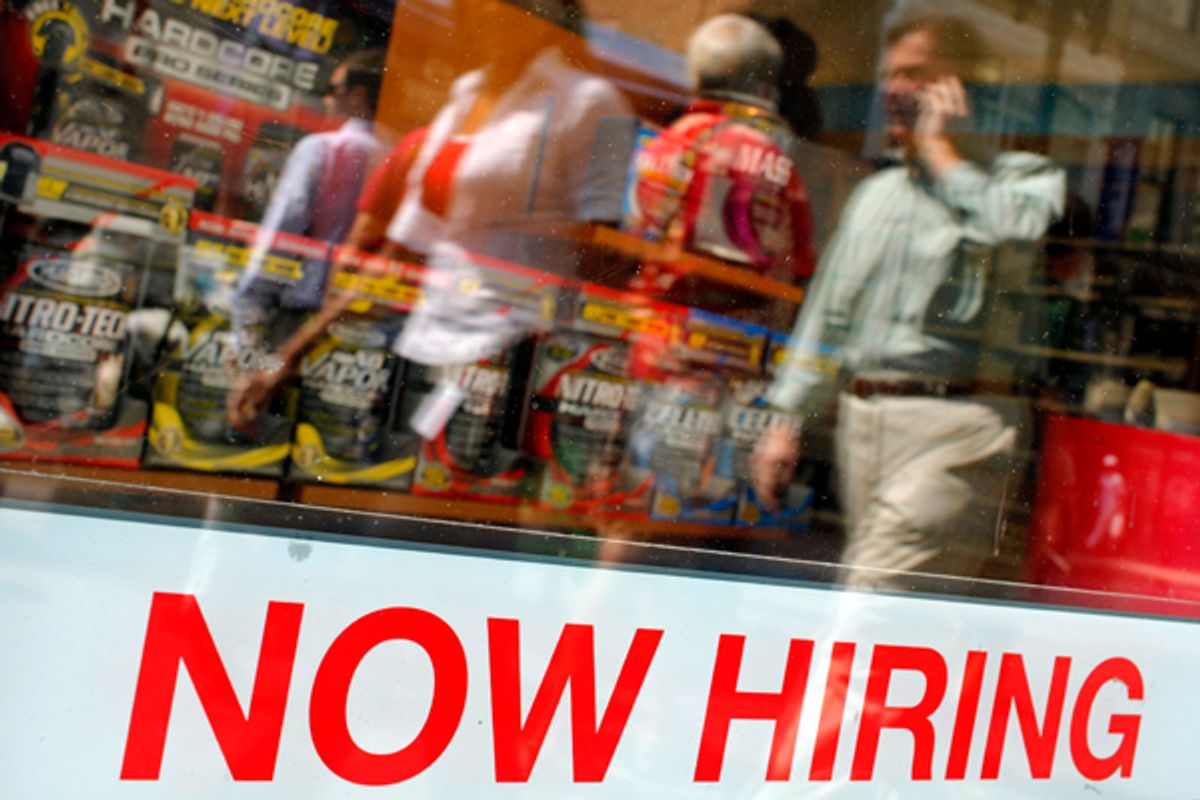
Pedestrians walk past a "Now Hiring" sign in the window of a GNC shop

Pedestrians walk past a "Now Hiring" sign in the window of a GNC shop  (Credit: Brian Snyder / Reuters)

Topics:

It’s always such a shame when the interests of labor don’t match up with the priorities of capital. The Bureau of Labor Statistics reported on Thursday that new claims for jobless benefits fell again last week. But in a Wall Street Journal roundup of reactions to the news, one economist found reason for concern.

Deutsche Bank’s Alan Ruskin observed that the rate at which productivity — the amount of goods and services produced per worker — is growing is beginning to slow down in the United States.

We are at the point in the cycle where squeezing any more output from the existing labor force, with the current capital stock, becomes more difficult and attempts to raise output, force an increase in employment or at least employee hours. The good news is that we are closer to the point where a virtuous cycle of increased demand, driving increased employment and income, generating more demand, is in place. The flip side is that the rise in wages relative to output pushes up unit labor costs and undermines productivity, and could chip into the record profit share of income with some negative implications for equities.

Continue Reading
Andrew Leonard

Andrew Leonard is a staff writer at Salon. On Twitter, @koxinga21.  More Andrew Leonard

Wednesday, Feb 22, 2012 5:10 PM UTC2012-02-22T17:10:00Zl, M j, Y g:i A T

An insider’s guide to the great manufacturing debate

Two economic visions compete for the future of the American economy

Manufactured in America

Manufactured in America  (Credit: Reuters/Anthony Bolante)

Manufacturing is back in the news.  The combination of Obama administration initiatives to help American manufacturing with criticism of China’s unfair trade and industrial policies by candidates for the Republican presidential nomination has produced a bipartisan backlash by prominent academic economists including Christine Romer, a Democrat and a former Obama economic adviser, in the New York Times., and Michael Boskin, a Republican and adviser to the first President Bush.

Continue Reading

Michael Lind’s new book, "Land of Promise: An Economic History of the United States", will be published in April and can be pre-ordered at Amazon.com.   More Michael Lind

Wednesday, Feb 22, 2012 12:45 PM UTC2012-02-22T12:45:00Zl, M j, Y g:i A T

How “uncertainty” didn’t kill the economy

Now that the economy is growing again, it's much harder to argue that healthcare reform is a job-killer

Employees work on the Volkswagen assembly line in Chattanooga, Tenn.

Employees work on the Volkswagen assembly line in Chattanooga, Tenn.  (Credit: Reuters/Billy Weeks)

Topics:

Whatever happened to the dread horror of job-killing uncertainty? Just last year, the talking point was all the rage, unanimously chorused by GOP pundits, politicians and economists looking to hammer President Obama for a stalled-out economy.

The argument was simple: Employers were refusing to hire because they feared the “regulatory uncertainty” flowing in the wake of the passage of the Affordable Care Act and the Dodd-Frank bank reform law. Terrified that the future implementation of these reforms would crimp their profits, employers laid low. A policy analyst at the Heritage Foundation provided the smoking gun: He argued that job growth slowed dramatically almost immediately after the passage of the Affordable Care Act in April 2010 — “this suggests,” he wrote, “that businesses are not exaggerating when they tell pollsters that the new health care law is holding back hiring.”

Continue Reading
Andrew Leonard

Andrew Leonard is a staff writer at Salon. On Twitter, @koxinga21.  More Andrew Leonard

Friday, Feb 17, 2012 9:30 PM UTC2012-02-17T21:30:00Zl, M j, Y g:i A T

The factory jobs aren’t coming back

Romney, Santorum and Obama all vow to fight for U.S. manufacturing. It's not just a lost cause; it's the wrong one

Rick Santorum, Mitt Romney and President Barack Obama

Rick Santorum, Mitt Romney and President Barack Obama  (Credit: AP)

This originally appeared on Robert Reich's blog.

Suddenly, manufacturing is back – at least on the election trail. But don’t be fooled. The real issue isn’t how to get manufacturing back. It’s how to get good jobs and good wages back. They aren’t at all the same thing.

Republicans have become born-again champions of American manufacturing. This may have something to do with crucial primaries occurring next week in Michigan and the following week in Ohio, both of them former arsenals of American manufacturing.

Mitt Romney says he’ll “work to bring manufacturing back” to America by being tough on China, which he describes as “stealing jobs” by keeping value of its currency artificially low and thereby making its exports cheaper.

Continue Reading

Robert Reich, a professor of public policy at the University of California at Berkeley, was secretary of labor during the Clinton administration. He is also a blogger and the author of "Aftershock: The Next Economy and America's Future."  More Robert Reich

Friday, Feb 17, 2012 12:00 PM UTC2012-02-17T12:00:00Zl, M j, Y g:i A T

Is China our future?

If we don't want six-day workweeks at rock-bottom pay, we need to rethink how America's free market functions

An employee works at the Yiwu Lianfa clothing factory in Yiwu, Zhejiang province, June 8, 2011

An employee works at the Yiwu Lianfa clothing factory in Yiwu, Zhejiang province, June 8, 2011  (Credit: Carlos Barria / Reuters)

For the last two decades, we’ve heard many myths purporting to explain the loss of American manufacturing jobs. CEOs, for instance, typically say they have sent jobs overseas because they can’t find skilled American workers. Conservative economists say the giant sucking sound is that of technology replacing obsolete workers. And conservative politicians say job loss is the result of high corporate tax rates, even though ours are among the lowest effective corporate tax rates in the industrialized world.

Continue Reading
David Sirota

David Sirota is a best-selling author of the new book "Back to Our Future: How the 1980s Explain the World We Live In Now." He hosts the morning show on AM760 in Colorado. E-mail him at ds@davidsirota.com, follow him on Twitter @davidsirota or visit his website at www.davidsirota.com.  More David Sirota

Saturday, Feb 11, 2012 8:00 PM UTC2012-02-11T20:00:00Zl, M j, Y g:i A T

The case for a global currency

Would it make more sense to have one currency for the entire world?

currency

 (Credit: Voloh via Shutterstock/Salon)

This article was adapted from the upcoming book, "The End of Money," in bookstores Feb. 14 from Da Capo Press.

In the age of globalization, what does it mean, really, to be from one country and not another? We have some easy answers, along the lines of language, shared history, cultural references, and geography. I grew up cheering for the Red Sox, not the Hiroshima Carp, so that adds to my American-ness. I had to learn about the Federalist Papers in high school. I pay taxes and vote here. All of these things, some minor, some major, contribute to my sense of being part of this country.

Greenbacks do too, whether I like it or not. The coins and banknotes of a place are one of the few remaining touch-points of national identity left in our increasingly digital world. The monuments, symbols, and famous people splashed on them help reinforce this sense of nationhood. But as representations of the currency, they do more than that, because the currency is both the fabric of the economy and the stitching of the state. Even Marco Polo saw this in China, as the currency pulled a vast kingdom together under one umbrella of economic organization.

Continue Reading

David Wolman is a frequent contributor to Wired and the author of the forthcoming book, "Righting the Mother Tongue: From Olde English to Email, the Tangled Story of English Spelling" (HarperCollins).  More David Wolman

Page 1 of 217 in U.S. Economy

Other News