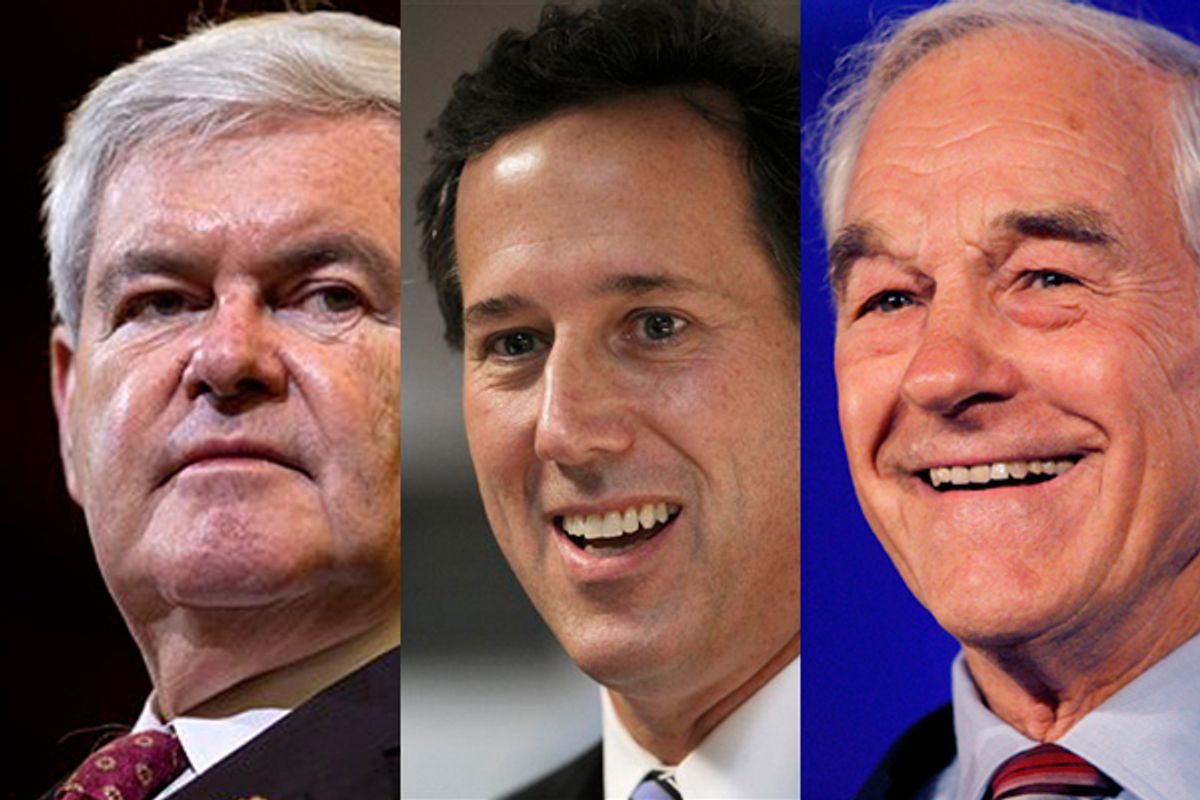
It’s easy to interpret the verbal bile of recent American politics as a new height in prejudiced and conspiracist thinking: a new hate. In the last few years, Sarah Palin has created the concept of Obama’s “death panels,” Glenn Beck has argued that George Soros was a collaborator with the Nazis during WWII — even though Soros is Jewish — and Donald Trump staked his presidential campaign on the idea that our president, black as he is and Muslim as his name seems to be, had not sufficiently proven his rights to citizenship in our country. More recently, Newt has taken to calling Obama the “food stamp president,” a title that is as racially charged as it is inaccurate.
But Arthur Goldwag, author of the new book “The New Hate: A History of Fear and Loathing on the Populist Right,” argues that the racist and conspiracist approach of today’s far-right pundits is largely the same as it was 50 years ago. Their language and theories are taken (sometimes verbatim) from right-wing populist vitriol at early times in American and European history, dealing in tropes well-worn by pre-WWII American Nazis, Joe McCarthy and fanatical anti-Catholic and anti-Masonic Protestant preachers of the 19th century.
Salon spoke with Goldwag — who has worked at Random House and the New York Review of Books and is the author, previously, of “Cults, Conspiracies and Secret Societies” — over the phone about today’s hate, the persistence and remarkable uniformity of American prejudice, and our potential for change.
Why is this resurgence of the “old hate” happening now?
We’re going through a historic shift in this country. We were on an incredible run of prosperity in the 1950s, ’60s and ’70s, thanks to the New Deal social compact, thanks to big unions, thanks to very strong regulation – thanks to all the things that Glenn Beck’s followers think are the most evil things in the world. Fairly unskilled, uneducated people were able to earn a good living, and send their children to college. And that’s changed. Income inequality is growing. If you look at American history, the bottom has dropped out of rural people’s lives every five years, but there used to also be a manufacturing class that made a decent living. There used to be a route for people that weren’t well educated to make a decent living. There isn’t anymore. There’s a lot of anxiety about our individual positions in our society, and our country’s position in the world. If you’re not educated to be able to understand it, and you’re trapped in a disadvantaged life, you might become really, really angry.
So these resurgences of hatred, and conspiratorial narratives, are related to a basic type of class-consciousness – a stripped-down awareness of unfairness.
Yes. It’s an old stereotype (it’s also a true stereotype) that rich Southerners drove wedges between poor whites and poor blacks so that they wouldn’t see that they were all in the same place. That’s very connected to the anger people have today. One of the most infuriating things about Obama to people is that he walks into the White House like he belongs there. But their anger is not really about him. It’s about them: their place in the world. Because he does belong there. But their kids will never go there, because they’re poor and feel they’re without open avenues.
What can we learn from the idea that the new hate is largely the same as the old? Is there a lesson there that can help political discourse move forward with more tolerance and rationality, or is this an endless cycle depending on where the political pendulum is? Or, is it a reminder not to panic, we’ve seen this before?
I’m going to say all of the above. I think it is reassuring to recognize that the scary fringe people that are cropping on the margins of the Internet now really aren’t that much more horrible than people that were cropping up in the past. It was harder to read them before, but they were there. A propaganda novel called “The Turner Diaries“ was written by a white supremacist named William Luther Pierce in 1978. It was self-published, he broadcast his speeches over a short-wave radio, and the book was passed from hand to hand. People at Christian identity compounds read it to each other, and it had a kind of talismanic quality. Now you can just download it on the Internet. And you can see pictures of him and you can watch him giving speeches on YouTube. One of the tricky things about the new hate is that you have access to all of the historic material at once. You can see Robert Welch giving a speech, then you can see Louis Farrakhan giving a speech, then you can see Hitler giving a speech. It’s all instantly available and reinforces each other.
But the types of people who espouse hatred on a broad scale have always been there, and won’t be going away. I look at that like psychology. You’re never going to cure a neurotic. But if you get the neurotic to recognize that some of the things that scare them and agitate them are things that they construct themselves, then maybe they can move forward.
In this case, that means calling out hatred for what it is, and not allowing it to “hide in plain sight,” as you say in the book.
Yes. A useful example is that Ron Paul was a figure in the John Birch Society. It’s no secret. He was a local leader, and he had real associations with white nationalists and very marginal people 20 years ago. But he’s been exposed for that past behavior, and now he can’t rely on it as a type of base appeal – he can’t go too near racism because it’s too dangerous for him. The New Republic brought it to light four years ago, and it became a third rail for him. And that’s a very salutary thing. Once you’ve shown a light on these types of things, they can’t be used anymore. As long as somebody’s pretending that their appeal isn’t racist, they can keep saying, “I’m just terribly concerned because I think you need to be a natural-born citizen to be the president of the United States.” But that’s bullshit and it’s racism and xenophobia and nativism. And once you name it, you can’t go there anymore and still be in the mainstream. If you’re David Duke, you can’t pretend to not be David Duke.
You also say in the book that mainstream discussion has moved farther toward the radical right, and that the new hate is in some ways more accepted than the old. So there seems to be a sweet spot where people in the public eye can avoid the really unacceptable activities – like membership in the John Birch Society – and can still make appeals to racist impulses in their base. But how is it that racist conspiratorial thinking could be more mainstream now than it was at time periods when we, as a country, were more xenophobic and more nativist, as a whole?
Well, I’m not sure that it is. But Ryan Lizza, the other week in the New Yorker, wrote about a study showing that in recent years the mainstream right has moved much farther to the right than the left has moved to the left. You have mainstream people pandering to the base by picking up some of these memes and some of these archetypes from 40 years ago – and much older. It was really horrifying when it first seemed like anti-Islamic sentiment was becoming mainstream.
As far as the snarky racist things that mainstream pundits are able to say about Obama – using the word “ghetto” and so on – that’s just pandering to the lowest common denominator. There’s crappy racism in American society, but every year there is a little bit less of it. Political correctness creates a burden, and coded messages and dog whistles become more of the main operating mode.
But sometimes open discrimination works. Pamela Geller had a tremendous amount of traction in 2010 when she led the charge against the Islamic community center near ground zero. She had the New York Post covering her, and even Harry Reid got scared about the “ground zero mosque.” Newt Gingrich jumped right in and talked about banning Shariah. Anti-Islamic sentiment is so vile. And as a Jewish person, I find it appalling that there are Jewish activists and politicians who don’t see that it is exactly the same thing that was said against us. If you’re Jewish, you know what it is to be completely demonized. It was appalling when the Anti-Defamation League didn’t condemn the attacks on the community center.
How does it work for a publication like Newsweek to take seriously a question like “Is Obama the Antichrist?” as they did? How are they able to do that without being shamed by all serious publications?
Some of it is that they don’t even realize how real that question is to some people. They think, “Oh, this is a funny little item, and we’ll talk to Matt Staver,” the guy they interviewed with that question. Well, Matt Staver’s a real, intense religious fanatic. But people in the mainstream don’t know a lot about that world. The worst thing that most people hear is a few seconds of Glenn Beck or Rush Limbaugh when they’re in a taxicab. But if you spend time at Media Matters or the Southern Poverty Law Center’s “Hate Watch” blog, and so on, or, if, God help you, you go to a white nationalist conference as I did in Washington in September, you know that these ideas have real currency.
My worry isn’t that Newsweek would approach some right-wing guy and get a quote from him, but that they would do it without knowing just how right-wing he is.
Paranoid and fear-based politics tend to rise up at times of national uncertainty – economic distress, political turmoil, and changing social norms all seem to contribute. You pointed out that there are striking similarities between the type of irrational anger faced by John F. Kennedy and the type now faced by Barack Obama. But you say that today, this hatred is “hiding in plain sight.”
Yes, it’s the obvious elephant in the room. For example, the “birther” issue. I couldn’t have imagined it before it began. There’s a judge in Georgia right now who’s demanded that Obama come and explain why he should be in the Democratic primary. A Republican judge said, “I want the president of the United States to come here and make a case for himself.” This is so intensely racist.
One of the most interesting parts of reading your book was learning how anti-communism, anti-Masonry, anti-Catholicism and raced-based discrimination are all tied together, and almost always have been linked to anti-Semitism. The existence or successes of other minority groups were blamed on Jewish people, or these groups were called out as Jews – even the Jesuits. It seems like the only group associated with evil conspiracies to take over the world and not linked to Judaism is Muslims. Is that true?
It’s true, and it’s weird. God knows most Jews were not bankers, and God knows most Jews were not rich. Jews were really poor people. But there were enough rich Jews to make the stereotypes stick, and rich Jews, like others, used the power of finance. You can find writings in the ancient world about the horrors of usury. As many people understand it, usury is a terrible form of magic: you’re making something out of nothing. The Templars were bankers, and all of the things that were said about Jews were said about them too, and they were also associated with the devil. There are mysteries that are just as profound as theological mysteries. People actually get through their lives without being personally affected by the mystery of the trinity, but if you buy a house for the first time and you discover that this $300,000 house is going to cost you $1.5 million, that’s pretty startling, and people think, “How is the bank making so much money out of money?” It makes sense to me that a rural populace in the mid-18thcentury would have latched onto anti-banker, anti-Semitic ideas. They were told to hate Jews anyway, for purely religious reasons. What’s crazy is that 100 years later, these ideas have the same power.
You point out cases in which prejudiced public figures on the left and the right meet at the point of their hatred or paranoia, as with neo-Nazis and Louis Farrakhan. Are there notable newer examples of this today?
Well, you can find that with 9/11 Truthers, and also if you hang around with Ron Paul people. I went to a John Birch Society meeting a month ago, and the people there were surprising. They were all people living off the grid, and they were pot smokers and Ron Paul people. I don’t even know that they would have identified themselves as conservatives. The John Birch Society recruiter there clearly had a lot of experience doing outreach to these types of people.
It seems that people may not even really understand where they are in that case. They may not know what the JBS is in a historical sense – they just know that it’s “alternative.”
I think that’s true. Extremely ideological organizations rely on the fact that you don’t know the whole story. They feed you political talking points and emotional talking points, and you don’t know the rest. I think that’s part of the Ron Paul phenomenon.
It seems there can be a tendency to latch onto a politician whose identity is “alternative” rather than one whose identity is more politically clear.
I think that’s true, and I think that’s a product of resentment and anxiety. It’s a way of individuating yourself. It’s also a not very successful way of escaping from cant that you know is cant. “Oh, the Democrats promised this, the Republicans promised that, but this guy’s a real outsider.” People say they are the true insurgent, and they turn out not to be much of an insurgent, or their insurgency has little to do with what you want from them.
In the book you discuss how right-wing populism has historically demonized academic scholars, and also how it has used selective “scholarship” – misappropriating information and repeating widely discredited ideas. This is, of course, something we can see clearly in characters like Glenn Beck who performed whole episodes of his show writing on a chalkboard and has developed his own recommended canon. How does it work to disparage “experts” and the “elite,” but also rely on this type of pseudo-academia?
Richard Hofstadter discusses this in “The Paranoid Style in American Politics.” There is a whole world of alternative scholarship, and for fanatics it functions like a fantasy world where they can only be right. That’s a psychological phenomenon rather than a political phenomenon to me. People do this in other parts of their lives as well. It’s called denial. You create an alternative reality where you don’t have to believe what you don’t want to. But we can believe Glenn Beck because he has footnotes! They always have footnotes. And Beck’s footnotes refer to Eustace Mullins. Eustace Mullins is one of the most vile, racist writers that you can imagine. I think Hitler would have been ashamed of a lot of what he wrote, but Glenn Beck’s “scholarship” relies on him.
Why doesn’t it matter that radical right-wing sources have been discredited over and over again? As you point out, “The Protocols of the Elders of Zion” – a known forgery – still informs endless right-wing conspiracies – including Beck’s infamous episodes on George Soros. Maybe this information is just too far removed from the original source. But what about Sarah Palin’s creation of Obama’s “death panels”? The correct information was available, but many people didn’t care. Is it all willful ignorance?
Yes. There is a quote from a New York Times Magazine article [“Faith, Certainty, and the Presidency of George W. Bush”] quoting an aid to the president who said that writers were in the “reality-based community,” but that the world didn’t run on reality anymore. There are people who believe they can push through “facts.”
And in surprising ways, that seems to work. If I want to say that person X is wrong, and there is a base of people that will come along with me on whatever trip I have to take to get there, then I’ll do that.
Because that person isn’t just wrong; they’re evil, they’re satanic. Take Newt Gingrich, for example. I truly don’t know what his agenda is, other than that it’s about bringing power to Newt Gingrich. And in order to get power, he will demonize whoever is against him.
Running in the back current of your book, is the distinction between genuine populist interests – improving the lives of working people – and hateful, populist rhetoric.
Yes. As Richard Hofstadter made clear, there is a difference between moral politics and ends-based politics. He said that positivist historians – those who assume that people are voting their economic interests – miss out on something. It’s a fallacy to say that people think economically all the time. Human behavior is not based on maxima. People are superstitious, and people are moral. And sometimes when you feel that your values are not being followed, you get angry.
Another interesting difference between the old hate and the new is that today’s right-wing racists make apologies for language that is too overt. A great example of this that you cite is from the man who runs a website called Jewwatch.com. He said, “It has never been my intent to defame the Jews” – a wild thing for him to say. Why do openly anti-Semitic or racist groups talk this way now? How does this work with their base supporters?
White supremacists repeatedly use a tactic where they claim that they are really just conservative, white-loving, white people. They say: “I don’t hate black people, I love my own kind. What’s wrong with loving your own?” And one of the things that comes with loving your own is obsessing over dark races moving into America and the low white birthrate. It’s about “blood and soil.” Millions and millions of people died because of “blood and soil”.
Another thing that these groups go out of their way to say is that it would be “absolutely wrong” to say terrible things about people that weren’t true. But, if I say that Jewish people are greedy and criminal and are trying to destroy the world, and if it’s true, then there’s nothing anti-Semitic about it. Beyond that, people really have a hard time being mean to people’s faces. If you meet one of these people, or they’re publicly confronted, they sometimes bend over backward to be polite to you. It’s really terribly inconsistent and weird.
What people “really” believe in is an implicit and explicit theme of the book. At the end, you say that leaders of these various hate and conspiracy movements did not really believe the theories they put forth. With entertainer-type pundits – Glenn Beck, Ann Coulter – this seems to make most sense. They profit regardless of their true beliefs. But what about their followers, who don’t necessarily stand to gain anything?
In some cases, people know that something isn’t true, but they “know” that it’s morally true. They may know there aren’t really going to be death panels, but socialism is evil and it will kill people, and so there might as well be death panels. I really don’t think that people believe most of these theories. It’s a type of pornography. There is a sadomasochistic element to the level of hatred found with many of these groups and on their websites. In the book I write about the story of Maria Monk, who claimed to have escaped from a sex den in a Catholic monastery. Her story was false, but at the time it was a real turn-on for people. In “Mein Kampf,” Hitler writes about the Jew waiting to rape the Aryan maiden. People don’t believe these things, but the ideas are so upsetting that they are appealing, and they also have a level of spiritual truth.
You discuss the connection between hateful language and real violence – whether it be JFK’s assassination in 1963 or the Tucson/Gabrielle Giffords shooting of 2011. Do you believe politicians have a responsibility to speak out against rhetoric that can encourage violence?
I think it’s demagoguery to blame the politicians when some crazy person shoots somebody, but politicians are culpable. And no, it’s not nice when some lunatic shoots some nice Jewish congresswoman in Arizona and all of the sudden you’re up in Alaska and you’re being blamed for it. It feels terrible. But, if you’re a politician don’t be a demagogue, encouraging hatred. If you’re Glenn Beck then it’s your job, and you’ve got to tough it out when someone gets killed. You can’t pretend you didn’t say this awful stuff. There was just a politician in Kansas who quoted a Psalm in relation to Obama saying “and may his wife be a widow.” When he was called out on it, he said that he only meant, “may his term be short.” That’s so disingenuous and it’s so wrong, and we shouldn’t be doing it. If you say, “Gee, I wish that person would die,” and they die, you should feel guilty.
Do you think there is a possibility to move away from this type of language? You say at one point that hatred is a Pavlovian response – implying that it comes about as a result of training, and that perhaps we can be trained out of it. It seems that on the mainstream level, maybe we have been trained away from hatred.
I was born in 1957, and I lived in Virginia, and there were colored-only water fountains. I can barely imagine that, but I saw them with my own eyes. If we move away from race and consider gay rights, it’s all happening very fast. Gay marriage is almost mainstream. There will be people who go to their graves screaming about it, but it’s a fact. We can change. People who learn in church that it’s wrong will change when a relative or friend comes out to them, because it’s very hard to hate people you know. The cure for racism is exactly what the Southerners were so terrified of 50 years ago: race mixing. When our families are multiracial – or mixed in religion, or include gay people – the same type of hatred can’t go on.
But there will always be haters, and there will always be fanatics, and it’s the role of the press and the role of writers and the role of thoughtful people to call it out. It’s our job to remind people that even though you’re angry and somebody’s appealing to your worst instincts, you do have better instincts too. You can be better than that. That’s my hope anyway.
At the height of the real estate boom in the 2000s, Robert M. “Robby” Browne, 2007 Corcoran Real Estate National Sales Person of the Year, put on his woman’s bathing suit and silver heels and walked out onto the Club Exit stage. A thousand screaming, cheering, photo-snapping real estate brokers roared their approval. The openly gay Browne, six feet tall and nearly two hundred pounds, danced a sweetly amateurish version of the Village People’s gay anthem, “YMCA,” as ten half naked male Broadway dancers backed him up.
“Is there any question of who the star is?” Browne asks proudly, watching the video today. For most real estate brokers, a third year as Corcoran’s top producer would have been stardom enough, but when Corcoran CEO Pam Liebman began planning the 2007 event, Browne thought he wouldn’t bother to attend. He’d had enough top-earner, $100-million-club years. He was turning sixty, and he was thinking about his life as a whole. Finally he said he would show up, but only if he could accept the award in drag. Browne’s beloved gay older brother, Roscoe Willett Browne, died of AIDS in 1985. He’d never forget the day when President George H. W. Bush said that dying of AIDS wasn’t as important as losing your job. “George H. W. Bush did not acknowledge the sacrifice of my brother and our love. My brother. He’s in his eighties and he still has his brothers and I don’t have any brothers,” says Browne. “And my brother was a Yalie and he was in Vietnam; Bush, how could he be more your person?” We exist, says Browne, looking at the video of his awards ceremony. “This show says we exist.”
Exist? You can’t pick up a paper without seeing evidence that gay people exist and are compelling American society to acknowledge them. The federal government protects them from homophobic violence and twenty-one states have laws against discrimination; 141 cities across the country constitute enclaves of equal treatment. A federal nondiscrimination bill gains more support in Congress with each passing year. Poll numbers show Americans overwhelmingly support protection for gays and lesbians against hate crimes and equality in health benefits, housing, and jobs. In July 2010, a federal judge struck down the federal law, the Defense of Marriage Act, that excluded gays from the federal benefits for which married people were eligible and that allowed the states to refuse to recognize the marriages if they pleased. In August, another federal judge invalidated the amendment to the California constitution, added by Proposition 8, that limited marriage to a man and a woman. September had hardly dawned when a third federal judge found the policy requiring gay soldiers to hide their sexual orientation, don’t ask/don’t tell, unconstitutional as well. The United States Congress repealed the law prohibiting out gays and lesbians from serving in the armed forces. Right after the Fourth of July in 2011, the federal courts in California ordered the United States military to stop screwing around getting ready and just cease enforcing it at once.
Gay playwright Edward Albee’s play about the unbounded nature of love objects, “The Goat, or Who Is Sylvia?,” won the Tony Award for best play in 2002; the heroic biopic about San Francisco gay activist Harvey Milk, “Milk,” won two Oscars in 2009. So many people in show business have come out as gay that some gay media are now pooh-poohing their confessions as cheap shots meant to bolster their flagging careers.
Two of the most famous heterosexual lawyers in America, David Boies and Ted Olson, brought the suit against the California marriage ban in 2009. Win or lose, Boies and Olson’s case has already achieved the crucial social goal of making same-sex marriage a legitimate claim. On the eve of the closing argument in the case in 2010, a New York Times editorial called same-sex marriage “A Basic Civil Right.” In 2011 the poll numbers in favor of same-sex marriage crossed 50 percent. Regardless of intermittent setbacks, gay people like Robby Browne have succeeded in forcing society to acknowledge that they exist—as humans with a right to life and as American citizens with a claim to equality under the United States Constitution. Most of all, they have staked their claim to be treated, without lying or hiding, as moral persons, whose lives, loves, and ambitions have value and cannot be discounted.
The year 2009 saw the fortieth anniversary of the uprising in a New York gay bar called Stonewall. In 1969, “homosexuals,” people who wanted to have sex with members of their own sex, were considered sinful by the church, their sexual practices were criminal in forty-nine states, the psychiatrists said they were crazy, and the State Department held that they were subversive. Forty-two years later, almost to the day, Andrew Cuomo, the governor of the state of New York, signed the law that enabled them to marry in New York. The Empire State Building was lit up in the rainbow colors of the symbolic gay flag.
How did this tiny minority of despised and marginalized people do it? They did it in America, what we philosophers call a “liberal (small L) state.” America’s roots go back to the beginning of modern Western political thought in the seventeenth century, when the philosopher Thomas Hobbes speculated that people create their governments; states are not handed down from God to Adam to the king. During the century and a half after Hobbes wrote, the English and their American colonists launched a variety of social movements—the English Revolution and the American Revolution among them—that pushed and pulled on the deal between people and government until they produced the basic outline of the modern western state, the liberal state. The liberal state makes three promises to its citizens. First, security: the state will protect its citizens from one another and not hurt them worse than the people it is protecting them from. Second, liberty: citizens have certain rights as human beings that even the state cannot interfere with. And finally, self-governance: for those aspects of life the state can control, citizens must decide for themselves on equal terms what they want the state to do. It’s a good deal. No wonder so many people want in.
By the late twentieth century, Americans had already undertaken two great social movements for inclusion in the liberal state, the racial civil rights movement and the feminist movement. Since people aren’t all that easy to organize, theorists have often speculated about how they did it. Their conclusions are that movements arise only when people come to see that their problems are political, not natural or personal, what theorists call “oppositional consciousness.” This “aha!” moment in the civil rights movement dates back at least to W. E. B. Du Bois in 1903, when he observed that “the problem of the Twentieth Century is the problem of the color-line.” In addition, movements need access to resources, as when the NAACP started getting hold of real money and the movement gained astute leaders, such as Martin Luther King Jr.
Students of the racial civil rights movement made the assumption that before people engage in new movements they do a rational cost-benefit analysis, weighing the benefits of political action against the cost. When people created social movements against all odds and acted against their own individual self-interest on behalf of the group, theorists had to rethink what really drives people to take action. As the racial civil rights movement gave way to other movements—the feminist, and, finally, the gay-liberation movement—sociologists produced more theories to explain the new movements; indeed, the later thinking is often called “new social-movement” theory. In the newer thinking, theorists speculated that people draw their sense of who they are from the groups or social networks they are already in. From those starting places, they conceive a positive vision of themselves and then a desire to change the way the larger society perceives them all. New social-movement theorists came to the realization that sometimes group identity is so strong that people act on behalf of the group whether it benefits them individually or not.
Classical or new, each of the movements before the gay movement was seeking citizenship in the liberal state. Women and racial minorities did not necessarily ask the dominant society to love them or approve of them. They sought to be secure against violence, to be tolerated as they exercised their human liberty, and to have equal access to political and economic life. Each movement got traction in these crucial areas. But both of them fell short of achieving all the elements of a full human life for most of the people they represented: they got little or no economic assistance or cultural validation, and, when the inevitable backlash came, they stalled or lost ground. It would take a newer new movement to make the next moves: it would take the gay revolution.
The gay revolution achieved more because it faced different challenges. The path to liberal equality almost always involves mimicking as much as possible the behaviors and beliefs of the straight white men in power. The racial civil rights and feminist movements both made substantial detours into defending difference—black separatism and difference feminism. They failed to establish that their divergent cultures were as worthy as the dominant one and all they did was to split their movements. At the end of the day, both these modern movements got most of their traction from maximizing their similarity to dominant political and social hierarchies.
By definition, people involved in the gay revolution could not replicate the majority behavior. Their very political identity was behavior that distinguished them from the majority, including, but not limited to, their sex lives. The liberal state has a basic concept of a person entitled to be a citizen. When gay activists began their efforts, the churches considered them sinful, all but one state criminalized their sex acts, the doctors thought they were crazy, and politicians saw them as traitors to the nation. Sinners were kept away from sacred rites like marriage; criminals were imprisoned; crazy people were put in asylums; and people of doubtful loyalty were fired from their government jobs. Sinful, criminal, crazy, and subversive, the gays who made the gay revolution had the vastly harder task of convincing society to recognize they were even suitable candidates for citizenship despite their difference. Although liberalism pretends to be morally neutral, homosexual sexual behavior pressed that liberal commitment to the limit. In so doing, instead of bringing their marginal group into conformity with the mainstream norms, they challenged the accepted versions of sin, crime, sanity, and loyalty and changed America for everyone.
The movement succeeded, uniquely and in large part because, at the critical moments, its leaders made a moral claim. “Gay,” as movement pioneer Franklin Kameny put it on the iconic button of the gay revolution in 1968, “Is Good.” Even though it’s different. No one told it better than activist Arthur Evans: “It was more than just being gay and having gay sex. We discovered who we were and we built authentic lives around who we were and we supported each other doing that and in the process came to very important questions about the meaning of life, ethics, the vision of the common good and we debated these issues and we lived them.”
Morally ambitious and clearly identified as different, the gay movement came from further behind than either the civil rights or the feminist movements had done. It took on the liberal state and achieved formal equality, as did the other two movements. During the AIDS epidemic, it took on not just oppression, but neglect. And then it took on the traditional institutions of heterosexual morality—marriage and the military—and is rapidly conquering those arenas as well.
Fueled by its moral ambition, the gay movement is the model of a new era. It is ironic, yet fitting, that the only counterpart to the morally driven gay revolution is its contemporary and fiercest opponent, the morally driven religious right. Indeed, it is the moral certainty of the gay revolution that explains why, unlike the racial and feminist movements, it has been able to stand up to that powerful counterforce and, slowly but surely, prevail.
The theories all suggest that a whole lot of things have to go really right for people to act collectively against legitimate political authority. Lacking the religious and historical jet fuel of racial civil rights and the demographic advantage of feminism, the gay revolution started out from much the weakest position of any of the modern movements. Brilliantly led, endlessly resourceful, and stunningly creative, it came the furthest. When we ask how a cross-dressing homosexual activist got to be the poster boy of the most successful real estate brokerage firm in New York, we are also asking how people cooperate to get anything done, much less take on their whole society and wrench it onto a different path altogether. The gay Victory is not just a story, although that would be enough. It’s an epic.
From the book “Victory: The Triumphant Gay Revolution.” Copyright © 2012 by Linda Hirshman. Reprinted courtesy of Harper, an imprint of HarperCollins Publishers.
Continue Reading
Close
“[T]he United States cannot afford another decline like that which has characterized the past decade and a half….[O]nly self-delusion can keep us from admitting our decline to ourselves.”
– Henry A. Kissinger, 1961
In these words, one of America’s most distinguished strategic thinkers and policy makers expresses alarm at America’s condition and the perils it faces. The warning seems timely, yet it was written more than half a century ago as an assessment of the Soviet threat, problems with allies and the developing world, and in frustration with what the author saw as dangerously inadequate policy and strategic choices. Henry Kissinger was by no means alone. He cited George Kennan’s lament about our domestic failings with race, the cities, the education and environment of our young people, and the gap between expert knowledge and popular understanding, even while criticizing Kennan’s focus on those problems to the exclusion of military and diplomatic threats.
Since World War II, the United States has been the preeminent actor in world affairs. Its status at the end of that conflict, its role in creating postwar international institutions, its leadership in the reconstruction of Europe and Japan, and its dominant status within the Western alliance during the Cold War are well known and beyond dispute. With the collapse of the Soviet Union in 1991, America emerged as the lone superpower. Yet some two decades later, its position of both absolute and relative power appears to have deteriorated. Many scholars and strategists point to economic, structural, political, and even military vulnerabilities, and contend that the United States is in serious decline. Meanwhile, the rise of important regional actors, especially Brazil, Russia, India, China and South Africa (the BRICSs), as well as others such as Indonesia, Turkey, Iran, and the increasingly prosperous and dynamic countries of East and Southeast Asia, is said to be seriously diminishing U.S. primacy in world affairs.
These depictions are pervasive on the Internet and in the press. A quick Google search for the term “American decline” yields 117 million “hits” in 0.13 seconds. A columnist for The New York Times writes that, “Wherever you choose to look . . . you’ll see a country in sad shape.” A leading German news magazine headlines, “A Superpower in Decline.” And from the realm of pop culture, the comic book action hero Superman renounces his U.S. citizenship. But are such assessments accurate?
Two propositions are widely asserted by those who see the ebbing of American predominance: first, that America itself as a society, an economy, and a political power is in decline; and second, that its international primacy is eroding as a result of the rise of other countries.
On the domestic front, the effects of a severe financial and economic crisis, an unprecedented national debt and deficit, a yawning balance of trade and payments deficits, and an aging and overloaded infrastructure lead a prominent financial journalist to foresee “the beginning of the end not just of an illusory ‘unipolar moment’ for the US, but of western supremacy in general and of Anglo-American power, in particular.” Fareed Zakaria, a widely quoted public intellectual, warns that America has become an “enfeebled” superpower and embellishes his case by observing that the world’s tallest Ferris wheel is now in Singapore and the largest casino is in Macao. For good measure he adds: “America’s success has made it sclerotic.”
Without a doubt, the United States now confronts serious problems at home and abroad. Nonetheless, recent declinist arguments carry an unmistakable echo of the past. Antecedents of these views were apparent in the 1970s, 1980s, and 1990s, and on occasion were even phrased in identical language. Indeed, declinist proclamations have appeared on and off since the late eighteenth century.
For the United States, historical as well as relatively recent comparisons provide evidence for its robustness and adaptability as a society and as a leading power. Time and again, America has faced daunting challenges and made mistakes, yet it has possessed the inventiveness and societal flexibility to adjust and respond successfully. In this regard, neither the rise of the BRICS and other regional powrs, nor competition in a globalized world economy, nor “imperial overstretch,” nor domestic weakness are by themselves bound to have the transformative effects that have been so often suggested. Despite major changes and severe challenges, these domestic and international constraints do not in themselves predetermine the end of America’s international predominance. All the same, just because America has previously overcome adversity and retained both its strength and international primacy does not guarantee that it will do so now.
Debate about America’s world role is nothing new. One notable version of it took place in the late 1980s. Paul Kennedy’s 1987 best seller, “The Rise and Fall of the Great Powers,” became one of the most widely cited books of that era. Kennedy cautioned that the United States ran the risk of “imperial overstretch,” which he defined not just in terms of military commitments, but in regard to the balance between resources and obligations. In a 1990 response, Joseph Nye was less pessimistic, arguing that the issue was not one of resources per se, but of policy and choice – that is, that to the extent the United States faced a problem, it was because it “lacks the will, not the wallet.”
The problem of “wallet” has since become more pressing. Even before the financial crisis that began in 2008, the historian Niall Ferguson cited the shift in America’s balance of payments and the change in its net international investment position – the difference between American-owned assets abroad and foreign-owned American assets – as a sign of deterioration. In doing so, he invoked comparisons with the decline and fall of the Roman Empire nearly two millennia ago. The comparison is tempting, but as with the parallels to the British experience of the past century, its relevance is tenuous at best.
Certainly the domestic situation is more difficult now than two decades ago. Yet while these problems should not be minimized, they should not be overstated either. Contrary to what many observers would assume, the United States has managed to hold its own in globalized economic competition and its strengths remain broad and deep. For the past several decades, its share of global output has been relatively constant at between one-quarter and one-fifth of world output. According to data from the International Monetary Fund (IMF), in 1980, the United States accounted for 26.0 percent of world GDP, and in 2011, 21.5 percent. These figures are based on GDP in national currency. Alternative calculations using purchasing power parities are somewhat less favorable, but still show the United States with 19.1 percent in 2011, as contrasted with 24.6 percent in 1980.
Moreover, America benefits from a growing population and one that is aging more slowly than all its possible competitors except India. And despite a dysfunctional immigration system, it continues to be a magnet for talented and ambitious immigrants. It is a world leader in science and in its system of research universities and higher education, and it has the advantage of continental scale and resources. In short, the United States remains the one country in the world that is both big and rich.
In addition, the American military remains unmatched and, despite intense stress from a decade of war in Afghanistan and Iraq, it has not suffered the disarray that afflicted it in Vietnam. This is evident in terms of indicators such as successful recruitment and performance of the volunteer force, the ongoing quality of the officer corps, and broad public support for the military as well as casualty tolerance. Moreover, in its capabilities, technology, capacity to project power, and command of the global commons, the United States has actually increased its military margin as compared with others, although with the important and challenging exception of China.
Beyond material strengths, the society itself benefits from a durable political system, rule of law, vigorous free press and information media, and a competitive and adaptable economy, as well as strong traditions of entrepreneurship and innovation, leadership and critical mass in new technology, and a history of resilience and flexibility in overcoming adversity.
The declinist proposition that America’s international primacy is collapsing as a result of the rise of other countries should also be regarded with caution. On the one hand, the United States does face a more competitive world, regional challenges, and some attrition of its relative degree of primacy. This process, or diffusion of power, is not exclusive to the post–Cold War era, but began at least four decades ago with the recovery of Europe and Japan from World War II, the rise of the Soviet Union to superpower status, and the emergence of regional powers in Asia, Latin America, the Middle East, and Africa. Still, in contrast to other great powers that have experienced decline, the United States has held a substantially more dominant position. For example, Britain at the start of the twentieth century was already falling behind Germany and the United States, although it did manage to continue for half a century as head of a vast empire and commonwealth.
Because of the enormous margin of power the United States possessed after the end of the Cold War, it should be able to withstand erosion in its relative strength for some time to come without losing its predominant status. While it is true that the weight of important regional powers has increased, many of these are allied or friendly. Those that are not (Iran, North Korea, Syria, and Venezuela) do not by themselves constitute serious balancing against the United States and its allies. Russia occupies an intermediate position, at times acting as a spoiler, but not an outright adversary. China presents a potentially more formidable challenge, notably through its growing economic might and the rapid expansion of its military capacity, but it has not yet become a true peer competitor. In any case, and despite the burden of a decade of war in the Middle East, America continues to possess significant advantages in economic breadth and depth, science, technology, competitiveness, demography, force size, power projection, military technology, and even in learning how to carry out effective counterinsurgency, and thus retains the capacity to meet key objectives.
In sum, although the United States predominates by lesser margins, it still remains a long way from being overtaken by peer competitors. However, given profound disagreements about policy, intense partisan rancor among political elites, growing social-class division, distrust of government, and deep disagreement about foreign commitments, nonmaterial factors could prove to be a greater impediment to staying power than more commonly cited indicators of economic problems and military overstretch. The United States retains the power and capacity to play a leading world role. The ultimate questions about America’s future are likely to be those of policy and will.
Power and Willpower in the American Future: Why the United States Is Not Destined to Decline, by Robert J. Lieber Copyright © 2012 Robert J. Lieber. Reprinted with the permission of Cambridge University Press.
Continue Reading
Close
An ancient and priceless book, a murky history of evasions and coverups, an underground of sinister and possibly violent dealers, a former spy who drops tantalizing hints and a wily 84-year-old millionaire who says stuff like, “The problem with this story is that it could damage your health”: Are these the ingredients for a cheesy, improbable historical thriller? Yet “The Aleppo Codex,” Matti Friedman’s account of his attempts to learn the history of one of the world’s most precious books, sports all of these assets, and it’s nonfiction. If reporting this story damaged Friedman’s health, it probably happened when he realized what he’d stumbled into and his reporter’s heart started beating in doubletime.
The Aleppo Codex is the most authoritative version of the Hebrew Bible, produced in the 10th century by the great rabbi Aaron Ben-Asher and the scribe Shlomo ben Buya. Friedman, who lives in Israel and has covered the Mideast and the Caucasus for the Associated Press and other publications, explains that the codex’s significance to Jewish faith and identity is more than symbolic. As a people scattered across the globe, “instead of being bound by a king, a temple, or geography, [Jews] needed to be bound by something else, something portable. What emerged was the idea that a people could be held together by words.” Yet in the centuries before printing, when words were transmitted orally and by copyists, it was all too easy for mistakes and variations to creep in, and “Jews could not be held together by a book if they were not reading precisely the same one.”
The codex was the perfect version of the Bible, a sort of atomic clock of Judaism, and intended to be the model for all subsequent copies. Its early history was fraught: captured by Crusaders in the fall of Jerusalem, ransomed by the Jewish community in Cairo and consulted by the fabled sage Maimonides, it was eventually taken to the Syrian city of Aleppo. There, it resided for half a century. Although it was well-cared-for by Aleppo’s Jewish community, it had come to be revered as a relic or treasure; few were allowed to see it and no one was allowed to copy it.
All that changed in 1947, when the establishment of the state of Israel by a United Nations resolution led to unrest in the Arab world and the harassment and persecution of Jewish communities in Muslim nations. In Aleppo, this took the form of riots and the sacking of the synagogue. The codex — commonly referred to as the Crown — was supposed to have been consumed in a fire set by the mob.
It was not, and in 1958, the Crown was smuggled into Jerusalem by a cheese merchant who was one of the few Syrian Jews to receive official permission to emigrate to Israel. Friedman became interested in this “lonely treasure and millennium-old traveler” in 2008, when he decided to write an article about it. He imagined the piece would be “an uplifting and uncomplicated account of the rescue of a cultural artifact,” but what he discovered instead was a thicket of conflicting reports, missing records, puzzling omissions, stonewalling officials and obsessed amateur sleuths.
The mysteries surround not the ancient history of the book, but what happened to it between 1947 and the mid-1970s, although even establishing where things got dodgy proved to be a challenge. Friedman relates each piece of the story as he untangled it himself, and part of the pleasure of “The Aleppo Codex” is getting to tag along on the heels of a real-life investigative journalist as he does his detective work. Those years spent writing wire copy have not eroded the author’s eloquence, either, as the book’s headier touches attest: “Down in those streets, the stores now shuttered, the women of the manzul were receiving clients, and the men were submerged in cafe smoke like deep-sea divers, tubes between their lips, inhaling the rose-scented oxygen of water pipes.”
While the official story simply states that the Crown was presented to the president of Israel, Itzhak Ben-Zvi, upon its arrival in Jerusalem in 1958, Friedman unearthed evidence that this was no simple handoff. Most of the Jewish community of Aleppo had immigrated to Israel, and their rabbis insisted that the Crown was supposed to have been delivered to them. The cheese merchant maintained that the rabbis still living in Aleppo, the ones who had passed him the book, told him no more than to give it to “a religious man.” (The Syrian government prevented communication with the Jews in Aleppo, so his story could not be confirmed or disproved.) The Aleppo rabbis decided to take their complaint to court.
This dispute embodied major tensions within the newly formed state. The Aleppo rabbis had presided over what was, as Friedman writes, “an old community by the time Roman legions destroyed the Jewish temple in Jerusalem in AD 70.” The Israeli leadership, “largely secular European socialists,” did not strike the Aleppo Jews as “representing the entire Jewish people.” Why should these interlopers be allowed to appropriate a book that had been the focal point of Aleppo’s venerable Jewish community for half a millennium?
The codex lawsuit was also a dramatic example of what Friedman describes as a “largely untold story” concerning the migration of the Jewish Diaspora to Israel after the formation of the state. Along with the movement of people, there was also a “great migration of books.” Jews from all over the Muslim world were forced to leave neighborhoods their families had inhabited for centuries. Not only did distinctive local cultures vanish overnight, but so did many of their treasured texts, left at docks and airstrips with the promise that they would be forwarded on to their owners in Israel, and then never seen again. Well, not exactly never: Some of these books and scrolls turned up later in state archives and even in booksellers’ shops.
If that were all there was to the story of the Aleppo Codex, it would be fascinating (and dismaying) enough, but after wrestling with the shadowy story of how the Crown got to Jerusalem, Friedman turns to a second and even more disturbing question: Where is the rest of it? About 200 pages, some 40 percent of the Crown, are missing. These are the most important parts of all: the first five books of the Bible, also known as the Pentateuch and the Torah. Again, the official story holds that portions of the Crown were burned in the 1947 fire, but this has since been disproved. A couple of single pages have been found in places as far-flung as Brooklyn, N.Y., where they were carried around by Aleppo old-timers as good-luck charms. The bulk of the Torah, however, remains MIA.
This is where Friedman’s investigation gets especially lively, as he consults with a former Mossad case officer and secretly records an impromptu interview with one of the dozen or so men rich enough to have bought the missing pages. Supposedly, this collector and his daughter were approached by two dealers with a briefcase at a Jerusalem book fair in the 1980s. They were shown an old codex identified as part of the Crown, but the collector says he refused to buy it because the price was too high. One of the dealers later turned up dead in a Tel Aviv hotel room registered to a man who didn’t exist.
Friedman has his suspicions about the collector’s story: Would this man really consider $1 million too much to pay for a supposedly priceless text? He devotes most of his energy, however, to getting to the bottom of who is responsible for ripping out the heart of the Crown and selling it on the black market. As he settles on three likely culprits, “The Aleppo Codex” builds to a moral crescendo more impressive than the climactic fight scene in any thriller. “A volume that survived one thousand years of turbulent history was betrayed in our times by the people charged with guarding it,” Friedman writes. “We might file this tale between Cain and Abel and the golden calf, parables about the many ways we fail.”
Continue Reading
Close