
Imprint
America’s forgotten Buddhist superhero
A New York gallery pays homage to a 1940s pulp magazine hero, the Green Lama
Sunday afternoons in New York can lead to all sorts of odd discoveries. This most recent one brought me to the Rubin Museum of Art on 17th Street and into an arts mashup the likes of which I have never seen and probably would not have believed if someone were to tell me about it.
First of all, you should know that the museum (my new favorite as it turns out; just spend five minutes in the serenity of the cafeteria to understand why) has an ongoing exhibition called Hero, Villain, Yeti!: Tibet in Comics. Reason enough to explore. But Sunday’s particular multi-pronged program featured an original commission by the acclaimed visionary composer Paul Haas. For this event, Haas created a synchronized work to accompany the panels of the 1940s cult classic comic book hero the Green Lama. “Part radio-play, part light show, part silent film, part concert, this unique offering by Sympho and the musical trio MAYA,” provided a narrative score for the sequential projections of panels from Episode 2 of the Green Lama comic book series. Hosted and narrated by WNYC’s Elliot Forest, the event featured noted actors Linus Roache (“Law & Order”) and Brian Cox (“X-Men,” “Troy,” virtually everything else) voicing the characters. I mean, really, with that setup, how could you lose?
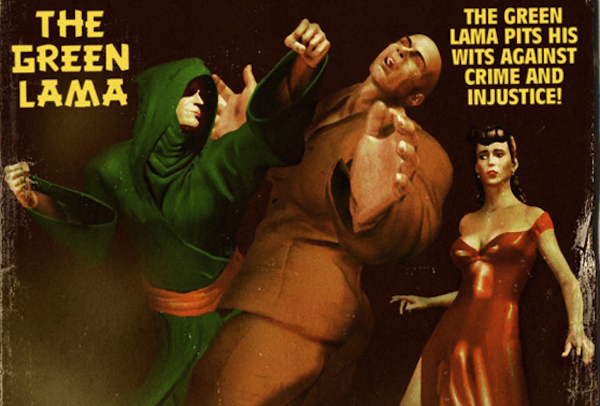
If you have never heard of the Green Lama (and I admit, even as a comic book nerd, I hadn’t) apparently he was an American pulp magazine hero of the 1940s whose superpower was imparted by, of all things, Buddhism. Om mani padme hum. Such is the mantra of billionaire playboy Jethro Dumont (best billionaire playboy superhero name ever) when he wants to magically turn into his crime-fighting alter ego, the Green Lama. With his trusty sidekick Tsarong, Dumont/Lama battles evildoers like Willie the Sleeper and the Mad Magi.
While the premise of the Green Lama’s power purports to be divined by the enlightened, the writing is pure pulp and camp (as evidenced by the panels included here).
But discovering a long lost superhero was really just part of the fun. Surreal as it was, the combination of the excellent music by MAYA (harp, flute and percussion), along with the spirited voice-overs, and the lighting/synth/background artistry by Haas himself, created a mixed-media sensory experience that was like nothing I’ve seen before and, dare I say it, it even bordered on the spiritual.
Copyright F+W Media Inc. 2011.
Salon is proud to feature content from Imprint, the fastest-growing design community on the web. Brought to you by Print magazine, America’s oldest and most trusted design voice, Imprint features some of the biggest names in the industry covering visual culture from every angle. Imprint advances and expands the design conversation, providing fresh daily content to the community (and now to salon.com!), sparking conversation, competition, criticism, and passion among its members.
Our bodies, our products
A look back at the long tradition of creating memorable trade characters from the objects they sell
I bet many of you don’t know what the Michelin Man, also known as the Bibendum, is made of. Take a wild guess! French cartoonist Marius Rossillon, also known as O’Galop, created the prototype for a Munich brewery (he was holding a glass of beer and quoting Horace’s phrase “Nunc est bibendum” — now’s the time to drink). It was rejected. But the Michelin brothers saw the image and suggested replacing O’Galop’s man with a figure made — yes indeed — from tires. Voila! The Bibendum is now one of the world’s most recognized and collected trademarks in the world.
When nuclear terror reigned
Old handbooks about atomic annihilation allow a fascinating glimpse into some of our greatest fears
England has a long tradition of dystopian prophecy in literature and cinema. The likes of H.G. Wells, George Orwell, J.G. Ballard, and Ridley Scott all seem to revel in presenting doomsday scenarios. Films such as 1961′s “The Day the Earth Caught Fire,” and the 1965 BBC docudrama “The War Game,” depicting a Soviet nuclear strike on England, as well as books like Raymond Briggs’ “When the Wind Blows,” a deceivingly innocent tale of untold horror, are among the works that underscore the British fascination with and fixation on nuclear devastation.
Illustrating the ’60s music revolution
How one book captured the spirit and art of the cultural transformation -- as it was happening
“When did music become so important?” That’s Don Draper from last week’s “Mad Men,” set in 1966. Later in the episode he turns off “Tomorrow Never Knows,” from the Beatles album “Revolver,” and walks out of the room.
How to resurrect a comic book
Should revived comics be made to look new or faded? Two releases explore both approaches
Memory is evanescent. I can’t recall where I made the purchase; perhaps it was during an elementary-school or Cub Scout trip. Nor do I remember my exact age; it was anywhere between 8 and 10. What I do remember vividly is the visceral experience: the feel and smell of the paper as I unfurled it. The sense that I was both witnessing and experiencing history, which I then held tangibly in my hands. In the morning of that day, my mother had given me some small change for the day’s trip, and I spent it on a reproduction of the Declaration of Independence. It was printed on a rough-hewn, yellow paper stock with stains on both sides, and it had a rigidity that made it hard to open (it was folded in quarters). The reproduction possessed a distinct smell, and the texture was coarse, as if it was once damp and left to dry. “Onion paper,” my mother explained when I got home. It sounded exotic. Sadly, I’ve forgotten the whereabouts of that formative piece of paper, but the power of the experience has remained.
Steven Brower is a graphic designer, writer and educator and the former Creative Director/ Art Director of Print. He is the author/designer of books on Louis Armstrong, Mort Meskin, Woody Guthrie and the history of mass-market paperbacks. He is Director of the “Get Your Masters with the Masters” low residency MFA program for educators and working professionals at Marywood University in Scranton, Pa. @stevenianbrower More Steven Brower.
Donny Osmond: Design icon
In the1970s, teen magazines were my obsession -- and inspired my love of design
Before there was a Justin Bieber — before there was even a Justin Timberlake — there was Donny Osmond. One summer night in the 1970s, my poor older brother, Mike, was forced to take his preteen sisters to see Donny and those other Osmonds, as well as the Jackson 5, at New York’s Madison Square Garden.
Imagine the stress of worrying about two adolescent girls and their obligatory mutual friend dancing their way down from the cheap seats to the slightly better view one section below. Mike was in college, and my sister and I weren’t even in high school yet. I guess that’s why our brother sat ducked down in his seat, hiding behind a newspaper.
Page 1 of 47 in Imprint


