Iran
Israel’s real target: Obama
Prime Minister Netanyahu's threats have more to do with challenging Washington than with actually attacking Iran
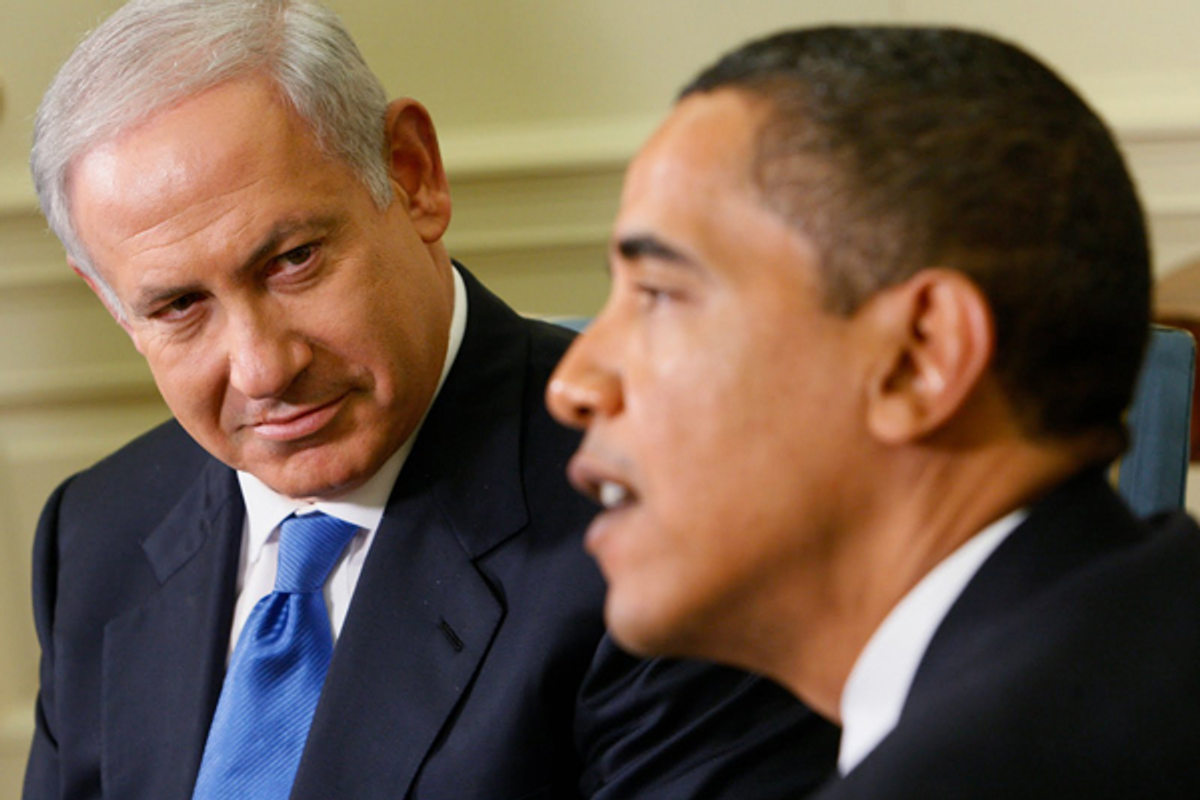
Israeli Prime Minister Benjamin Netanyahu and President Obama (Credit: AP) After being elected in large part because he’d opposed a “dumb” war in Iraq, President Obama finds himself confronting an even dumber one in Iran. Exponentially dumber, actually.
Dumb because like the targeted assassinations of Iranian nuclear scientists rarely cited by columnist commandoes, bombing raids alone can’t achieve the alleged goal: preventing the Ayatollahs from acquiring nuclear weapons.
Slow them down, probably. Stop them, no. Short of a full-scale invasion and occupation of a nation three times larger than neighboring Iraq in population and five times larger in land area, that can’t be done. Global disapproval didn’t stop North Korea, Pakistan or, for that matter, Israel.
Exponentially dumb because it could set the entire Middle East aflame.
You’d think the Israelis, of all people, would recognize that threatening a people with death and destruction hardens their resolve. Yet the New York Times reports that Israeli Prime Minister Benjamin Netanyahu “told visitors that he believes the Tehran government to be deeply unpopular, indeed despised, and that a careful attack on its nuclear facilities might even be welcomed by Iranian citizens.”
Yes, and Dick Cheney predicted that U.S. forces invading Iraq would be greeted with candy and flowers. “Most analysts [in Jerusalem] and abroad,” the Times noted cautiously, “take a different view.” Indeed, historical examples of civilian populations cheering on aerial bombardments are rare, if not nonexistent. Despite his and Cheney’s obvious affinities, one would expect Netanyahu to be made of saner stuff.
Assuming that the Israeli prime minister’s motives for threatening a unilateral Israeli strike against Iranian nuclear facilities are as reported. I suspect they are not. To put it bluntly, it’s not so much the regime in Tehran that Netanyahu is keen to destabilize as the one in Washington. The question now is how far he’s willing to take it.
Despite media chatter about “red lines” being crossed, it’s hard to point to anything the Iranians have done to provoke the current crisis. They’ve been trash-talking since 1979. Otherwise, no Iranian armies are massing. With its navy badly outgunned in the Persian Gulf, and a vestigial air force scarcely capable of defending against Israeli bombers, Iran sits surrounded by U.S. bases in Turkey, Saudi Arabia, Iraq, Pakistan, Afghanistan — well, everywhere.
Iran’s last military action of any consequence was its catastrophic 1980s war with Saddam Hussein’s Iraq, during which it suffered more than a million dead. The Persians haven’t actually invaded anybody for more than 300 years. The Shiite regime’s expanded regional influence came about as an unintended consequence of the U.S. invasion of Iraq.
For what it’s worth, the Ayatollahs deny any intention of attacking the “Zionist Entity”— despite frequently wishing that it would vanish from the earth. Even Iranian clients Hezbollah and Hamas have been mostly quiet. With Iran’s economy faltering under economic sanctions engineered by the Obama administration, and much of its population seething with resentment amid an acrimonious feud between President Ahmadinejad and Supreme Leader Khameni, the Tehran regime’s got all it can do to survive, much less to start a suicidal conflict with Israel — not to mention the United States.
But when articles invoking the Holocaust and urging “creative destruction” in Iran appear on the same day (Feb. 7) in the Washington Post, Wall Street Journal, Newsweek and Bloomberg News, a skeptical observer might be forgiven for suspecting a well-coordinated propaganda campaign.
Writing in Beirut-based Al-Akhbar, American journalist Max Blumenthal dates its inception to a Jan. 3 article in Israel Hayom revealing that Israel’s National Security Council — basically Netanyahu’s closest political allies — had concluded that “U.S. President Barack Obama is ‘naive’” and fails to understand Israel’s precarious position. Deemed a Likud Party organ, the newspaper is owned by multibillionaire Las Vegas casino tycoon Sheldon Adelson, who bankrolls Netanyahu and serves as Newt Gingrich’s Sugar Daddy too.
Netanyahu appears to see an Obama second term as an impediment to further Israeli expansion into the West Bank — or “Judea” and “Samaria,” as Likudniks style it — and has cast his lot with the Republican right. He’s made public appearances with notables like Glenn Beck and “End Times” evangelist John Hagee. Adelson himself has pledged his vast resources to Obama’s defeat.
In his State of the Union speech, President Obama reiterated his determination to prevent Iran’s getting nuclear weapons. He said he was “taking no options off the table.” But he also expressed hope that international sanctions could lead to a peaceful resolution.
On cue, Washington Post columnist Richard Cohen called this “startlingly naïve.” Only a fool or a Frenchman, the same pundit once opined, could doubt the existence of Saddam Hussein’s WMD. Bombs away!
President Obama also reportedly dispatched Joint Chiefs Chairman Gen. Martin Dempsey to Israel to warn Netanyahu that if he tries to force the United States’ hand, he’s on his own.
But can he make it stick?
For his sake and everybody else’s, he’d better.
Arkansas Times columnist Gene Lyons is a National Magazine Award winner and co-author of "The Hunting of the President" (St. Martin's Press, 2000). You can e-mail Lyons at eugenelyons2@yahoo.com. More Gene Lyons.
Energy wars heat up
From Africa to South America, conflicts over waning resources are becoming more tense -- and dangerous
A member of the military stands guard near pump stations before a
ceremony in which oil operations at Heglig oilfield will resume in
Heglig, Sudan, May 2, 2012.
(Credit: Reuters/Mohamed Nureldin Abdallah) Conflict and intrigue over valuable energy supplies have been features of the international landscape for a long time. Major wars over oil have been fought every decade or so since World War I, and smaller engagements have erupted every few years; a flare-up or two in 2012, then, would be part of the normal scheme of things. Instead, what we are now seeing is a whole cluster of oil-related clashes stretching across the globe, involving a dozen or so countries, with more popping up all the time. Consider these flash-points as signals that we are entering an era of intensified conflict over energy.
Continue Reading CloseNYPD must spy on all Muslims to protect us from Iranian photographers
New York City's own constitutionally iffy intelligence agency justifies itself with fear-mongering
Ray Kelly (Credit: Reuters/Brendan McDermid) The NYPD is less a “police department” than a secretive and unaccountable international intelligence-gathering organization with a large minority-frisking division and the firepower of a mid-sized army. Lately they have been facing a bit of criticism for their style of intelligence-gathering, which seems to be done with more gusto than concern for civil liberties or… accuracy. Sometimes the NYPD’s muscular-but-stupid approach to spying gets them in trouble with the FBI. And when the organization that fights terror by recruiting shady weirdos to try to trick random Muslims into saying “jihad” into tape recorders says your practices are counterproductive and out of line, they are probably pretty counterproductive and out of line.
Continue Reading Close
Alex Pareene writes about politics for Salon and is the author of "The Rude Guide to Mitt." Email him at apareene@salon.com and follow him on Twitter @pareene More Alex Pareene.
Former Bush official warns against Iran attack
National Security Council advisor and Iraq hawk Stephen Hadley counsels diplomacy, not war
Stephen Hadley (Credit: AP/Alex Brandon) Another voice against war in Iran is heard and from perhaps an unexpected source. Former Bush administration National Security Advisor Stephen J. Hadley warned against an attack on the Islamic Republic yesterday. “If something needs to be done, it is not military action,” said Hadley. “There’s a wide spectrum between sheer diplomacy and military action.”
Hadley was an early and enthusiastic functionary in the war against Iraq. During the George H. W. Bush administration, he was a Pentagon aide to uber-hawk Paul Wolfowitz, and later served as a senior foreign policy advisor to George W. Bush’s presidential campaign. Hadley was instrumental in allowing the “Yellowcake Forgery” fabrication into Bush’s 2003 State of the Union address, a mistake for which he reportedly offered to resign. Taking over as national security advisor in 2005 from Condoleezza Rice, he was known for being on the relatively moderate spectrum of the Bush administration (well, at least when compared to Cheney and Rumsfeld). Upon leaving office, he formed a consulting shop with Rice, and he recently co-wrote a piece calling for negotiations with the Taliban.
Continue Reading CloseJordan Michael Smith writes about U.S. foreign policy for Salon. He has written for the New York Times, Boston Globe and Washington Post. More Jordan Michael Smith.
What Iran’s election results mean
The growing divide between the president and the Supreme Leader could be good news for the West
In front of a portrait of late Iranian leader Ayatollah Khomeini, former President Akbar Hashemi Rafsanjani casts his ballot for the parliamentary elections at a polling station in Tehran, Iran, Friday, March 2, 2012 (Credit: AP Photo/ISNA, Ruhollah Vahdati) BOSTON — It was no coincidence last week when Iran’s Supreme Religious leader, Ayatollah Ali Khamenei, praised a 64 percent turnout for parliamentary elections at home as well as President Barack Obama’s words that dampened talk of war against Iran. The elections gave him a commanding authority at home and a freer hand to deal with foreign threats.
Continue Reading CloseNazila Fathi reported out of Iran for nearly two decades, most recently for The New York Times. In 2009, following the elections, she was forced to leave the country because of government threats against her. She was a Nieman Fellow at Harvard in 2010 and is currently a fellow at the Shorenstein Center on Press, Politics and Public Policy at the Harvard Kennedy School. More Nazila Fathi.
A Hollywood party, with a nervous look to Iran
Behind the scenes at the Academy Awards with the star of "A Separation"
Payman Maadi (right) in "A Separation" The 405, Los Angeles’ leading freeway, is under construction. Lanes suddenly close and then merge haphazardly into the one nuzzled next to it. Center dividers inch closer and closer into carpool lanes. And drivers – which in a city of waitresses, actresses and waitresses longing to be actresses, might be the most infamous population of all — drive erratically as a result. The drivers are erratic because the road has become erratic; the road has become erratic because the city is erratic.
Continue Reading CloseRod Bastanmehr is a freelance writer, born in San Francisco, with a focus on film, culture and politics. His writing has appeared in Nerve, Thought Catalog, Not Coming to a Theatre Near You and more. More Rod Bastanmehr.
Page 1 of 91 in Iran
