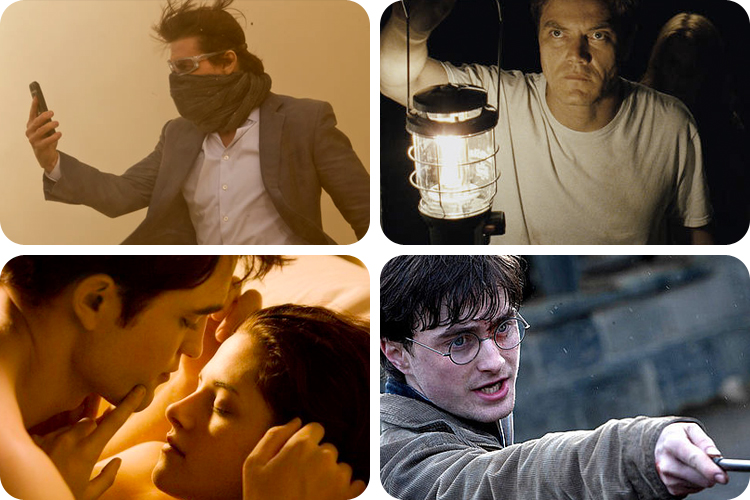

I’m here to make a modest proposal. What if the Oscars — an imaginary Oscars, a thought-experiment Oscars, the Oscars of an alternate universe — honored movies that people actually liked?
No, I know, I know — they sometimes do, pretty much on the stopped-clock-occasionally-correct principle. And somebody must like each of this year’s best-picture nominees, with the possible exception of the universally allergenic “Extremely Loud & Incredibly Close.” (I appreciated one reader’s recent comment that the hidden virtue of that film lay in combining the annual quota of schmaltzy Tom Hanks and Sandra Bullock vehicles into one compact package.) After all, the whole reason why “The Artist” appears to be the front-runner is because it’s charming and unpretentious and nearly impossible to dislike — although I don’t happen to think it’s all that great — whereas the other nominees do not share that quality.
Still, you know what I’m talking about. Generally speaking, in recent years only certain kinds of movies have been serious candidates for the major Oscar categories, and in particular for best picture. While it’s impossible to lay out a precise description, it’s like Justice Stewart’s famous definition of obscenity: You know it when you see it. Earnest, middleweight dramas that teach life lessons and feature major emotional climaxes always leap to the forefront. They should make you laugh before they make you cry, or vice versa. Classic three-act structure; a major star playing slightly against type; at least one odd or gruesome or humorous supporting performance from a name actor. (Notice that I have just precisely described “The Descendants,” a tailor-made Oscar-winner if ever there was one, which for both extrinsic and intrinsic reasons is likely to fall short this year.)
Even Oscar winners that appear to violate some of these rules hew to the overall pattern. “No Country for Old Men” is an open-ended, nihilistic, ’70s-style American drama, but also one that alternates dark and light, features identifiable stars and a classic Western landscape. “The Hurt Locker” has no name actors, but offers an archetypal tale of courage in warfare that straddled the nation’s ideological divide. (It was also the least successful best-picture winner in history.) “Slumdog Millionaire” also had no stars and was set in a foreign country, but was essentially an old-time Hollywood drama filtered through India and then through canny stylemonger Danny Boyle.
I think we all understand that the 6,000-plus voters of the Academy of Motion Picture Arts and Sciences are a peculiar and self-selected group, and that they aren’t selecting the winners based on criteria that are important to anyone else. They aren’t picking movies the public likes. Indeed, over the last two decades the Academy’s taste has wandered increasingly far from that of the mass audience. And while artistic merit is an inherently nebulous and subjective concept, I don’t think that’s what they’re using either. Seriously, Academy members — let’s go out for coffee, and then you can sit there and look me in the eye and tell me that “War Horse” or “Midnight in Paris” or “Extremely Loud & Incredibly Close” (for the love of Jesus!) is a better movie than “Melancholia” or “Take Shelter” or “Coriolanus” or “Drive” or about 30 other things I could come up with.
For that matter — and this one’s just as important — try to convince me that those nominated films are a better example of what Hollywood does best than such big, spectacular and hugely popular films as “Harry Potter and the Deathly Hallows: Part 2,” or “The Twilight Saga: Breaking Dawn Part 1″ or “Mission: Impossible — Ghost Protocol.” Sorry, but no. The thing is, Oscar voters are picking the movies that make people who work in the film industry feel better about what they do, for reasons that perhaps a highly-paid shrink could puzzle out. When we get involved in obsessive horse-race coverage of the Oscar campaign, we’re using voodoo and amateur psychology and meaningless statistics and other forms of hokum to try to get inside the heads of those 6,000 voters. I say the hell with it.
OK, I don’t quite say the hell with it. I’m as professionally interested in the outcome as anybody else who covers this business for a living, and as my editor recently observed, the Oscars are quite a bit like the Republican presidential contest. Just because the whole thing’s a charade doesn’t mean that nobody cares, or that we can ignore it. But my proposal for an Alternate-Dimension Oscars tries to imagine what the awards might be like if they didn’t disqualify, de facto, almost every kind of movie that people like to watch.
Believe it or not, I’m not envisioning an awards show geared toward the artsy-fartsy films that pointy-headed intellectuals like me tend to favor. If the best-picture race were between “Melancholia” and “Uncle Boonmee Who Can Recall His Past Lives,” and Nick Cave were getting ready to rip open that envelope and announce the winner, wouldn’t that have America on the edge of its sofa? Please, no. I think the “Dark Knight” problem is a much bigger one, by which I mean the Academy’s propensity to ignore large-scale, well-crafted, ambitious entertainments — the kind of movies at which Hollywood excels, like it or not — if they seem too violent or too pulpy or too fanboyish or too free of tedious message-delivery.
This isn’t exactly breaking news, but most popular genres of film are de facto ineligible for Oscar consideration: superhero movies, thrillers, crime dramas, romantic comedies and franchise pictures of any kind. On the other side of the coin, despite a recent reputation for indie-ness, the Academy largely steers away from the kinds of serious art-house dramas that play film festivals and keep upscale big-city audiences excited about the possibilities of the form. Instead, the real-life Oscars find themselves hopelessly trapped in the middle, endorsing calculated middlebrow pablum that everybody involved knows is a big pile of unmemorable meh. If the aim of the entire organization and its awards show is to present the best face of the American film industry to the world, then this whole situation is ridiculous and self-destructive.
Hence my proposal for an Alternate Universe Academy Awards, an unholy blend of the MTV Movie Awards and the Indiewire critics’ poll that will get people excited, lead to considerable fighting and weeping, and produce some genuinely unexpected moments on Oscar night. This is my alternate universe, at least for now, so I’m announcing the best-picture nominees. I hope you’ll play along, with your own lists, emendations and angry deletions. In recognition of the fact that there’s at least a little Venn-diagram overlap between my manufactured universe and the real one, I’ve kept the unlikeliest of this year’s Oscar nominees on the list.
Harry Potter and the Deathly Hallows Part 2 I’m not a big fan of the series, or the books, but that’s not what this is about. A tremendous technical accomplishment and a huge worldwide hit, managed with considerable dramatic chops and without selling out the source material.
The Lincoln Lawyer We can talk about the best-actor category later, where I think Matthew McConaughey’s underappreciated comeback role should be a strong contender. But from its ’70s-style L.A. noir vibe to its combination of sleaze, humor, emotion and violence, “Lincoln Lawyer” was arguably the year’s best Hollywood genre film.
Melancholia No need to repeat all the praise I and other critics have lavished on Lars von Trier’s hybrid of Chekhovian wedding comedy and apocalyptic masterpiece, with terrific performances from Kirsten Dunst and Charlotte Gainsbourg. Cinematic accomplishment of the year.
Mission: Impossible — Ghost Protocol Tom Cruise back in his borderline creepy, control-freak comfort zone, and a dynamite live-action debut from director Brad Bird added up to an enormous hit and the year’s most satisfying action flick by far.
A Separation Yeah, it’s a real-world nominee in the foreign-language category, but Asghar Farhadi’s continually surprising Iranian domestic drama, with its hidden stories about class conflict and its tense, involving portrait of life inside the Islamic Republic, is the year’s best example of global realism.
Take Shelter For my money this apocalyptic weather thriller — or is it a private tale of madness? — captured the American national mood better than anything else I saw all year, with a shattering lead performance by Michael Shannon and terrific supporting work by Jessica Chastain.
Tinker Tailor Soldier Spy Gary Oldman actually is nominated as best actor for his disturbing, ultra-quiet role as George Smiley, and deservingly so. But Tomas Alfredson’s chilly, modernist period piece is a witty and brilliant reimagining of John le Carré’s most famous spy novel.
The Tree of Life I was as surprised as anybody to see Terrence Malick’s long-brewing history of humanity and the universe on this year’s real-world best-picture list, and I think that’s largely due to the performances by Brad Pitt and Chastain in the more comprehensible Texas-childhood scenes. Given its reputation among critics (not necessarily including me) and Malick’s near-godhead status, it belongs here too.
The Twilight Saga: Breaking Dawn Part 1 Go ahead and laugh, superior-minded Salon readers. Laugh, I tell you! This is a strongly crafted pulp movie, so pretty you want to bite it. Director Bill Condon fully satisfied the worldwide Twihard base while also hinting at some of the genuine perversity that underlies the saga. I won’t indulge my Twilight-vs.-Harry Potter riff right now, except to restate my view that the best of the former (this one) is probably superior to the worst of the latter.
The only thing that Hollywood loves more than itself is its past. And that slavish attention to nostalgia could not have been more evident Sunday, when perennial Oscar host Billy Crystal was trotted out after an eight-year hiatus, and the theme of the evening was, oh, I don’t know, something about the magic of the movies. That whole James Franco and Anne Hathaway “youth” thing of last year a distant memory and those five minutes we thought Eddie Murphy would host a somewhat less distant one, this year’s Oscars were awash in a self-congratulatory past. Unsurprising, maybe, given how many of the evening’s big winners were movies set in the dreamy past of the Depression and the pre-civil rights era South. Magical! And though we say it every year, my God, this was truly one of the dullest, blandest evenings of millionaires slapping each other on the back ever. A show bloated with Reese Witherspoon’s praise for “Overboard” couldn’t spare three minutes to let Bret McKenzie perform his winning “Man or Muppet”? Is nothing sacred? But there were still a few surprises and oddities and genuine moments of joy to be had. We endured the whole three-hour broadcast to whittle down our 10 standout moments.
Sacha Baron Cohen’s pre-show bit of pouring the ostensible ashes of Kim Jong Il on Ryan Seacrest was so daring! So rock ‘n’ roll! So hilariously calculated and self-promoting for his new movie “The Dictator”! And yet, the event Jezebel helpfully dubbed “the ashing” would prove the first surprise of the evening — and the moment of “Seacrest dumping” America’s waited a good 10 years for.
Billy Crystal, in the predictable opening mashup of nominated films, segued from appearing as a time-traveling, Hitler-killing “Midnight in Paris” blackfaced Sammy Davis Jr. straight into the poop pie scene from “The Help.” Perhaps we haven’t yet cured that whole racial sensitivity thing, America.
A tearful, visibly overcome Octavia Spencer, who got a standing ovation and thanked the entire state of Alabama, still had to end her emotional acceptance speech with “Please wrap up? I’m wrapping up. I’m sorry, I’m freaking out.” At least nobody tried to crowd her offstage to make way for Blur.
A pretaped bit imaging a 1939 focus group for “The Wizard of Oz” was a Christopher Guest alumni reunion, featuring Guest and his repertory veterans Catherine O’Hara, Eugene Levy, Fred Willard, Bob Balaban and Jennifer Coolidge. A powerful reminder that it’s been way too long since the guys who sent up the Oscars in “For Your Consideration” made a movie together – and that everybody loves flying monkeys.
In one of the night’s few political moments, “A Separation” writer and director Asghar Farhad accepted his win for best foreign film by saying, “At a time of talk of war, intimidation and aggression is exchanged between politicians, the name of their county, Iran, is spoken here through her glorious culture, a rich and ancient culture that has been hidden under the heavy dust of politics. I proudly offer this award to the people of my country, the people who respect all cultures and civilizations and despise hostility and resentment.” The moment was only undercut a little by Steven Spielberg’s pinched O RLY? face.
Cirque du Soleil – which just happened to also advertise during the broadcast – paid homage to the golden age of movies in its uniquely limber, vaguely unsettling way. It was dramatic, for sure, with performers swaying over the audience in trapezes and cavorting about like human slingshots. But we’re not convinced that the best way to “We love cinema” is a lady who can touch the back of her head with her foot.
Former host Chris Rock, so scathing and so on the money, noted that in animation, “If you’re a white man you can play an Arabian prince. And if you’re a black man you can play a donkey or a zebra.” Rock, who made an excellent zebra in “Madagascar,” then went on to demonstrate how much “hard work” it takes to be a voice actor in Hollywood. “And then I go, ‘It’s time to go to the store!’ And then they give me a million dollars.” Line of the night.
Flashing a formidable portion of her endless leg, presenter Angelina Jolie – who just a few weeks ago won wows for her Golden Globe look, stumbled over her words and quickly lit up the Twitterverse with comments about how gaunt she appeared. Maybe the actress is looking a bit underfed these days, but all the remarks about how she needs to eat a sandwich seemed remarkably tone deaf in an evening when the show’s writers were dishing out a bevy of fat jokes. Body snarking – still gross when you do it to thin people! On the upside, however, the whole episode did spawn the instantly awesome Twitter account for Angelina Jolie’s Leg.
The cast of “Bridesmaids,” presenting for the short subjects and not so coyly turning it into an opportunity for jokes about how heft, length and size matter, provided a little much needed raunch in a deeply unsubversive evening. Even better than the penis jokes, however, was Melissa McCarthy and Rose Byrne whipping out their little airplane-size bottles to do shots at the utterance of the word “Scorsese.” Just like all of us at home.
Eternal nominee Meryl Streep admitted that she could hear half of America saying “Oh, no. Come on, why her… again?” when she pulled her upset over Viola Davis. But after adding a sassy, “But whatever,” she tearfully acknowledged her friends and her “inexplicably wonderful career” and confessed, “I really understand I’ll never be up here again.” It was a graceful moment of gratitude, one that almost made the evening worth staying up for. The movies, like Meryl, remain inexplicably wonderful. So why is celebrating them still such a crap shoot?
Continue Reading
Close
Maybe the joke about George Clooney kissing Billy Crystal in a fake scene from “The Descendants” would have been funnier if Crystal didn’t actually look like an old lady. That moment was awkward — like virtually everything else about Sunday’s 84th Academy Awards, — but it was also confusing. Was George supposed to be delivering a goodbye smooch to his wife, or his mom? Seconds later, we were treated to Crystal in blackface, or at least in tan-face, sorta-kinda doing Sammy Davis Jr. Extra-double awkward and confusing! Even if you’ve heard of Davis (and half the people watching probably hadn’t), it took several beats to grasp exactly what target Crystal was shooting for. (It’s been more than 25 years since Crystal played Davis on “Saturday Night Live.”) Liberace’s black half-sister, perhaps?
Angelina Jolie’s awkwardly exhibited right leg rapidly acquired its own Twitter handle, whose jokes were (at least in the moment) funnier than anything that actually happened inside the theater on Oscar night. Honestly, that sums it up. Was this worse than the James Franco-Anne Hathaway wannabe-hip debacle of last year? Perhaps not; almost nothing could be. But from Angie’s jambe droite — c’est pour toi, Jean Dujardin! — to Cameron Diaz and J.Lo’s derrières to Crystal’s quadruply warmed-over Borscht Belt gags to the fact that the best actor can’t speak English and nobody can pronounce the best director’s name, this was a monumentally awkward Oscar telecast. Most of the big moments felt weirdly off, and so did a lot of the little ones: Robert Downey Jr. trying to be funny and failing, the women from “Bridesmaids” likewise, Tom Hanks rocking a gray beard that made him look like a doubly-douchey guy who listens to jam-band music but works on Wall Street. It was the Off-scars. The Awk-scars.
Maybe the Squawk-scars. What in God’s name was that tinny, high-pitched, icepick-to-the-brain feedback noise that seemed to accompany all the live sounds from the stage? Was the sound-board being run by my ninth-grade drama teacher? I didn’t think the Ellen De Generes commercials were all that funny or effective, necessarily — right now, writing at 2 a.m., I have no idea what she was advertising — but holy cats, that was professional-grade entertainment compared to the show.
No, I know — the Oscars are still a big event, and this year was no exception. But the event-ness of it had very little to do with the actual telecast aired by ABC, which possessed the strange quality of seeming devoid of content and yet taking forever. (The supporting actor and actress awards weren’t handed out until about 45 minutes into the show.) As usual, it had even less to do with the movies being honored, which most viewers probably hadn’t seen and didn’t care about. It’s been true for years that getting together with your friends to ooh-and-ah and crack jokes and then momentarily get swept away by it all has been at least half the fun of Oscar night. But in the age of social media, we’ve reached the point of all tail and no dog. The torrent of electronic commentary has expanded to fill the entire space, leaving the awards show as a Potemkin village that doesn’t even try to look solid, a pseudo-event that makes no pretense of meaning anything.
I had the feeling on more than one occasion that the show itself was an afterthought, a distraction from what seemed really important — reading the outraged or joyous or ridiculously funny things that friends and acquaintances and total strangers were saying about it. Sure, Twitter is an evanescent literary form, one vanishing thought at a time flowing out of the spigot and down the drain. But at least nobody on Twitter was trying to compel me to listen to Adam Sandler talk earnestly, in a black-and-white video clip, about truth and beauty. (Here’s a thought, Adam: Make a silent movie.) Nobody on Twitter is responsible for the fact that neither Angelina Jolie nor her gams can adequately read a Teleprompter, or the fact that Clooney’s “Descendants” co-star Shailene Woodley said “under-exaggerated” in an interview and nobody cared enough to edit it out so she wouldn’t look like an ass.
It was nearly impossible to find a viable online feed of the Oscar telecast this year, which may just be a by-product of the recent crackdown on illegal live streaming. But it also feels like a way of trying to pump up ratings, to turn back the clock to some year when Billy Crystal was famous and less pickled-looking, and generally cram the genie back into the bottle. At least the dude Dujardin plays in “The Artist” ultimately has no choice but to deal with the massive social and technological change that has transformed the movie industry. The Academy’s approach, to this point, appears to involve two things. First, pretending that there’s no problem with this fast-sinking awards show or the industry it represents, and that the audience is just as fascinated by movie-star glamour as ever. And second, producing a really lackluster and mediocre television program.
As far as the actual, y’know, Academy Awards, here’s my summary: Christopher Plummer, “A Separation,” and all those technical and design awards for “Hugo.” (And the big zero for “Extremely Loud & Incredibly Close.”) Those were the right prizes won for the right reasons. Oh, and I guess Octavia Spencer for “The Help,” although all the women in that category were terrific and there was no way to get it wrong. (Well, Crystal still managed to get it wrong, cracking that after seeing “The Help” he wanted to hug the first black woman he saw, “which in Beverly Hills is about a 45-minute drive.”) Even with Spencer and Plummer, there was more than a hint of Offscar-ness and Awkscar-ness. Both got standing ovations, which in the latter case could be justified as paying tribute to a life’s work, but jointly it all started to look like special circumstances. She’s black and he’s old, and isn’t it amazing of us to give major awards to people like that?
I have nothing against “The Artist,” which is a charming love letter to old Hollywood, executed with considerable craft. But in a year or two it’s going to look like an obvious fluke, the oddball film that Harvey Weinstein wizarded to five awards amid a weak field. Jean Dujardin is a delightful performer who pulled off an improbable feat, but I’m beginning to wonder whether he’ll ever be heard of again on this side of the pond. And for the second year in a row, after Tom Hooper of “The King’s Speech,” the directing Oscar goes to the least qualified of the five nominees. (Michel Hazanavicius — and by the way, the name is Lithuanian — over Woody Allen, Terrence Malick, Alexander Payne and Martin Scorsese. Please.) I’m sure the French nation is delirious right now, but eventually a moment of clarity will arrive: All the films we’ve made since the days of the Lumière brothers, and this one conquers Hollywood?
“The Artist’s” big awards were 100 percent expected, whereas we’d all talked ourselves into thinking that Meryl Streep wouldn’t win best actress for “The Iron Lady.” I definitely wanted to see and hear the crackerjack speech Viola Davis would have delivered, and there’s no point consoling ourselves with “oh, she’ll get her chance,” because we all know she probably won’t. As for Streep, yeah, on merit she absolutely deserves it, and she had a real moment up there, a moment of being tremendously moved and maybe something else too. Pissed, possibly? Deflated? Halfway wishing that she weren’t such a trouper, and had just stayed home like Woody Allen? She said herself that she knows she’ll never be on that stage again; she was turning a page in her life and in movie history. She wins her first Oscar in 28 years, and quite possibly her last, and it’s an Awk-scar.
Continue Reading
Close
Hollywood has long had a problem with women, but with Kathryn Bigelow’s historic best director Oscar in 2010 for “The Hurt Locker,” it looked like things might be slowly changing. And in 2011, the box-office success of “Bridesmaids,” a raunchy comedy written by and starring women, led to predictions that Hollywood was finally ready to recognize the reality that female-centric movies could be as profitable as man-centric movies. While no industry that employs Michael Bay can really be considered a safe space, more women in production positions might mean better depictions of women, more roles for older actresses, and more influence at the Academy of Motion Picture Arts and Sciences, the organization that awards the Oscars.
That may end up being the case years down the line. But judging from the available evidence, it’s not going to happen any time soon. Bigelow’s movie was released in 2009, but in 2011, only 5 percent of the top-grossing movies were directed by women. And, astoundingly, the Oscars are even worse. None — zero — of the films in the best picture, best director, best adapted or original screenplay, best lead or supporting actor, and best supporting actress categories were directed by women. In the major categories, 98 percent of nominations went to movies directed by men, 84 percent went to movies written by men, and 70 percent went to movies starring men. The only female-centered movies that appear outside the best actress categories are “The Help” and “Bridesmaids.” In the best picture category, there are as many movies about women as there are movies about horses.
Getting beyond basic cast-and-crew details, Anita Sarkeesian, a feminist pop culture media critic and the editor of Feminist Frequency, has produced a video putting the 2012 best picture nominees to the so-called Bechdel test. This looks at whether a film has, at any point, female characters having an interaction with each other that’s not about a male character. Only two of the 10 pass. While it’s possible for male directors and writers to produce representative depictions of women (as Manohla Dargis said in a 2009 interview, “Flaubert wrote ‘Madame Bovary.’ That’s all we need to say about that”), they mostly don’t. Female characters aren’t given anything to do besides pine about their (heterosexual) romantic interests.
Besides Bigelow, only three other women have been nominated for the best director Oscar: Sofia Coppola for “Lost in Translation” in 2003, Jane Campion for “The Piano” in 1993, and Lina Wertmüller for “Seven Beauties” in 1976. In the years since Bigelow’s win, no women have been nominated. “Women in Hollywood are still largely excluded from prominent decision making and production roles,” Sarkeesian wrote in an email. “Bigelow’s win is definitely something to celebrate, but I don’t think it reflects on any substantial shift within the film industry as a whole.”
“Hollywood is very big on symbolism and mistaking symbolic breakthroughs for actual breakthroughs,” Richard Rushfield, a veteran entertainment journalist who blogs at rushfieldbabylon.com, wrote me. “And then once they’ve had the symbolic breakthroughs and pat themselves on the back for a job well done, they forget to do the job.”
Nor were the 2010 Oscars an unalloyed triumph for feminism. As Rebecca Clark Mane, a feminist cultural critic from the University of Washington, pointed out, the dual wins for Sandra Bullock in “The Blind Side” and Mo’Nique in “Precious” sent a troubling message. “They managed to both celebrate regressive gender politics which locate women’s primary role as mothers while at the same time setting the ‘bad’ black mother against the ‘good’ white mother,” she wrote.
“Bridesmaids” has already had a positive effect on the fortunes of some women in the industry; “Who Invited Her?,” a comedy by Sascha Rothschild about a woman invited along on a bachelor party weekend, was quickly picked up after “Bridesmaids’” big numbers came out. But it’s troubling that the job prospects of an entire gender seem dependent on what’s likely to be a comedy fad, and it’s telling that every action movie of note released since “The Hurt Locker” has been directed by a man.
The source of women’s underrepresentation at the Oscars is not exactly a mystery. A recent study by the L.A. Times confirmed what we all pretty much suspected: The Academy is overwhelmingly white and male. Seventy-seven percent of Oscar voters are male, a population that is very much at odds with America but fairly representative of the people who make the decisions in Hollywood.
Hollywood’s sexism is so obvious that it’s become almost hard to get worked up about. But these numbers should be incredibly troubling. Few industries that aren’t explicitly men-only, like professional sports, are allowed to display such drastic gender bias. Hollywood movies are funded by men, made by men — and, usually, made for men, especially young men.
Awareness of that audience makes the Academy’s embrace of even the two female-centric movies problematic. While the commercial success of “Bridesmaids” is heartening, its Oscar nominations came only in the writing and supporting actress categories, not the prestige picture/director awards. And it’s notable that only a female comedy that was repeatedly, and pointedly, presented as a male “raunch comedy” with female leads could receive recognition. It’s like the supposedly anachronistic plot of another nominee, “Albert Nobbs“: Women can only succeed by acting like men. It’s not that “Bridesmaids” isn’t a great film that deserves a billion awards. It’s just that, standing up there by itself, you start to get suspicious why that film was singled out. It’s like Carrie suddenly getting picked as homecoming queen. Reasonable observers begin to suspect there’s an ulterior motive at work.
There’s a similar problem with “The Help” being the only female-centric best picture nominee. Its problems with race have been widely discussed (and, indeed, Sarkeesian does in her video). But its representation of women in general is problematic, too. In the best picture category, male leads get to be actors, landowners, adventurers, inventors, writers, executives, soldiers and architects. Female leads get to be … housewives or domestic servants. (Even the supporting female characters are largely wives and mothers.) It’s not that this doesn’t represent an aspect of women’s experiences. It’s just that it doesn’t represent anything close to the entirety of women’s experiences, and the recognition of a film that emphasizes gender stereotypes and not a movie that gives another kind of portrait (like “Young Adult,” say) is telling.
How to fix this? The industry isn’t going to deal with the problem by itself, or it would’ve done so already. It’s even in its self-interest to cater to female audiences (movies like “Twilight” show how much potential is there), but Hollywood still can’t manage to get its act together. Nor is the nature of the entertainment business holding movie executives back from employing more women. Television, while far from parity, at least offers better opportunities for female creators, from Tina Fey’s “30 Rock” and Jenji Kohan’s “Weeds” to all the female showrunners now working and the older actresses that have found a home on the small screen when the movies turned their back.
Maybe we need some affirmative action for Hollywood. If the government thinks it’s important to set standards for equality in workplace hiring, sports and college admissions, it might be time to recognize the importance of movies’ cultural and economic power. Hollywood is, after all, a multibillion-dollar industry, and one of America’s biggest exports. For women to have so few opportunities in the upper ranks of such an important industry is absurd, and exactly the kind of thing the government would want to get involved in — theoretically, anyway. In reality, of course, Hollywood has ingratiated itself so thoroughly with elected officials that it’s highly unlikely any such action will get taken soon.
Writing about these sorts of issues can sometimes be hard, especially when it comes to private organizations like movie studios. Unlike the government, Paramount Pictures never agreed to fairly represent their audience, and have the right to pursue profit however they please, even if it would be more profitable not to ignore half of your potential audience. And if Terrence Malick wants to make a movie so man-focused that it could fairly be retitled “Father Issues Across the Ages,” he should go right ahead, especially if it’s going to turn out as wonderfully as “Tree of Life” did. But award shows are dedicated to recognizing a large number of quality films regardless of commercial interest, and are decided by a small, defined elite. Though they are also, of course, four-hour smugfests of meaningless, self-congratulatory drivel, they offer an opportunity for a cultural industry to show what it values. And if the Oscars are anything to judge by, then Hollywood doesn’t value women very highly at all.
Continue Reading
Close
Months after its release, and perhaps in spite of the Academy Award nominations and Golden Globe awards garnered by two of its actresses, “The Help” continues to court controversy. Such was the case recently when Viola Davis and Octavia Spencer visited the set of “The Tavis Smiley Show,” and the host raised long-standing questions about why the actresses accepted roles that he felt diminished their humanity and that of other African-Americans. Smiley admitted disappointment that Davis and Spencer were being feted for playing the same role — as domestics — that earned Hattie McDaniel the first Oscar for an African-American for her role as “Mammy” in the film “Gone With the Wind” 73 years ago. Underlying Smiley’s gentle admonishment of Davis and Spencer is the simple question: Has so little changed that African-Americans are still tethered to the same stereotypical roles that defined their presence in mainstream American media nearly a century ago?
It is nearly impossible not to recall McDaniel in light of the success of “The Help.” Indeed, the pairing of Davis and Spencer evokes the similar pairing of McDaniel and Butterfly McQueen, whose comic turn as Prissy in “Gone With the Wind” was equally deserving of a nomination in 1939. And indeed, McDaniel and McQueen faced those same criticisms about the roles they took, as did their industry contemporary Lincoln Perry (aka Stepin Fetchit) and Bert Williams, whose success came in the early part of the 20th century. Though Perry and Williams are now celebrated for their comic genius, such latitude has rarely been given to black actresses like McDaniel, Spencer or recent nominees such as Gabourey Sidibe and Mo’Nique (who won for best supporting actress in 2010), who are criticized in some black circles as much for the roles they portray as they are for their body types, which seem to conjure, in the minds of many, the worst stereotypes of black domestics and so-called welfare queens.
Given the realities of racist imagery that continues to circulate in American society, whether as thoughtless tweets about professional basketball player Jeremy Lin or cartoons that compare the first black president to apes, it is not surprising that there is a desire among some blacks to police representations. This is old and dirty business, which led McDaniels in her day to make her oft-cited claim that she would rather play a maid in the movies than be one in real life; the kind of business that led the Hollywood Branch of the NAACP to establish the Image Awards in the late 1960s to more directly regulate the production and reproduction of blackness. Of course, the organization never fails to find itself in the quandary of having to mute its own proclivity to criticize black images that don’t adhere to some sanitized and respectable notion of how “Colored People” are supposed to look and act, especially when those images are produced by blacks themselves (see Tyler Perry) or if some of those “Colored People” are up for Academy Awards, as was the case 27 years ago when they shifted their criticism of “The Color Purple.” “The Help,” by the way, won several awards at the recent NAACP Image Awards.
For far too many people invested in the gatekeeping of all things black, Barack Obama’s “Dreams From My Father” is really a “Dream of Sidney,” the dashing, cinematically daring, Afro-Caribbean man, who in the late 1950s not only exemplified the best of his profession (regardless of race), but became the template for the right way to act and be black on-screen. Poitier, of course, continually wrestled with his characters, trying not to be some cardboard cutout of the naturally integrated and un-offensive black man (an image that our current president often chooses not to wrestle with), as witnessed by the roles he took on that we don’t so much celebrate: “The Lost Man” (1969), where he portrays an Army veteran turned radical; “The Organization” (1971), the third in his trilogy of Virgil Tibbs films that began with “In the Heat of the Night” (1967); or as post-civil rights gangster Manny Durrell in “A Piece of the Action” (1978), opposite Bill Cosby.
Ultimately for many black artists the “politics of respectability” is simply tiring and defeating; Poiter’s retreat from acting in the late 1970s was as much about the lack of quality scripts as it was a rejection of having to always represent the race. It was the same trap faced by Poiter’s once and future heir-apparent Denzel Washington. With seminal black heroic figures such as Steven Biko, Malcolm X, Rubin Carter and high school football coach Herman Boone in his rearview, Washington has sought to play less than respectable characters in his movies. When pressed about those choices and his responsibilities after the release of “American Gangster,” in which he portrayed legendary Harlem drug lord Frank Lucas, he told Men’s Vogue, ”It’s not about the black experience. It’s more specific and selfish than that. It’s what I feel like doing, not what I feel like people need.” Though some have griped about Washington’s late career choices — including Smiley — he is allowed to be seen simply as a black artist, who brings depth to whatever role he plays.
Such courtesies are rarely extended to black actresses, who as an extension of the roles that black women often play in black communities, are expected to carry the “blood-stained banner” for the uplift of the race, even at the expense of their artistry. This was the point that Davis made as she responded to Smiley’s concerns with the assertion that such critiques are “absolutely destroying the black artist. The black artist cannot live in a place – in a revisionist place – the black artist can only tell the truth about humanity and humanity is messy, people are messy.”
Yet, I can’t help thinking what Hattie McDaniel, who died in 1952, would say about all of this. I imagine that McDaniel might be surprised at the number of black women who have been honored since 1939, and perhaps would take great pride in the ability of Davis and Spencer to elevate the humanity of those women who actually work as domestics — as McDaniel did many years ago. I imagine she’d be surprised by all the attention surrounding the portrayal of black women domestics of the 1960s, sensing a freedom to speak back — a spirit of resistance, that she couldn’t experience on- or off-screen in 1939. Finally, I imagine she’d just be happy that Davis and Spencer are allowed to celebrate their accomplishments among their White peers, unlike McDaniel and her escort, who were forced to sit alone because of segregated seating arrangements.
It’s all relative and it’s about time we trust black artists to make choices for the sake of their art and not tired ideals about how “negro-folk” are supposed to act.
Continue Reading
Close