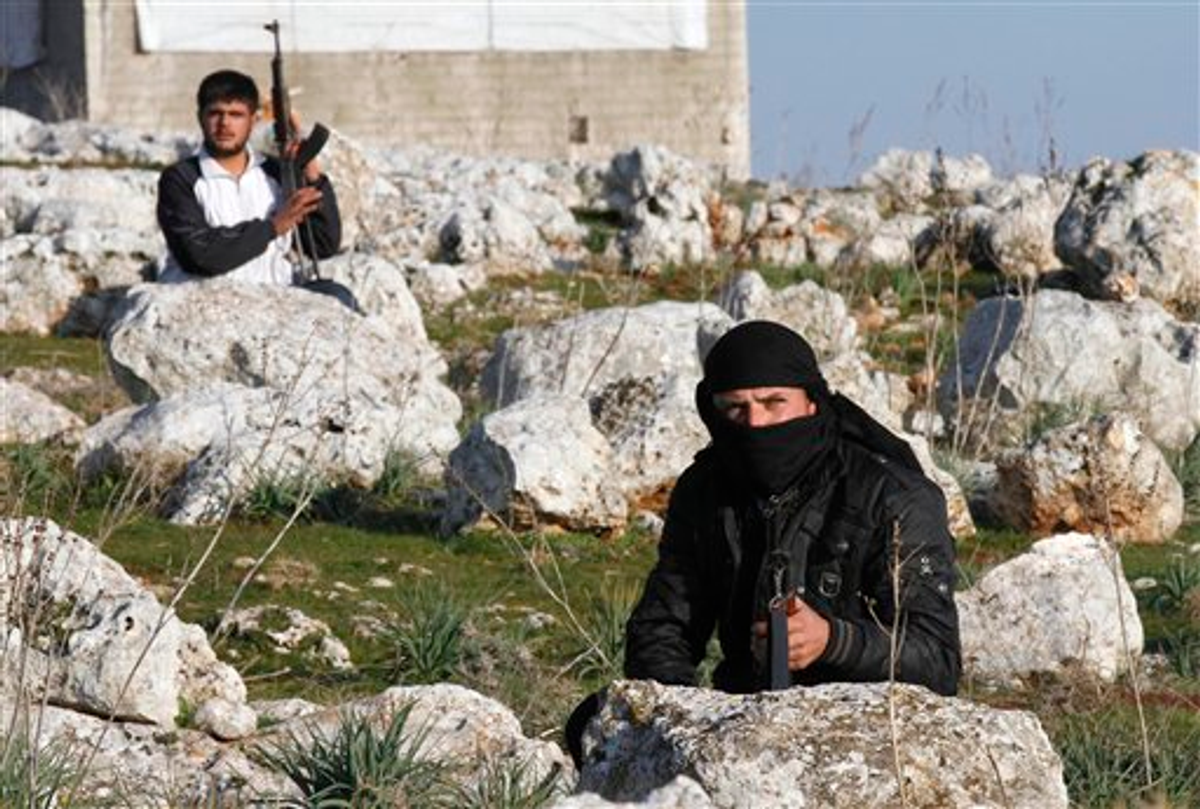
BEIRUT, Lebanon — Homs is now a war zone, a city under siege by the army of Syria’s president, Bashar al-Assad. It is a city where rebel soldiers are being joined by jihadis to fight a guerrilla insurgency, and where once mixed communities have begun to split along religious lines as the seeds of a civil war take root.

“We’re working by candlelight because there is no electricity and our generator is running out of fuel,” a doctor known as Abdel Rizk from Homs’ easterly Karm Zeitoun neighborhood told GlobalPost.
Trained as an anesthetist but lacking any serious painkillers, Abdel Rizk has morphed from a practitioner of the exact sciences into a battlefield surgeon of the most basic kind, completing multiple amputations in a day, using underwear to bandage wounds in the absence of gauze, and appealing desperately for help.
“We’ve got almost no medical supplies left,” said the doctor, whose 15 patients, dying slowly in a single room of an old Syrian home, included two with serious chest wounds, five injured by mortars and three with amputated limbs.
“I was able to get a few stitches into the amputees, but they are going to die because we have no antibiotics or muscle relaxants,” he said, speaking to GlobalPost using a satellite modem because all mobile and landlines have been cut, as has electricity to the neighborhood for the past two months.
“We are calling on the Red Cross or Red Crescent to come right away as the situation is intolerable. Today there was no bread. Children are dying.”
Many in Homs fear a repeat of the massacre that took place exactly 30 years ago this month, when Assad’s father, Hafez, sent his artillery to pound neighboring Hama, another Sunni-majority city that dared to rise up against the oppressive rule of one family and a regime drawn largely from the minority Allawite sect, an off-shoot of Shiite Islam.
The 1982 assault on Hama, which was triggered by an armed insurgency by the Syrian Muslim Brotherhood, ended with Assad’s troops going house to house, killing, raping and looting, with an eventual death toll estimated between 20,000 and 30,000 people, the huge majority civilians.
Since the bombardment of Homs began on Feb. 3, activists estimate the death toll has exceeded 500 with more than 1,000 people injured. A researcher with the Syrian Network for Human Rights (SNHR), who has been traveling between neighborhoods in Homs, told GlobalPost that his group had counted 754 people killed, though accurate figures were impossible to verify.
Amid all the chaos, long dormant sectarian fault lines are beginning to open up, dividing neighbor from neighbor, Sunni from Allawite and opening a space for militants to operate freely.
In the Allawite neighborhood of Homs’ Nuzha district, a GlobalPost reporter met with Haidar, a successful 40-year-old lawyer, who is married to an Allawite school teacher and has two young boys.
Haidar and his family used to live in the Hamadieh area, a mix of Sunnis, Allawites and Christians. But after young Allawites volunteered or were paid to shoot and beat Sunni protesters alongside regular security forces, Haidar said he was “advised” by some of his Sunni neighbors to leave Hamadieh.
“President Assad and his father stacked the security forces with Allawites so now Sunnis see all Allawites as part of the killing machine,” Haidar said. “I understand their feelings, but what can I do?”
Haidar said he moved to Nuzha for “social protection from my community” and was now considering leaving Syria altogether for Qatar or another Gulf state.
“What is going on in Homs is a real civil war between the government and Allawites on one side and the Sunnis on the other,” Haidar said. “I don’t think we as Allawites have any future in Homs if the Assads go. We are shaking with fear for the future.”
Sectarian disintegration has also occurred the other way, with Sunnis, such as 25-year-old Firas, leaving Allawite neighborhoods. “I will be frank and say Homs is divided. There is no more national unity,” said the Sunni former resident of Haddarah who moved to the Sunni-majority neighborhood of Deir Baalbah. “The Assad regime created this sectarian war when it gave arms and money to young Allawites to attack us.”
In Homs’ Qusour neighborhood, home to about 35,000 people, an activist there said the majority of the one fifth Allawite population had moved away over the past six months.
“The pattern of sectarian consolidation that is taking place in central Syria and along the coastline has now spread to Damascus itself,” warned Peter Harling, the Damascus-based Syria Project Director at the International Crisis Group. “People are moving into homogenous neighborhoods, social ties are being cut, polarization is increasing.”
As communities divide along religious lines and the Allawite security forces continue to torture and kill Sunni civilians, forces long held in check by Syria’s secular system are emerging to stake a claim in an uprising many now fear is morphing into the nightmare of sectarian conflict suffered across the border in Iraq.
“I am not afraid to say that I support the opposition with money and weapons,” said Abu Annas al-Homsi, a Syrian Salafist fundamentalist who fought with Sunni militants against American-led troops in Iraq and who now leads Islamist militants fighting in Homs.
“The international community was too weak to protect civilians, so now we fight an open war to liberate our land and defend our religion.”
On Sunday, Al Qaeda leader Ayman Zawahiri called for the first time on Muslims in Iraq, Jordan, Lebanon and Turkey — Syria’s neighboring countries — to join the uprising against Assad’s “pernicious, cancerous regime.”
His call came just days after twin suicide car bombs killed 28 and injured 235 soldiers and security members in Aleppo, Syria’s largest city, so far noted for its relative stability. The Free Syrian Army denied involvement in the attack and no group claimed responsibility.
State-run Syria TV — broadcasting images of destruction from Aleppo within minutes of the explosions while ignoring Homs completely — blamed “foreign terrorists.” In Syria’s tightly-controlled police state, however, such high-profile attacks by organized terrorist groups are extremely rare. Opposition members say the regime staged the explosions in an attempt to divert attention from its massacres in Homs.
A reporter working with GlobalPost who spent two days in Homs this week said the city reeked of corpses. Since the crackdown on the popular uprising against the Assad family’s 42-year dictatorship began last March, rights group Avaaz has confirmed more than 5,600 Syrians killed. Several other rights groups say that number could be higher. Tens of thousands have also been injured. The regime, meanwhile, says more than 2,000 members of its security forces have been killed battling “armed gangs and terrorists.”
In interviews on satellite phones and with a reporter in Homs, residents said they were in shock. Many said they felt abandoned by the outside world after Russia and China vetoed a UN Security Council resolution that would have condemned the Assad regime and opened the door for possible sanctions and military intervention.
On Sunday, the Arab League said it would end its observer mission to Syria — widely criticized by the Syrian opposition for failing to protect civilians — and would ask the UN Security Council to send an international peace keeping force to end the bloodshed.
For now Homs continues to suffer bombardment from afar by artillery and rocket launchers. A GlobalPost reporter in the city witnessed scores of tanks and armored vehicles being deployed in Sunni-majority neighborhoods, with sandbags, checkpoints and soldiers around all buildings of the secret police and ruling Baath Party.
Activists in Baba Amr, the neighborhood that has been the hardest hit so far, said residents were now terrified that a ground assault was imminent with troops amassing on the area’s outskirts, while a reporter for Sky News who spent time in Homs last week said rebel fighters of the Free Syrian Army estimated a build up of about 10,000 troops outside the city.
Fighting with only Kalashnikovs and the occasional Rocket Propelled Grenade launcher, the defected soldiers and armed civilian volunteers of the Free Syrian Army (FSA) in Homs are severely outgunned.
Several members of just one small FSA unit interviewed by GlobalPost last November have been killed fighting Assad’s forces recently, while several others wounded.
But an FSA commander in Baba Amr told GlobalPost this weekend that his fighters had successfully repelled a ground assault against the city.
“They will enter only over our dead bodies,” said the rebel commander, known as Captain Ammar al-Wawi. “We destroyed four tanks when they tried to enter and we prepared a lot of surprises for the regime if they try to storm Homs. But we do not have a lot of weapons because no one is supporting us. We appeal to the international community to support the revolt in Homs because there is a massacre ongoing.”
Western powers have so far ruled out arming the FSA, as they did with Libya’s rebel fighters, fearing such a move would hasten Syria’s descent into civil war and concerned that neither the FSA nor the political opposition Syrian National Council are sufficiently united.
A GlobalPost journalist in Homs contributed reporting for this story.
BERLIN, Germany – It started with a handshake, not a kiss. When Chancellor Angela Merkel and new French President Francois Hollande finally met in person on Tuesday evening, there was little of the warmth that marked her meetings with Nicolas Sarkozy in recent years.
Aides had downplayed the rendezvous as simply aimed at getting to know one another rather than about hammering out any policy. Yet the future of Europe could hinge on whether these two leaders find a way to work well together.
Rarely have two people met for the first time with so much baggage. Merkel refused to meet with Hollande during his election campaign, and made the highly unusual step of publicly backing his rival, fellow conservative Sarkozy. Hollande for his part seemed to be campaigning as much against Merkel as the incumbent, pledging to renegotiate the fiscal pact that she had championed.
Now the two have finally met face-to-face and the encounter seemed cordial if hardly warm. Following the ceremonial reviewing of the guard of honor – during which Merkel had to gently nudge Hollande in the right direction on the red carpet – the two held an hour -long meeting. They then addressed the throng of international journalists in a joint press conference during which Merkel remained stony-faced during much of Hollande’s comments, interspersed with the odd smile.
The pair did seek to downplay their differences and strike a friendly tone with Merkel even joking that the lightning that had struck Hollande’s plane on his way to Berlin was perhaps a “good omen.”
“I’m not sure whether there is sometimes more divergence perceived in the public realm than there really is,” the chancellor told the press conference. “We are aware of our responsibility, as Germany and France, for a positive development in Europe. Carried by this spirit I believe we will of course find solutions for the different problems.”
Both tried to show a united front on Greece, which risks ejection from the euro zone if it backs anti-austerity parties in the fresh elections likely after the parties failed to form a government. “Just like Frau Merkel,” Hollande said, he wanted Greece to remain in the euro zone while insisting that Athens meet the terms of the bailout agreement.
Yet when it came to the crux of the differences between the two, on austerity versus growth, it was obvious that the only thing that had been agreed so far was that they disagree.
After all, it remains to be seen how Merkel’s strict stance on rapidly reducing budget deficits can be married with Hollande’s plea for some kind of stimulus package to boost growth.
Hollande reiterated his promise to reopen talks about the fiscal pact, the agreement on strict budget discipline which he has said France will not ratify unless a growth element is also adopted.
“I said in the campaign, and I repeat today, that I want to renegotiate what was established at a certain moment,” Hollande told reporters. “Everything that can contribute to growth must be put on the table. I don’t want growth to be just a word, but tangible measures.”
He mentioned boosting competitiveness, as well as Euro bonds – essentially pooling the debt of euro zone members – something Merkel has so far flatly rejected.
He did not, however, mention tinkering with the European Central Bank’s mandate, surely a red line if ever there was one in Berlin.
For all the inauspicious beginnings, observers predict that the two will eventually hit it off. Both play on their modest, down- to-earth style and exude an air of pragmatism rather than charisma. Hollande depicts himself as “Mr Normal” in contrast to the Bling Bling of his predecessor Sarkozy, while the unassuming Merkel is often seen doing her own grocery shopping. And both are said to have a wry sense of humor in private.
Furthermore, Hollande’s gesture of appointing Germanophile Jean-Marc Ayrault as his prime minister will have gone down well in Berlin.
Yet, it is hardly a meeting of equals. Merkel is an old hand in European politics now, in her seventh year in office, while Hollande’s previous executive experience has been confined to serving as mayor of the small town of Tulle.
Furthermore Germany is the EU’s economic powerhouse, with its export-driven economy keeping the rest of the euro zone out of recession, according to figures released on Tuesday. And Berlin has long been calling the political shots in Europe, with the fiscal compact being dreamed up by Merkel, as a way of preventing EU states from getting into deeper debt in the future.
At the same time Merkel is increasingly isolated in Europe, as there is a growing realization that austerity is choking off growth. Hollande knows that other leaders, including conservatives like Italy’s Mario Monti, also want Berlin to budge on its debt reduction fixation.
Hollande came to Berlin straight from his inauguration ceremony in Paris. After beating Sarkozy on May 6 he will feel he has a mandate from the French people to push for a change of direction in Europe. Yet he also faces a tough economic situation back home, with just 0.1 percent growth in the first quarter and growing unemployment, now at a 13-year high of 10 percent. If the economy were to contract even further, it could make it very difficult to fulfill many of his campaign pledges, such as reversing Sarkozy’s pension reforms.
Merkel has her own problems, despite the strong economy. Her party, the conservative CDU, has just suffered a bruising defeat in the state of North Rhine-Westphalia. Her coalition is increasingly fractious, with Bavaria’s CSU leader Horst Seehofer publicly slamming the CDU candidate in North Rhine-Westphalia Norbert Roettgen on TV for his campaign, while the FDP is unpredictable due to an ongoing leadership crisis.
The fact that she needs a two-thirds majority in the Bundestag to ratify the fiscal compact means she is dependent on the opposition SPD. And while the party has broadly backed her euro policy, it has been emboldened by Hollande’s victory and the strong showing in NRW. On Tuesday the party’s leaders said that they would delay the vote on the fiscal pact, originally scheduled for late May, saying it wanted to see concrete growth measures as well as austerity.
That would leave time for Merkel and Hollande to agree to some sort of compromise solution.
The pair said they will seek an agreement ahead of the next big summit of EU leaders in June. “It will be very important that Germany and France present their ideas together at this summit, and we have talked about the preparation,” Merkel said.
They will see each other before that, meeting at an informal dinner of EU leaders on May 23, as well as at the forthcoming NATO and G8 summits.
However, Hollande is unlikely to show much willingness for compromise with Berlin just yet. After all his party is facing legislative elections in mid June and he will want to make sure he is not seen to be backsliding on campaign pledges.
Hollande wants his five-year term to start with his Socialist Party securing control of the National Assembly so that he can push through his agenda. Otherwise he faces a frustrating period of “cohabitation” with a prime minister from the opposing camp, such as occurred when conservative Jacques Chirac’s presidency coincided with the premiership of Socialist Lionel Jospin from 1997 to 2002.
As such Merkel cannot expect Hollande to veer from his insistence on growth measures. And for all his unassuming manner, he could well prove to be a more difficult partner than Sarkozy in the long run.
Nevertheless Merkel is also likely to stand firm on many issues. Asked on Tuesday night if she feared Hollande’s campaign promises she replied coolly: “I am seldom afraid, as fear is not a good counselor in politics.”
Continue Reading
Close
Tuesday, May 15, 2012 12:29 PM UTC
As Greek politics become increasingly chaotic, the once-taboo subject of euro disintegration has become unavoidable
By Paul Ames, GlobalPost
A man is reflected in the chart with stock prices at the Greek Stock Exchange in Athens, Monday, May 14, 2012. (AP Photo/Petros Giannakouris) (Credit: AP)
BRUSSELS – It was the scenario never to be named, a prospect so terrible that the mere mention of it would conjure up doom and destruction for the eurozone.
In the last few days, however, the risk that Greece could be forced out of the currency bloc has become too real to be ignored. The once-taboo subject has become an unavoidable topic of conversation among Europe’s financial leadership.
“The price would be very high if they decided to leave the euro,” warned German Finance Minister Wolfgang Schauble, before talks Monday with his eurozone partners.
Governors of three central banks have openly raised the option of a Greek exit.
“Technically it could be managed,” said Patrick Honohan, the Irish governor. “It is not necessarily fatal, but it is not attractive.”
Even Jose Manuel Barroso, the usually cautious president of the European Commission, had a stark warning for the Greeks: “If a member of a club does not respect the rules of the club, it’s better not to remain in the club,” he told Italy’s Tg24 TV last week.
In the corridors of the European Union’s headquarters the fear now is not only that Greece could be forced out, but that the resultant chaos would spread quickly to Portugal, Ireland, Spain and beyond, causing a collapse of the euro currency and a generalized economic meltdown.
The prospect has more than just Europe worried. For all its problems, the eurozone’s $13.6 trillion economy remains the world’s second largest. Its collapse would risk a global economic earthquake making Lehman Brothers look like a mild tremor.
“This is not just about Europe, there is a possibility that it may spread to the global economy,” Japanese Prime Minister Yoshihiko Noda told Dow Jones Newswires over the weekend. “This is the biggest downside risk factor for the Japanese economy.”
The doomsday scenario is not yet inevitable, but unless European leaders get their response right, the dominoes could start to fall very quickly.
Greece could be forced into a rerun of its inconclusive May 6 election in mid-June. Polls predict an even stronger showing for the mishmash of Trotskyites, neo-Nazis and other anti-austerity groups who surged in support triggered the current impasse.
They want Greece to renege on commitments to cut its huge budget deficit in exchange for the 130 billion euro bailout. Germany and other creditors have warned that would lead to a freezing of bailout payments. A bankrupt Greece would then be forced to drop out of the eurozone.
As that prospect draws near, savers facing the threat of exchanging their euros for a much weaker new national currency could spark a run on the banks and send their money to Germany or some other safe haven. Some reports suggest Greeks have already transferred 250 billion euro out of the country.
Renewed fears over Greece are already having a major impact on other at-risk countries. Portugal’s stock index hit its lowest level since 1996 on Monday and Italy and Spain both saw rates on their bonds rise to the highest levels this year.
If Greece heads toward a euro exit, creditors would send those rates soaring, casting doubt on the nations’ ability to pay their debts. Savers in Portugal, Ireland and Spain could also take fright and move their money abroad. Shaky banks would implode. G-8 economies Italy and France would come under threat.
Saving the euro, at that point, would need a massive intervention by the European Central Bank, backed by increased firewall funding from Germany and other more stable northern European nations to prop up the southerners. An agreement to share debt burdens or devalue the euro may also be required.
It is by no means certain, however, that skeptical voters in Germany, the Netherlands and Austria would go along with that. The incoming Socialist administration in France and restless political parties in Italy could also rebel against austerity measures which the northerners are likely to insist upon as part of a new financing deal.
Ireland could rule itself out of any future EU bailouts, if its austerity weary voters reject the EU’s fiscal discipline treaty in a May 31 referendum.
As eurozone finance ministers gathered in Brussels on Monday evening, officials in Brussels were acknowledging that the risk of a Greek exit — they are calling it the “grexit” — is now as great as at any time since the crisis erupted in late 2009.
Jean Claude Juncker, the Luxembourg Prime Minister who chaired Monday’s meeting of eurozone finance ministers, insisted, however, that other EU members were not seeking to push Greece out.
“Nobody was mentioning an exit of Greece from the euro area (in the ministerial meeting). I am strongly against,” Juncker told a news conference. “I don’t envisage, not even for one second, Greece leaving the euro area. This is nonsense. This is propaganda.”
Given that most Greeks say they want to keep the euro, European leaders are hoping they will return to mainstream politicians if there is a second election in June.
For that to happen, leaders in other European countries may have to take a gamble and intervene directly in the election campaign by making clear the vote will be in effect a referendum on staying in the eurozone.
“Without a Greek commitment this (bailout fund) won’t work, and this is the responsibility of Greek politicians,” Olli Rehn, the EU’s economics commissioner, said after the eurozone ministers’ meeting. “The future of Greece and the welfare of its citizens lie more than ever on the shoulders of Greek politicians.”
There is a risk that more foreign lecturing to the Greeks could backfire if voters rebel against yet more outside interference, but the EU is rapidly running out of options if it wants to keep the eurozone together.
Continue Reading
Close
Monday, May 14, 2012 2:30 PM UTC
After a disastrous showing in a regional election, the German leader's party is at risk -- and so is Euro stability
By Siobhan Dowling, GlobalPost
German Chancellor Angela Merkel (Credit: AP Photo)
BERLIN, Germany – It is a paradox of German politics that Chancellor Angela Merkel remains overwhelming popular, while the parties that make up her governing coalition lurch from one defeat to the next in a string of regional votes.
That was made evident yet again on Sunday when her conservative Christian Democrats (CDU) suffered their worst ever result in Germany’s most populous state of North-Rhine Westphalia. The party only managed to get just over 26 percent of the vote in the snap election, shedding almost 9 points since securing 35 percent in the last vote there in 2010.
Her junior coalition partners the Free Democrats did manage an impressive comeback, securing a surprise 8 percent and managing to return to the state parliament thanks to its dynamic leader in the state, Christian Lindner. However, the disastrous performance by the CDU will allow the Social Democrats and Greens to form a stable coalition, after operating as a minority government for the past two years.
The SPD won 39 percent of the vote in what had been its traditional heartland, largely thanks to the huge popularity of its leading candidate, state governor Hannelore Kraft. The Greens only fell back slightly, down from 12 to 11 percent, a relief given the strong showing of the Pirates who stormed into their fourth regional parliament after securing almost 8 percent. The post-communist Left Party only attracted just over 2 percent, compared to over 5 percent in 2010, and thus failing to enter parliament.
North Rhine-Westphalia is often a strong indicator of the national mood. When former SPD Chancellor Gerhard Schroeder suffered a defeat there in a state vote in 2005 he called an immediate snap general election, which paved the way for Merkel’s rise to power.
Now, seven years later, could the bruising defeat in that state again be a harbinger of change at the federal level?
Even though the CDU had been braced for defeat on Sunday, the extent of the drubbing left the party reeling. “We have been bludgeoned,” said Peter Altmaier, the CDU’s chief whip in the Bundestag, on Sunday.
Their campaign had been a disaster, with their leading candidate Norbert Roettgen infuriating voters by failing to commit to giving up his current job as federal environment minister to lead the state opposition if the CDU were defeated. As such yet another possible internal rival to Merkel has been eliminated. Yet this also signals a defeat for a man who represented the moderate center of the party, and particularly for a possible coalition with the Greens.
While the CDU in North Rhine-Westphalia are left to lick their wounds, Merkel and the party strategists in Berlin will have to assess the vote’s significance for the party’s chances of holding onto power after next year’s federal election.
The party had been working on the assumption that the FDP would continue to implode and that the CDU would need to form a new alliance either with the SPD or with the Greens, who it was assumed would fail to muster enough support for a coalition of their own.
Now the victory in a state that is home to one in four Germans points to a possible resurgence of the SPD and Green alliance. However, it might be unwise to assume that the parties could achieve a similar result on a national level and revive their coalition of 1998-2005.
After all much of the victory on Sunday is being attributed to the successful duo of the SPD’s Kraft and the Green party leader and deputy governor Sylvia Loehrmann. The two women worked extremely well together, managing to form alliances with the other parties on a range of issues, and seemed to present a less harsh, more socially oriented governing style. “We put people at the heart of this election campaign,” Kraft said on Sunday.
The SPD at a national level is far less popular, and it has still not decided who will challenge Merkel at the next federal election. The current troika of leaders, Peer Steinbrueck, Frank-Walter Steinmeier and Sigmar Gabriel lack the common touch and warmth displayed by Kraft. They are also more associated with the severe welfare cuts and labor market reforms of the previous SPD-led government, which alienated much of the party’s traditional base.
While Kraft is increasingly being touted as a possible rival to Merkel in 2013 based on her triumph on Sunday, she has so far insisted that she has no desire to switch to federal politics.
Nevertheless the North Rhine-Westphalia election has given both the SPD and Greens a much needed boost. The SPD suffered its worst ever election defeat in the federal election of 2009, attracting only 23 percent of the vote and it has struggled to make headway against the ever popular Merkel.
Their strong performances both in North Rhine-Westphalia and in Schleswig-Holstein the previous week could encourage the opposition to be more forthright in demanding more concessions from Merkel when it comes to her austerity policy in Europe.
Merkel needs a two-thirds majority in the Bundestag in order to ratify the so-called “fiscal compact” which would see EU states commit to strict budget discipline.
The SPD and Greens, already emboldened by the victory of Socialist Francois Hollande, are demanding that the vote be delayed until the French and German leaders agree to some form of growth package to complement the fiscal rectitude ordained by the pact. While the SPD and Greens have largely backed Merkel’s euro policies, they are increasingly complaining that concentrating on austerity alone is not only failing to cure the euro zone’s ills but proving to be counter-productive.
While Merkel has insisted that no more debt can be taken on as part of any growth package, Hollande’s victory and the defeat in North Rhine-Westphalia may prompt her to show more flexibility on going beyond strict austerity in Europe. However, she has insisted that any growth strategy cannot be achieved by taking on more debt and she will not see the pact itself renegotiated, considering that it has already been ratified by a number of countries as is up for a public vote in the Irish referendum on May 31.
What remains to be seen is whether Merkel’s clout in Europe will be affected by her party’s election debacle back home.
After all, the austerity versus growth debate was very much a part of the North Rhine-Westphalia campaign, with the CDU campaigning on the merits of belt-tightening and budget consolidation, while the SPD and Greens advocated a looser approach to state finances.
Kraft’s government had fallen over its budget, which envisaged taking on more debt in order to help out cash-strapped cities dealing with the long-term effects of post-industrialization in a state which has a long tradition of steel production and mining. Roettgen had sought to portray the SPD and Greens as profligate spenders, not unlike the much maligned southern Europeans. In North Rhine-Westphalia at least, it seems German voters were happy to see the purse strings eased.
Nevertheless, polls still show that over 60 percent of Germans do not want growth policies in Europe to involve taking on more debt. And around the same number approves of Merkel’s firm handling of the euro crisis.
Yet, that popularity it seems is not translating into support for her party, despite a relatively strong economy and the lowest unemployment levels in 20 years. And if the euro crisis starts to really impact the German economy, then Merkel’s own popularity, never mind that of her party, could rapidly evaporate.
Continue Reading
Close
Wednesday, May 9, 2012 3:25 PM UTC
A maritime dispute in the South China Sea threatens to draw in the United States
By Benjamin Carlson, GlobalPost
(Credit: Wikipedia)
HONG KONG, China — With a US ally engaged in a tense standoff with China over disputed territory in the South China Sea, America risks wading into increasingly perilous waters.
The conflict began in mid-April, when a Filipino frigate — a 1960s Coast Guard vessel bought from the United States — attempted to stop several boats of Chinese fishermen who had taken live sharks, giant clams and coral from waters claimed by the Philippines around a rocky patch called the Scarborough Shoal. The Chinese dispatched several larger, more modern boats from one of its civilian maritime agencies, which intercepted the frigate, allowing the fisherman to escape with their catch. Filipino fishermen say they have since been barred from fishing in the lagoon.
Now, after nearly a month, ships from the two nations have refused to budge from the waters surrounding the shoal, while populists back home have whipped up a nationalist frenzy.
In the Philippines, the office of the president declared that it was unilaterally renaming the disputed land, “Panatag Shoal.” (Chinese call it Huangyan Island.) In China, a video went viral on Wednesday showing a TV anchor pronouncing — falsely — that the Philippines is “Chinese territory,” and that China “has unquestionable sovereignty” over the island nation. Meanwhile, a major general wrote an op-ed urging the Chinese navy to smash the Philippines “with both fists” next time, generating 174,000 responses — the majority of them supportive.
This scuffle is merely one of dozens of overlapping, contradictory claims for territory in the South China Sea, where the nations of Southeast Asia are facing off against an increasingly assertive China — and against one another.
“China certainly shares much of the blame for the current standoff. Its claims to the South China Sea, based on limited historical evidence, do not provide a significant basis to make sweeping, unilateral assertions,” says Andrew Billo of the Asia Society.
Where does the US fit into this toxic brew of jingoism, nationalism, and disputed territory? Its strategic shift to the Pacific, geopolitical rivalry with China, and alliance with the Philippines have inescapably drawn American interests to the Asian hotspot.
In early May, Secretary of State Hillary Clinton outlined America’s emerging priorities in the South China Sea: freedom of navigation, unimpeded commerce, maintenance of peace and stability, and respect for international law.
Beyond that, the sea plays an enormously valuable role as the international highway of global trade. Half of all the world’s intercontinental goods pass through the South China Sea, amounting to $1.2 trillion in trade with the US every year, according to a January report from the Center for New American Security. And its untapped energy resources are vast: 900 trillion cubic feet of natural gas, and as much as 130 billion barrels of oil are estimated to lie undiscovered beneath the seabed.
“The geostrategic significance of the South China Sea is difficult to overstate,” the authors of the CNAS report write. “The South China Sea functions as the throat of the Western Pacific and Indian Oceans.” Yet, they note, American interests in the region “are increasingly at risk” due to “the economic and military rise of China and concerns about its willingness to uphold existing legal norms.”
Taking any overt action to defend those interests would set off alarm bells in China. Last month, after Americans posted 4,500 personnel to the Philippines — coincidentally during the April standoff over Scarborough Shoal — Chinese critics blasted the US for “meddling” in regional affairs.
Since then, the US has exercised caution, refusing to take sides in the dispute, even as Manila requested support.
Complicating matters further is the difficulty of weighing the validity of the competing claims.
Since the 1940s, Chinese maps have included a “9-dash line” that encircles nearly all of the South China Sea; Beijing has yet to explain what the line means. Vietnam has meanwhile ramped up its naval power, while proceeding to sell oil rights in disputed territory to Western companies. Belatedly, the Philippines has become more forceful in asserting its exclusive rights to areas — such as Scarborough Shoal — that Chinese fisherman have visited for generations.
Even if they looked to the United Nations for resolution, the International Tribunal for the Law of the Seas has no power to settle disputes over sovereignty. And while diplomacy stalls, fishermen and civilian ships from each country are taking matters into their own hands.
“We’re now running a risk of an accident or confrontation arising from lack of clear instructions on how to behave,” says Carlyle Thayer, professor emeritus at the Australian Defence Force Academy. “The South China Sea is like a bathtub: When you put more ships in it, there’s going to be a collision.”
While efforts are underway in ASEAN, the regional association, to create a binding “Code of Conduct” on the seas, it has proved too feeble to stand up against Chinese pressure. “Some nervous nellies in ASEAN don’t want to confront China,” says Thayer.
So where does that leave the US? In the awkward position of being the final backstop against China, while simultaneously trying to maintain an appearance of neutrality. That means honoring its military commitments to the Philippines, Thayer says, while stopping short of endorsing its allies’ assertion of territorial rights.
“The US should continue backing the Philippines,” says Thayer. “That’s the weak reed, and if China breaks the Philippines, it will affect other countries’ claims.”
Other experts say that America’s main focus should be on guaranteeing the freedom of global trade routes, while leaving the mess of sorting out sovereignty to the states themselves.
“The US should take a step back from the issue,” says Billo of the Asian Society, “It has made its point with respect to its support for a key ally, and the region as a whole, but ultimately it is in the US interest to have regional stability and not allow the conflict to escalate further.”
Continue Reading
Close
Wednesday, May 9, 2012 12:45 PM UTC
Prime Minister Benjamin Netanyahu's political maneuvering over the past week strengthens his position on an attack
By Noga Tarnopolsky, GlobalPost
Israel's Prime Minister Benjamin Netanyahu delivers a speech to his Likud party members during the party convention in Tel Aviv, Israel, Sunday, May 6, 2012. (AP Photo/Ariel Schalit) (Credit: AP)
JERUSALEM — Israeli Prime Minister Benjamin Netanyahu’s frenetic politicking over the last week appears aimed at one thing: strengthening his ability to take on Iran.
Only days after announcing the surprise dissolution of his government and early elections, on Tuesday Netanyahu presented his compatriots with a second shocker: He cancelled elections and announced a strengthened parliamentary coalition, bolstered by unification with the opposition Kadima party.
This new union means Netanyahu will control more than 90 seats in Israel’s 120-seat parliament, known as the Knesset. The new majority is unprecedented in modern times. Former army chief of staff and Kadima’s newly-elected leader, Shaul Mofaz, will join as deputy prime minister. The center-right Kadima party adds heft to Netanyahu’s mandate at a time of urgently polemical debate in Israel over Iran’s nuclear program.
Netanyahu’s political jockeying provoked an immediate and strong reaction in Israel.
Labor Party leader Shelly Yachimovitch, who will benefit politically if, as expected, she is now named opposition leader, said: “This ugly maneuver is going to be taught in universities for a long, long time.”
Israel’s Occupy-style protest movement, meanwhile, announced a series of demonstrations to call for political reform this coming weekend. The main question occupying Israel’s punditry even after this second twist remains the same: Is Netanyahu acting to strengthen his hand if he decides to strike Iran before the American elections in November?
Ari Shavit, a top political analyst at the Israeli daily Ha’aretz, who is known for his contacts in circles close to Netanyahu, told GlobalPost that the prime minister has been intent on early elections for at least a few months, for one principal reason that will not please Washington.
“Netanyahu designed to have early elections in Israel so they preempt the American elections in November and give him time to bring the Iranian nuclear crisis to a climax in autumn, in the two months between the Israeli elections and the Americans’,” he said.
Netanyahu’s decision to then abandon early elections in favor of a broader coalition appears aimed at that same result. “Netanyahu suddenly understood that the Likud” — Netanyahu’s party — “could easily split to the right, in which case, even if re-elected, he would not have the mandate he needs,” Shavit said. “Instead of an election preparing the ground for a confrontation, now he has unity preparing the ground for confrontation.”
The Israeli leader has long argued that a pre-emptive strike on Iranian facilities may be the only way to prevent Iran from developing nuclear-weapons capability.
But opposition from European leaders and US President Barack Obama, who supports a diplomatic approach, and from a growing chorus of former Israeli military commanders who argue that a unilateral strike would only delay, not halt, Iranian ambitions, have weakened the prime minister’s position.
Netanyahu’s logic seems to hold that if Obama is re-elected in November, he will no longer have to worry about domestic politics and will be able to press Netanyahu on Iran and the question of peace talks with the Palestinians — an area Netanyahu is eager to keep out of the international spotlight.
“The Iranian reason remains Netanyahu’s motivation,” Shavit said. “The difference is that now the season is shortened. He does not have to wait until the election on Sept. 4 before bringing the Iranian issue to a head. He can act now.”
Chanan Kristal, a political analyst for Israel Radio, had a somewhat different take. He said that two possibilities exist that can explain Netanyahu’s actions — but agreed that the move was driven by Iran.
“Either [Netanyahu] needs [new Deputy Prime Minister] Mofaz in his government in order to justify postponing any action against Iran, or he needs Mofaz inside so as to provide legitimacy for when he does attack Iran. Mofaz has so far come out against an attack, but it remains clear that those making the decision will be Netanyahu and Defense Minister [Ehud] Barak. For now, all bets are off.”
Shavit warned that anyone interested in preventing a conflict with Iran, such as the United States, will need to act swiftly to find a political solution.
“Otherwise there is a risk by the end of summer, we’ll find ourselves in a dire situation,” he said.
At the joint press conference announcing his union with Kadima and Mofaz, Netanyahu appeared to be peeved at much of the sniping he has recently faced by a growing list of former military and intelligence leaders expressing doubts about his Iran policy. He seemed especially put off by Yuval Diskin, the former head of Israel’s internal security agency and an apolitical figure respected across the board, who last week took the criticism farther than most.
“My major problem is that I have no faith in the current leadership, which must lead us in an event on the scale of war with Iran or a regional war,” he said. “I don’t believe in either the prime minister or the defense minister. I don’t believe in a leadership that makes decisions based on messianic feelings.”
The implication that Netanyahu and Barak are not competent to make decisions on matters of national security, specifically regarding Iran, ricocheted loudly across the political universe and clearly remained on Netanyahu’s mind today as he repeatedly stressed the “sanity” of his government and said: “I have even been referred to as messianic. Yes, messianic.”
Continue Reading
Close
Page
1
of
35
in
GlobalPost