Grammys

The Grammys’ most memorable moments

Adele, Glen Campbell and the Boss triumph, Whitney's remembered -- but what was Nicki Minaj up to? VIDEO

  • more
    • All Share Services

Topics: , , , ,

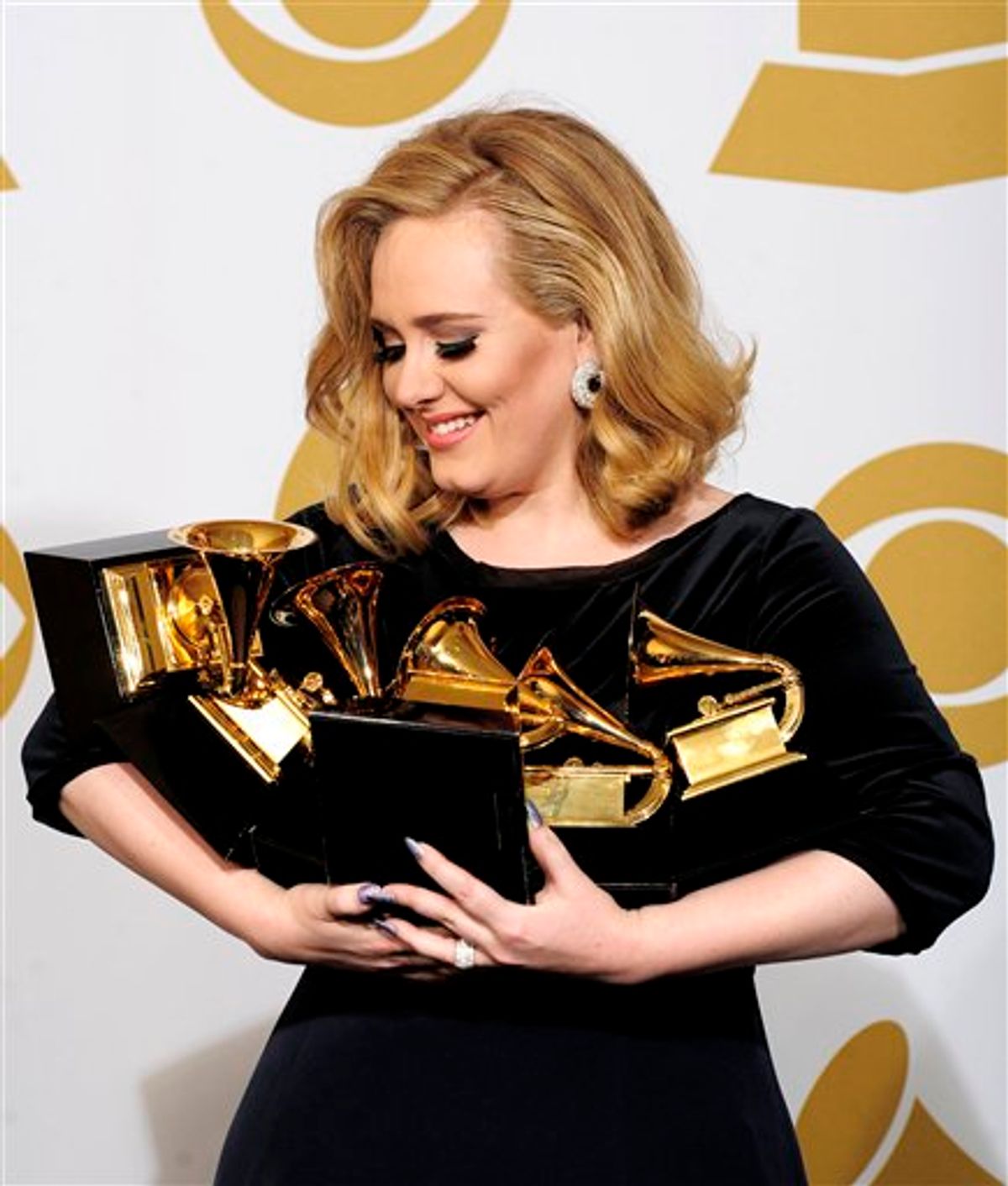
The Grammys' most memorable momentsAdele poses backstage with her six awards at the 54th annual Grammy Awards on Sunday, Feb. 12, 2012 in Los Angeles. Adele won awards for best pop solo performance for "Someone Like You," song of the year, record of the year, and best short form music video for "Rolling in the Deep," and album of the year and best pop vocal album for "21." (AP Photo/Mark J. Terrill) (Credit: AP)

The Grammys have always trod the line between dull veneration of industry success and outrageous celebration of rock ‘n’ roll excess. But this year, with the losses of Etta James, Clarence Clemons, Gil Scott-Heron and Amy Winehouse, the show had an even tougher time finding the right pitch than Coldplay’s Chris Martin did.

The specter of death would have hung heavily over the proceedings even if Whitney Houston hadn’t died suddenly the day before. But the singer’s untimely demise Saturday gave an unavoidable air of sorrow to the proceedings, a grim dose of reality that couldn’t help crashing into the fantasy realm of Lady Gaga scepters and Nicki Minaj eyelashes. That’s why the most memorable aspects of the broadcast weren’t just the loudest or the tackiest. They were sad, they were weird, they were sometimes awful; sometimes, they were even fantastic. And they were dominated by two big-throated ladies – the troubled diva from Newark and Adele, the whiskey-voiced British blonde. And though we loved The Civil Wars’ one minute of perfection and were baffled by Rihanna’s “When Harry Met Sally” hair and got weepy over Paul McCartney and company’s poignant and timely “Golden Slumbers/Carry That Weight,” these are Salon’s top-10 biggest moments of the night.

Bruce Springsteen

With all his trademark energy intact and backed with a massive string section, the Boss — who lost his longtime collaborator Clarence Clemons last year – kicked off the evening with a rousing version of “We Take Care of Our Own.” It was soulful, spirited and just the right touch of mournful.

LL Cool J

Admitting that “There is no way around this — we had a death in our family,” the night’s host then announced “the only thing right is to begin with a prayer … for our fallen sister.” Depending on your philosophic perspective, watching the audience solemnly bow its collective head while Cool James invoked our “heavenly father” was either a moving tribute or a sudden reminder of why having an atheist like Ricky Gervais host awards shows is a cool idea. But when he cut to clip of Whitney blowing the roof off with a live performance of “I Will Always Love You” at the Grammys a generation ago, it set a bar for vocal performance that would be damn near impossible to match for the rest of the night.

Alicia Keys and Bonnie Raitt

Honoring the late, great Etta James, two knockout performers of different eras and genres gave a stripped-down version of “Sunday Kind of Love.” It was one of the few pairings of the night that worked, a stunning moment of sincerity and finesse in an evening that often veered heavily to schmaltz.

Chris Brown

It’s not that we can expect the music industry to ignore chart-topping, domestic-abusing, frequently terrible Chris Brown. He’s had a huge year, and on Sunday’s broadcast, he even managed to pick up a Grammy. But aside from his historic awfulness, there’s another reason to ponder whether it was really necessary to subject America to two separate performances. Decked out in his preppy “I’m not dangerous, ladies!” varsity jacket, he jumped around lip-syncing “Turn Up the Music” and “Beautiful People” with a posse of bat-winged, masked performers in a performance apparently inspired by the old video game Q*Bert early in the night, then came back near the end for a dead-behind-the-eyes “tribute to dance.” At least he managed to prove that he doesn’t need his abusive record to be reviled; feel free to shun him just because he sucks.

Jennifer Hudson

It took the powerhouse Jennifer Hudson — who two years ago performed Houston’s most successful smash for the woman herself at the BET Awards — to take “I Will Always Love You” back from the place of power ballad clichés where it’s lived the last two decades and make it ache like new. No big crescendo, no sappy orchestration, just a clearly emotional Hudson belting her heart out. Beautiful.

Foo Fighters

In an intense performance outside the Staples Center for the regular folk, Dave Grohl and company – a gang whose own experience of tragedy was brought home by that audience member thrashing around in a Nirvana shirt — howled through a fiery rendition of their “never wanna die” anthem “Walk.” Later, picking up the Grammy for best rock performance, Grohl admitted, “We made this one in my garage with some microphones and a tape machine,” eloquently pleaded for “the human element of music” and promised, “It’s not about being perfect.” It was a shining example of old-school authenticity, only slightly undercut by the appearance, immediately after, of Ryan Seacrest.

Glen Campbell

Lifetime-achievement award winner Campbell, who last year announced he was facing Alzheimer’s and would release a final album and do one last tour, is not going gently into his disease. After the Band Perry shouted uncomprehendingly through “Gentle On My Mind” and Blake Shelton did a serviceable “Southern Nights,” it was Campbell himself who rocked the house. Looking undeniably unwell but in remarkably stronger voice than the likes of fellow Grammy performers Carrie Underwood or Paul McCartney, he staunchly belted out “Rhinestone Cowboy,” enthusiastically coaxing the entire audience to sing along. It was by the far the greatest exhibition of bad-ass, rock ‘n’ roll indominability of the night.

Katy Perry

Aw, remember when Katy Perry did the Grammys gently swaying in a trapeze swing, showing off home movies from her wedding? Sure you do; it was last year. Post-Russell Brand divorce Katy seems to have decided to go for a different vibe. Performing her new song “Part of Me,” she was all about shattering glass, engulfing ice effigies of men in flames, and declaring, “You can keep the diamond ring, in fact, you can keep everything.” Katy, you blue-haired, pissed-off little minx, you know what? I believe you.

Nicki Minaj

The Catholic Church hasn’t taken this much of a beating since Madonna’s “Like a Prayer” era. In a performance of “Roman Holiday” that topped even Lady Gaga’s “Alejandro,” Minaj went through a confession gone wrong, an exorcism, and wound up surrounded by dancing monks getting groped by hot leather babes – all while “Oh Come All Ye Faithful” took on a whole new meaning. Did we mention she levitated? It was the closest the Grammys has ever come to turning into a Ken Russell movie.

Adele

Taking the stage after vocal surgery in November, the night’s biggest winner was clearly not in as forceful voice as in her Royal Albert Hall performance of last year. But she was so clearly enjoying her triumphant night of multiple wins, pointing at herself while snarling, “You could have had this all,” she personified bittersweet awesomeness. When the audience thundered to its feet, Adele’s mastery of simultaneous heartbreak and victory was not just in powerful evidence, it was conspicuously infectious. And when, later, she tearfully picked up the final award of the night for album of the year, she copped both to an inspiring “rubbish relationship” and to fending off “oh my God, snot.” And that is whyyyyyyyy we will always love youuuuuuu, Adele.

Continue Reading Close
Mary Elizabeth Williams

Mary Elizabeth Williams is a staff writer for Salon and the author of "Gimme Shelter: My Three Years Searching for the American Dream." Follow her on Twitter: @embeedub.

Did the Grammys actually get it right?

The awards remain clueless about metal, R&B and Americana -- but amazingly, it's hard to argue with the major picks

  • more
    • All Share Services

Topics: ,

Did the Grammys actually get it right?Adele (Credit: AP/Matt Sayles)

‘Tis the season for gathering family near, taking generous sips from steaming cups of mulled cider or hot toddy, watching the skies for that first snowflake — and for bitching about the Grammys.

That last tradition may not be quite as old as the others, but it is surely practiced with just as much enthusiasm and vigor. Each year the Grammy nominations, which are determined by members of the National Academy of Recording Arts and Sciences, engender what often sounds like deafening protest. Some music fans think the nominees are too populist, while others think they’re not populist enough; some ponder the hair-splitting difference between record of the year and song of the year, while others — many, many others — simply ignore the classical and New Age categories. Most people, however, bemoan the exclusion of their favorite artists.

For the second year in a row, however, the Grammys have played Grinch by actually getting the major categories right. Mostly right. Well, they certainly didn’t embarrass themselves.

Just like last year, when album/song/record of the year trifecta actually included some intriguing and even excellent artists, this year’s top nominees include some incredibly deserving musicians. Sure, you could argue that the Foo Fighters’ aggressively mediocre “Wasting Light” would have been safely forgotten if not included among the nominees, and I’d argue that any list that includes the enormously insufferable Mumford & Sons — surely one of the most baffling grass-roots success stories since Insane Clown Posse — is essentially flawed. And just to remind you that the Grammys have some of the weirdest time-frame regulations, there are nominations for Kanye West’s still excellent “My Beautiful Dark Twisted Fantasy” and Rihanna’s “LOUD,” both from late 2010 and already feted on innumerable year-end lists.

But the list also includes two nominations for Bon Iver’s gorgeous “Holocene,” from the band’s self-titled second record. And in retrospect, Adele was a shoo-in, but what’s amazing about her juggernaut second album “21″ is that it’s just as good as — maybe even better than — all those sales would indicate. And Bruno Mars’ forward-thinking revivalism gets a few mentions, as does Lady Gaga’s “Born This Way,” to which I say, finally: Uncle.

The inclusions are mostly worthy, and the omissions likewise promising: There are no desperate bids for ratings (sorry, Bieber) and no self-congratulatory nods to industry veterans releasing would-be comeback albums (see: Herbie Hancock in 2008, Steely Dan in 2002). In fact, the lists for album of the year, record of the year, song of the year and even best new artist all seem strangely democratic, representing a variety of pop genres. That means there’s going to be some serious competition here. Will Katy Perry and Lady Gaga split the dance-pop vote? Could Bruno Mars pull an upset? Is Bon Iver the Jon Huntsman in this scenario? I’ll probably put all my money on Adele for a sweep, but a win by Gaga or Bon or Bruno or Ye wouldn’t prompt a sledgehammer to my television set.

On the other hand, let’s remember back to Feb. 13, when the last batch of Grammy winners was announced. At the end of the broadcast, Canadian indie rock mainstays the Arcade Fire won a surprise victory for album of the year. Their appropriately sprawling third album, “The Suburbs,” beat a humorless bout of navel gazing by Eminem, a collection of candy-coated pop by Katy Perry, a country-in-name-only album by Lady Antebellum and a monster hit by Lady Gaga. It was the Arcade Fire’s biggest triumph, swiftly followed by their greatest indignity: Overnight tweets and blog posts decried the decision, and a Tumblr posed the question Who Is Arcade Fire? Some guy even took out a full-page ad in the New York Times to bitch about it.

A similar fate could befall Bon Iver if “Holocene” beats out “Rolling the Deep” and “The Edge of Glory” this February, making a Grammy less a gleaming crown than a set of lead boots. More interestingly, the Arcade Fire debacle illustrates just how fragmented contemporary audiences have become and just how ill-suited the Grammys are to represent those vying constituencies. For many viewers (myself included), the Arcade Fire weren’t just obscure nobodies; they were as close to the Biggest Band in the World as you can get these days. “The Suburbs” debuted at No. 1 on the Billboard album charts just a few months previous, and the group had sold out Madison Square Garden. They had even licensed a song to the Super Bowl (with all royalties benefiting Partners in Health’s relief efforts in Haiti).

Their win may have shocked legions of Little Monsters and Eminem diehards, but others were shocked that so many people were shocked. It was an eye opener: A band that all but defined a particular audience could still be virtually unknown to the larger music-listening population. It’s yet another sign of the fragmentation and entrenchment of music audiences in the digital age, and surprisingly the major Grammy categories — record/album/song of the year, and possibly best new artist — seem to be well equipped to mirror this development. For two years at least, they’ve spotlighted diverse nominations that speak to the breadth and ambition of contemporary pop music, with a strong sense of the past but an eye squarely on the future.

Oh, but keep scrolling down that list and things start to look a little less impressive. The Grammys’ annual forays into specific genres reveals a voting block that defines pop music too broadly but thinks of metal, R&B, dance, Americana and jazz in only the most superficial terms. Consider the award for best hard rock/metal performance. The term “hard rock” is an obvious catchall, but Dream Theater and Sum 41 certainly don’t belong on this list (and a win for either would reenact the ’89 Jethro Tull/Metallica debacle all over again). As one of the most popular traditional metal bands, Mastodon isn’t a bad choice, nor is Megadeth, who’ve proved durably heavy while many of their peers have softened. But there’s not much depth here, especially considering that metal has undergone a renaissance over the past few years, allowing acts like Skeletonwitch, Kylesa, Wolves in the Throne Room and Hammers of Misfortune to redefine many of the genre’s most historically rigid conventions.

Or look at the Americana category. There’s nothing wrong with Levon Helm, Ry Cooder or Emmylou Harris, and apparently I’m the only person who thought “Blessed” was a seriously subpar Lucinda Williams effort. But you could have compiled this list at any time over the last 25 years. These acts are being recognized less for their music and more for their longevity. Only the obscure and kinda doofy Linda Chorney, nominated for her sixth album, “Emotional Jukebox,” is a surprise. But you could scratch any of these names and substitute lesser-known but much better albums by Hayes Carll, A.A. Bondy, Amanda Shires, Buddy Miller and Abigail Washburn.

Similar arguments could be made this year about the alternative rock, contemporary blues, and folk categories. In fact, the Grammys aren’t truly representing the realities and innovations of these genres, but instead what seems like an uninterested, third-person perspective on them. They’re skimming the surface for obvious names rather than spotlighting the genres’ greatest accomplishments. And while the major categories seem to be evolving and even becoming more adventurous, the future doesn’t look especially bright for categories further down the list. Earlier this year, NARAS announced that it was cutting more than 30 awards, including best Hawaiian album, best Native American album, and several from the Latin category.

Historically, the organization  has treated these categories as somewhat fluid, making changes to reflect new social, technological, musical or business developments. For example, there are no longer Grammys for best jazz composition of more than five minutes duration, nor are there separate gospel awards for white and black artists. But these severe cuts mark an awkward consolidation at a time when audiences are dividing. If they want to remain relevant, the Grammys should not only add more categories, but explore them more thoroughly. Otherwise, we’ll all just have to keep bitching about them being out of touch and irrelevant.

Continue Reading Close

Cee Lo Green’s neon video for “Bright Lights, Bigger City”

It almost makes us forget you(r performance at the Grammys)

  • more
    • All Share Services

Topics: , ,

Cee Lo Green's neon video for Tripping the light fantastic

Thank you for making this beautiful, psychedelic remix, Cee Lo Green. You know, I didn’t mention it at the time because I knew it was “your moment” or whatever and sometimes you just have to let your freak flag fly, but I was a little bit worried about you at the Grammys. You looked like a character from a Pixar movie about an outcast peacock that would be voiced by Elton John. Maybe you were going with a whole Muppet-vibe thing, but honestly, it was such a downer to see you perform “Forget You” with Gwyneth Paltrow. Because the great thing about your jam last summer is that it was an instant classic despite having the word “fuck” in the title, and that was kind of a statement, right? The song was catchy as hell, everyone loved it, and suddenly you were making all these concessions so you could go on “Saturday Night Live” and the Grammys and hang out with your new bestie Gwyneth. Not that there is anything wrong with that! But we just prefer the original track, in all its “Fuck You” glory.

So anyway, Cee Lo, it’s just really nice to see your video for “Bright Lights, Bigger City,” because it’s trippy and fun (just like you!) and does that thing where you visualize all the words of your song, so it’s kind of like a Sing-a-long! Yes, I know Justice did it with “D.A.N.C.E.” and Kanye had “All of the Lights,” and there was that fan video for Daft Punk’s “Harder Better Faster,” but what’s great about “Bright Lights” is that it shows us a city populated entirely by neon signs instead of people.

Seriously, dude, you need to call those guys over at Pixar, because a film about a lonely Las Vegas billboard looking for love could be the next “Wall-E.”


Continue Reading Close

Drew Grant is a staff writer for Salon. Follow her on Twitter at @videodrew.

Hipsters relax: Despite Grammy, Arcade Fire still unknown

They may have won album of the year for the "The Suburbs," but the indie darlings are far from mainstream

  • more
    • All Share Services

Topics: , ,

Hipsters relax: Despite Grammy, Arcade Fire still unknownWhat is an Arcade Fire?

Sunday’s biggest Grammy win was a bittersweet moment for fans of Canadian indie band Arcade Fire. On the one hand, the music industry was finally recognizing Win Butler and his gang of Quebec hipsters for their haunting melodies, sharp lyrics and outsider status. On the other, it is a known fact that once a band starts being popular, it stops being good and starts being “mainstream.” *

We shouldn’t have worried: Who Is Arcade Fire is a new Tumblr that collects tweets and Facebook status updates from the vast number of Americans who still have no idea who or what Arcade Fire is, why they brought bikes onstage during their Grammy performance, or how they managed to beat out Lady Gaga who hatched out of an egg, for chrissakes.

And while Kanye West might approve of the win, Arcade Fire can sleep easy tonight, knowing that Dog the Bounty Hunter and Rosie O’Donnell still have no effing idea what the “he’ll” these guys are.


*Though we really should have been more worried about the band “selling out” last year, when their song “Wake Up” was featured in an NFL ad during the Super Bowl. Then again, the commercial was a promotion for a Haiti relief charity, so maybe the whole thing equals out.

Continue Reading Close

Drew Grant is a staff writer for Salon. Follow her on Twitter at @videodrew.

Rise of the celebrity stoner

Lady Gaga, Seth Rogen, Zach Galifianakis: Why are so many stars being honest about lighting up?

  • more
    • All Share Services

Topics: , , ,

Rise of the celebrity stoner

Sit down, America; this may come as a shock. Sometimes Lady Gaga, among other people in the entertainment industry, gets high. I know, you think you know — you’ve heard about that Charlie Sheen and that Lindsay Lohan and their arrests and their rehabs and E! True Hollywood Stories. But get this: Sometimes famous people just smoke a little weed and they don’t even develop a substance abuse problem or go to jail. Crazier still, this happens all the time to regular folks as well.

Maybe this isn’t revelatory to you, Cheech. The history of pop culture is infused with the herbal aroma of the “Harold and Kumar” franchise, certain green-themed Showtime series, and the Black Crowes’ set list. Actor Jack Black has admitted to “an occasional celebratory jay,” while Sarah Silverman says, “I have contempt for pretty much every drug other than pot.” And Woody Harrelson and Snoop Dogg have practically made second careers of their enthusiasm for it, predilections slyly referenced in such mainstream venues as Martha Stewart’s show.

Lately, however, it seems we’ve reached a new level of openness about a recreational — and, in most places and circumstances, illegal — indulgence that lots of people enjoy regularly. Last October, Zach Galifianakis sparked controversy when he lit up a suspicious-looking funny cigarette on Bill Maher’s show to make a point about California’s soon-to-be-doomed, marijuana-tolerant Proposition 19. Then in January, Roseanne Barr declared in her new memoir that “Pot is the only drug that should be legal. In fact, it should be mandatory.”

But we must really be in high stoner season now. Just last week Kevin Smith candidly praised his “Zack and Miri Make a Porno” star Seth Rogen to MTV, saying, “I got so much from him. He reenergized me in a weird way. I became a stoner because of Seth Rogen.” Smith, whose recent weight loss would seem to disprove the popular notion of plus-size potheads, seemed eager to dispel another common perception about them as well, describing Rogen as a “constantly writing [and] productive … functioning stoner” full of “brilliant ideas.”  He further stated that, “The moment I start smoking, I start working.”

As if to lend support to Smith’s testimonial on the productivity-boosting power of pot, on “60 Minutes” Sunday night, the overachieving Lady Gaga stated plainly to Anderson Cooper: “I smoke a lot of pot when I write music. I’m not gonna sugarcoat it for ’60 Minutes.’ I drink a lot of whiskey and I smoke weed when I write.” She added, “I don’t do it a lot because it’s not good for my voice.” Her admission was followed by an inevitable slew of online comments regarding the colorful, not-afraid-to-wear-a-steak-or-two entertainer’s obviously weed-muddled brain.  “I can tell, Gaga!” wrote a commenter on CNN, while another on PopEater huffed, “Gee who would have guessed that this walking freak show uses drugs?” Dude, if everybody who smoked pot acted like Gaga, a whole lot more people would be making entrances in giant eggs.

Gaga’s Sunday evening frankness was at once casual and revelatory, a theme that continued into the night during the Grammys. First, David Letterman cracked about how “Willie Nelson provided the Grammy show snacks,” and later, “functioning stoner” Seth Rogen himself joking before presenting an award that “I was backstage getting high with Miley Cyrus.” (Cyrus was famously caught on video enjoying some salvia last autumn.)

We turned a corner culturally when, 14 years after Bill Clinton blustered that he tried marijuana in England but “didn’t like it” and “didn’t inhale,” Barack Obama unrepentantly duh-ed, “I inhaled frequently. That was the point.” But the willingness of public figures to cop not only to having smoked pot but to still be doing it on a regular basis has in recent months gained a new kind of traction, fueled no doubt in part by challenges to the drug laws, loosening of restrictions on medical marijuana,  and a growing body of research on its medicinal effectiveness.

And there remains something ridiculous about not being able to open a magazine or turn on a television without being bombarded with ads for alcohol and prescription drugs, while the government continues to wage a “drug war” on something you can grow in your yard. And consider the fact that the much-joked-about Willie Nelson, age 77, was arrested last November for possession, and a report issued just last week showed that “more people were arrested last year in New York City on charges of marijuana possession than during the entire 19-year period from 1978 to 1996,” a rate of about 140 arrests a day. Thanks, Mayor Bloomberg, a man who’s stated of his own pot smoking that “You bet I did, and I enjoyed it.” I’d hate my city tax dollars to go toward improving the public school system or anything. 

While Gaga or Rogen or Smith may believe their high profiles make them relatively low risk for backlash when they discuss their own pot smoking, their admissions nevertheless come with a raft of still deeply embedded cultural taboos — and potential legal retribution. Maybe speaking up and even joking about their marijuana use won’t effect a sea change in the drug laws. But their candor might at least open the door for others to come out of the closet on the subject too, and eliminate some of the stigma and misconceptions about pot smokers. It’s not all “Dark Side of the Moon” and Ben & Jerrys binges, you Internet scolds and DEA officials, you. As with many other things in life, it’s silly to have so much secrecy and denial attached to something so many people do. As Gaga explained Sunday night, it’s not about getting high; it’s just about elevating the conversation. “I don’t want to encourage kids to do drugs,” she said. “But what artists do wrong is they lie, and I don’t lie.” And you don’t have to be an artist to appreciate someone being refreshingly blunt.

Continue Reading Close
Mary Elizabeth Williams

Mary Elizabeth Williams is a staff writer for Salon and the author of "Gimme Shelter: My Three Years Searching for the American Dream." Follow her on Twitter: @embeedub.

Twitter and websites poke fun at reporter who suffered possible stroke on air

CBS's Serene Branson is the newest viral hit for "flubbing" on air. The problem? Potentially an on-air stroke

  • more
    • All Share Services

Topics: , , , ,

Twitter and websites poke fun at reporter who suffered possible stroke on airSerene Branson

During a Grammy recap last night, CBS reporter Serene Branson began slurring her words on-air. Then she seemed to lose her train of thought entirely, and the camera quickly cut away. The initial reaction from the internet: Branson was drunk.

It was a perfect storm for Tweeters and a number of websites that disseminated the video — salivating, no doubt, over the traffic spikes such clips bring. One blog kept track of the publications that poked fun at the reporter. Fox News in particular seemed to revel in Branson’s “flub.” 

But the real story of what happened is no laughing matter. It turns out that Branson was rushed to the hospital shortly after the gaffe, and it’s suspected she suffered a stroke. (Warning: the video could be disturbing to some viewers.)

UPDATE: CBS News is now saying that, despite reports to the contrary, Branson was not hospitalized. After the cameras cut out, paramedics examined the reporter and found that all her vital signs were normal. 

The article included an interview with one doctor not involved in Branson’s treatment who said that the episode could have been something called a transient ischemic attack, or a “mini-stroke.”

“I am a little surprised,” Dr. John Krakauer, associate professor of neurology and neuroscience at Johns Hopkins School of Medicine in Baltimore, told CBS News. “Frankly, I would have admitted her.”

Continue Reading Close

Page 1 of 6 in Grammys