
Whitney Houston
Did the war on drugs kill Whitney Houston?
Tony Bennett blames drug laws for the deaths of Houston and Amy Winehouse -- but misunderstands addiction
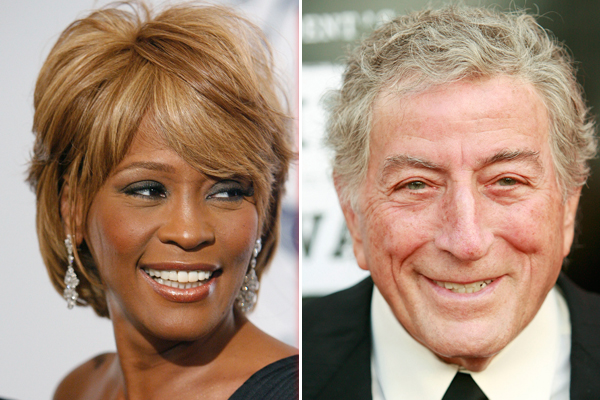
Whitney Houston and Tony Bennett (Credit: AP) It may be weeks before the exact circumstances of Whitney Houston’s death Saturday are determined, but Tony Bennett has some ideas on how it could have been prevented. Drug legalization.
Just hours after the news of the singer’s death, Bennett was at a Grammys event in the Beverly Hills Hilton – where Houston died just a few floors above – and said, “First it was Michael Jackson, then there was Amy Winehouse, and now the magnificent Whitney Houston. I’d like to have every gentleman and lady in this room commit themselves to get on government to legalize drugs … Let’s legalize drugs like they did in Amsterdam. No one’s hiding or sneaking around corners to get it. They go to a doctor to get it.”
Bennett knows plenty about drugs — and the ravages of addiction. He’s been upfront in the past about his own experience with drug abuse and his near fatal 1979 overdose on cocaine. In his 1998 memoir, “The Good Life,” he wrote of passing out in a bathtub, an eerie foreshadowing of the discovery of Houston’s body in her hotel tub. And on Sunday, he shared a Grammy win with the late Amy Winehouse for a duet on “Body and Soul.”
Back in September, Bennett said that Winehouse “knew that she was in a lot of trouble” and “that she wasn’t going to live.” After taking the stage with Winehouse’s parents Sunday night, the 85-year-old Bennett told Rolling Stone that drug legalization would “get rid of all the gangsters that make people hide. One thing I’ve learned about young people, when you say ‘Don’t do this,’ that’s the one thing they’re going to try and do. Once it’s legal and everybody can do it, there is no longer the desire to do something that nobody else can do … I witnessed that in Amsterdam. It’s legal, and as a result there’s no panic in the streets. There’s no deals, there’s no ‘Meet me at the corner and I’ll give you something.’ You’re always afraid you’re going to get arrested. You have to hide. Why do that?”
You don’t have to be Zach Galifianakis to know that America’s 40-year war on drugs is a joke. Or as the Global Commission on Drug Policy called it last year, a flat-out failure, one with “devastating consequences for individuals and societies around the world.” Arrests for nonviolent possession offenses continue to rise, disproportionately targeting minorities and creating a booming prison population. According to the Bureau of Justice Statistics, “Between 2000 and 2007, drug offenders represented 45 percent of the growth in the federal prison population.” Meanwhile, even the president of the United States can acknowledge, “I inhaled frequently. That was the point.”
But talking about drugs – and how we as individuals and a society handle them – can’t be managed with a simple “It’s all good.” To do so ignores not only the enormity and unmanageability of the international trade but the complexities of consumption. Smoking weed and running a meth lab out of your basement aren’t exactly the same things. We can’t just make blanket statements about “drugs” as if they’re all the same, not in a culture where we still expect limits on environmental toxins. And if you’ve ever wandered into a circle of thuggish, hooker-seeking British tourists in Amsterdam on a summer weekend, it’s worth asking – Hey, Tony Bennett, is this really the greatest argument we’ve got for how great legalization is?
Yet what really muddles the waters is the examples Bennett used, of Michael Jackson and his friend Amy Winehouse. The claim that “Once it’s legal and everybody can do it” problems go away is sadly untrue. Michael Jackson didn’t meet his maker shooting heroin into his veins; he died of “Acute Propofol Intoxication” — and his doctor, Conrad Murray, was subsequently convicted of involuntary manslaughter. Other drugs found in Jackson’s system at the time of his death were the FDA-approved Lorazepam, Lidocaine, Diazepam and Midazolam. Winehouse, meanwhile, died of alcohol poisoning.
Houston was no stranger to the illicit. In 2009, she admitted doing “heavy drugs, every day,” including cocaine, to Oprah Winfrey. But the investigation into her death so far has focused on prescription medications. A plea for a saner approach to our misguided, punitive drug war is a valid one to make. But accessibility doesn’t cure the problem of abuse. And as Dylan Thomas, Marilyn Monroe, Elvis Presley, Jackson, Winehouse — and quite possibly Whitney Houston — discovered, you can die just fine without breaking any drug laws.
Mary Elizabeth Williams is a staff writer for Salon and the author of "Gimme Shelter: My Three Years Searching for the American Dream." Follow her on Twitter: @embeedub. More Mary Elizabeth Williams.
The Enquirer’s ghoulish Whitney cash-in
The tabloid publishes a photograph of her corpse -- and proves, again, just how low it will go
Whitney Houston (Credit: Reuters) What would you call a photograph of a dead celebrity, peddled out to a bottom-feeding rag? How would you describe an image running with the exclamation-pointed words “The last photo!” and details of how much money the jewelry on her corpse was worth? Creepy? Morbid? Gross? Speaking to Fox.com news on Thursday, ghoulish Enquirer publisher Mary Beth Wright thought her “world exclusive” purported photo of Whitney Houston laid out in her coffin “was beautiful.”
Continue Reading Close
Mary Elizabeth Williams is a staff writer for Salon and the author of "Gimme Shelter: My Three Years Searching for the American Dream." Follow her on Twitter: @embeedub. More Mary Elizabeth Williams.
What Whitney’s death should have us talking about
Despite its obsession with the star's demise, the press ignores the real issues behind America's deadliest epidemic
(Credit: AP)
Just minutes after Whitney Houston was found dead in a bathtub at the Beverly Hilton last Saturday at the age of 48, a caravan of network trucks began slowly encircling the plush hotel, morbidly eager to document her untimely demise. Since then, it’s been nearly impossible to turn on the TV or log on to the Web without witnessing a tribute to the singer, often including depressing video footage of her long, painful decline. Her memorial on Saturday had the pomp and pageantry of a state event—complete with dignitaries, crying onlookers and flags at half-mast.
Maer Roshan is Founder and Editor of The Fix. Previously he served as Founder and Editor-in-Chief Radar Magazine and Radaronline.com, Editorial Director at Talk, Deputy Editor of New York, and Senior Editor of Interview. He is also Founding Editor of the forthcoming I-Pad publication, Punch! More Maer Roshan.
The real problem with honoring Whitney
The uproar over Christie's order to fly the flags at half-staff was about race and gender, not drug addiction
(Credit: AP) If any single political figure in America is a flesh-and-blood personification of a Rorschach test, it is Republican New Jersey Gov. Chris Christie. In almost every way, he raises vexing questions which ultimately say more about us than they do about him.
Is he, for instance, refreshingly authentic or just downright offensive? Is he regular-guy fat or too obese to be president? Is he a rare moderate Republican who is at least willing to discuss legalizing gay marriage or is he a standard GOP bigot who is deftly maneuvering to prevent such legalization?
Continue Reading Close
David Sirota is a best-selling author of the new book "Back to Our Future: How the 1980s Explain the World We Live In Now." He hosts the morning show on AM760 in Colorado. E-mail him at ds@davidsirota.com, follow him on Twitter @davidsirota or visit his website at www.davidsirota.com. More David Sirota.
Nancy Grace is more terrible than ever
Wild and unfounded speculation about Whitney Houston's death is a new low for the HLN host VIDEO
Nancy Grace (Credit: AP/Chris Pizzello) Cable news depends on colorful characters to draw eyeballs in between those reminders that there are “no new developments” in the real stories of the day. But even in a sea of distinctive jerkwads – your Erin Burnetts and Piers Morgans and Bill O’Reillys and Megyn Kellys – HLN host Nancy Grace never fails to distinguish herself. And just when you think she can’t find new depths to plumb, along comes the Whitney Houston story.
Continue Reading Close
Mary Elizabeth Williams is a staff writer for Salon and the author of "Gimme Shelter: My Three Years Searching for the American Dream." Follow her on Twitter: @embeedub. More Mary Elizabeth Williams.
Whitney Houston’s lessons in love
As a girl, the late diva's songs taught me about love. As an adult, she showed me about loss and pain VIDEO
Whitney Houston at Wembley Stadium in 1988. (Credit: Reuters) In seventh grade I owned the cassette tape of “Whitney,” the second album by Whitney Houston, which was true of pretty much every 12-year-old female in America. I played the hell out of that tape. I used to spend afternoons in my bedroom, lip-syncing those songs to my bedroom wall, because that’s the kind of kid I was. Always longing for an imaginary audience. I did not want to be a writer back then, or the president of the United States. I wanted to be a pop star. And in 1987, there wasn’t any pop star more elegant or talented than Whitney Houston. Daughter of a gospel singer, cousin of an R&B legend, smashingly beautiful — she was practically anointed by the gods for greatness.
Continue Reading CloseSarah Hepola is an editor at Salon. More Sarah Hepola.
Page 1 of 7 in Whitney Houston