Opening Shot
What a GOP cave looks like
The House’s top Republicans desperately want to retreat on the payroll tax – if the Tea Party lets them
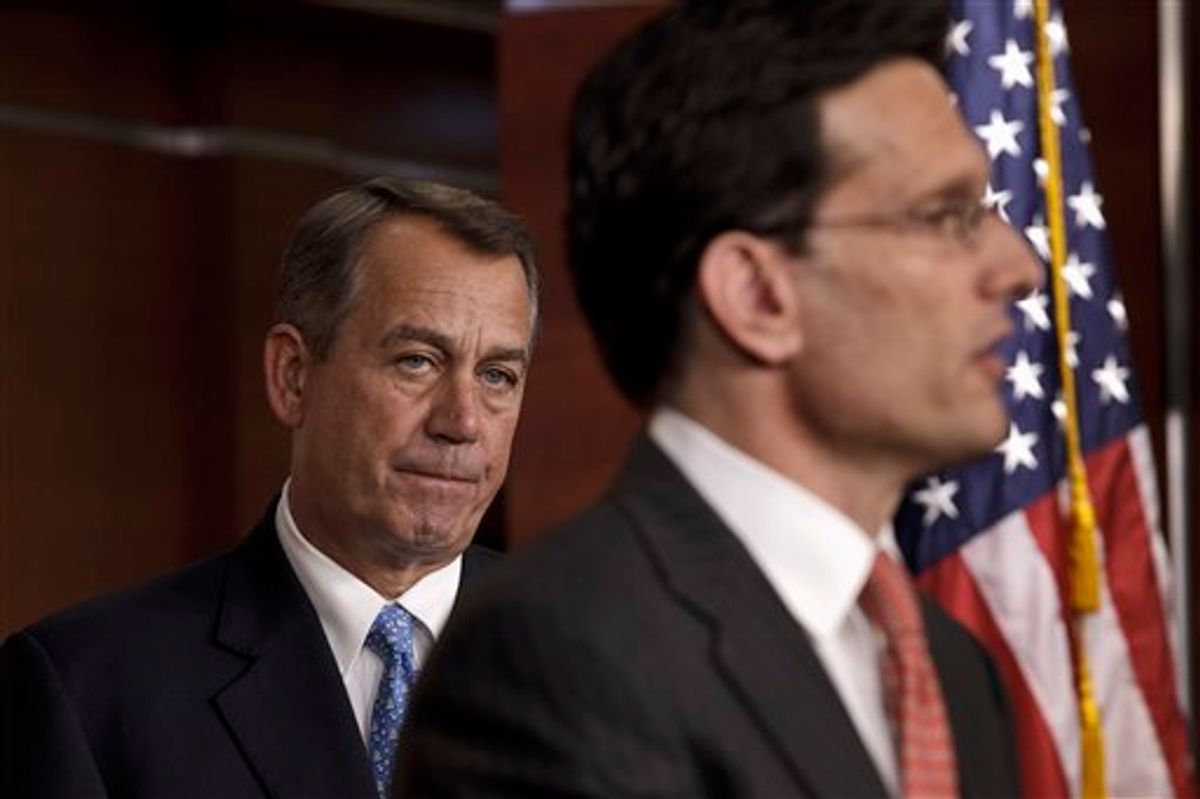
House Speaker John Boehner of Ohio listens at left as House Majority Leader Eric Cantor of Va., talks about jobs and the latest government report on unemployment, Friday, Feb. 3, 2012, during a news conference on Capitol Hill in Washington. (AP Photo/J. Scott Applewhite)(Credit: AP) Since the 112th Congress was seated more than a year ago, the Republican House Conference has served as a generally reliable reflection of the Tea Party movement’s passions and priorities. A significant chunk of its members — mainly freshmen, but also some veterans — are explicitly aligned with the movement, while those who aren’t know better than to break too loudly or too publicly with it, lest they fall victim to a primary challenge.
This is why Speaker John Boehner, a Capitol Hill lifer whose political biography invites automatic Tea Party suspicion, has been repeatedly forced to subordinate his best judgment to the zeal of purity-obsessed rank-and-filers. And it’s why Boehner’s surprise decision yesterday to support a payroll tax cut extension even if it’s not paid for represents a real gamble — one that seems grounded in a reasonable calculation but that still has the potential to create another serious political mess for him and his party.
The political logic of his move is obvious: If an extension isn’t implemented by the end of the month, tens of millions of middle-class Americans will face an election year tax increase — one for which congressional Republicans, who’ve seen their poll numbers drop lower and lower with each showdown they’ve forced with President Obama, will likely take the blame. Given the relatively low cost of an extension, it hardly seems worth risking further damage to the GOP brand, especially since the party’s hold on the House is somewhat tenuous.
But as the past 13 months have demonstrated, this sort of political logic doesn’t tend to hold sway with the Tea Party crowd, which has convinced itself that rigid, compromise-averse devotion to ideological purity is the key to a sustained GOP revival. It helps that many of the true believers in the House come from safely Republican districts where there’s little or no threat of a general election backlash. So the risk for Boehner is that Tea Party Republicans in the House — and influential Tea Party leaders outside the House — will deem his payroll tax move a sellout, since it would add to the deficit.
And by last night, there were some ominous signs for the speaker. As Politico reported:
The announcement shocked rank-and-file members, who were back in their House districts. Senate Republicans were likewise caught off guard — even one GOP leader who was trying to negotiate a compromise had no idea it was coming.
And conservative ire rose throughout the day, threatening to derail Speaker John Boehner’s plan to take the thorny issue off the table.
[SNIP]
More than a half-dozen House Republicans, reached directly by POLITICO, declined to comment on the record about the decision, saying they wanted to hear the case from their leadership when they return Tuesday. GOP leadership said the decision to move forward with this plan depends on reaction from the rank and file.
In other words, when push comes to shove, they’d much rather increase the federal budget deficit than to raise even a dime of taxes on wealthy Americans.
Look for Obama to point that out once or twice this year when Republicans attack him on the deficit.
Steve Kornacki writes about politics for Salon. Reach him by email at SKornacki@salon.com and follow him on Twitter @SteveKornacki More Steve Kornacki.
Dems’ best friend: The GOP base
The conservative masses revolt again, this time in Nebraska's Senate primary
At the very least, the Republican Party base’s revolt against its own establishment cost the GOP a 50-50 Senate tie in 2010, with primary voters forcing unelectable nominees on the party in three races that it had otherwise been on course to win. A decent case can be made that the uprising actually cost Republicans outright Senate control.
And now the same thing may be happening all over again, with Nebraska joining a growing list of unexpected 2012 Senate battlegrounds – at least for the moment.
Continue Reading Close
Steve Kornacki writes about politics for Salon. Reach him by email at SKornacki@salon.com and follow him on Twitter @SteveKornacki More Steve Kornacki.
A brand-new Sarah Palin headache
Don’t look now, but her candidate might be on the verge of a huge upset in Nebraska today
Sarah Palin (Credit: AP) Let’s be clear: No matter what, Republicans in the state of Nebraska will be nominating a very conservative candidate for the U.S. Senate today. But the sudden prospect of a surprise victory by an underfunded state legislator best known for the endorsement she received from Sarah Palin lends potential national significance to tonight’s outcome.
To set the stage, the front-runner in the race is (and has been the entire way) Jon Bruning, Nebraska’s third-term attorney general. The 43-year-old Bruning has made some gestures to his party’s restive base, suing the Obama administration over its healthcare reform law and contraception mandate and likening welfare recipients to raccoons. But his polished demeanor and political resume – elected to the state Senate at age 27, a seamless rise to the AG’s office six years later, and now a Senate bid – make him seem more like an establishment man on the rise.
Continue Reading Close
Steve Kornacki writes about politics for Salon. Reach him by email at SKornacki@salon.com and follow him on Twitter @SteveKornacki More Steve Kornacki.
The neutering of Mitch McConnell
How the Tea Party is destroying the Senate GOP leader’s clout – and why it’s bad for America
Mitch McConnell (Credit: AP) The possibility that Mitch McConnell might be ousted when Senate Republicans pick their leader after the November elections was raised by a Sunday New York Times story, which found several Tea Party-aligned GOP candidates refusing to commit to backing him. McConnell, though, still has plenty of allies and remains the prohibitive favorite to retain his post.
But there’s a more interesting question at work here than whether he can hang on: Why would he even want to?
Continue Reading Close
Steve Kornacki writes about politics for Salon. Reach him by email at SKornacki@salon.com and follow him on Twitter @SteveKornacki More Steve Kornacki.
Harry Reid’s filibuster rage
A particularly tedious bit of GOP obstructionism prompts the Senate majority leader to suggest the unthinkable
For those who are anxious to see the filibuster die, this week has produced some very hopeful developments.
The biggest news came late yesterday afternoon, when what Harry Reid thought was going to be a routine exercise – approving a bill already passed by the Republican-controlled House to reauthorize the Export-Import bank – was ruined by surprise Republican objections, forcing the majority leader to file a cloture motion and delaying action on the bill at least until next Monday.
This is the 84th time in the current Congress that Reid has formally sought to bypass a Republican filibuster or filibuster threat, a continuation of a trend toward Senate obstructionism that has been building for decades – but that really took off when Republicans returned to minority status in 2007. In the Congress that began that year, Reid filed 139 cloture motions, and in the next one there were 137, numbers that dwarf anything seen since the procedure for cloture was developed in 1917.
Continue Reading Close
Steve Kornacki writes about politics for Salon. Reach him by email at SKornacki@salon.com and follow him on Twitter @SteveKornacki More Steve Kornacki.
The unlikely liberal hero
Joe Biden sped up history this week -- and made some new friends who could help him fulfill his most elusive dream
FILE - In this March 15, 2012, file photo, Vice President Joe Biden in Toledo, Ohio. (AP Photo/Madalyn Ruggiero, File) (Credit: AP) One of the striking aspects of this week’s gay marriage drama is how neither Barack Obama nor Joe Biden played to type.
When they teamed up four years ago, Obama was the face of the new Democratic Party, one composed of college-educated professionals and young voters who held decidedly liberal cultural views. Biden’s addition to the ticket was partly a nod to the party’s blue-collar roots – specifically, to the white, working-class voters who had continued to line up behind Hillary Clinton all the way to the end of the 2008 primaries, even when it became clear Obama would be the winner. In Biden, a Scranton-born Catholic who once took heat for calling Obama “articulate and bright and clean,” it was hoped, these voters would find reassurance that the Democratic Party was still for them, too.
Continue Reading Close
Steve Kornacki writes about politics for Salon. Reach him by email at SKornacki@salon.com and follow him on Twitter @SteveKornacki More Steve Kornacki.
Page 1 of 25 in Opening Shot