Ask the Pilot

The things I carry

All those gadgets, chargers, adapters and cords are supposed to make my life easier. I'm not so sure

(Credit: Patrick Smith)

The scourges of modern-day air travel.

I can think of a few: TSA, delayed flights, garbage in your seat pocket. Screaming kids and misdirected luggage. “CNN Airport News.”

Or, how about the blizzard of cardboard placards that hotel chains insist on littering their rooms with? I spend a quarter of my life in hotel rooms, and I resent having to spend the first five minutes of every stay gathering up an armful of this diabolical detritus and heaving it into a corner where it belongs. Attention, innkeepers: This is fundamentally bad business. One’s first moments in a hotel room should be relaxing. The room itself should impart a sense of welcome. It shouldn’t put you to work.

And here’s another one: the ever-expanding collection of electronic cords, adapters, chargers and gadgets I’m obliged to haul around with me. You know what I’m talking about. Anybody who travels regularly knows what I’m talking about. All of this, supposedly, to keep us “connected.” To make our lives easier and more productive.

Does it?

Don’t get me wrong. Riding the subway out to Logan, I love being able to pop in my earbuds and catch a few cuts from the Wedding Present, the Jazz Butcher or the Velvet Underground. And my MacBook Air is as essential for travel as a change of socks. But there is, or was, something to be said for that unplugged, disconnected age of not so long ago. If nothing else, our carry-ons were lighter, with more room for clothes.

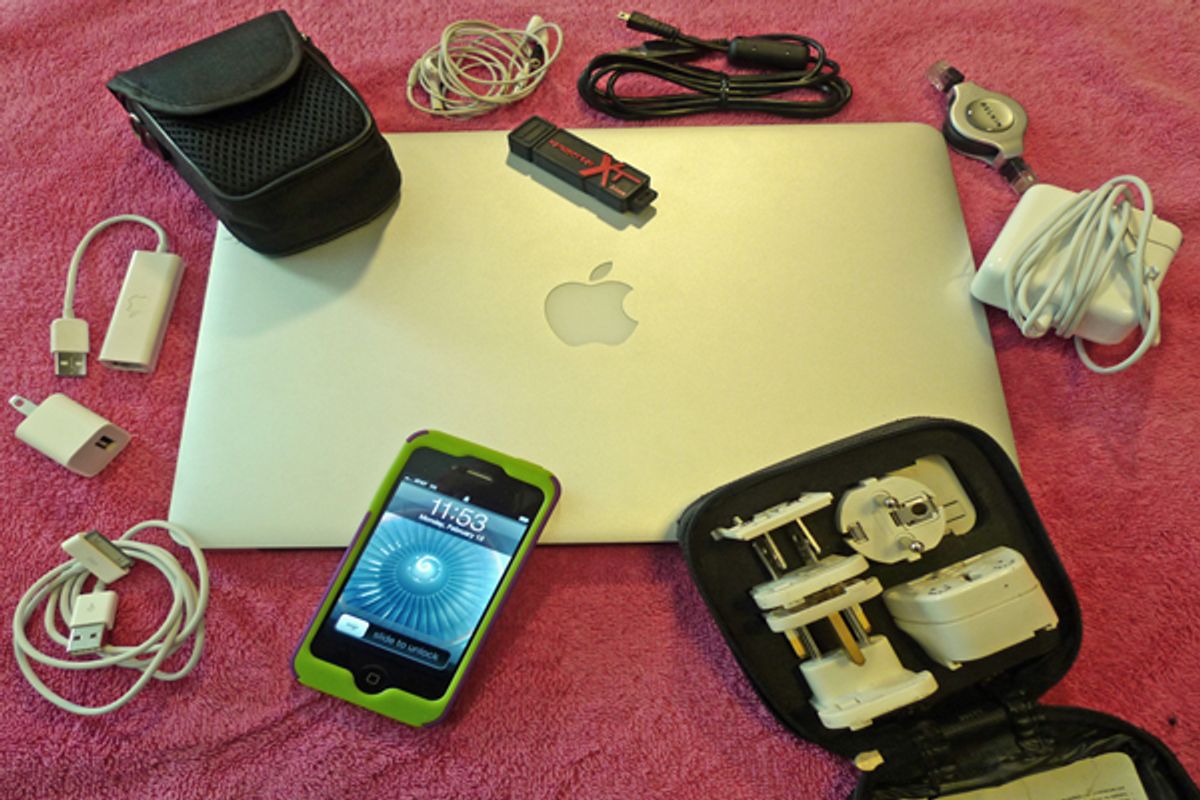
The photo above shows the assortment of electronic gadget and gizmos I take with me pretty much every time I hit the road, be it for work or pleasure. As recently as a decade ago I owned none of this. I didn’t even have a cellphone until 2006.

Clockwise-ish, from upper left:

– That black case contains the camera that I used to take this picture. I currently use a Panasonic DMC-LX3. It’s a decent point-and-shoot with a Leica lens and super-long battery life. (The more recent pictures in my Flickr archives were taken with this camera.) I bring it with me on most, though not all, of my layovers and holidays.

– Earbuds. I recently upgraded to a pair of Klipsch and retired this Apple set.

– 32GB flash drive. For my backup files, and for transferring to and from my “master” computer at home.

– USB connector for camera (optional).

– Ethernet cord. Useful in those (too many) hotels where Wi-Fi is weak and a wired connection runs more robustly. Hotel-supplied Ethernet cords are often broken.

– Power adapter for laptop.

– AC adapter set. Essential when traveling overseas. One problem is, if I’m assigned to reserve status I often don’t know if I’ll be heading overseas until the last minute, so I’ve always got this with me.

– iPhone 4. Product unplug: Am I the only person who despises — and I mean really despises — the iPhone’s messaging keypad? Because the special function keys — caps, space bar, backspace and return — are so close to the normal character keys, I’m constantly capitalizing, spacing and backspacing when I don’t mean to. This happens in either the vertical or horizontal layout, and it’s especially annoying for those of us with fat fingers. It takes me five attempts to complete the simplest sentence.

– USB charger for iPhone.

– USB-to-AC connector thing for iPhone (optional, but a good thing to have).

– USB-to-Ethernet adapter (see Ethernet cord above).

And, in the middle of it all, my beloved MacBook Air.

All together, we’re looking at roughly five pounds of technology that, for all intents and purposes, is mandatory carry-on. Sometimes it’s slightly less, other times slightly more. Not shown, for instance, is my Flip video camera, which I bring on longer trips. ( Flip brought you this, among other works of directorial art.)

Thus the real must-have gadget is a decent case or container in which to consolidate all of this crap. For me, most of the more wiry components above fit nicely into an old business class amenities kit, which keeps them out of the way and avoids tangles. (How frustrating is it, meanwhile, that so many electronic devices require their own proprietary charging cord or adapter? Imagine if every lamp took a different kind of light bulb.)

The amenities case, together with the laptop, camera and phone, fit snugly into either of my larger carry-ons. Now that my flight case has been retired — a milestone previously detailed here — I typically go to work with two pieces of luggage:

The first is a custom crew roll-aboard from Luggage Works. At the moment I use the 26-inch LW with the plastic frame, which is much lighter than the more popular metal frame version. To make it even lighter, I’ve retrofitted the stainless steel retractable handle with an aluminum one.

I don’t know what “custom crew” means. I just thought it sounded cool. Over 95 percent of LW users are airline crew members, but anybody can order one.

A number of my colleagues use Travelpro bags (I’ve owned a couple of Travelpros over the years), but on the whole that brand is more popular with flight attendants than with pilots.

For a long time pilots resisted using roll-aboards at all. The thinking was that rolling your belongings was, like, too effeminate for the macho pilot (take me, for example). And so pilots would hand-haul their 40-odd pounds of personal luggage and pilot gear through the airport, toning their tough-guy biceps and making many a chiropractor happy.

By the way, have you ever heard somebody refer to roll-aboard bags as “roller board” bags? I was on a plane a few weeks ago and the flight attendant made an announcement reminding people to stow their “roller boards” handle-first into the bins.

My smaller bag, hung from my roller board using a hook that I designed myself, is a $300 Tumi briefcase that I bought about six months ago and quickly learned to hate, with its useless, miniature exterior pockets that I can barely squeeze my fingers into.

I’m something of a pro when it comes to short-notice, multi-climate packing. Here’s a tip: Go with lightweight clothing. What a concept, I know, but I’m amazed by how many people travel with heavy cotton jeans — even to hot climates. I own a lot of fast-dry synthetics. They’re not stylish, but when have I ever been? On the other hand I can launder a pair of pants in the hotel room bathtub and they’re dry before morning.

- – - – - – - – - – - -

GO-AROUNDS

Re: The Funniest Thing Ever Written

Several readers emailed demanding that I immediately scan and post copies of the 1988 “Guide to Harvard University Dining Services” booklet that I wrote about last week. A great idea, but the thing is 38 double-sided pages long. Tell you what: I’ll do it, but not for free. My price is $5, sent to my PayPal account. I figure if 20 people are interested, that’s $100, which makes it worth my trouble. Once I hit a hundred bucks I’ll send scans of every page to anybody who wants to see them, or else I’ll post them somewhere on my home site. If I don’t hit the $100 mark within the next 10 days I’ll refund your donations. (I really don’t expect to bring in much beyond that, as people will be waiting for the early birds to cover the cost.)

- – - – - – - – - – - -

Join the Ask the Pilot mailing list. Keep abreast of changes, the newest articles and other info. To sign up, send a message to patricksmith@askthepilot.com with the word “subscribe” in the title.

Behind the underwear bomb

The latest airplane terror plot wouldn't have been foiled without airport security -- but not the kind we all know

Travelers line up at a TSA checkpoint at Los Angeles International Airport. (Credit: Reuters/Danny Moloshok)
Another deadly plot taken down in the planning stages. This time, thanks to the work of a CIA double agent, officials were able to infiltrate a Yemen-based al-Qaida plot to destroy a U.S.-bound jetliner using a nearly undetectable underwear bomb.The moral of the story: Airport security works!Am I being facetious?  Not necessarily.  It depends on your definition of airport security.

In my mind, the key to keeping airplanes safe is, and always has been, stopping acts of sabotage while they are still in the planning stages. Here in the age of the TSA checkpoint, with its toothpaste confiscations and obsession with pointy objects, we tend not to think this way, preoccupied instead with a kind of airport Kabuki — the tedious, fanatical screening of passengers and their carry-ons. Real airport security takes place offstage, as it were. It is the job of the folks at the CIA and the FBI, working together with foreign authorities. And while TSA has an important role here too, we can do without the spectacle of airport guards rifling through innocent people’s bags in a pathological hunt for what are effectively harmless items.

The concourse checkpoint needs to be there.  Just the same, chances are good that once an adversary has made it to the airport, he or she has engineered a way to outwit the system.  And spend as we might, there will always be a way to outwit the system.  ”Even if our technology is good enough to spot it,” said California Rep. Adam Schiff, commenting on the news of the latest underwear plot, “technology is still in human hands and we are inherently fallible.”

That’s one of the smartest things I’ve heard a politician utter in some time.

Getting a handle on this takes us all the way back to Sept. 11, 2001, the day that everything, and yet really nothing, changed.  I’ve said this before, but it bears repeating: Conventional wisdom holds that the 19 hijackers exploited a weakness in airport security by smuggling box cutters onto four Boeing jetliners. But conventional wisdom is wrong. What the men actually exploited was a weakness in our mind-set — a set of presumptions based on the decades-long track record of hijackings and how they were expected to unfold. (In prior years, a hijacking meant a diversion, perhaps to Havana or Beirut, with hostage negotiations and standoffs; crews were accordingly trained in the concept of “passive resistance.”) The presence of box cutters on 9/11 was merely incidental. The men could have used almost anything — a deadly sharp can be fashioned from a broken first-class dinner plate or a ballpoint pen — particularly when coupled with the bluff of having a bomb. The success of their plan relied not on hardware but on the element of surprise. It wasn’t a failure of airport security that allowed those men to hatch their takeover scheme. It was a failure of national security — a breakdown of communication and oversight at the FBI and CIA level.

To put it succinctly: The success of the 9/11 attacks had almost nothing to do with airport security at all — a great and painful irony, of course, to any passenger forced to endure the checkpoint rigmarole in 2012.

Not that frontline guards don’t play a deterrent role.  And, in the opinions of some, the plot uncovered in Yemen underscores the value of full-body scanners — those controversial walk-through machines that allow guards to look beneath a passenger’s clothing. It’s a compelling argument, but the way in which these scanners have — and have not — been deployed is apt to make some of us cynical. For instance, the vast majority of body scanners are found at U.S. domestic airports. Overseas, where a bomb is far likelier to originate, they are rare. Is this really about safety, we wonder, or is it about billions of dollars going into the coffers of the companies contracted to build these machines?

And although the scanners are effective, where does the arms race end?  Not long ago, the idea that passengers would be marched through body scanners and photographed naked before being allowed to board an airplane, would have seemed outrageous. Yet here we are. What might be next?  The stubborn truth is, we can turn airports into fortresses if we want (in some respects we’re well along that path), yet we’ll never be entirely safe. Airport screening alone, no matter how thorough, how expensive, and how technologically advanced, will never defeat a relentless enough, resourceful enough adversary intent on downing a plane.

That isn’t capitulation, it’s reality.  And acknowledging this reality would go a long way toward warding off panic and overreaction when the next successful attack occurs.

Regrettably, too, we often forget that commercial air travel has long been a target of terrorist extremists.  The 1970s and 1980s in particular were, as I like to describe them, a Golden Age of Air Crimes, comparatively rife with bombings, hijackings and other deadly assaults against airplanes and airports. Over one five-year span between 1985 and 1989 we can count at least six high-profile terrorist attacks, including the horrific bombings of Pan Am 103 and UTA 772; the bombing of an Air India 747 over the North Atlantic that killed 329 people; and the incredible saga of TWA Flight 847.  And let’s not forget what might have been, such as the so-called “Project Bojinka,” the 1994 scheme masterminded by Ramzi Yousef (nephew of Kalid Sheikh Mohammad), in which impossible-to-detect (at the time) liquid explosives were to be used to simultaneously destroy a dozen U.S. airliners over the Pacific Ocean. Fortunately the plot unraveled and Yousef was arrested.

While we can argue, quite persuasively, that many of the current-day security measures have done little if anything to make us safer, we’ve nevertheless introduced measures that have been useful and effective, from explosives screening of checked luggage to the sorts of trans-border partnerships that broke up the most recent plot from Yemen. Whether in spite of, or because of, the attention we’ve lavished on All Things Terrorism, the past decade has seen fewer attacks against commercial air travel than any since the 1950s.What we need to remember, though, is that our success has had more to do with the security measures we don’t see than those taking place in plain view. And if our luck is to hold, we need to better rationalize and streamline our entire approach to airport security. For instance, if we’re going to have those body scanners, let’s put them where they’re needed. If this requires negotiating with foreign authorities whose airports are beyond TSA’s jurisdiction, so be it. Meanwhile, here at home, TSA’s one-size-fits-all approach, in which every single person who flies is seen as a potential threat, is simply unsustainable in a country where close to 2 million people fly daily. Things like taking snow globes from children, haggling over tiny container sizes, or confiscating a dessert fork from a uniformed, on-duty airline pilot (it happened to me) serve no useful purpose whatsoever. On the contrary, they divert valuable time and resources away from the things that could make us safer.  Let’s scale back that concourse Kabuki and retrain guards in the finer points of a more sensible, risk-based assessment of passengers and their belongings.

And lastly, if only as an aside, let’s behold for a moment the term “underwear bomb.”  That was the operative phrase in literally hundreds of articles and broadcasts over the past several days, and nowhere did it raise a snicker.  What does it say about our country, I wonder, that such a preposterous expression is instantly understood and effectively taken for granted?

Strange times indeed.

Continue Reading Close

Letter from Mumbai

Could this long-winded carpet merchant really mistake me for a wealthy customer, ready to whip out my credit card?

(Credit: Patrick Smith)

Flying from Europe to India, we pass overhead Odessa, Ukraine. Odessa, they say, is home to the most beautiful women in the world. Then across the Black Sea to Azerbaijan and the gorgeous barren landscapes of Georgia. Next comes the ink-dark Caspian, and then the long desolate outback of northwestern Iran. (The controllers down in Tehran are courteous and professional, their English impeccable — easier to understand than most Scottish controllers.)

From there it’s directly overhead the apocalypse of Karachi, followed by a turn southbound, out across the Arabian Sea toward Mumbai.

It’s true about the smell. At around 10,000 feet the airplane begins filling with the rank bouquet of India: a soupy waft that tastes of putrefaction and exhaust fumes. As if, somewhere below, the world’s largest garbage dump has been set on fire. It’s a smell that burrows into your clothes and your hair and right through the concrete bunker walls of your five-star hotel.

Twenty-four hours downtime.

The concierge hooks me up with young driver named Faiyaz — a most conscientious and law-abiding wheelman with a silver Toyota and remarkably handsome teeth. A hundred U.S. dollars for the day it will cost, gas and sporadic commentary included.

It’s monsoon season, and we set out under a nervous, curdled sky. The air has a smell of rotten expectation, like a sink full of dirty dishes.

Maximum City, as Suketu Mehta dubbed it. And I never thought I’d see a metropolis with traffic worse than, say, Cairo or Bangkok. But at least the chaos of Cairo stays more or less in motion. Mumbai’s traffic never has the chance to become chaotic. Every road, highway, back street and boulevard exists in a permanent state of gridlock. And all of it four-wheeled and motorized. One misses the cows and three-wheel auto-rickshaws that jostle for space in other Indian cities. If nothing else they make for a more exotic view — a form of entertainment when you’re cemented into a non-moving column for 45 minutes.

The 10-mile drive to downtown takes almost two hours. Averaged out, that’s a little faster than walking. It’s a long, if morbidly engrossing trip through the city’s most frenetic northern suburbs.

Mumbai isn’t unlike most big cities, I reckon — provided you took that city, layered it under several inches of solid and semi-solid waste, then ran it through a blender. That’s a cheap and nasty description, but looking upon Mumbai is, for me, a pained gaze through layer upon layer of chaos — a noisy, smelly, kaleidoscopic battle between machinery, concrete, garbage and flesh. From the car I catch sight of a tiny kitten, skinnier than a sparrow, moving nervously along the roadside gutter with a rat hanging limply from its fangs. The miniature, mud-spattered feline is boxed in by an endless stream of vehicles, and is simultaneously being bullied by an impetuous gang of hooded crows. A half-dozen of the lead-colored birds are jabbing at the kitten with their deadly black noses.

How does this battle conclude? Who knows. Faiyaz hits the gas and we’re gone, onward to the next little nightmare.

Looking skyward, the air above, I notice, is no less a conglomeration of noise and form, swollen with sooty rain and noisily aflutter with creatures. It’s the crows who dominate, their ranks swollen by a surplus of streetside carrion. There are pigeons too; hawks; the occasional green parrot; and a huge, day-flying bat with a wingspan as wide as a seagull’s.

Finally reaching downtown, Faiyaz navigates down a leafy street to the Mani Bhavan Gandhi Sangrahalaya, longtime residence of the country’s most beloved and well-known historical figure. I take in the history of the great scrawny Mahatma as presented through photographs, artifacts (yes, a spinning wheel) and an oddly engaging series of dollhouse-style dioramas.

It’s a self-guided tour, but I’m shadowed at each turn by a family of four, chattering away in Arabic. They are, I realize with some discouragement, decked out in the ubiquitous regalia of the upwardly mobile Arab: The man is about 35, stocky and fit, with a pair of expensive sunglasses retracted atop his head. He is wearing dark navy Levi’s, a leather belt and a Ferrari polo shirt. His young son, around 8 or 9, is wearing both a Ferrari polo and a Ferrari ball cap. Three paces behind trundles the man’s wife, heavyset, covered top-to-bottom in a Gulf-style abaya. A miniature daughter in a purple skirt and a plastic princess crown clutches the woman’s hand, chirping along in tow.

Next is Chhatrapati Shivaji Terminus, formerly Victoria Terminus, the prickly, Gothic Revival wedding cake of a railway station and UNESCO World Heritage Site. The station has a prominent cameo in 2008′s “Slumdog Millionaire.”

And on Nov. 26 that same year, you might recall, two men spent the better part of an hour inside Shivaji firing AK-47s and hurling grenades at commuters, killing 58 of them.

Eight of the attackers’ colleagues had meanwhile scattered elsewhere around South Mumbai and were having a similar night out, shooting and blowing things up at the Oberoi Trident Hotel, the Cama Hospital (for women and children), the Leopold Cafe, a Jewish community center, and, most infamously, at the British Empire’s most luxurious home-away-from-home, the Taj Mahal Palace Hotel. All together, 167 people were murdered in the attacks, and nine of the 10 terrorists were shot by police.

Today the reopened Taj, like many big-city hotels, is at least nominally protected by airport-style metal detectors and X-ray belts. I’m not sure what good this does. Inside, there’s no trace of the 60-hour siege that caused $40 million in damages. It’s all rich wood and rich upholstery and rich-looking men bent in hushed, important-sounding conversations. (I’d hardly turn down a night’s stay in the place, but as a tourist destination I prefer the actual Taj Mahal, several hundred miles to the north, in the pandemonium sprawl of Agra.)

Across the street from the Taj sits the Gateway of India, a 90-foot basalt archway and promenade poised at the harbor’s edge. It was here that the Mumbai gunmen had boated ashore from Pakistan, and where, after so much time in the car, I’m eager to go for a stroll.

The problem is parking.

Fiayaz suggests that we use a complimentary space offered by a carpet emporium — a place called All Asian Imports. The catch being that I’ll initially have to go into the store and pretend to be shopping, at least for a minute or two. Then I’ll be free to take my walk along the waterfront. Faiyaz will wait in the car.

This seems a reasonable, if entirely facetious plan, but as I’m pushing through the heavy glass doors I can’t help feeling conspicuous and a bit embarrassed. This just ain’t my kind of place. I’ve bought rugs in foreign countries before — the gouged-up floors of my apartment are concealed by curio-quality kilims from Morocco and Egypt — but the emporium’s nearly conjoined proximity with one of the world’s most exclusive hotels, not to mention its showroom chandelier, ample air conditioning and smartly dressed salespeople, say one thing clearly: There is nothing in here that I can afford.

I’m thinking, fast in, fast out, until I’m grabbed hostage by a salesman with brightly polished shoes and a furry black monobrow. I might be an obvious impostor, in my New Balance sneakers and a sweat-stained T-shirt, but for the next half-hour I am given a theatrical dissertation in the finer points of oriental carpet appraisal. I can’t get a word in edgewise. All escape is blocked.

Of all the things that might possibly happen in this store, my taking out a credit card and purchasing a carpet is beyond the realm of possibility. I’m afraid to let him know that, however. It would be impolite, even a touch hostile, not to feign interest.

So I nod and crinkle my forehead as Monobrow speaks. Nod and crinkle, nod and crinkle, nod and crinkle — the globally recognized expression of “yes, fascinating, tell me more,” as I slowly suffocate from the sheer boredom of it all.

Carpets are everywhere, stacked like logs. Monobrow snaps his finger and an assistant pulls a cylinder from the rack, unfurling it with a crackle. He shows me cotton-on-cotton, silk-on-cotton, then quizzes me on the differences. He rolls out a factory-made Chinese synthetic, laying it next to a sumptuous $5,000 Kashmiri example (something-on-something, with alkaline, or maybe it was non-alkaline, dyes). Can I spot the differences?

Maybe. Sort of.

Next example. Then another and another and another. Soon there are several inches of rugs on the floor, slabbed atop each other like sheets of multicolored plywood. Somebody, it strikes me, has to roll them all back up again. Do I look like a wealthy customer, I’m wondering, skeptically. Or is he on to our parking scam and screwing with me, just to keep me from my promenade stroll?

At one point I bend down like a baseball catcher and pinch the fringy corners of several of the offerings, running the material briefly through my fingers in what I imagine to be the gesture a serious carpet-buyer might make.

Did I give myself away?

“Thread count,” Monobrow booms, as if an entire audience had gathered in the room, “is how a fool judges a carpet!” Is that what I was doing in my crouch, counting threads-per-centimeter?

Ditto, I’m informed, about the intricacy of the pattern (which would have been my second guess). No, a rug’s real value comes from the qualities of three and only three things: “Material, dyes and workmanship.”

He pauses after each of these words, as if it were a quiz and I might fill in the blanks instead of just staring at him.

I cast a glance sideways, through tinted windows and out to the Gateway, where I’m supposed to be enjoying the rest of my afternoon. The weather, I notice, is looking more ominous than ever.

And it dawns on me that the experience of travel, like the experience of life in general, is made up of too many scenes exactly like this one. That is, long stretches of boredom and squandered time, from which one yearns to escape, only to find his egress obstructed by an instrument of commercial tedium. Like those papyrus store “convenience stops” on the way to Giza or that place near Siem Reap with the rows and rows of Buddhas. In this case it’s a long-winded lecture from a carpet merchant.

My means of escape, though, turns out to be simple enough.

“This one is extremely nice,” I say to Monobrow, pointing to whichever rug he happened to have unfurled below me at the moment. “But before we talk about price, my wife will need to see it.”

“Your wife? Of course. Where is she?”

“Across the street, at the Gateway. Let me go and find her and bring her over.”

Suddenly I’m hit by an old, old memory. The first time I ever bought a carpet in a foreign country — or maybe in any country. It was in Kusadasi, Turkey, near the ruins of Ephesus, in 1992. Kirsten, maybe, still has that little rug somewhere. This was before they lopped off all those zeroes from the Turkish lire, and I remember on my credit card statement how the numbers went right off the end of the page.

Monobrow is suspicious, I can tell, as he ought to be. But my excuse is wonderfully bulletproof. “As you wish,” he says.

“She will love the alkaline, non-alkaline cotton-silk non-Chinese dyes of this carpet.”

And with that I’m finally out of there.

As the door closes behind me I feel dirty, guilty, all eyes upon me, like a man slinking out of a whorehouse. I had no business being in there. I’m a kid from Revere, Mass., who went to community college. I don’t spend thousands of dollars on deluxe imported carpets, and I don’t feel comfortable in high-end boutiques that smell like jasmine and where the salesmen sip tea out of fancy china.

Again the alienation and failure of travel — the disappointment of finding yourself somewhere different, but not where you hoped to be.

The Gateway looks a lot like the Arc de Triomphe and its cousins in Washington Square and Brussels and everywhere else. Except that it’s grander and prettier, with its 16th-century Gujarat styling — at once European and Eastern, Victorian and Mughal.

There’s the crack of thunder. The sky looks like the bottom of a car, all rusted and scabbed and preparing to wreak havoc on everything beneath it. When the downpour comes the filthy gutters will turn to a brown, clotted stew.

I take my stroll, along past the Taj and to the back side of the Gateway, dark waves lapping at the seawall, occasional raindrops hitting me in the shoulder. I imagine the Mumbai attackers sloshing ashore here, clambering onto the street in their Adidas sneakers and cargo pants, weapons concealed in their satchels and backpacks. All the way from Pakistan they sailed. Travel of another kind.

For additional photos, see the author’s Mumbai set here.

- – - – - – - – - – - -

Join the ASK THE PILOT mailing list.  Keep abreast of upcoming changes, the newest articles and other info.  To sign up, send a message to patricksmith@askthepilot.com with the word SUBSCRIBE in the title.

Continue Reading Close

Revere Beach reveries

It was my perfect beach: Sand, clean water to swim in, and situated right below the approach to Logan Airport

A smiley-face balloon floats over Revere Beach in Revere, Mass. (Credit: AP)

Sometimes when I hear the whine of jet engines, I think of the beach.

I don’t expect that to make sense to you — unless, like me, your childhood was defined by an infatuation with jetliners and summers spent at a beach that sat directly below an approach course to a major airport.

That would be Revere Beach, in my case, just north of Boston, in the mid- to late 1970s.

Then as now, the city of Revere was a gritty, in many ways charmless place: rows of triple-deckers and block after block of ugly, two-story colonials garnished in gaudy wrought-iron. (Revere is a city so architecturally hopeless that it can never become gentrified or trendy in the way that other Boston suburbs have.) Irish and Italian families spoke in a tough, North Shore accent that had long ago forsaken the letter “R.” Shit-talking kids drove Camaros and Trans-Ams, the old-country cornuto horns glinting over their chest hair.

(For more on the Revere Experience, check out the work of Roland Merullo, the city’s second-most talented and famous author.)

Revere’s beach was the first public beach in the United States. Like the rest of the city, it wasn’t the kind of place that lent itself to niceties or sentimental descriptions. The roller coasters had long ago burned down and the boulevard was dotted by biker hangouts and the sort of honky-tonk bars and restaurants that, as a kid, you never dared set foot in, no matter how bad you needed to use the bathroom. Seagulls swooped and gorged on the garbage toppling out of overloaded barrels and dumpsters.

But it had the sand, and water that was clean enough to swim in — with those long, flat, shimmering low tides that seemed to recede all the way past Nahant and into the horizon. We spent our summers here, nearly all of the weekends and many of the weekdays too. My parents would have the car packed by 10 a.m. I remember the folding chairs, the towels and the endless supply of Hawaiian Tropic suntan lotion, its oily coconut aroma mixed with the hot stink of sun-baked Oldsmobile leather.

I swam, dug around for crabs and endured the requisite mud-ball fights with my friends. But for me, the real thrill was the airplanes. Revere Beach’s mile-long swath lines up almost perfectly with Logan International Airport’s Runway 22L, the arrivals floating past at regular intervals, so low you’d think you could hit them with one of the discarded Michelob bottles poking from the sand. I’d bring a notebook and log each plane as it screamed overhead.

They’d appear first as black smudges. You’d see the smoke — the snaking black tails of a 707 or DC-8 as it made its final turn up over Salem or Marblehead.  Then came the noise. Little kids — and grown-ups too — would cover their ears. People today don’t realize how earsplittingly loud the older-generation jets could be. And they were low, barely 1,500 feet above the sand, getting lower and lower and lower until finally disappearing over the hill at Beachmont, maybe 20 seconds from touchdown.

I remember all of them: TWA 707s and L-1011s in the old, twin-globe livery. United DC-8s and DC-10s in the ’70s-era bow-tie colors. Flying Tiger DC-8s and 747s.  Allegheny’s DC-9s and BAC One-Elevens. Eastern’s 727 “Whisperjets” that did anything but whisper.  And so on. I remember Braniff, Piedmont, Capitol and Seaboard World; TAP, North Central, Zantop and Trans International.

The term “regional jet” wouldn’t exist for at least another decade. Instead we had “commuter planes.” There was PBA and its Cessna 402s; Air New England’s Twin Otters and FH-227s and Bar Harbor’s Beech-99s. Pilgrim, Empire, Ransome and Downeast.

Fast-forward 30 years:

The arrivals pattern to 22L hasn’t changed. It still passes directly over Revere Beach. After I finally became an airline pilot, one of my biggest thrills was being at the controls on a 22L arrival into BOS, looking down at the same beach from which I spent a childhood looking up.

But other things are different.

The demographics of Revere and its beach have changed, for one. The Revere of my youth was a city in which pretty much every last family was Italian, Irish or both. At the beach it was no different. Today, both the neighborhoods and the sand are a virtual United Nations of the North Shore. Those harsh, R-less accents are only a portion of the mix, joined by voices in Hindi, Arabic, Portuguese and Khmer. The muscle shirts, Italian horns and shamrocks are still there, but those sunburned Irish complexions are contrasted against those from Somalia, Ghana, Haiti and Morocco. Not long ago the idea of a black person at Revere Beach was unheard of. In fact, I remember a day — it must have been ’77 or ’78 — when word spread across the sand that a black family had staked out a blanket down near the MDC bathhouse. This was such a novelty at the time that my friends and I took the quarter-mile stroll just to look at them.

And overhead, those plumes of oily smoke are gone. The jets nowadays are cleaner, much quieter. And, thanks to the generification of the modern jetliner, they’re also a lot less exciting. At age 12 I could tell a DC-10 from an L-1011 when it was 10 miles out. Every plane had its own distinct profile. Today’s jets are often indistinguishable, even at short range. And somehow the endless procession of A320s, 737s and regional jets just doesn’t get the pulse going, or the sunbathers pointing, the way a 707 or a DC-8 would — its motors shrieking, smoke spewing behind in a hellish black rooster tail.

Revere itself has both gained and lost character over the years. The skies above, though, have mostly just lost it.

- – - – - -

Related story: Logan Redux. The Deeper Meaning of Airports (and Pranks)

- – - – - -

Join the Ask the Pilot mailing list. Keep abreast of changes, the newest articles and other info. To sign up, send a message to patricksmith@askthepilot.com with the word “subscribe” in the title.

Continue Reading Close

Beware the “office” romance

Do pilots and flight attendants really stay in separate hotels on layover? Plus: Do pilots bring their own food?

(Credit: Xavier Marchant via Shutterstock)

Why can’t commercial jets be fitted with an exclusive side entrance into the cockpit, making it impossible for a potential skyjacker to gain access?

I am asked this all the time. It presents a number of complications.

First, you can’t simply cut a hole into the side of a plane and add an extra door. Doing so would require a large-scale and extremely expensive structural redesign. And in most cockpits there simply isn’t room for such an addition.

Presumably, too, you’d need to add a lavatory to the cockpit. And what about rest facilities? Long-haul flights carry augmented crews that work in shifts, and the off-duty pilots require a suitable place to relax or sleep. You’d be doubling or tripling the size of the average cockpit, which in turn would take up space already used for galleys, storage and passenger seats.

In addition there are times when it’s beneficial for pilots to have direct access to the cabin, for checking out certain mechanical problems, helping the flight attendants deal with passenger issues, and so on. Plus, I don’t like the idea of there being only one way out of a cockpit during an emergency.

But even if this were an easy or affordable thing to do, which it’s not, would it really be worth the trouble? Strategically, the Sept. 11 suicide takeover scheme was a one-shot, one-time formula. Hijacking protocols are different today, and the awareness of passengers and crew, together with armored cockpit doors, does about as good a job as is necessary, in my opinion.

Long and short: Having the crew barricaded upfront is going to cause more problems than it solves.

Apropos of your column about layovers, is it true that there was once a move afoot to have pilots overnight in different hotels than flight attendants — an effort by wives to cut down on “office” romances?

This is already the case at some airlines, at least on domestic routes, and has been for years. Pilots go to one hotel, flight attendants to another.

I really don’t know how much the hanky-panky aspect enters in. From an airline’s point of view it also can be logistically advantageous, and cheaper.

For example, flight attendant contracts often aren’t as nitpicky as pilot contracts when it comes to layover stipulations, and a carrier can sometimes get away with putting up its cabin crews in accommodations that are less costly than those given to pilots. And pilots and flight attendants don’t always fly identical patterns (see next question). If the pilots are leaving early in the morning but the FAs are working a later flight, it might be the pilots who are out at the airport Holiday Inn while the FAs go to a nicer place downtown. Or vice versa.

Again, this pertains mostly to domestic. Splitting up crews on international assignments is rare.

And yes, the airline covers the cost of all crew-member accommodations while on assignment. An hourly per diem is also paid — somewhere around a couple of dollars per hour. This is added to the employee’s bimonthly paycheck.

If you see a pilot or flight attendant paying for a room, chances are that he or she is off duty and on the front or back end of a commute. Around 50 percent of airline crews live in a different city than the one they are based in — something I discussed here and here. If an assignment begins early in the day or finishes late, leaving insufficient time to fly in or out, we’re on the hook for accommodations. Many crew members buddy-up in nearby apartments known colloquially as “crash pads.” Others will rent a room in a hotel close to the airport.

How long do flight deck crews work together? I imagine it’d be terrible to be holed up there for any length of time with somebody you can’t stand.

It varies. At most carriers cockpit crews are paired up only for as long as a particular assignment lasts. This can be anywhere from a day to two weeks, though the average pattern lasts about three days. If I’ve got four different trips on my schedule for the month, generally I’ll fly with four different captains. Some airlines, though, use a different, more traditional bidding system in which cockpit crews are matched up for the entire month.

Cabin and cockpit crews are not necessarily together for an entire trip. On international assignments it’s typically the same group in both directions, but domestically they are constantly swapping out. On a six-leg domestic trip I’ll be with the same captain the entire time, but it’s not unusual to fly with six different teams of flight attendants.

In a column recently you mentioned food. How are flights catered for the crew? Do pilots bring sometimes their own food from home?

The specs will vary carrier to carrier, but as a general rule pilots are fed on any flight longer than about five hours. Some stations will stock a designated crew meal, but normally we get the same food that is served in first or business class (yes, all the courses, including soup, salads and desserts). At my airline we are given a menu prior to departure and will write down our choices for dinner and breakfast (first choice, plus at least one alternate).

Airbus planes have a fold-out table at each pilot station. The Boeing I fly does not. Eating in the cockpit can be messy, so on international flights I usually take my meals in the cabin, on my rest break. With potential illness in mind, pilots are encouraged to eat different entrees, but this is not a hard and fast rule. In practice it comes down to your preferences and what’s available.

On my carrier’s flights from Brazil, the caterers will stock a special meal exclusively for the captain. The foil-covered entree has a sticker marked “Comandate Breakfast.” Some foreign stations will also bring a tray of sandwiches or appetizers just for the crew, in addition to our regular crew meals.

Shorter-haul domestic and regional pilots are on their own. It’s pretzels, peanuts, the food court [crack about Chick-fil-A removed by editor], or whatever you carry from home.

And when you find yourself at the Hampton Inn at midnight, starved from a lack of catering, it’s noodle time! As you might recall, I’m a certified Grand Master of Ramen.  Give me a packet of Trader Joe’s finest noodles, some Guyanese hot sauce and an in-room coffee maker, and I’ll show you a feast. (That’s why I carry around those forks that airport security warriors are always taking from me.)

Speaking of pretzels and peanuts, I’ve always been a bit mystified by the airlines’ choice of in-flight snacks. Why do they go with the messiest possible options? Approximately 30 percent of those tiny pretzels, and 80 percent of peanuts, end up on the floor, where they are crushed into unsweepable bits beneath the greasy Tevas of the slob who dropped them. I know there’s a certain lowest-common-denominator appeal here, but there has to be something else.

Carrots, maybe?

- – - – - – - – - – - -

GO-AROUNDS:

Re: The Funniest Thing Ever Written

For those of you interested in seeing that copy of the 1988 “Guide to Harvard University Dining Services,” the fundraiser continues. I’m still a bit short of the $100 mark. Send $5 to my PayPal account (patricksmith@askthepilot.com), and once I hit a hundred I’ll send a copy to anybody who wants one. It’ll be a hard copy: I’ve decided that it’s a lot easier to simply run off some copies down at the UPS store than spend all day scanning and uploading.

No word yet on the whereabouts of Samuel David or Sanders Metcalf, the supposed editors of the parody. According to the Harvard alumni guide, no such individuals ever graduated from the university. Perhaps they dropped out? I’m thinking the names are fake, or in some way juxtaposed.

- – - – - – - – - – - -

Join the Ask the Pilot mailing list. Keep abreast of changes, the newest articles and other info. To sign up, send a message to patricksmith@askthepilot.com with the word “subscribe” in the title.

Continue Reading Close

Mexico City does it right

Bleachers in the arrivals lobby -- brilliant. Plus: The funniest thing ever written

(Credit: Patrick Smith)

For those of you in the Boston area, I’ll be appearing this Sunday, Feb. 12, at 12:15 p.m. at the Boston Globe Travel Show at the Seaport World Trade Center. I’ll take questions from the audience, and will be interviewed by Alex Beam, the longtime Boston Globe columnist and author of the Funniest Thing Ever Written.*

This is your chance to hear me repeat all of the things I’ve been saying for years in my column, except live and in-person, and have your expectations shattered when you discover that the big-shot swashbuckling Pilot is actually just some slouchy old bald guy with a lousy attitude and a terrible speaking voice. Say it isn’t so!

I’m thinking maybe I’ll just show some travel pictures instead of talking about airlines.  Or hook my iPod up to the speakers and play some Grant Hart songs.

There will be a meet-and-greet sort of thing afterward. I accept cash, checks and gift certificates, plus canned goods and other non-perishables.

* The Funniest Thing Ever Written is exactly that. It’s a line from one of Alex Beam’s columns back in the fall of 2000:

Beam is discussing Applebee’s, the restaurant chain. “On Sunday night,” he writes, “I ordered Applebee’s new specialty, Santa Fe Stuffed Chicken. My solicitous and friendly waitress kept asking me if it tasted ‘too spicy.’ I didn’t have the heart to tell her it tasted like something NASA might feed the astronauts on Cinco de Mayo from festively decorated tubes.”

That’s it. That’s the Funniest Thing Ever Written.

The Second Funniest Thing Ever Written is, I think, a tossup. Option 1 is the entire contents of the old Whitehouse.org parody site, edited by John Wooden, now archived here.

Option 2, infinitely lesser-known, is a small, hand-stapled booklet that I’ve owned for more than 20 years.

The booklet, 34 pages long, is titled “A Guide to Harvard University Dining Services.” It’s a parody created by two Harvard students, Samuel David and Sanders Metcalf, that was surreptitiously inserted into the university’s freshman welcome package in 1988. There’s no point in quoting the material here — I wouldn’t know where to begin — but it’s been 24 years since the last time I was able to look at a potato without laughing.

Google tells me nothing about David or Metcalf. (I’m thinking maybe the names were fake, or somehow juxtaposed?) If there’s any justice in the world they went on to make a fortune writing comedy somewhere. Wherever they are, they should know their long-ago efforts are savored to this day — at least by me.

Right, so where am I going with all of this? Heck if I know. I should probably say something about airplanes or airports, though, before signing off for the weekend.

Airports, yes…

I was back in Mexico City again, a week or so ago. Terminal 2 at MEX is a peculiar structure, with its giant Dixie cup planters, Swiss cheese facade and overzealous security guards.  One feature, though, is nothing if not brilliant. I’m talking about the bleachers you see in the photo above.

At most terminals the international arrivals lobby is a chaotic place. People crush around the doors, elbowing and jostling and craning their necks, waiting for friends or loved ones to emerge from the customs hall with their bags. At MEX they’ve eliminated much of this chaos with this unique, stadium-style waiting area. It keeps people from randomly milling around, and gives them a bird’s-eye view of the lobby.

How cool is that? (The photo was taken on an unusually quiet afternoon; at other times those benches are crowded.) It’s the simple, cheap, practical sort of thing that airports could use more of.

Speaking of Mexico, it’s hard to believe that Mexicana airlines is no longer with us. Founded in 1921, Mexicana was the fourth-oldest carrier in the world (KLM, Avianca and Qantas are numbers 1-3), before it ceased operations in 2010.

And as maybe you heard, another storied national carrier recently bit the dust. Hungary’s Malev shut its doors earlier this month after 66 years of operation.

Mexicana, Malev, Swissair, Sabena, Air Afrique … It’s been a rough 10 years or so for some of the industry’s oldest hands.

- – - – - -

Get on the Ask the Pilot mailing list…

As some of you have already heard, this column will be changing/morphing/moving in the coming weeks. Details aren’t fully worked out yet, but so you’re not left behind, please join my mailing list. You’ll get updates on where to find the latest postings, news about the new edition of the book, etc. (no more than an email or two per week, I promise).

To sign up, send a message to patricksmith@askthepilot.com with the word “subscribe” in the title.

Continue Reading Close

Page 1 of 89 in Ask the Pilot

www.salon.com/topic/ask_the_pilot/