 I think of fashion as a medium of communication,” says Victor-John Villanueva. “It can convey ideas, both large and small. On a very personal level, it can convey your mood and state of mind.”
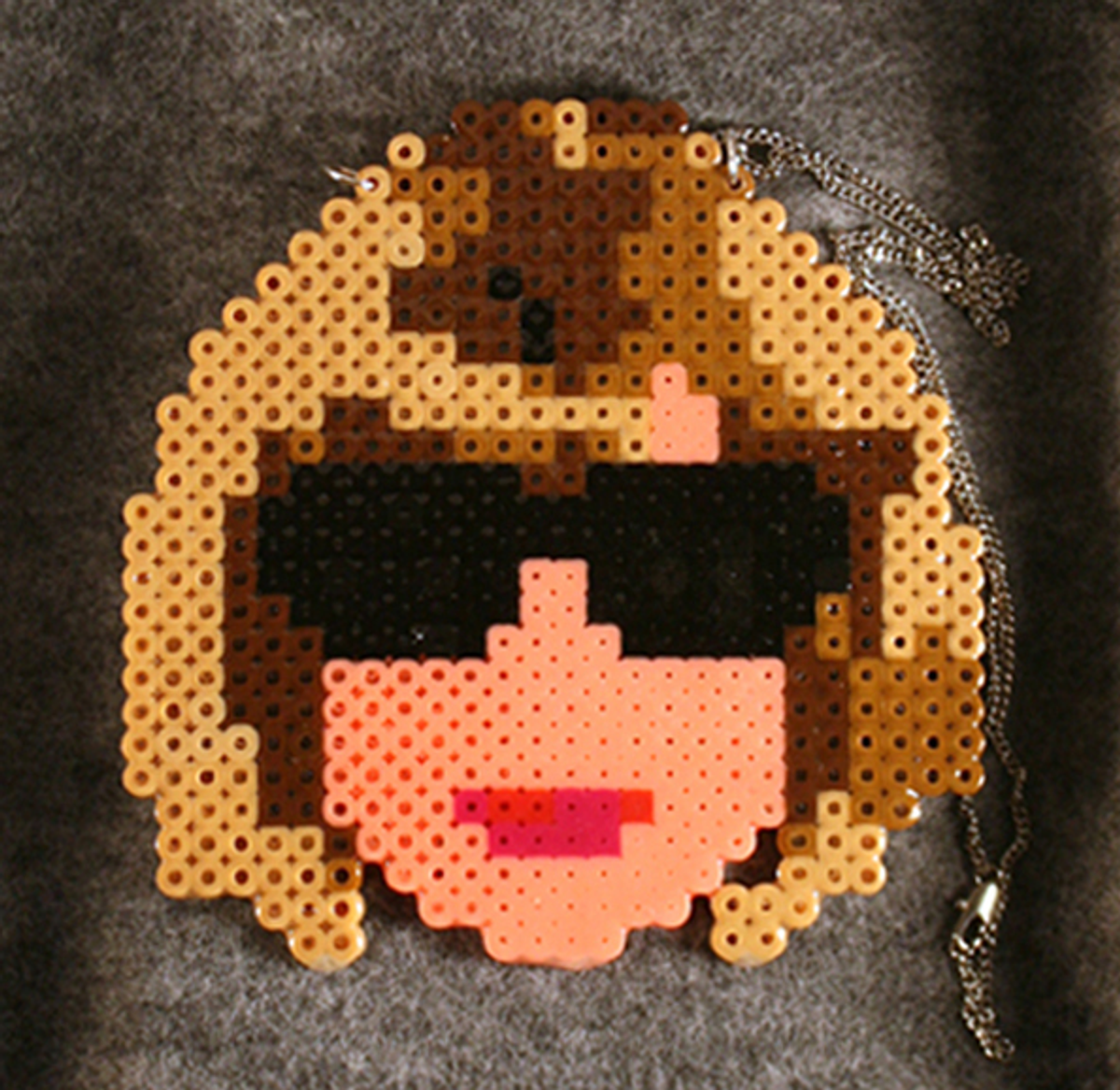
On Feb. 13, Victor became a Fab.com sensation when he officially launched 3PTPOP with a plan to bridge the gap between art and fashion — fashion communication. He’ll be accomplishing that with his line of celebrity fusible bead portraits, using Perler beads, those plastic objects you were tempted to chew on as a kid.
[caption id="attachment_259151" align="alignnone" width="460" caption="Anna Wintour on a chain"] [/caption]
[caption id="attachment_252621" align="alignnone" width="460" caption="Pharrell NERD type"] [/caption]
I first met Victor in 1997, when he was a sophomore Literature and Rhetoric major at SUNY Binghamton. Victor was considering becoming a graphic designer, and when next we met, he’d transferred to the School of Visual Arts to pursue his passion. Next came a stint as a Simon & Schuster book jacket designer, and in 2003, after two years in publishing, Victor participated in the JET program (Japan English Teaching Programme), sharing his culture with townspeople and teaching ESL. “I relocated from an office on 49th and 6th to a tiny school in a town of 7,000 in Kochi Prefecture, Japan,” Victor recalls. “The move was a game changer.”
[caption id="attachment_258211" align="alignleft" width="144" caption="Pixel Victor"] [/caption]
"Japan brought another level of depth to my artistic and personal development," he continues. In the beginning, Victor’s slightest efforts to communicate were difficult, but by the end, he was able to negotiate with real estate brokers. “Japan took me outside of my world as I’d known it to that point,” he says. “I made great friends and learned a lot about myself.”
Upon his return to New York, Victor became the art director of New York City Opera — after showing a body of personal work he’d created about his experiences abroad. And Victor soon got his fashion on (Do the kids still say that?), creating T-shirts emblazoned with hand-painted portraits of style icons like Vogue’s André Leon Talley, writer Glenn O’Brien, Lynn Yaeger, Kim Hastreiter, and Simon Doonan. Victor’s T-shirts garnered press from The New York Times, New York, Paper, and GQ.com—and even made appearances (the T-shirts, not Victor) on Martha Stewart’s TV show, and "America’s Next Top Model."
Next came the fusible beads.
[caption id="attachment_259161" align="alignnone" width="460" caption="Bill Cunningham and camera"] [/caption]
"When I bead, I feel as though I am painting a picture,” Victor says. “Big patches of color here, small strokes there.” Just like anything new, there is a learning curve associated with the beading. “After I select the person I want to create, I pixelate reference photos on my computer and use them as a basis for the picture.” After creating an initial sketch, Victor goes back and refines the details. “It’s strange how sometimes the placement of one bead can really make or break a piece,” he says.
Victor works in his NYC home studio, a space filled with inspirational toys, fashion, design, art, and books. He coats his fusible bead portraits in resin himself, a process refined through trial and error — and open windows. “I’m really inspired by artists who use resin in their work,” he says. “Maybe it’s the synthetic nature, or the durability of it. It was natural for me to want to make the portraits more permanent.”
Victor hopes 3PTPOP will grow as a brand that straddles the worlds of art and fashion. “I envision creating collections based on pop culture icons who’ve had an influence on me,” he says. “In that way, the work becomes kind of a diary of the pop culture addict within me.”
[caption id="attachment_256261" align="alignnone" width="460" caption="The always dapper Karl Lagerfeld"] [/caption]
[caption id="attachment_255811" align="alignnone" width="460" caption="Victor sports Lady Gaga"] [/caption]
[caption id="attachment_252641" align="alignnone" width="460" caption="The fusible factory"] [/caption]
[caption id="attachment_258041" align="alignnone" width="460" caption="The beads, the brand"] [/caption]
[caption id="attachment_252631" align="alignnone" width="460" caption="The ultimate style icon"] [/caption]
Copyright F+W Media Inc. 2012.
Salon is proud to feature content from Imprint, the fastest-growing design community on the web. Brought to you by Print magazine, America's oldest and most trusted design voice, Imprint features some of the biggest names in the industry covering visual culture from every angle. Imprint advances and expands the design conversation, providing fresh daily content to the community (and now to salon.com!), sparking conversation, competition, criticism, and passion among its members.
Shares