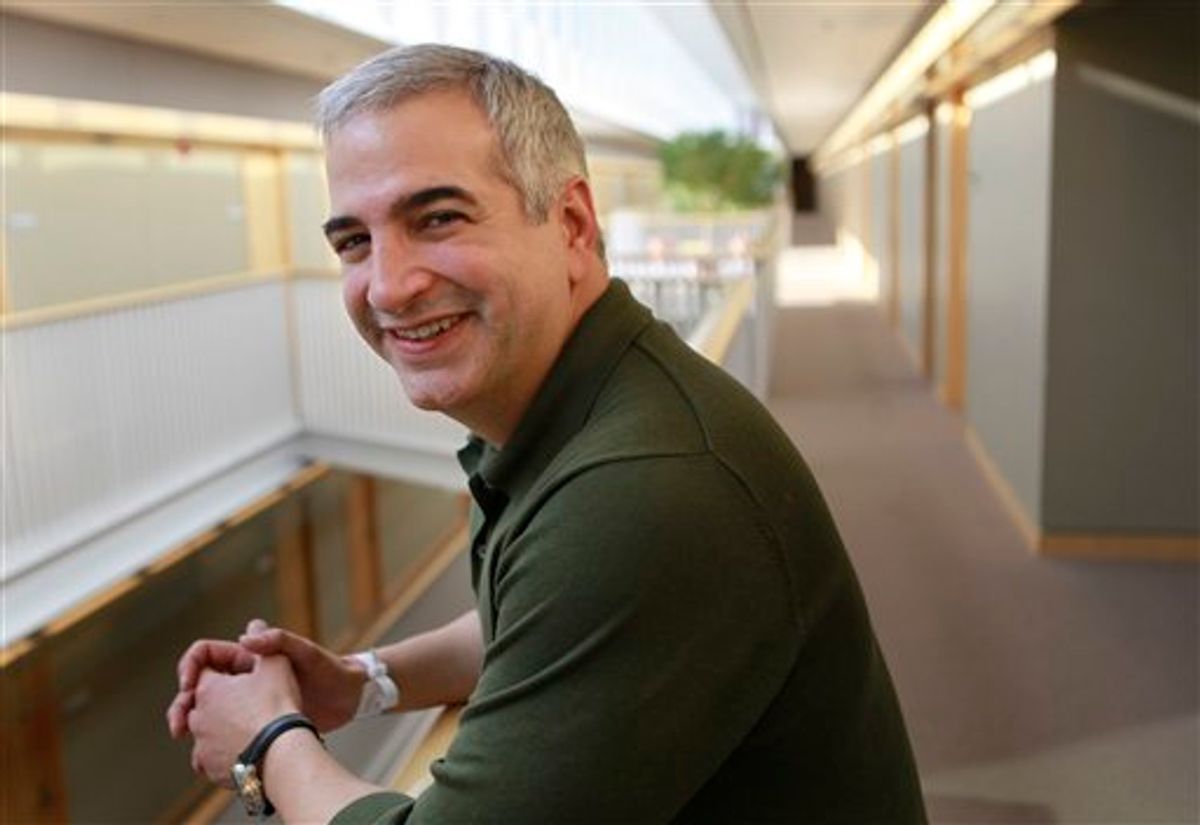
Anthony Shadid, the best of his generation
The NYT reporter, acclaimed for his unparalleled coverage of the Middle East, died in Syria on Thursday
Anthony Shadid, winner of the 2010 Pulitzer Prize for International Reporting with The Washington Post (Credit: AP) WARSAW, Poland — I woke up this morning to the news that Anthony Shadid has died — apparently of an asthma attack — while on assignment in Syria. Whether you knew his byline or not, the loss is incalculable.
I can speak in absolutes about the quality of his work. No one reported the Middle East with greater clarity and nuance than Shadid. No one brought the humanity of the people of the region, people who live in a perpetual state of stress even when they are living in the comparative comfort of Beirut and Tel Aviv, to the wider world with a surer touch than Anthony.
He could have coasted on his one great advantage — fluency in Arabic — to beat other reporters to the story. He did not. He used it as a foundation to serve readers — and help colleagues. When I left Iraq after the overthrow of Saddam, a sizeable part of my heart was left behind with new friends who were struggling to make the country a better place. Amid the constant shifts in the chaotic post-war era, Anthony’s dispatches were the ones I relied on to give me the complete picture of what was happening around the country.
American reporters are trained to be objective. It is an ideal to aspire to, more than an achievable goal. We are human beings and those of us who cover conflicts have our emotions challenged every day. The desire to bear witness and to make readers and listeners feel what we feel is overwhelming. Sometimes this gets in the way of objectivity. Anthony, who saw more terrible things than most, managed to stay closer to that ideal than any one. That’s what makes his reporting the best and why in years to come, it will truly be seen as the first draft of history.
We published books on Iraq at the same time and shared a panel at the Brattle Theatre in Cambridge, Mass. on Iraq. I had long since decided that objectivity was getting in the way of my reporting. It was important to let my readers know that I was angry and that my friend had died because of the criminally poor planning of the bigwigs in Washington. That emotion suffused my book. Anthony’s book was scrupulously written, you could never guess what he felt about the war.
My memory is that during the course of the conversation I pressed him about keeping his feelings about the war out of the book. He came back at me with full vigor, eloquently defending the importance of objectivity. He was a big-hearted, supremely talented man — and disciplined about the work. The panel was recorded by C-Span and you can watch Anthony and get some sense of who he was and what we have lost here.
Egypt erupts again
Anger over Egypt's surprising election results has spilled into the streets. It's now anyone's guess who will win
The revolutionary youth of Egypt return to Tahrir to protest the outcome of the Egyptian presidential election, Cairo, Egypt, Monday May 28, 2012. (Credit: AP Photo/Fredrik Persson) CAIRO, Egypt — Egyptian protesters set fire last night to the campaign headquarters of Ahmed Shafiq, the controversial presidential contender, following the official announcement of Egypt’s first round of presidential elections in Cairo.
Hundreds of demonstrators took to Cairo’s iconic Tahrir Square to rally against Shafiq, a member and unabashed supporter of the regime of former President Hosni Mubarak, toppled last year following a wave of popular protests. At least eight people were arrested, but no injuries or deaths were reported.
Disneyland: Japan’s gay pioneers
A recent ceremony at Tokyo Disneyland highlights how far the country still needs to go for gay rights
(Credit: Cindy Hughes via Shutterstock) TOKYO, Japan — In one respect, the decision by Tokyo Disneyland to allow a gay couple to hold their “wedding” at the theme park is a sign of progress in a country that has, until recently, largely ignored the issue of same-sex unions.
But some campaigners have argued that leaving it to Mickey Mouse to give his blessing to Koyuki Higashi and her partner, Hiroko Masuhara — in a strictly symbolic ceremony — is also a mark of how far Japan has to go before it affords the same rights to the lesbian, gay, bisexual and transgender (LGBT) community as it does to heterosexual couples.
Egypt’s women rise up
As the country chooses a president, female rights advocates target the ruling military and the rise of Islamism
An Egyptian woman walks past defaced posters of Egyptian presidential candidate Ahmed Shafiq in Cairo, Egypt, Wednesday, May 16, 2012. (Credit: AP Photo/Manu Brabo) Omran, a self-described feminist and human rights activist, was there attempting to legally represent the protesters, including 26 female detainees — one as young as 14-years old — all accused by the military prosecution of attacking military personnel.
Continue Reading CloseEuro bonds to the rescue?
France's new president, Francois Hollande, believes he's found a solution to the euro crisis -- but others disagree
In this May 15, 2012 file photo, German Chancellor Angela Merkel, left, talks to new French President Francois Hollande in Berlin. (Credit: AP Photo/Markus Schreiber, File) BRUSSELS – French President Francois Hollande thinks he’s found a solution to the euro zone crisis: the name’s Bonds. Euro bonds.
Unfortunately, Angela Merkel’s still playing Dr. No.
At a euro zone summit on Wednesday, the new French leader plans to revive proposals for bonds that would be jointly issued by euro zone countries to spread national debt burdens across the whole currency bloc.
Did slaves catch your seafood?
Thailand, a major source of fish imported to the US, depends on forced labor for its product
(Credit: Alena Brozova via Shutterstock) PREY VENG, Cambodia, and SAMUT SAKHON, Thailand — In the sun-baked flatlands of Cambodia, where dust stings the eyes and chokes the pores, there is a tiny clapboard house on cement stilts. It is home to three generations of runaway slaves.
The man of the house, Sokha, recently returned after nearly two years in captivity. His home is just as he left it: barren with a few dirty pillows passing for furniture. Slivers of daylight glow through cracks in the walls. The family’s most valuable possession, a sow, waddles and snorts beneath the elevated floorboards.
Page 1 of 36 in GlobalPost