GlobalPost

When I was captured by Gadhafi’s forces

After the Libyan rebels we were embedded with came under fire, we became hostages of the regime VIDEO

  • more
    • All Share Services

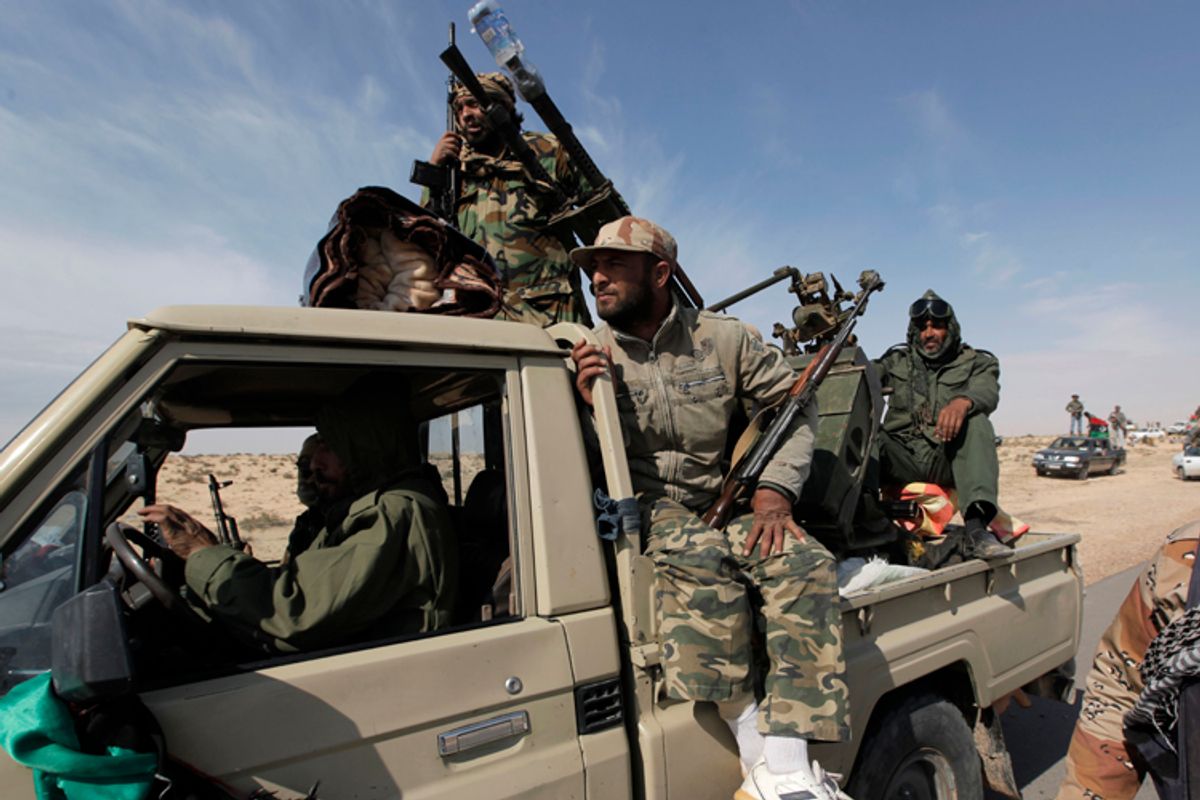
When I was captured by Gadhafi's forcesLibyan rebels head towards the front line outside the eastern town of Brega, Libya Friday, April 1, 2011 (Credit: AP)
GlobalPost correspondent James Foley spent 44 days in captivity inside Moammar Gadhafi's Libya. This first chapter of his story originally appeared on GlobalPost. For the full series, click here.

There is a single main highway along which lies every major city between the rebel stronghold of Benghazi in the east and the capital Tripoli in the west. It snakes along the coast and passes through Ajdabiya, Brega, Sirte and Misrata, cities made world famous by months of back and forth, and deadly, conflict.

Global Post
The four of us were riding in the back of a blazing red minibus at the beginning of April, approaching the strategic oil town of Brega, where the worst fighting of the conflict had been taking place. Our driver was a teenage boy, like his friend in the passenger’s seat. The so-called front in this war was always changing. But we had already passed the last rebel checkpoint and we knew whatever front existed was beginning to reveal itself.

Our goal was to learn, and then report, who was in control of Brega.

We were getting nervous. We knew the boys driving were scouting the road ahead, and maybe on their own initiative. Anton, the most experienced journalist in the group, mumbled something about it being risky. We could feel our guts begin to tighten. Manu and I looked at each other. But said nothing.

Two armed trucks raced toward us from behind, filling up our back window before soaring past. This was how the rebel convoys seemed to form, like schools of fish that hunted together, but have no clear leader or command structure.

Over a small hill we saw some men, boys really, standing around a sedan. We leaped out to do some interviews. Clare asked how far away Gadhafi’s forces were. The boy said 300 meters. 300 meters? I looked at Clare. It seemed impossible. But as a precaution, we hustled off to the side of the road. A static mortar or a rocket position could have easily dialed in on us from that distance. The small convoy rolled ahead, leaving us behind in what we thought was relative safety.

We watched the rebels push forward. They weren’t 200 meters away, at the rise of the next hill, when they sped back around. We watched for a second as they beared back down on us, followed by a barrage of machine gun fire. The loudest I had ever heard. Our small group of journalists — Anton, Clare, my fellow American, and Manu, a Spanish photographer — took off running.

“We need to get to the vehicles,” Anton shouted. But the rebel trucks were retreating too fast and the ones in pursuit were firing wildly. There were two Gadhafi military pickups — tan with large machine guns mounted on the back. The trucks were overflowing with armed men.

With all the bullets flying, we pressed ourselves as close to the ground as possible. The rebels faded into the distance and the Gadhafi trucks slowed to a stop. The shooting continued. The roar of bullets overhead sounded like machines eating up metal. AK-47 rounds ripped past us from less than 50 meters.

Libya: Tripoli scenes from the uprising:

I crawled back toward Clare and Manu, who were under several small trees. The shooting intensified. We tried to speak, to yell for each other. But the bullets tearing overhead deafened everything. In a corner of my mind I hoped that we were in a cross fire, that behind us the rebels were shooting back. I crawled forward toward a larger sand dune with my camera rolling. Anton crouched in front of me. The bullets streamed directly over my helmet and shoulders. This was no crossfire. They were shooting at us, and they were shooting to kill.

“Help, help,” I heard Anton cry. His voice was weak. My mind tried to convince me of something I knew was not true. Maybe he had just fallen and twisted something. Another barrage of bullets passed over me. “Anton, are you OK?” I shouted between bursts of fire.

“No,” he said, in a much weaker voice.

****

I’ve heard journalists say that Libya was the perfect war. A reporter could get to the front line, close enough to hear the shells coming in, and back to a comfortable hotel in Benghazi, with a solid Internet connection, by evening.

But in reality, this war was anything but perfect — something I’d soon come to learn. It was a war led by confusion, abductions and an oppressive sense of the unknown. This latest spasm of the Arab Spring had none of the idealism of Tunis or Cairo. For me, it began with a rifle butt to he head, which bled into weeks of uncertainty, crushing captivity and ended, however improbably, in a four-star hotel in the besieged Libyan capital.

Along the way, between blindfolds and quiet conversations with fellow captives deep inside the country’s brutal prison system, I witnessed the last gasps of the Gadhafi regime — a corrupt and corrupted system that for more than 40 years ruled this tribal, oil-rich land.

I had done several tours as an embedded reporter with U.S. troops in Iraq and Afghanistan. So, for me, the frontlines felt natural. And I believed it was my job. But the freedom with which you could maneuver was deceptive. There was no highly-trained U.S. platoon to escort you. And the rebels were said to be some of the worst trained soldiers in the world. Most had never held a gun before the end of February, when they stormed Benghazi’s “katiba” and took them by force.

I tried to hold farther back after a few close calls — a near miss by a Girad rocket, for instance, or a tank shell ripping over the heads of Manu and I outside Ajadibya. Our ears popped. But the front kept calling.

As is common among freelancers, Clare Gillis, a 34-year-old from Connecticut, Manu Brabo, a 29-year-old from Gijon, Spain, and myself had been sharing rides and interviews together for several weeks. Anton Hammerl, a South African photographer who covered much of Africa — from the townships during Apartheid to child soldiers in the Congo — came late to our little group.

With all the rebel offensives and retreats along the coastal highway, we felt we had to get to the front every few days or risk completely losing track of the story. So on April 5, we headed out.

Our plan was to try to get a sense of who was really controlling Brega, a strategic oil town that had been the scene of some of the most deadly fighting since the uprising began several months earlier. A rebel general told us that if the rebels took Brega, they would hold it without advancing right away, thus learning from earlier mistakes where they stretched themselves too thin and were forced into whole scale retreats.

But Brega was dangerous. Manu and I had been caught in heavy shelling outside the town days before. I had seen two shells bounce off the ground a hundred meters away. A rebel was killed by shrapnel to the head in the truck Manu and I had leaped into for escape. We went with them to the hospital, hugged the bawling comrades afterwards and shot some eerie photos of them washing blood off their grenades.

Still, Brega was where the front was, so we woke up early to beat the crush of reporters. The four of us went in a Mercedes van piloted by a teen. We stopped at the only manned checkpoint some 20 kilometers outside town, where a crowd of the usual disheveled men, many of them teens, milled about waiting for the real fighters to assemble. We got out into the early sunshine and told our driver he could leave us there. It was just after 10 a.m.

We waited. Usually, with shouts of “Allah Akbar,” a convoy would push ahead, and we’d jump into one of the rebel vehicles heading to the front.

The red minibus started moving and we hustled on. It drove ahead with us as its only passengers, the young driver and his friend in front looked nervously from side to side. We stopped after a kilometer to inspect two smoldering pickup trucks, blackened crisps in the road. It appeared to have been a rebel ambush.

“Hit by a Sam 7,” Anton said pointing out the expended launcher and wire guidance system leading to the cindered vehicles. I took note of his wealth of knowledge. He’d been forced to join the South African infantry as a young man and hadn’t relished it.

****

The firing continued all around us. The men had gotten out of their vehicles and were now approaching. “Anton!” I shouted again. He was silent. The terrifying reality grabbed hold of me. The soldiers firing probably didn’t know that we were reporters. Rebels didn’t dress in regular uniforms and many were often not even armed. I had to surrender or we’d all be gunned down.

I leaped up from where my head had been buried in the sand to face the group of wild men shooting uncontrollably — it seemed our only hope. I held up my hands and yelled, “Sahafa! Sahafa!” It was one of the few Arabic words I knew. It means “journalist.” I walked slowly toward them.

There were three or four skinny, Arab-looking soldiers carrying AK-47s and a larger, darker one to the right. My eyes drifted toward Anton as I stumbled past the dune ahead of me. He was lying face down in the sand, his body askew, cameras still strapped around his shoulders, his legs splayed out.

As soon as I reached the soldiers, the dark one slammed me across the chin with the butt end of his AK-47. I dropped my camera. He smashed his rifle down on my head. My helmet and Oakley sunglasses were thrown off and he punched me in the eye. Another one crushed my head several more times with an AK-47. All my instincts for self-preservation gathered within me. I went completely limp and complacent. The adrenaline was coursing so heavily through my body. I felt no pain.

I was thrown into the back of one of the pickup trucks. An Army boot pushed my face onto the floor. I glanced back and saw Manu and Clare being pulled off the ground.

A crazed looking soldier looked down and jeered at me in English, “You go on patrol! You go on patrol!” as if he knew exactly what we’d been trying to do. A cell phone was pushed close to my face. A picture was snapped. “Gadhafi Meia Meia,” a younger one said, thumping his chest, “Gadhafi 100 percent.” These words terrified me. After weeks of being with rebels who said things like, “Fuck Gadhafi,” with regular consistency, we had now found ourselves with the other side, the ones who had pledged their dying allegiance to the country’s dictatorial leader of more than four decades.

Clare and Manu were also forced down into the bed of the truck. Manu was face down and Clare, pushed against his side, was facing me. I looked at her for the first time. She had a purpled eye. She saw blood running from my scalp.

“Jim, are you OK?” she said, pleadingly. I nodded, and took stock of the blood pooling in the back of the truck. With a boot again on my face, my hands were bound behind me with a plastic cord. We sped away from the scene.

You can read Part 2 of James Foley’s story here.

Egypt erupts again

Anger over Egypt's surprising election results has spilled into the streets. It's now anyone's guess who will win

  • more
    • All Share Services

Egypt erupts again The revolutionary youth of Egypt return to Tahrir to protest the outcome of the Egyptian presidential election, Cairo, Egypt, Monday May 28, 2012. (Credit: AP Photo/Fredrik Persson)
This article originally appeared on GlobalPost.

CAIRO, Egypt — Egyptian protesters set fire last night to the campaign headquarters of Ahmed Shafiq, the controversial presidential contender, following the official announcement of Egypt’s first round of presidential elections in Cairo.

Global PostHundreds of demonstrators took to Cairo’s iconic Tahrir Square to rally against Shafiq, a member and unabashed supporter of the regime of former President Hosni Mubarak, toppled last year following a wave of popular protests. At least eight people were arrested, but no injuries or deaths were reported.

Campaigning on law and order and a heavy-handed crackdown on anti-regime protesters, Shafiq secured second place in last week’s vote. In what many Egyptians say is the most polarizing outcome of the elections, Shafiq will face the Muslim Brotherhood’s candidate, Mohamed Morsi, in a run-off that pits Islamists against a Mubarak holdover on June 16.

Both Shafiq and Morsi scored surprise, upset victories against the other candidates, after trailing considerably in pre-election polls behind secular-liberal candidate, Amr Moussa, and independent Islamist, Abdel Meneim Aboul Fotouh.

Analysts and observers of Egyptian politics are reeling from the results, cautioning that right now the Egyptian electorate is so dynamic — with alliances and voter sentiment shifting so rapidly and unpredictably — that attempting to accurately forecast a winner of next month’s run-off is ultimately futile.

“Everything I thought I knew about this country has collapsed,” said Hisham Kassem, independent publisher and longtime opposition activist, of the divisive election results. “All analyses of the polls are so far unconvincing. The game has changed considerably.”

Indeed, for weeks preceding the elections — the first free, multi-candidate polls in Egypt’s history — both local and international think-tank surveys put Moussa, a former minister of foreign affairs and centrist figure, in the lead, with as much as 40 percent of the vote.

In the final tally, Moussa scored just under 11 percent.

In another bombshell, Hamdeen Sabbahi, a leftist-socialist candidate who, along with Morsi, never broke 10 percent in pre-election surveys, won both of Egypt’s most populated governorates — Cairo and the Islamist stronghold of Alexandria — to land in third place nationally.

Morsi, with the strong electoral machine of the Brotherhood behind him, was catapulted to first place with the most votes, after being written off as a weak candidate with only 8 percent of the vote prior to the vote.

The Brotherhood flourished for years as Egypt’s largest and most organized opposition force.

Some observers blamed the gross miscalculations on the difficulties of conducting research in Egypt, particularly in gauging voter sentiment in rural areas.

The government-affiliated Al Ahram Center for Strategic Studies, for example, conducted face-to-face interviews with 1,200 respondents for their surveys, but did not publish the socio-economic breakdown of the survey’s subjects.

“But sometimes in face-to-face interviews, villagers are influenced by having a village elder nearby,” said Rasha Hassan, a social researcher with Harassmap, an Egyptian, online social initiative that tracks sexual harassment trends through text messaging. “You have to take [things like this] into account.”

Telephone polls are also misleading, because most rural village households do not have landlines — only mobile phones.

Still, the polls, including one from the DC-based Brookings Institution that was in fact quite rigorous, could not capture the tumult and fluidity of voter sentiment in Egypt’s transition period, said Michael Hanna, a fellow at The Century Foundation in New York.

Similar to other countries that have made the transition from authoritarian to democratic rule, the Egyptian political landscape is likely to change drastically from one election to the next in the immediate post-revolution period, experts say.

There are many factors that could have swayed the vote, even at the last minute.

Least surprising was Morsi’s jump to first place, buoyed by the mammoth grassroots network of the Muslim Brotherhood that energized voters to go to the polls, analysts say. Many of their core ideological voters, particularly in Egypt’s impoverished southern region, may not have been represented accurately in the surveys.

Kassem said he had predicted there would be two strong voting currents — Islamist and pro-stability — but that the so-called “stability” vote would be represented by Moussa, who echoed many ordinary Egyptians’ sentiments by chiding demonstrators for spreading chaos.

Shafiq, as a member of the old regime who emphasized his military credentials during the campaign, did not have a true constituency among Egyptian voters, he said.

Shafiq was indeed ranking low in the polls, until a last-minute surge at the end of May, when several surveys from the Cabinet Information Decision and Support Center, a government-linked research group, put Shafiq in the lead.

Hanna credits his rise to violent clashes between protesters and military police at the ministry of defense in the Abbaseya neighborhood of Cairo earlier this month, and state media still controlled by Mubarak holdovers.

“Obviously the control of state media, the law and order narrative put forward by SCAF” — the Supreme Council of Armed Forces, made up of Egypt’s ruling generals — “is potent in combination with Abbaseya,” Hanna said. “It had a big impact on the election, drawing the stability vote from Moussa to Shafiq, whom some state-run polls were putting in the lead in the last days of the campaign period.”

But to draw a linear plot from secular and Islamist voter choices in the first round to the run-off would be a mistake, Hanna and Kassem say.

Saleh Ali Ahmed, a 39-year-old voter and self-described devout Muslim from the Brotherhood stronghold of Ismailia province, exemplifies the complexity of the Egyptian electorate.

“If the run-off is between Morsi and Shafiq, I will vote for Shafiq,” he said on the first day of the polls, before the official results were announced. “Morsi is very weak within the Brotherhood, and he will have no real power.”

Kassem said one can assume that those who voted for Moussa, a non-Islamist, will switch to Shafiq, who has promised to curb rising Islamist power.

“But it is just a guess,” he said. “And anyone’s guess is as good as mine.”

Continue Reading Close

Disneyland: Japan’s gay pioneers

A recent ceremony at Tokyo Disneyland highlights how far the country still needs to go for gay rights

  • more
    • All Share Services

Disneyland: Japan's gay pioneers (Credit: Cindy Hughes via Shutterstock)

TOKYO, Japan — In one respect, the decision by Tokyo Disneyland to allow a gay couple to hold their “wedding” at the theme park is a sign of progress in a country that has, until recently, largely ignored the issue of same-sex unions.

Global PostBut some campaigners have argued that leaving it to Mickey Mouse to give his blessing to Koyuki Higashi and her partner, Hiroko Masuhara — in a strictly symbolic ceremony — is also a mark of how far Japan has to go before it affords the same rights to the lesbian, gay, bisexual and transgender (LGBT) community as it does to heterosexual couples.

Tokyo Disneyland condoned this and all future same-sex ceremonies after receiving an inquiry from Higashi. Cue a confused response from a subsidiary, Oriental Land Company, which licenses the name and characters from Disney in the United States.

Higashi, 27, and her partner could “marry” at the park, they were told, but only if they dressed “like a man and a woman.” Park officials were worried that other visitors might be offended by the sight of two women in wedding dresses or morning suits.

The park relented on the dress code after a storm of protest on Twitter and other social media networks — it had all been a misunderstanding by an individual employee, it said — but the couple will not be allowed to exchange vows in the park’s chapel due to “Christian teachings.”

Those restrictions go to the heart of the flimsy protection offered to the rights of LGBT people in Japan, say campaigners. Homosexuality is not illegal, but same-sex marriages are not legally recognized.

“There needs to be more pressure for legal unions between gay people in Japan,” said Taiga Ishikawa, one of only a handful of openly gay politicians in the country. “This is only a guess, but I’d say there are more people now who are in long-term relationships and want that to be recognized in the form of a civil partnership.”

The 37-year-old, who won a seat on the Toshima Ward assembly in Tokyo last year, is campaigning to introduce an ordinance in the area to offer some form of marital recognition and to increase the number of administrative rights and services afforded to same-sex couples. But he admits that it’s “some way off.”

If Disneyland was being held up as an agent of progress, one of Japan’s most popular celebrities popped up to demonstrate that, in some quarters, ignorance reigns.

Commenting on TV on President Barack Obama’s recent declaration of support for gay marriages in the US, the film director and comedian Takeshi Kitano told a fellow guest: “Obama supports gay marriage. You would support marriage between humanoid and animals eventually, then,” before questioning the ability of gay couples to raise children.

Kitano has since tried to explain his outburst: “I was only talking about people who love their pets so much that they may think of marrying them,” AFP reported him as saying. “There is no way I look at gay people in the same way as I do animals, let alone implying sexual relations with animals.”

His were not the first comments with homophobic overtones to be made by a high-profile public figure in Japan. In late 2010, Shintaro Ishihara, the outspoken governor of Tokyo, suggested gay people were “deficient” after watching same-sex couples take part in a parade in San Francisco. “We have even got homosexuals casually appearing on television,” he said. “Japan has become far too untamed.”

Yuji Kitamaru, a journalist who writes about LGBT issues, said he was “very disappointed” by Kitano’s remarks, particularly as he has spoken up for minorities, including transgender people, in the past. “I felt it was a big betrayal not only to us and the audience, but also to himself. Public figures like Kitano can easily indulge in that kind of bigotry because Japanese people in general haven’t considered the difference between public discourse and private gossip.”

Yet Kitamaru, who has written on LGBT issues in Japan for two decades, believes social media has quickly become the forum for a more open discussion about sexuality, citing Twitter’s role in the Disneyland decision and a meeting held in Ni-chome, a gay neighborhood of Tokyo, to thank Obama for his support.

Higashi and her partner, meanwhile, have visited Disneyland to break their good news to Mickey Mouse. They have yet to set a date for the wedding, and there are reports that their inquiries were intended only to test the theme park’s commitment to equality.

Ishikawa welcomed Disneyland’s decision, which apparently came after officials in Tokyo contacted the company’s US headquarters. “I wrote 10 years ago that I looked forward to the day when gay and lesbian couples could hold hands and go to Tokyo Disneyland, so I’m very happy,” he said. “But we’re still not at the point where a man or woman can tell people, especially co-workers, that they have a same-sex partner.”

Continue Reading Close

Egypt’s women rise up

As the country chooses a president, female rights advocates target the ruling military and the rise of Islamism

  • more
    • All Share Services

Egypt's women rise up An Egyptian woman walks past defaced posters of Egyptian presidential candidate Ahmed Shafiq in Cairo, Egypt, Wednesday, May 16, 2012. (Credit: AP Photo/Manu Brabo)
This article originally appeared on GlobalPost.
CAIRO — It was the middle of the night in Cairo when Ragia Omran, one of the country’s most prominent human rights lawyers, rushed to C-28, Egypt’s notorious military court, where almost 300 civilian detainees were being held without lawyers.

Omran, a self-described feminist and human rights activist, was there attempting to legally represent the protesters, including 26 female detainees — one as young as 14-years old — all accused by the military prosecution of attacking military personnel.

Global PostBut she was barred from entry, an insult added to injury by the military, a powerful and patriarchal institution that has been accused of many violations, including the sexual assault of its own female prisoners and aggressive indifference to the rights of women on a wide scale.

“They were denying me entry because it was 2 a.m., with the excuse that I am a female so it is ‘too late’ for me to enter the premises,” she told GlobalPost. “I stood there regardless and continued to demand to enter because each detainee has the right to a lawyer.”

Fifteen months after the fall of Hosni Mubarak, Egyptians head to the polls Wednesday and Thursday to choose the country’s first-ever civilian president. This election and the constitution to be framed in its aftermath will set a course for Egypt’s fledgling democracy, and there is almost no one who has more at stake than the country’s women.

As the debate continues about how much power the new president will have relative to the Supreme Council of the Armed Forces (SCAF) and how much influence the majority Islamist parliament will exert on society, women like Omran who were on the forefront of the revolution say they’re now being pushed out of public and political life, at best an afterthought to two rival and very male camps — Mubarak’s “old guard” and the Islamists.

None of the presidential candidates — all men after former television presenter Bothaina Kamel failed to qualify for the ballot — have demonstrated significant interest in women’s issues, advocates say, while many women have been targeted for violence and intimidation by the ruling military. But many women are pushing back against this campaign of marginalization, fighting to secure a role in Egyptian society at a pivotal time in the country’s history.

“Not a single candidate made efforts to sit down with the female coalition’s movement during his campaign, except for Amr Moussa,” said Fatma Emam, who is currently a researcher at Nazra for Feminist Studies and an activist blogger.

Emam, an outspoken 29-year-old woman from Nubia in Southern Egypt, said she is disappointed by the current front-runners, which include Moussa, the Muslim Brotherhood’s Mohamed Morsi, Abdel Moniem Aboul Fotouh and the Nasserite candidate Hamdeen Sabahy.

“What’s happening now in the elections shows that women’s rights are not a concern,” she said.

Emam believes economic and security concerns have trumped social issues — including women’s rights, fair laws and education reform — in voters’ minds. Recent Pew Research Center polling confirms that 81 percent of Egyptians consider economic improvement to be “very important” in the election — more than any other issue.

However, according to Egypt’s National Council for Women, 33 percent of Egyptian households are headed by women.

“Up until recently, five years or so ago, women were not given tax cuts by the tax authority because they were not considered heads of households, even though now at least 33 percent of women are breadwinners,” Emam said.

Though women are currently a crucial part of the Egyptian economy, the society still lacks a fair legal system that would guarantee the rights of all citizens, according to Mozn Hassan, a self-described women rights defender and head of Nazra for Feminist Studies.

From “virginity tests” allegedly administered by the army upon Samira Ibrahim and dozens of other women, to excessive violence strategically targeting female protesters like the “girl in the blue bra,” the women’s struggle has been closely tied to a larger movement against military rule in Egypt.

“A huge part of the idea of militarization in society involves targeting women,” said Hassan. “All of these events, including the virginity tests, are a part of it all, [and] this won’t end with presidential elections.”

The Women’s Vote

While many Egyptians hope that significant change will come with a newly elected president, Egyptian women say they must retrieve their rights themselves.

Dalia Ziada, one of the country’s most active women’s rights advocates, is currently leading a study at the Ibn Khaldun Center for Democratic Studies that focuses on the situation of women after the Arab Spring.

Ziada, director for the Ibn Khaldun in Egypt, will be working closely with the center’s researchers to monitor this week’s elections in 22 governorates across the country, including Cairo, Alexandria and Upper Egypt.

As an Egyptian woman, Ziada believes that many of today’s candidates have failed to address female voters, which make up 52 percent of society.

“Although he is associated with remnants of the old regime and he may easily prolong military rule behind the scenes, [Amr] Moussa, as a liberal, is the only candidate who has reasserted that women’s rights would be a priority,” she said.

But Ziada believes even Moussa exhibits a chauvinism that is pervasive in Egyptian politics.

“When asked about the role of the first lady, all of the candidates said they do not want their wives to be involved in politics,” said Ziada.

“If a president does not respect his wife and does not see that she can play a role in politics, then how will he respect the average Egyptian woman?”

Women Taking Action

Shortly after Hosni Mubarak’s ouster in February 2011, a few hundred women marched on International Women’s Day hoping to protest against sexual harassment, which has been a social epidemic in the Arab world’s most populous country for years.

But the women were attacked and harassed by small groups of men in Tahrir Square, the epicenter of the country’s uprising. The men yelled “now is not the time” for trivial demands.

Later in December 2011, images of soldiers slapping elderly women on the face, stripping young female protesters, and dragging women by their hair quickly circulated.

Despite evidence of violence, many people brought blame on the women, criticizing their presence in the streets and, in some cases, their “provocative” clothing.

This time, thousands of determined women of all ages and social backgrounds marched in unprecedented numbers to protest the Egyptian army’s excessive use of force and sexual harassment against pro-democracy protesters. As the women marched, male protesters made a human cordon around them, fearing that the women might be attacked again.

Meanwhile, the SCAF defended the soldiers’ actions, stating that they were acting “according to the circumstances.”

In March 2012, a court ruled against Samira Ibrahim, who accused a military doctor of forcefully administering a virginity test after she was detained by the military while protesting against the SCAF’s prolonged rule on March 9, 2011.

Although military generals had publicly admitted that the military conducts virginity tests as a safeguard against allegations of sexual assault or rape in military confinement, the court stopped short of assigning specific blame.

Many advocates see it as their role to denounce the autocratic regime, which is still “very much in place” and without much female representation.

Just 10 women won seats in Egypt’s parliamentary elections earlier this year. Women’s representation in the constituent assembly, which will be tasked with drafting Egypt’s new constitution, remains a contested issue.

“We have drafted a list of amendments in the constitution that need to be adjusted immediately, said Emam.

“The Egyptian Young Feminist Movement has also provided the speaker of parliament with a list of women who are eligible to serve on the constituent assembly who can help draft a constitution, but all of these efforts have been overlooked,” she added.

The Struggle with Legal Reform

With Islamists making up as much as 70 percent of the people’s assembly, Hassan fears that women’s voices will continue to be stifled.

“Till this day, the parliament has not passed a single progressive decision regarding the past incidents of violence,” she said. “There is also no law till now that would protect women from domestic violence.”

As the country’s ruling powers fail to hold accountable those responsible for such violence, society follows suit.

“The Nadim Center [for Rehabilitation of Victims of Violence] recently drafted a petition hoping to include a law that would support victims of domestic violence, but only 2,000 citizens actually signed the petition,” Emam said.

Parallel to legal reform, Emam strongly believes there must be societal and governmental restructuring so that women can successfully work to achieve their rights.

“I hoped they would discuss these issues in parliament, but instead they discuss our age of marriage,” Hassan said, referring to parliament’s controversial debates regarding a bill that would lower a woman’s legal age of marriage from 16 to 14.

However, Hassan believes that while the current people’s assembly ignores women’s concerns, the military institution does not even hear them.

“Even if Islamists are aggressive in their decisions regarding women’s rights, the military does not even see us,” she said.

Despite these obstacles, however, Egyptian women are proving that they are doers, not victims.

“I’m against the idea of victimizing women,” Hassan stressed. “You are in a patriarchal society, they already see you as victims. But if we are subjected to violence, we are not looking to be consoled. We are aiming to empower ourselves and to to be in positions that would allow us to put an end to these problems.”

Although they both work independently, Ziada from Ibn Khaldun shares Hassan’s sentiment when it comes to the threat of rising extremism.

“The rising Islamism gave a justification for the patriarchal mentality,” said Ziada. “Everything in the past was inappropriate for women to do; now it is not only inappropriate, it is haram, or a sin. Before, it was not right to challenge society; but now you can’t challenge God, according to Islamists.”

Taking matters into her own hands, Ziada is currently working with Ibn Khaldun on a program that aims to empower women from Egypt, Yemen, Tunisia and Saudi Arabia.

Still in the works, the program will choose women activists from the region and provide them with the tools that would allow them to compete for positions of power.

“We are going to start this initiative in two or three months. It will take about a year, and we hope to recruit women who have potential to lead in legal, religious, economic or political fields,” said Ziada.

By starting from the grassroots level and equipping Arab women with the skills of communication and international relations, the project aims to give them the opportunity to be part of the decision-making process.

“Our aim is to empower young women. This is what will achieve real change,” she added.

Continue Reading Close

Euro bonds to the rescue?

France's new president, Francois Hollande, believes he's found a solution to the euro crisis -- but others disagree

  • more
    • All Share Services

Euro bonds to the rescue?In this May 15, 2012 file photo, German Chancellor Angela Merkel, left, talks to new French President Francois Hollande in Berlin. (Credit: AP Photo/Markus Schreiber, File)
This article originally appeared on GlobalPost.

BRUSSELS – French President Francois Hollande thinks he’s found a solution to the euro zone crisis: the name’s Bonds. Euro bonds.

Unfortunately, Angela Merkel’s still playing Dr. No.

Global PostAt a euro zone summit on Wednesday, the new French leader plans to revive proposals for bonds that would be jointly issued by euro zone countries to spread national debt burdens across the whole currency bloc.

Hollande knows however that there is little chance the German chancellor will warm to the idea, even faced with the mounting concern that, without drastic action, the euro zone is headed toward a disastrous breakup.

“We spoke about it and both sides confirmed their well-known positions,” said France’s Finance Minister Pierre Moscovici, after meeting with his German counterpart on Monday to prepare the summit.

“Francois Hollande plans to put everything on the table … even those proposals that cannot be agreed immediately,” Moscovici added.

As the euro zone’s strongest economy, Germany knows that euro bonds will mean its taxpayers end up taking on debts incurred by Greece, Spain, Italy and other troubled economies.

That would ease the immediate pain in the southern Europe and the risk of the euro’s early demise. But, critics argue, euro bonds would reward financial sloppiness and relax pressure on the southerners to purse the painful reforms and fiscal discipline needed to get their economies back in shape.

And if the euro bonds didn’t work, paying out for the south could undermine Germany’s financial stability.

“That’s a prescription that comes at the wrong time and carries the wrong side effects,” Germany’s Deputy Finance Minister Steffen Kampeter told Deutschlandfunk radio over the weekend.

He contended that common financing was unlikely to be in place for a decade or more, and certainly would not be decided when Hollande holds his first meeting with other euro zone leaders at Wednesday dinnertime summit in Brussels.

Hollande is expected to get support for euro bonds from the leaders of Spain, Italy and many smaller members of the 17-nation currency bloc, as well as the European Union’s head office which put forward a plan for jointly issued debt last year.

“It would make economic sense to create a deep, liquid and stable market for government bonds with the joint issuance of common debt — euro bonds — at least, once we have reinforced our economic governance further to ensure fiscal prudence,” EU Economics Commissioner Olli Rehn said at a speech in Oxford last week.

Even were the Germans to agree, the legal complexities involved in introducing jointly-issued debt would mean that euro bonds are years away. However, supporters say an agreement to work on their creation could help calm jittery markets and convince voters in Greece and Ireland to support European debt-fighting plans when they go to the polls in the coming weeks.

A “no” vote in Ireland’s May 31 referendum on the new EU fiscal discipline treaty could leave the country cut off from further European rescue funding. However polls show a significant number of voters, disgruntled with the austerity that came as a condition for a 67 billion euro bailout in 2010, are considering rejection.

Greece is holding a fresh election on June 17, six weeks after a nationwide vote produced political stalemate after a surge in support for parties on the far left and far right who oppose austerity measures attached to a 130 billion euro rescue plan.

Polls show most Greeks want to keep the euro, but they are deeply dissatisfied with mainstream politicians and what they view as foreign-imposed hardship.

Although other European leaders have lined up to say they want Greece to stay in the euro zone, the Greeks have been warned that could be impossible if they vote for parties that refuse to implement the bailout conditions.

“There is a choice: you can either vote to stay in the euro, with all the commitments you’ve made, or if you vote another way you’re effectively voting to leave,” British Prime Minister David Cameron told the Greeks Sunday on the sidelines of the NATO summit in Chicago.

Britain is outside the euro zone, but like other world leaders, Cameron is acutely aware of the potentially catastrophic impact a Greek exit could have on the global economy – through the risk it could also force out larger economies such as Spain and Italy, causing the collapse of the euro.

With that in mind, Wednesday’s meeting of euro zone presidents and prime ministers is expected to place new emphasis on pro-growth policies.

Merkel, Hollande and other leaders are working to find common ground on ideas such as frontloading EU funding lines to support job-creation projects in Greece and other hard hit nations, or leveraging up to 60 billion euros in funding from the EU’s investment bank.

Hollande wants a “growth pact” to complement the EU’s new fiscal discipline treaty, and there’s talk of easing austerity by giving countries like Spain, France and Italy more time to cut budget deficits.

The hope is that a more growth-friendly agenda and some signs of compromise from Merkel will produce an “Hollande-effect” on Greek voters, boosting mainstream parties who support the bailout and euro membership.

Continue Reading Close

Did slaves catch your seafood?

Thailand, a major source of fish imported to the US, depends on forced labor for its product

  • more
    • All Share Services

Did slaves catch your seafood? (Credit: Alena Brozova via Shutterstock)
This article originally appeared on GlobalPost.

PREY VENG, Cambodia, and SAMUT SAKHON, Thailand — In the sun-baked flatlands of Cambodia, where dust stings the eyes and chokes the pores, there is a tiny clapboard house on cement stilts. It is home to three generations of runaway slaves.

Global PostThe man of the house, Sokha, recently returned after nearly two years in captivity. His home is just as he left it: barren with a few dirty pillows passing for furniture. Slivers of daylight glow through cracks in the walls. The family’s most valuable possession, a sow, waddles and snorts beneath the elevated floorboards.

Before his December escape, Sokha (a pseudonym) was the property of a deep-sea trawler captain. The 39-year-old Cambodian, his teenage son and two young nephews were purchased for roughly $650, he said, each through brokers promising under-the-table jobs in a fish cannery.

There was no cannery. They were instead smuggled to a pier in neighboring Thailand, where they were shoved aboard a wooden vessel that motored into a lawless sea. His uncle had fallen for the same scam five years prior and escaped to warn the others. But Sokha told his son, then just 16, that this venture would turn out differently. He was wrong.

“We worked constantly, for no pay, through seasickness and vomiting, sometimes for two or three days straight,” he said. “We obeyed the captain’s every word.”

Near-daily death threats reinforced the captain’s supremacy. So did his Vietnam War-era K-54 pistol, and the night he carved up another slave’s face in view of the crew. “For 20 hours a day, we were forced to catch and sort sea creatures: mackerel, crabs, squid.” It’s back-breaking work, under the searing tropical sun. “But the fish wasn’t for us,” he added.

So who was it all for?

The answer should unsettle anyone who closely examines Thailand’s multi-billion dollar wild-caught seafood industry and the darkest links in its supply chain.

“It’s an export-oriented market. And we know the countries where these products are exported to,” said Lisa Rende Taylor, chief technical specialist with the United Nations Inter-Agency Project on Human Trafficking or UNIAP. “Do the math.”

For Americans, the calculation is worrisome. Thailand is the United States’ second-largest supplier of foreign seafood. Of America’s total seafood imports, one out of every six pounds comes from the Southeast Asian nation.

In 2011 alone, Thailand exported 827 million pounds of seafood worth more than $2.5 billion to the US, according to National Marine Fisheries Service figures. The only nation that consumes more Thai seafood exports is Japan.

Murder is an occupational hazard. But a monotonous job assembling iPads is heaven compared to slavery on a Thai trawler, where conditions are as grueling and violent as any 19th-century American plantation. The lucky escape within a year or so. Less fortunate are those traded several times over for years on end.

Denying that the fruits of forced labor reach the biggest importers of Thai seafood — Japan, America, China and the European Union — has become increasingly implausible.

The accounts of ex-slaves, Thai fishing syndicates, officials, exporters and anti-trafficking case workers, gathered by GlobalPost in a three-month investigation, illuminate an opaque offshore supply chain enmeshed in slavery.

A long trail of offshore operators — slave boats, motherships and independent fishmongers — can obfuscate the origins of slave-caught seafood before it ever reaches the shore. While the industry’s biggest earners rely on clannish and violence-prone fishing crews for raw material, they’re distanced from the worst abuses by hundreds of nautical miles and several degrees of middlemen.

The result is that many Thai factory bosses have no idea who caught the seafood they process for foreign consumers.

There are caveats. The majority of Thailand’s two largest seafood exports to the US — tuna and shrimp — are sourced differently. Most “Thai” tuna is actually imported from overseas and processed for re-export. The shrimp industry, though routinely accused of abusing poor migrants, is at least vulnerable to spot checks on seaside farms.

The same cannot be said for deep-sea trawlers, the favored vessel of slave-driving captains.

The species caught by Thai trawlers legal and illicit alike include sardines, mackerel, cuttlefish, squid, anchovies and “trash fish,” tiny or foul-tasting catch ground into animal food or preserved to create fish sauce. Americans consume these breeds en masse. One in five pounds of America’s imported mackerel or sardines comes from Thailand, according to US government records. For processed fish balls, puddings or cakes — made from trawlers’ trash fish — the figure is one in three pounds. Thai fish sauce supplies nearly 80 percent of the American market.

All that trawler catch ends up in familiar American fare: anchovy pizzas, squid linguine, smoked mackerel salads and fish fillets on ice. Even pets are entangled: trash fish is a common dog- and cat-food ingredient. But industry representatives in Thailand admit there’s often no way to tell whether a particular package of deep-sea fish was caught using forced labor.

Using bar codes, American shoppers can track packaged Thai-exported seafood to its onshore processing facility, said Arthon Piboonthanapatana, secretary general of the Thai Frozen Foods Association. “You can trace it back to the factories.”

But exporters, he said, are not in the business of policing the fishing syndicates that supply their factories. “We only have the power to enforce our members,” Arthon said. “We have no power to enforce other stakeholders such as boats or fishermen.”

American seafood importers consider themselves similarly powerless in overseeing far-flung Thai boats. “Western regulatory agencies have little or no reach, or authority, over various parts of the value chain,” said Gavin Gibbons, spokesman for the National Fisheries Institute, America’s chief seafood trade organization and lobbying group based outside Washington, DC. The institute will promptly respond to allegations against specific factories, he said. But so far, it has not found an effective way to monitor conditions on deep-sea boats catching US-bound fish.

“We have started discussions with our members about just how far an audit could realistically go and whether, perhaps, there are dockside audits that could be developed,” Gibbons said.

The “nature of boats being at sea,” he said, presents a major challenge to industry’s self-policing efforts.

International pressure to rid Thailand’s seafood trade of slavery is mounting. Thailand teeters just above the US State Department’s worst human-trafficking ranking and could be downgraded this summer. Last year, during a visit that vexed Bangkok officials, a UN rapporteur declared that forced labor is “notoriously common” in Thailand’s fishing sector and even alleged police complicity.

“It’s not like monitoring brothels, plantations or factories … all this labor is at sea,” Rende Taylor said. “So it’s essentially a universe where captains are king. Some are out to make as much money as possible by working these guys around the clock and being as cruel as they want to be.”

Continue Reading Close

Page 1 of 36 in GlobalPost