
War on Terror

Hypnotized into an endless dirty war

America has decided it has the right to kill whoever it wants, whenever it wants.

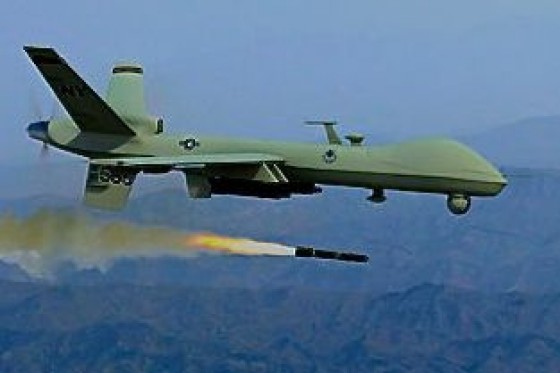
If in the year 2000 the U.S. president had told the American people that the government would soon begin using robot planes to track people, including U.S. citizens, all over the world, and would reserve to itself the right to kill them without trial, it is safe to say there would have been an enormous uproar. But that is exactly what is happening today, and nobody cares. The majority of Americans, including those who were opposed to the war in Iraq, have no problems with their government killing at will, so long as the killing is done in the name of “national security.”

How did this happen? In retrospect, the war in Afghanistan was the prime culprit. That endless, Sisyphean war was the thin end of the wedge. In that murky, shifting struggle, it was normal for the U.S. to arrogate to itself the right to kill the Taliban wherever they were in Afghanistan or Pakistan. Once that precedent was established, it was an small step to killing bad guys in Iraq, Somalia, Yemen and Libya. And so, by imperceptible steps we arrived at the place we are now, where 77 percent of liberals support President Obama’s vastly expanded killer drone campaign, where an American citizen can be remotely vaporized at the touch of a button and no one cares. The war on Afghanistan set the precedent that shaped the entire “war on terror” paradigm. The chimera of “safety from terrorism” led us by easy stages to begin waging dirty war across the globe — changing the definition of war, eroding moral and legal standards and greatly increasing the likelihood of ugly future consequences.

What makes this subject so tricky is that morally, legally and by any standard, the war on Afghanistan was completely justified. Recall the situation before we launched the invasion. 9/11 had just happened. The Taliban were in control of Afghanistan. They had aided and abetted Osama bin Laden, and refused to hand him over. This was an intolerable situation. As accomplices to mass murder, they could not be allowed to get away with their monstrous crimes. Moreover, if bin Laden remained at large he could plan another attack. Removing the Taliban was a matter of self-defense. We had to do everything possible to reduce the chances of another 9/11.

For all these reasons, I, like the vast majority of Americans, supported the war on Afghanistan. There did not seem to be any alternative. Were we really going to just sit there and let the Taliban remain in power? And once we toppled them, were we going to leave and let them return? What would have been the point of getting rid of them in the first place?

But if the war on Afghanistan was justified, that does not – in retrospect – mean it was wise.

It almost feels treasonous to raise doubts about the war. We have all been subjected to the red-white-and-blue “no price is too great to pay for national security” mantra for so long that we have forgotten that if trying to prevent a terrorist attack by launching a war results in more Americans being killed than would have been killed in the attack, the price obviously is too great. All we would have done in that case is trade more military lives for fewer civilian ones.

Of course, there is no way to ever know for certain whether the war in Afghanistan has cost more lives than it saved. (For what it’s worth, 1,896 U.S. troops have died in Afghanistan; almost 3,000 people died in the 9/11 attacks.) We don’t know if the war has saved any American lives. What we do know is that by every other measure, it has not been worth the cost.

Perform the following thought experiment. Imagine that 9/11 has not taken place. The corrupt and incompetent government of Afghanistan, a profoundly impoverished and backward nation with no tradition of democracy or civic institutions, riven by tribal loyalties and bearing the unpromising nickname “graveyard of empires,” has been locked for years in a bitter, bloody struggle with a radical Islamist group, the Taliban. The Taliban has strong support in southern Afghanistan and also has a safe haven in the tribal regions of neighboring Pakistan, another poverty-stricken, backward country whose government is almost equally corrupt and incompetent and whose intelligence service has deep ties to the Taliban. Other shadowy Islamist militants around the world are operating out of hidey-holes in various failed states and war-torn countries, trying to overthrow their governments and talking about attacking the U.S., but their capabilities are extremely limited.

Should the United States declare war on the Taliban and other militant Islamist groups around the world, send more than 100,000 troops to Afghanistan, spend more than $450 billion on the war ($113 billion this fiscal year alone), and launch hundreds of drone missile strikes against suspected militants in five different countries?

Anyone who said “yes” to that question would be a lunatic. Why on earth would the U.S. step into such an obvious quagmire? We would have everything to lose and almost nothing to gain.

Of course, that thought experiment included a huge counterfactual: In it, 9/11 never happened. But that omission only highlights the significance of the fact that today, most Americans no longer believe that the war in Afghanistan is worth fighting, even though everyone knows that our departure will dramatically increase the possibility of the Taliban taking power again. The connection between the Taliban and 9/11 no longer seems worth fighting a full-scale war over: Americans just want us to get out. The administration agrees: Defense Secretary Leon Panetta just announced that some U.S. combat troops will come home in 2013, a year earlier than originally planned.

Of course, the war on Afghanistan can’t be undone. I only raise the subject of whether it was worth fighting because that question is directly relevant to something we do still have control over: the endless global dirty war against alleged terrorists that George Bush started and Barack Obama has not just continued, but greatly expanded. If we’re willing to abandon Afghanistan to its fate, why do we insist on continuing the war on terror elsewhere? With the end of the official war finally coming into sight, it is essential that we begin a national discussion about whether we really want to continue the unofficial one forever.

It’s understandable why the dirty war has few critics. Drone attacks and special forces operations are cheap, out of sight, and involve low casualties (none, at least immediately, when drones are used). Politically, the dirty war inoculates Obama against GOP charges that he is “soft on terrorism:” not only is he continuing to prosecute a renamed version of Bush’s “war on terror,” he has significantly escalated it. And now that the dirty war has been launched, it is politically almost impossible to stop it: what president, Democratic or Republican (Ron Paul is the exception, but he is not going to win the election) would dare to stop blowing up alleged militants, knowing that if there was subsequently a successful terrorist attack, he or she would be held responsible?

Moreover, the dirty war has been tactically effective. It has killed significant numbers of top Taliban and Al-Qaida leaders, including bin Laden himself, and forced other radical jihadists underground, disrupting their command and control and generally making their lives difficult.

Finally, dirty war has a proven historical track record. Agents of the American OSS and the British SOE, fighting behind enemy lines, carried out major acts of sabotage and subversion, tied up Axis troops and provided invaluable support to resistance groups. (I should know: I wrote a book about the SOE.) Dirty war tactics helped win World War II.

So why stop using such an effective instrument?

The answer is simple: Because it is not effective. Far from making us safer, the permanent dirty war is endangering our national security. It may be tactically effective, but it is strategically disastrous. Unfortunately, there’s no way to prove this. But there are some compelling arguments for why it is true. And it would be a start if progressives and Democrats would at least start to question the wisdom of the U.S. playing God all over the world.

The first point to be made is that this isn’t World War II. We’re not fighting Hitler or Tojo, national leaders commanding huge armies and controlling vast amounts of territory and resources, but a bunch of ragged fanatics in caves. By treating these puny adversaries as if they were more formidable than they are, we’re squandering resources that would be better used trying to improve the lives of the people living in their countries. By employing the same tactics the terrorists use, we are descending to their level. In a fight against terrorism, which ultimately is a fight for hearts and minds, this is a losing proposition.

Second, dirty war is still war. By pursuing an endless war, we are opening a Pandora’s Box – for war, no matter how low-level, is always a Pandora’s Box. War is the ultimate generator of chaos. And chaos produces unexpected consequences –what spooks call “blowback.”

There are a number of reasons to fear blowback. The places we are fighting are murky and unpredictable. Their governments could fall as a result of anger over our dirty wars – a real possibility in Pakistan — and chaos within their borders can spill over into neighboring countries, destabilizing them as well. Nor are the players clear-cut. As the Iraq “surge” proved, which succeeded because we paid off Sunnis we considered “terrorists” yesterday to fight al-Qaida today, the line between good guys and bad guys is blurry. Some of the people we are blowing up are Salafi jihadis who want to destroy the Great Satan, but others are insurgents resentful of foreign troops, and still others are farmers in the wrong place at the wrong time. Every one of these people has survivors who may or may not vow to take revenge on us. And one thing we know is that the people involved have long memories. One of the reasons Iraqis were suspicious of their American occupiers’ idealistic pronouncements, as the late Anthony Shadid pointed out in his superb book about the Iraq war, is that the Iraqis remembered that when the British occupied Iraq in 1917, they uttered the same pretty phrases – and then remained in control of Iraq and its oil for decades.

Finally, there is the fact that our dirty war tactics are increasingly hard to distinguish from the terror attacks they are intended to forestall. (There is a bizarre and disturbing parallel between the destruction of the World Trade Center by planes that suddenly slammed into it, and the equally apocalyptic death from above that rains down upon the victims of drone strikes who are incinerated in their cars without ever even hearing the sound of the incoming missile. I am not equating the morality of the two attacks, only their shared spectacle, but many people in Middle East make no such distinction — and some will burn to replay the spectacle on American soil.) Obama’s extra-legal assassination of the radical cleric and American citizen Anwar Awlaki tacitly accepts the terrorist credo that might makes right and morality is simply a fig leaf covering naked power. This makes it impossible for America to take the high moral ground, and puts us on a slippery slope: if it’s OK to kill Awlaki today, why shouldn’t it be OK to kill some foreign scientist we deem dangerous to our national security tomorrow? By embracing the law of the jungle, we have opened the door to hell.

The question Donald Rumsfeld, of all people, asked about Iraq is still the central one: Is our dirty war creating more terrorists than it’s killing? And there is every reason to believe that it is.

It is tempting to see our new way of waging war as having no consequences. A functionary sitting in a mountain in Colorado pushes a button, blows up three people in a field in Pakistan, and then goes to the bathroom. Suppose the brothers of those three guys are mad at America – so what? They’re in Pakistan. What are they going to do? If they start to make trouble, we’ll blow them up too.

This complacent attitude towards the consequences of war has deep roots both in American history and contemporary culture. Because of geography and military strength, America never been subjected to the horrors of foreign invasion. (The War of 1812 doesn’t count.) Our virtual culture of video games and disembodied online interactions, in which “communities” can be composed of people who have never met and messy, all-too-human consequences can be avoided or erased with the touch of a mouse, turns war into an electronic game of whack-a-mole. And, of course, fewer and fewer Americans have ever served in the military or even seen a dead body.

All these factors make war weightless. For Americans, “fighting terrorists” on a permanent basis by blowing people up here and there across the globe is just something a responsible country does, the same way that a good dog owner remembers to give his pooch his flea medicine.

But war isn’t weightless. War means exploding bodies, and guts hanging out, and bloody scraps of flesh, and brains spattered on the ground. The people on the receiving ends of drone attacks are no more two-dimensional than the people in the World Trade Center. Their relatives and friends and acquaintances will not see them as pixels.

There are dark, primordial, psychological reasons why Americans support the dirty war. It is driven by the dream of perfect safety. Like all terrible traumas, 9/11 instilled in us an overpowering desire to protect ourselves. In an ambiguous and threatening world, the knowledge that we are fighting our enemies, that we are doing something, is reassuring. And it cannot be denied that remaining in a constant state of war may result in some short-term gains. Covert operations could kill someone up who might at some point launch a terrorist attack against us. And it could prop up governments that take our side against jihadis. But those successes are not only ephemeral, they set off chain reactions we cannot control. Endless war is much more likely to result in the slow, inexorable growth of hatred against us. Until we abandon the illusion that we can make ourselves completely safe, we will only succeed in making ourselves less so. As a great president said when facing an infinitely more dangerous adversary than we face today, “The only thing we have to fear is fear itself.”

Like frogs placed in slowly boiling water, we have been lulled into seeing our current situation, in which we arrogate to ourselves the right to kill without formally being at war, as normal. But it is not normal. It represents a radical break with the way we have made war throughout our entire history. After 9/11, George W. Bush rashly launched a “war on terror,” Barack Obama, in his folly, continued to prosecute it, and the American people accepted it. This permanent, undeclared war may appear innocuous, but it is a ticking bomb.

No one knows when that bomb will go off. The risk is not quantifiable. But that is precisely the point. War, no matter how small and sanitized, is the most unquantifiable thing in the world. We have, in effect, decided to play God, reaching down from our high-tech heaven to kill whoever we want, whenever we want, wherever we want. We have gotten away with it so far. But if we know anything from human history, it is that bad things happen to people who try to become God.


Gary Kamiya is a Salon contributing writer.

Obama’s dismal civil liberties record

Despite vows to increase transparency, the president has made the government ever more authoritarian and intrusive

President Barack Obama speaks at a fundraising reception at The Henry Ford in Dearborn, Mich., Wednesday, April 18, 2012. (AP Photo/Carolyn Kaster) (Credit: AP)
This article originally appeared on AlterNet.

When Barack Obama took office, he was the civil liberties communities’ great hope. Obama, a former constitutional law professor, pledged to shutter the military prison at Guantanamo Bay, Cuba, and run a transparent and open government. But he has become a civil libertarian’s nightmare: a supposedly liberal president who instead has expanded and fortified many of the Bush administration’s worst policies, lending bipartisan support for a more intrusive and authoritarian federal government.

AlterNetIt started with the 9/11 attacks. Within a week, Congress, including many liberals, gave the White House blanket authority to wage a war on the terrorists. A month after that, Congress passed the USA Patriot Act, authorizing many anti-terrorism measure including expanded surveillance. By mid-November, the White House ordered creation of military tribunals to try terrorists who were not U.S. citizens.

Bush quickly expanded covert operations, creating a shadow arrest, interrogation and detention system based at Guantanamo that violated international law and evaded domestic oversight. While the Supreme Court eventually ruled that detainees have some rights, the precedent that the Constitution does not restrict how a president conducts an endless war against a stateless enemy was firmly planted. In response, groups like the American Civil Liberties Union proposed reforms the newly elected president could make. What few anticipated was how he would embrace, expand and institutionalize many of Bush’s war on terror excesses.

President Obama now has power that Bush never had. Foremost is he can (and has) ordered the killing of U.S. citizens abroad who are deemed terrorists. Like Bush, he has asked the Justice Department to draft secret memos authorizing his actions without going before a federal court or disclosing them. Obama has continued indefinite detentions at Gitmo, but also brought the policy ashore by signing the National Defense Authorization Act of 2012, which authorizes the military to arrest and indefinitely detain anyone suspected of assisting terrorists, even citizens. That policy, codifying how the Bush administration treated Jose Padilla, a citizen who was arrested in a bomb plot after landing at a Chicago airport in 2002 and was transferred from civil to military custody, upends the Posse Comitatus Act of 1878’s ban on domestic military deployment.

Meanwhile, more than a decade after the 9/11 attacks, Washington’s wartime posture has trickled down into many areas of domestic activity — even as some foreign policy experts say the world is a much safer place than it was 20 years ago, as measured by the growth in free-market economies and democratic governments. Domestic law enforcement has been militarized — as is most visibly seen by the tactics used against the Occupy protests and also against suspected illegal immigrants, who are treated with brute force and have limited access to judicial review before being deported.

One of Bush’s biggest civil liberties breaches, spying on virtually all Americans via their telecommunications starting in 2003, also has been expanded. Congress authorized the effort in 2006. Two years later, it granted legal immunity to the telecom firms helping Bush — a bill Obama voted for. The National Security Agency is now building its largest data processing center ever, which Wired.com’s James Bamforth reports will go beyond the public Internet to grab data but also reach password-protected networks. The federal government continues to require that computer makers and big websites provide access for domestic surveillance purposes. More crucially, the NSA is increasingly relying on private firms to mine data, because, unlike the government, it does not need a search warrant. The Constitution only limits the government searches and seizures.

The government’s endless wartime footing is also seen in its war on whistle-blowers. Obama has continued cases brought by Bush, such as going after the “leaker” in the warrantless wiretapping story broken by the New York Times in 2005, as well as the WikiLeaks case, prosecution of Bradley Manning, and others for allegedly mishandling classified materials related to the war on terrorism. Its suppression of war-related information given to journalists extends overseas, where the State Department this month has blocked a visa for a Pakistani critic from speaking in the U.S. The White House also recently pressured Yemen’s leader to jail the reporter who exposed U.S. drone strikes. Meanwhile, the administration has stonewalled Freedom of Information Act requests, particularly the Justice Department, which has issued the secret wartime memos.

How bad is it? Anthony Romero, the ACLU executive director, exclaimed in June 2010 that Obama “disgusted” him. Meanwhile, the most hawkish Bush administration officials have defended and praised Obama.

Last summer, liberal lawyer-journalist Glenn Greenwald tallied a list of Bush warrior endorsements. Jack Goldsmith, the former DOJ officials who approved the torture and domestic spying efforts, wrote in the New Republic in May 2009 that Obama actually was waging a more effective war on terror than Bush.

“The new administration has copied most of the Bush program, has expended some of it, and has narrowed only a bit,” Goldsmith wrote. “Almost all of the Obama changes have been at the level of packaging, argumentation, symbol and rhetoric.” Bush’s final CIA director, Gen. Michael Hayden — whose confirmation Obama opposed as a senator — told CNN there was a “powerful continuity between the 43rd and 44th presidents.” And in early 2011 Vice President Dick Cheney told NBC News, “He’s learned that what we did was far more appropriate than he ever gave us credit for while he was a candidate.”

All of these civil liberties issues — executive authority to order assassination of citizens, unlimited detention without charges at Guantanamo, authority to deploy the military domestically to arrest and indefinitely detail terrorism suspects, a parallel “due process” that is outside the judicial branch, the expansion of the surveillance state, the increased militarization of local police and federal agencies especially ICE, the increasingly punitive treatment of protesters including strip searches, the war on whistle-blowers, and others — are very complicated. The details are filled with shades of gray.

Bradley Manning’s harsh treatment, for example, is thought to be tied to the White House’s fear that the vast WikiLeaks cache contained references to the pursuit of Osama Bin Laden before his assassination — and could have alerted al-Qaida. Better data mining and analysis could have detected the 9/11 attacks, the Patriot Act’s defenders past and present have repeatedly argued. But from a civil liberties perspective, Obama has more than chipped away at freedom from federal intrusion. The underlying problem is the tactics and values forged in foreign war have seeped into domestic policing.

“We are witnessing the bipartisan normalization and legitimization of a national security state,” Jack Balkin, a liberal Yale University Law School professor, told the New Yorker in a 2011 feature about a prominent NSA whistle-blower. “The question is not whether we will have a surveillance state in the years to come, but what sort of state we will have,” he wrote in a prescient law review article published early in Obama’s presidency.

The larger dangers, Balkin said, was that the government is creating a “parallel track of preventative law enforcement that bypasses traditional protections in the Bill of Rights.” Moreover, he worries “traditional law enforcement and social services will increasingly resemble the parallel track.” And because the Constitution only restricts government actions, not “private parties, government has increasing incentives to rely on private enterprise to collect and generate information for it.”

“The major defining feature of the Obama administration on this issue is the eagerness with which it embraced the stunning evisceration of civil rights and liberties that was a hallmark of the Bush administration, and then deepened those outrageous programs,” said Mara Verheyden-Hilliard, executive director of the Partnership for Civil Justice Fund, who is an attorney representing many Occupy protesters swept up in last fall’s mass arrests. “He has successfully counted on the acquiescent silence of the liberals.”

Eric Holder, the Defender

The biggest difference between Bush and Obama on civil liberties and the war on terror is the Obama administration is more attuned to the optics of trying to appear reasonable as it conducts much of the same policies. To be fair, Obama has not kidnapped innocent people en masse in Afghanistan and warehoused them in Cuba, as Bush did. But he has launched drone strikes in numerous counties, where the victims include children.

In 2010, the ACLU and New York-based Center for Constitutional Rights, which has represented many Guantanamo detainees, filed a suit asking a federal court to set legal standards when the government could use lethal force against a U.S. citizen who was overseas but not on an active battlefield. That suit was dismissed. But Eric Holder, perhaps giving a victory to critics who have condemned the administration’s secrecy, gave a speech this March at Chicago’s Northwestern University School of Law explaining Obama’s wartime actions and authority. The speech was exactly what Goldsmith had described a year earlier in the New Republic — nearly identical on substance to Bush administration policy, but with more attention to the packaging for the public.

“In the long history of the world, only a few generations have been granted the role of defending freedom in its hour of maximum danger,” Holder began, quoting President John F. Kennedy’s inaugural at the height of the Cold War. “But just as surely as we are a nation at war, we are also a nation of laws and values,” Holder continued, saying, “Our actions must always be grounded on the bedrock of the Constitution.”

Holder explained the challenge for government was what to do after someone is found who is suspected of participating in a terrorist plot against the United States. He said the federal courts have done an excellent job in dealing with suspected terrorists since 9/11—and those who claim otherwise “are simply wrong.” But then Holder built the case for using a “reformed” military commission system—granting foreign detainees a right to counsel, a right to see evidence against them, and a right to cross-examine witnesses.

Moreover, Holder defended the administration’s right to transfer a terrorism suspect from civilian courts to military custody “based on the considered judgment of the President’s senior national security team.” And he said that in a “war with a stateless enemy” that the federal government has a right an obligation “to target specific senior operational leaders of Al Qaeda and associated forces,” just as the military shot down the plane with the top Japanese Admiral who led the Pearl Harbor attacks in World War II. “It is important to explain these legal principles publicly,” Holder said. “The Constitution does not require the President to delay action until some theoretical end stage of planning—when the precise time, pace and manner of an attack become clear.”

Holder then said there is no constitutional requirement that the president “get permission from a federal court before taking action against a United States citizen who is a senior operational leader of al-Qaida or associated forces. This is simply not accurate. ‘Due process’ and ‘judicial process’ are not one and the same, particularly when it comes to national security. The Constitution guarantees due process, not judicial process.”

Holder’s arguments sound reasonable until you stop and ask where it ends up. The U.S. is still involved in dubious warfare efforts overseas — particularly Afghanistan. But the full wartime powers invoked by Obama to endlessly fight stateless terrorists, which are on par to Franklin Delano Roosevelt’s suspension of civil liberties in World War II, arguably are disproportionate to the scope of military actions. Moreover, people like Obama who are schooled in constitutional law know there are reasons why the foundation of American democracy is based on being a nation of laws — not arbitrary decisions by men — and are expected to respect that distinction and govern with due deference and restraint.

Those who understand Obama’s civil liberties failing best include lawyers serving in the military, like David Frakt, a lawyer in the Air Force and Barry University School of Law professor. He recently wrote on Jurist.org that Obama’s targeted assassinations — a word Holder rejected in the speech — was the foreign policy equivalent of the domestic “stand your ground” laws that led to Trayvon Martin’s killing.

“During the Bush administration, we developed the rule of ‘we can kill you, but you can’t kill us,’” Frakt wrote. “Now, under the Obama administration, we have added a corollary … namely, ‘you can’t kill us, only we can kill us,’” referring to killing U.S. citizens abroad where “capture is not feasible.” The stand your ground laws “are the logical domestic criminal counterpart to our nation’s aggressive pre-emptive self defense doctrine, under which we have gone to war on the same flimsy suspicions that George Zimmerman acted upon.”

The problem — as seen with more than 600 innocent people taken to Guantanamo — is that the White House can make mistakes. Cheney famously called them “the worst of the worst,” but by 2009 only one in seven were seen as being enemy combatants. Sen. Ron Wyden, D-Ore., responding to Holder’s talk, said that, “Based on what I’ve heard so far, I can’t tell whether or not the Justice Department’s legal arguments would allow the president to order intelligence agents to kill an American inside the United States.”

Domestic civil liberties are fragile. They are not the same as a World War II battlefield where a grunt shoots first and asks questions later. Civil liberties take years to create and accrue, whereas a domestic terrorist attack can occur in a flash and then unwind those protections quickly and for many years. What started under Bush and has continued under Obama are battlefield values that have been conflated with domestic policing.

Just as stand your ground laws turn every American going about their lives into a threat that needs to be measured, so too does a growing surveillance state encroach on privacy and specific constitutional rights, such as freedom from warrantless searches, judicial review and other constitutional checks and balances.

The question, as Balkan noted at the start of the Obama presidency, is not whether we will have a growing surveillance and police state, but what that state will be like. Obama has begun to wind down the wars in Iraq and Afghanistan. But he hasn’t begun to roll back the most extreme civil liberties abuses tied to the earliest phases of that war. Liberals expected otherwise from a former constitutional law professor and candidate who campaigned against the excesses of the Bush administration.

Continue Reading Close

Petraeus and the signature of U.S. terror

The CIA pressures Obama to step up indiscriminate attacks in Yemen

David Petraeus(Credit: Wikipedia)

Greg Miller of the Washington Post reports on the White House debate about CIA director David Petraeus’ request for a homicidal escalation of the CIA drone war in Yemen.

The CIA is seeking authority to expand its covert drone campaign in Yemen by launching strikes against terrorism suspects even when it does not know the identities of those who could be killed, U.S. officials said.

Securing permission to use these “signature strikes” would allow the agency to hit targets based solely on intelligence indicating patterns of suspicious behavior, such as imagery showing militants gathering at known al-Qaeda compounds or unloading explosives.

The brutality of “signature strikes” is not new for the CIA leadership. As the London-based Bureau of Investigative Journalism has reliably reported, “signature strikes” have regularly targeted funeral ceremonies in Pakistan. The amorality of the U.S. actions is chilling. An alleged militant is killed by a U.S. drone. Then when his family and friends try to come to mourn him, the U.S. attacks the gathering from the sky, on the grounds that attending an al-Qaida funeral is evidence of hostile intentions toward the United States. In one such attack reported by the New York Times in June 2009, 60 people were killed. Local press accounts of the incident, cited by BIJ, put the death toll at 83, 45 of whom were non-combatants. It is said that 10 were children.

The Post story indicates that the efficacy and wisdom of such tactics is now being debated in the White House. Obama has defended the drone war on the grounds of its specificity.

“Drones have not caused a huge number of civilian casualties,” he told a questioner at an online forum. ‘This is a targeted, focused effort at people who are on a list of active terrorists trying to go in and harm Americans.”

It seems Petraeus and his allies in the current inter-agency debate do not want to be constrained by a list. They calculate if the U.S. slaughters a particular crowd of people at an al-Qaida funeral, they are sure to kill men plotting to attack the United States. The logic, if not the morality, is persuasive: If you kill the certainly innocent, you will also get some of the presumably guilty.

This is also the logic of terrorism, which is one reason why the defenders of “signature strikes” prefer that their names not be published in the Washington Post.

U.S. officials said the agency killed more senior al-Qaeda operatives there [Pakistan] with signature strikes than with those in which it had identified and located someone on its kill list.

Why these “U.S. officials,” who may include Petraeus, approved of the illegal leaking of this classified information to the Post, is inevitably hazy in a story dependent on anonymous sources. It appears Petraeus trying to overcome reluctance of the Obama White House to expand the use of signature attacks. It may be that White House officials are trying to shed public light on the CIA practices the better to resist their use in Yemen.

A senior administration official, who like others spoke on the condition of anonymity to discuss sensitive internal deliberations, declined to talk about what he described as U.S. “tactics” in Yemen, but he said that “there is still a very firm emphasis on being surgical and targeting only those who have a direct interest in attacking the United States.”

Surgical strikes, otherwise known as “profile strikes,” are directed at a specific person, known or suspected of planning attacks. These too have killed non-combatants but their morality seems more defensible. Signature strikes are intentionally less discriminating and more lethal. That, it seems, is precisely why the CIA and Petraeus want to introduce them to the battlefield of Yemen.

Some U.S. military commanders recognize the folly, if not criminality, of such a strategy. Dennis Blair, four star admiral and former director of National Intelligence, called for scaling back the drone war last year:

… as the drone campaign wears on, hatred of America is increasing in Pakistan. American officials may praise the precision of the drone attacks. But in Pakistan, news media accounts of heavy civilian casualties are widely believed. Our reliance on high-tech strikes that pose no risk to our soldiers is bitterly resented in a country that cannot duplicate such feats of warfare without cost to its own troops.

But the “bitter resentment” of the family and friends of innocent people killed from afar does not overly concern the CIA. This is the sort of argument that Petraeus must overcome if the Agency is to expand the terror tactics of the drone war to another battlefield.

Continue Reading Close
Jefferson Morley

Jefferson Morley is a staff writer for Salon in Washington and author of the forthcoming book, Snow-Storm in August: Washington City, Francis Scott Key, and the Forgotten Race Riot of 1835 (Nan Talese/Doubleday).

Pakistan’s War on Terror con

The U.S. "ally" continues to receive billions in aid despite protecting dangerous Islamist jihadis. Here's why

Hafiz Mohammad Saeed, right, chief of Jamaat-ud-Dawwa and founder of Lashkar-e-Taiba, addresses a news conference with anti-American cleric Sami ul Haq in Rawalpindi, Pakistan on Wednesday, April 4, 2012. (Credit: AP Photo/B.K. Bangash)
This piece originally appeared on TomDispatch.

The following ingredients should go a long way to produce a political thriller. Mr. M, a jihadist in an Asian state, has emerged as the mastermind of a terrorist attack in a neighboring country, which killed six Americans. After sifting through a vast cache of intelligence and obtaining a legal clearance, the State Department announces a $10 million bounty for information leading to his arrest and conviction. Mr. M promptly appears at a press conference and says, “I am here. America should give that reward money to me.”

A State Department spokesperson explains lamely that the reward is meant for incriminating evidence against Mr. M that would stand up in court. The prime minister of M’s home state condemns foreign interference in his country’s internal affairs. In the midst of this imbroglio, the United States decides to release $1.18 billion in aid to the cash-strapped government of the defiant prime minister to persuade him to reopen supply lines for U.S. and NATO forces bogged down in the hapless neighboring Islamic Republic of Afghanistan.

Alarmingly, this is anything but fiction or a plot for an upcoming international sitcom. It is a brief summary of the latest development in the fraught relations between the United States and Pakistan, two countries locked into an uneasy embrace since September 12, 2001.

Mr. M. is Hafiz Muhammad Saeed, a 62-year-old former academic with a tapering, hennaed beard, and the founder of the Lashkar-e-Taiba (the Army of the Pure, or LeT), widely linked to several outrageously audacious terrorist attacks in India. The LeT was formed in 1987 as the military wing of the Jammat-ud Dawa religious organization (Society of the Islamic Call, or JuD) at the instigation of the Pakistani army’s formidable intelligence agency, Inter-Services Intelligence (ISI). The JuD owes its existence to the efforts of Saeed, who founded it in 1985 following his return to his native Lahore after two years of advanced Islamic studies in Riyadh, Saudi Arabia, under the guidance of that country’s Grand Mufti, Shaikh Abdul Aziz bin Baz.

On its formation, the LeT joined the seven-year-old anti-Soviet jihad in Afghanistan, an armed insurgency directed and supervised by the ISI with funds and arms supplied by the CIA and the Saudis. Once the Soviets withdrew from Afghanistan in 1989, the Army of the Pure turned its attention to a recently launched anti-Indian jihad in Indian-administered Kashmir and beyond. The terrorist attacks attributed to it range from the devastating multiple assaults in Mumbai in November 2008, which resulted in 166 deaths, including those six Americans, to a foiled attack on the Indian Parliament in New Delhi in December 2001, and a successful January 2010 attack on the airport in Kashmir’s capital Srinagar.

In January 2002, in the wake of Washington’s launching of the Global War on Terror, Pakistan formally banned the LeT, but in reality did little to curb its violent cross-border activities. Saeed remains its final authority. In a confession, offered as part of a plea bargain after his arrest in October 2009 in Chicago, David Coleman Headley, a Pakistani-American operative of LeT involved in planning the Mumbai carnage, said: “Hafiz Saeed had full knowledge of the Mumbai attacks and they were launched only after his approval.”

In December 2008, the United Nations Security Council declared the JuD a front organization for the banned LeT. The provincial Punjab government then placed Saeed under house arrest using the Maintenance of Public Order law. But six months later, the Lahore High Court declared his confinement unconstitutional. In August 2009, Interpol issued a Red Corner Notice, essentially an international arrest warrant, against Saeed in response to Indian requests for his extradition. Saeed was again put under house arrest but in October the Lahore High Court quashed all charges against him due to lack of evidence.

It is common knowledge that Pakistani judges, fearing for their lives, generally refrain from convicting high-profile jihadists with political connections. When, in the face of compelling evidence, a judge has no option but to order the sentence enjoined by the law, he must either live under guard afterwards or leave the country. Such was the case with Judge Pervez Ali Shah who tried Mumtaz Qadri, the jihadist bodyguard who murdered Punjab’s governor Salman Taseer for backing an amendment to the indiscriminately applied blasphemy law. Soon after sentencing Qadri to capital punishment last October, Shah received several death threats and was forced into self-exile.

Aware of the failures of the Pakistani authorities to convict Saeed, U.S. agencies seemed to have checked and cross-checked the authenticity of the evidence they had collected on him before the State Department announced, on April 2nd, its reward for his arrest. This was nothing less than an implied declaration of Washington’s lack of confidence in the executive and judicial organs of Pakistan.

Little wonder that Pakistani Prime Minister Yousaf Raza Gilani took umbrage, describing the U.S. bounty as blatant interference in his country’s domestic affairs. Actually, this is nothing new. It is an open secret that, in the ongoing tussle between Pakistani President Asif Ali Zardari and his bête noire, army chief of staff General Ashfaq Parvez Kayani, the Obama administration has always backed the civilian head of state. That, in turn, has been a significant factor in Gilani’s stay in office since March 2008, longer than any other prime minister in Pakistan’s history.

How to Trump a Superpower

Given such strong cards, diplomatic and legal, why then did the Obama administration commit itself to releasing more than $1 billion to a government that has challenged its attempt to bring to justice an alleged mastermind of cross-border terrorism?

The answer lies in what happened at two Pakistani border posts 1.5 miles from the Afghan frontier in the early hours of November 26, 2011. NATO fighter aircraft and helicopters based in Afghanistan carried out a two-hour-long raid on these posts, killing 24 soldiers. Enraged, Pakistan’s government shut the two border crossings through which the U.S. and NATO had until then sent a significant portion of their war supplies into Afghanistan. Its officials also forced the U.S. to vacate Shamsi air base, which was being used by the CIA as a staging area for its drone air war in Pakistan’s tribal areas along the Afghan border.  The drone strikes are exceedingly unpopular – one poll found 97 percent of respondents viewed them negatively — and they are vehemently condemned by a large section of the Pakistani public and its politicians.

Furthermore, the government ordered a comprehensive review of all programs, activities, and cooperation arrangements with the U.S. and NATO. It also instructed the country’s two-tier parliament to conduct a thorough review of Islamabad’s relations with Washington. Having taken the moral high ground, the Pakistani government pressed its demands on the Obama administration.

An appointed Parliamentary Committee on National Security (PCNS) then deliberately moved at a snail’s pace to perform the task on hand, while the Pentagon explored alternative ways of ferrying goods into Afghanistan via other countries to sustain its war there. By contrast, a vociferous campaign against the reopening of the Pakistani supply lines led by the Difa-e Pakistan Council (Defense of Pakistan), representing 40 religious and political groups, headed by Hafiz Saeed, took off. Its leaders have addressed huge rallies in major Pakistani cities. It was quick to condemn Washington’s bounty on Saeed, describing it as “a nefarious attempt” to undermine the Council’s drive to protect the country’s sovereignty.

Meanwhile, the loss of the daily traffic of 500 trucks worth of food, fuel, and weapons from the Pakistani port of Karachi through the Torkham and Chaman border crossings into Afghanistan, though little publicized in U.S. media, has undermined the fighting capability of U.S. and NATO forces.

“If we can’t negotiate or successfully renegotiate the reopening of ground lines of communication with Pakistan, we have to default and rely on India and the Northern Distribution Network (NDN),” said a worried Lieutenant General Frank Panter to the Readiness Subcommittee of the Armed Services Committee of the U.S. House of Representatives on March 30th. “Both are expensive propositions and it increases the deployment or redeployment.”

The main part of the NDN is a 3,220-mile rail network for transporting supplies between the Latvian port of Riga and the Uzbek town of Termez (connected by a bridge over the Oxus River to the Afghan settlement of Hairatan). According to the Pentagon, it costs nearly $17,000 per container to go through the NDN compared to $7,000 through the Pakistani border crossings.

Moreover, U.S. and NATO are allowed to transport only “non-lethal goods” through the NDN.

Other military officials have warned that the failure to reopen the Pakistani routes could even delay the schedule for withdrawing American “combat troops” from Afghanistan by 2014.  That would be bad news for the Obama White House with the latest Washington Post/NBC News poll showing that, for the first time, even a majority of Republicans believe the Afghan War “has not been worth fighting.” A CBS News/New York Times survey indicated that support for the war was at a record low of 23%, with 69% of respondents saying that now was the time to withdraw troops.

In the Pakistani capital, Islamabad, the PCNS finally published a list of preconditions that the U.S. must meet for the reopening of supply lines. These included an unqualified apology for the air strikes last November, an end to drone attacks, no more “hot pursuit” by U.S. or NATO troops inside Pakistan, and the taxing of supplies shipped through Pakistan. Much to the discomfiture of the Obama administration, a joint session of the National Assembly and the Senate called to debate the PCNS report took more than two weeks to reach a conclusion.

On April 12th, the Parliament finally unanimously approved the demands and added that no foreign arms and ammunition should be transported through Pakistan. The Obama administration is spinning this development not as an ultimatum but as a document for launching talks between the two governments.

Even so, it has strengthened Prime Minister Gilani’s hand as never before. Furthermore, he has to take into account the popular support the Saeed-led Difa-e Pakistan Council is building for keeping the Pakistani border crossings permanently closed to NATO traffic. Thus, Saeed, a jihadist with a U.S. bounty on his head, has emerged as an important factor in the complex Islamabad-Washington relationship.

Squeezing Washington: The Pattern

There is, in fact, nothing new in the way Islamabad has been squeezing Washington lately. It has a long record of getting the better of U.S. officials by identifying areas of American weakness and exploiting them successfully to further its agenda.

When the Soviet bloc posed a serious challenge to the U.S., the Pakistanis obtained what they wanted from Washington by being even more anti-Soviet than America. Afghanistan in the 1980s is the classic example. Following the Soviet military intervention there in December 1979, the Pakistani dictator General Muhammad Zia ul-Haq volunteered to join Washington’s Cold War against the Kremlin — but strictly on his terms. He wanted sole control over the billions of dollars in cash and arms to be supplied by the U.S. and its ally Saudi Arabia to the Afghan Mujahedin (holy warriors) to expel the Soviets from Afghanistan. He got it.

That enabled his commanders to channel a third of the new weapons to their own arsenals for future battle against their archenemy, India.  Another third were sold to private arms dealers on profitable terms. When pilfered U.S. weapons began appearing in arms bazaars of the Afghan-Pakistan border towns (as has happened again in recent years), the Pentagon decided to dispatch an audit team to Pakistan. On the eve of its arrival in April 1988, the Ojhiri arms depot complex, containing 10,000 tons of munitions, mysteriously went up in flames, with rockets, missiles, and artillery shells raining down on Islamabad, killing more than 100 people.

By playing on Ronald Reagan’s view of the Soviet Union as “the Evil Empire,” Zia ul-Haq also ensured that the American president would turn a blind eye on Pakistan’s frantic, clandestine efforts to build an atom bomb. Even when the CIA, the National Security Agency, and the State Department determined that a nuclear weapon assembled by Pakistan had been tested at Lop Nor in China in early 1984, Reagan continued to certify to Congress that Islamabad was not pursuing a nuclear weapons program in order to abide by a law which prohibited U.S. aid to a country doing so.

Today, there are an estimated 120 nuclear bombs in the arsenal of a nation that has more Islamist jihadists per million people than any other country in the world. From October 2007 to October 2009, there were at least four attacks by extremists on Pakistani army bases known to be storing nuclear weapons.

In the post-9/11 years, Pakistan’s ruler General Pervez Musharraf managed to repeat the process in the context of a new Afghan war.  He promptly joined President George W. Bush in his Global War on Terror, and then went on to distinguish between “bad terrorists” with a global agenda (al Qaida), and “good terrorists” with a pro-Pakistani agenda (the Afghan Taliban). Musharraf’s ISI then proceeded to protect and foster the Afghan Taliban, while periodically handing over al Qaida militants to Washington. In this way, Musharraf played on Bush’s soft spot — his intense loathing of al Qaida — and exploited it to further Pakistan’s regional agenda.

Emulating the policies of Zia ul-Haq and Musharraf, the post-Musharraf civilian government has found ways of diverting U.S. funds and equipment meant for fighting al-Qaeda and the Taliban to bolster their defenses against India. By inflating the costs of fuel, ammunition, and transport used by Pakistan’s 100,000 troops posted in the Afghan-Pakistan border region, Islamabad received more money from the Pentagon’s Coalition Support Fund (CSF) than it spent. It then used the excess to buy weapons suitable for fighting India.

When the New York Times revealed this in December 2007, the Musharraf government dismissed its report as “nonsense.”  But after resigning as president and moving to London, Musharraf told Pakistan’s Express News television channel in September 2009 that the funds had indeed been spent on weapons for use against India.

Now, the widely expected release of the latest round of funds from the Pentagon’s CSF will raise total U.S. military aid to Islamabad since 9/11 to $14.2 billion, two-and-a-half times the Pakistani military’s annual budget.

There is a distinct, if little discussed, downside to being a superpower and acting as the self-appointed global policeman with a multitude of targets. An arrogance feeding on a feeling of invincibility and an obsession with winning every battle blind you to your own impact and even to what might be to your long-term benefit.  In this situation, as your planet-wide activities become ever more diverse, frenzied, and even contradictory, you expose yourself to exploitation by lesser powers otherwise seemingly tied to your apron strings.

Pakistan, twice during America’s 33-year-long involvement in Afghanistan made a frontline state, is a classic example of that. Current policymakers in Washington should take note: It’s a strategy for disaster.

To stay on top of important articles like these, sign up to receive the latest updates from TomDispatch.com here.

Continue Reading Close

Dilip Hiro is the author of Secrets and Lies: Operation "Iraqi Freedom" and, most recently, Blood of the Earth: The Battle for the World's Vanishing Oil Resources, both published by Nation Books.

Big Brother on campus

From breaking up Occupy protests to spying on Muslim students, homeland security is targeting college kids

A University of California at Berkeley police officer asks for the dispersal of students and the removal of "Occupy Cal" tents on Wednesday, Nov. 9, 2011, in Berkeley, Calif. (Credit: AP/Ben Margot)
This piece originally appeared on TomDispatch.

Campus spies. Pepper spray. SWAT teams. Twitter trackers. Biometrics. Student security consultants. Professors of homeland security studies. Welcome to Repress U, class of 2012.

Since 9/11, the homeland security state has come to campus just as it has come to America’s towns and cities, its places of work and its houses of worship, its public space and its cyberspace. But the age of (in)security had announced its arrival on campus with considerably less fanfare than elsewhere — until, that is, the “less lethal” weapons were unleashed in the fall of 2011.

Today, from the City University of New York to the University of California, students increasingly find themselves on the frontlines, not of a war on terror, but of a war on “radicalism” and “extremism.” Just about everyone from college administrators and educators to law enforcement personnel and corporate executives seems to have enlisted in this war effort.  Increasingly, American students are in their sights.

In 2008, I laid out seven steps the Bush administration had taken to create a homeland security campus.  Four years and a president later, Repress U has come a long way.  In the Obama years, it has taken seven more steps to make the university safe for plutocracy.  Here is a step-by-step guide to how they did it.

1. Target Occupy

Had there been no UC Davis, no Lt. John Pike, no chemical weapons wielded against peacefully protesting students, and no cameras to broadcast it all, Americans might never have known just how far the homeland security campus has come in its mission to police its students.  In the old days, you might have called in the National Guard.  Nowadays, all you need is an FBI-trained, federally funded and “less lethally” armed campus police department.

The mass pepper-spraying of students at UC Davis was only the most public manifestation of a long-running campus trend in which, for officers of the peace, the pacification of student protest has become part of the job description.  The weapons of choice have sometimes been blunt instruments, such as the extendable batons used to bludgeon the student body at Berkeley, Baruch and the University of Puerto Rico.  At other times, tactical officers have turned to “less-lethal” munitions, like the CS gas, beanbag rounds and pepper pellets fired into crowds at Occupy protests across the University of California system this past winter.

Yet for everything we see of the homeland security campus, there is a good deal more that we miss.  Behind the riot suits, the baton strikes, and the pepper-spray cannons stands a sprawling infrastructure made possible by multimillion-dollar federal grants, “memoranda of understanding” and “mutual aid” agreements among law enforcement agencies, counter-terrorism training, an FBI-sponsored “Academic Alliance” and 103 Joint Terrorism Task Forces (which provide “one-stop shopping” for counterterrorism operations to more than 50 federal and 600 state and local agencies).

“We have to go where terrorism takes us, so we often have to go onto campuses,” FBI Special Agent Jennifer Gant told Campus Safety Magazine in an interview last year.  To that end, campus administrators and campus police chiefs are now known to coordinate their operations with Department of Homeland Security (DHS) “special advisors,” FBI “campus liaison agents,” an FBI-led National Security Advisory Board and a Federal Law Enforcement Training Center, which instructs local law enforcement in everything from “physical techniques” to “behavioral science.” More than half of campus police forces already have “intelligence-sharing agreements” with these and other government agencies in place.

2. Get a SWAT team

Since 2007, campus police forces have decisively escalated their tactics, expanded their arsenals, and trained ever more of their officers in SWAT-style paramilitary policing. Many agencies acquire their arms directly from the Department of Defense through a surplus weapons sales program known as “1033,” which offers, among other things, “used grenade launchers (for the deployment of less lethal weapons)… for a significantly reduced cost.”

According to the most recent federal data available, nine out of 10 campus agencies with sworn police officers now deploy armed patrols authorized to use deadly force.  Nine in 10 also authorize the use of chemical munitions, while one in five make regular use of Tasers.  Last August, an 18-year old student athlete died after being tased at the University of Cincinnati.

Meanwhile, many campus police squads have been educated in the art of war through regular special weapons training sessions by “tactical officers’ associations” which run a kind of SWAT university.  In October, UC Berkeley played host to an “Urban Shield” SWAT training exercise involving local and campus agencies, the California National Guard, and special police forces from Israel, Jordan, and Bahrain.  And since 2010, West Texas A&M has played host to paramilitary training programs for police from Mexico.

In October, the University of North Carolina at Charlotte got its very own SWAT team, equipped with MP-15 rifles, M&P 40 sidearms, and Remington shotguns.  “We have integrated SWAT officers into the squads that serve our campus day and night,” boasted UNC Charlotte Chief of Police Jeff Baker.  The following month, in Chapel Hill, North Carolina, a SWAT team staged an armed raid on an occupied building, pointing assault rifles at the heads of activists, among them UNC students.

3. Spy on Muslims

The long arm of Repress U stretches far beyond the bounds of any one campus or college town. As reported by the Associated Press this winter, the New York City Police Department (NYPD) and its hitherto secret “Demographics Unit” sent undercover operatives to spy on members of the Muslim Students Association at more than 20 universities in four states across the Northeast beginning in 2006.

None of the organizations or persons of interest were ever accused of any wrongdoing, but that didn’t stop NYPD detectives from tracking Muslim students through a “Cyber Intelligence Unit,” issuing weekly “MSA Reports” on local chapters of the Muslim Students Association, attending campus meetings and seminars, noting how many times students prayed, or even serving as chaperones for what they described as “militant paintball trips.”  The targeted institutions ran the gamut from community colleges to Columbia and Yale.

According to the AP’s investigation, the intelligence units in question worked closely not only with agencies in other cities, but with an agent on the payroll of the CIA.  Police Commissioner Ray Kelly, facing mounting calls to resign, has issued a spirited defense of the campus surveillance program, as has Mayor Michael Bloomberg.  “If terrorists aren’t limited by borders and boundaries, we can’t be either,” Kelly said in a speech at Fordham Law School.

The NYPD was hardly the only agency conducting covert surveillance of Muslim students on campus.  The FBI has been engaging in such tactics for years.  In 2007, UC Irvine student Yasser Ahmed was assaulted by FBI agents, who followed him as he was on his way to a campus “free speech zone.”  In 2010, Yasir Afifi, a student at Mission College in Santa Clara, California, found a secret GPS tracking device affixed to his car.  A half-dozen agents later knocked on his door to ask for it back.

4. Keep the undocumented out

Foreign students are followed closely by Immigration and Customs Enforcement (ICE) through its Student and Exchange Visitor Information System (SEVIS).  As of 2011, the agency was keeping tabs on 1.2 million students and their dependents.  Most recently, as part of a transition to the paperless SEVIS II — which aims to “unify records” — ICE has been linking student files to biometric and employer data collected by DHS and other agencies.

“That information stays forever,” notes Louis Farrell, director of the ICE program.  “And every activity that’s ever been associated with that person will come up.  That’s something that has been asked for by the national security community… [and] the academic community.”

Then there are the more than 360,000 undocumented students and high-school graduates who would qualify for permanent resident status and college admission, were the DREAM Act ever passed.  It would grant conditional permanent residency to undocumented students who were brought to the U.S. as children.  When such students started “coming out” as part of an “undocumented and unafraid” campaign, many received DHS notices to appear for removal proceedings.  Take 24-year old Uriel Alberto, of Lees-McRae College, who recently went on hunger strike in North Carolina’s Wake County jail; he now faces deportation (and separation from his U.S.-born son) for taking part in a protest at the state capitol.

Since 2010, the homeland security campus has been enlisted by the state of Arizona to enforce everything from bans on ethnic studies programs to laws like S.B. 1070, which makes it a crime to appear in public without proof of legal residency and is considered a mandate for police to detain anyone suspected of being undocumented.  Many undocumented students have turned down offers of admission to the University of Arizona since the passage of the law, while others have stopped attending class for fear of being detained and deported.

5. Keep an eye on student spaces and social media

While Muslim and undocumented students are particular targets of surveillance, they are not alone.  Electronic surveillance has expanded beyond traditional closed-circuit TV cameras to next-generation technologies like IQeye HD megapixel cameras, so-called edge devices (cameras that can do their own analytics), and Perceptrak’s video analytics software, which “analyzes video from security cameras 24×7 for events of interest,” and which recently made its debut at Johns Hopkins University and Mount Holyoke College.

At the same time, students’ social media accounts have become a favorite destination for everyone from campus police officers to analysts at the Department of Homeland Security.

In 2010, the DHS National Operations Center established a Media Monitoring Capability (MMC).  According to an internal agency document, MMC is tasked with “leveraging news stories, media reports and postings on social media sites… for operationally relevant data, information, analysis, and imagery.”  The definition of operationally relevant data includes “media reports that reflect adversely on DHS and response activities,” “partisan or agenda-driven sites,” and a final category ambiguously labeled “research/studies, etc.”

With the Occupy movement coming to campus, even university police departments have gotten in on the action.  According to a how-to guide called “Essential Ingredients to Working with Campus Protests” by UC Santa Barbara police chief Dustin Olson, the first step to take is to “monitor social media sites continuously,” both for intelligence about the “leadership and agenda” and “for any messages that speak to violent or criminal behavior.”

6. Coopt the classroom and the laboratory

At a time when entire departments and disciplines are facing the chopping block at America’s universities, the Department of Homeland Security has proven to be the best-funded department of all.  Homeland security studies has become a major growth sector in higher education and now has more than 340 certificate- and degree-granting programs.  Many colleges have joined the Homeland Security and Defense Education Consortium, a spinoff of the U.S. Northern Command (the Department of Defense’s “homeland defense” division), which offers a model curriculum to its members.

This emerging discipline has been directed and funded to the tune of $4 billion over the last five years by DHS.  The goal, according to Dr. Tara O’Toole, DHS Undersecretary of Science & Technology, is to “leverag[e] the investment and expertise of academia… to meet the needs of the department.”  Additional funding is being made available from the Pentagon through its blue-skies research arm, the Defense Advanced Research Projects Agency, and the “intelligence community” through its analogous Intelligence Advanced Research Projects Activity.

At the core of the homeland security-university partnership are DHS’s 12 centers of excellence. (A number that has doubled since I first reported on the initiative in 2008.)  The DHS Office of University Programs advertises the centers of excellence as an “extended consortium of hundreds of universities” which work together “to develop customer-driven research solutions” and “to provide essential training to the next generation of homeland security experts.”

But what kind of research is being carried out at these centers of excellence, with the support of tens of millions of taxpayer dollars each year?  Among the 41 “knowledge products” currently in use by DHS or being evaluated in pilot studies, we find an “extremist crime database,” a “Minorities at Risk for Organizational Behavior” dataset, analytics for aerial surveillance systems along the border, and social media monitoring technologies.  Other research focuses include biometrics, “suspicious behavior detection,” and “violent radicalization.”

7.  Privatize, subsidize and capitalize

Repress U has not only proven a boon to hundreds of cash-starved universities, but also to big corporations as higher education morphs into hired education.  While a majority of the $184 billion in homeland security funding in 2011 came from government agencies like DHS and the Pentagon, private sector funding is expected to make up an increasing share of the total in the coming years, according to the Homeland Security Research Corporation, a consulting firm serving the homeland security industry.

Each DHS Center of Excellence has been founded on private-public partnerships, corporate co-sponsorships, and the leadership of “industry advisory boards” which give big business a direct stake and say in its operations. Corporate giants allied with DHS Centers of Excellence include:

*Lockheed Martin at the Consortium for the Study of Terrorism and Responses to Terrorism (START), based at the University of Maryland at College Park.

*Alcatel-Lucent and AT&T at the Rutgers University-based Command, Control, and Interoperability Center for Advanced Data Analysis (CICADA).

*ExxonMobil and Con Edison at the Center for Risk and Economic Analysis of Terrorism Events (CREATE), based at the University of Southern California.

*Motorola, Boeing and Bank of America at the Purdue University-based Center for Visual Analytics for Command, Control, and Interoperability Environments (VACCINE).

*Wal-Mart, Cargill, Kraft and McDonald’s at the National Center for Food Protection and Defense (NCFPD), based at the University of Minnesota-Twin Cities.

What’s more, universities have struck multimillion-dollar deals with multinational private security firms like Securitas, deploying unsworn, underpaid, often untrained “protection officers” on campus as “extra eyes and ears.”  The University of Wisconsin-Madison, in one report, boasts that police and private partners have been “seamlessly integrated.”

Elsewhere, even students have gotten into the business of security.  The private intelligence firm STRATFOR, for example, recently partnered with the University of Texas to use its students to “essentially parallel the work of… outside consultants” but on campus, offering information on activist groups like the Yes Men.

Step by step, at school after school, the homeland security campus has executed a silent coup in the decade since September 11th.  The university, thus usurped, has increasingly become an instrument not of higher learning, but of intelligence gathering and paramilitary training, of profit-taking on behalf of America’s increasingly embattled “1 percent.”

Yet the next generation may be otherwise occupied.  Since September 2011, a new student movement has swept across the country, making itself felt most recently on March 1st with a national day of action to defend the right to education. This Occupy-inspired wave of on-campus activism is making visible what was once invisible, calling into question what was once beyond question, and counteracting the logic of Repress U with the logic of nonviolence and education for democracy.

For many, the rise of the homeland security campus has provoked some basic questions about the aims and principles of a higher education: Whom does the university serve? Whom does it protect? Who is to speak? Who is to be silenced? To whom does the future belong?

The guardians of Repress U are uninterested in such inquiry. Instead, they cock their weapons.  They lock the gates.  And they prepare to take the next step.

To stay on top of important articles like these, sign up to receive the latest updates from TomDispatch.com here.

Continue Reading Close

Michael Alexander Gould-Wartofsky is a writer from New York City and a MacCracken Fellow in Sociology at New York University.

Doubling down on 9/11

A decade after the attacks, our national security regime continues to grow ever more punitive and secretive

Army Pfc. Bradley Manning (Credit: AP Photo/Cliff Owen)
This piece originally appeared on TomDispatch.

By now, you’d think we’d be entering the end of the 9/11 era. One war over in the Greater Middle East, another hurtling disastrously to its end, and the threat of al-Qaida so diminished that it should hardly move the needle on the national worry meter. You might think, in fact, that the moment had arrived to turn the American gaze back to first principles: the Constitution and its protections of rights and liberties.

Yet warning signs abound that 2012 will be another year in which, in the name of national security, those rights and liberties are only further Guantanamo-ized and abridged. Most notably, for example, despite the fact that genuinely dangerous enemies continue to exist abroad, there is now a new enemy in our sights: namely, American oppositional types and whistleblowers who are charged as little short of traitors for revealing the workings of our government to journalists and others.

Here and elsewhere, it looks like we can expect the Obama administration to continue to barrel down the path that has already taken us far from the country we used to be. And by next year, if a different president is in the Oval Office, expect him to lead us even further astray. With that in mind, here are five categories in the sphere of national security where 2012 is likely to prove even grimmer than 2011.

1. Ever More Punitive (Ever Less Fair-minded).

Those who imagine the era of overreach in the name of national security coming to an end any time soon would do well to remember that some spectacular national security trials are on the horizon — and that we may be entering a new age of governmental vindictiveness. Among the most newsworthy of those trials: the military commissions at Guantanamo that will bring to the docket Khalid Sheikh Mohammed, the alleged mastermind of the 9/11 attack, and his co-conspirators, as well as Abd al-Rahim al-Nashiri, the alleged point person in the 2000 suicide attack on the U.S.S. Cole in the port of Aden. These will likely include capital charges and be prosecuted in a spirit of vengeance.

But that spirit won’t stop with al-Qaida ringleaders and operatives.  A series of cases not involving attacks on or the killing of Americans will also be argued in the name of national security and in a similar spirit of vengeance. To begin with, there is the upcoming court martial of Pfc. Bradley Manning, accused of downloading classified U.S. government documents and leaking them to the website WikiLeaks. And then, of course, there is the potential prosecution of WikiLeaks founder Julian Assange in federal court — a federal grand jury is now considering his indictment — for his alleged collaboration with Manning.

Both cases have been hailed with a righteous anger that might strike an outsider as akin to frothing at the mouth. Top officials have insisted that the WikiLeaks materials threatened American lives and left “blood” on the hands of both Assange and Manning (though no one has yet pointed to a single individual physically harmed by the release of those documents).

At the more bloodthirsty end of the American political spectrum, former Arkansas governor and presidential candidate Mike Huckabee and Congressman Mike Rogers (R-Mich.), among others, have called for Manning’s execution. As Rogers explained, “I argue the death penalty clearly should be considered here… [Manning] clearly aided the enemy to what may result in the death of U.S. soldiers or those cooperating. If that is not a capital offense, I don’t know what is.”

A similar, if less lethal, desire for punishment lies behind the Obama administration’s determination to aggressively pursue and crack down on leaks to the media from inside the government, even when they don’t involve the actual theft of government documents. Obama, of course, entered the Oval Office proclaiming a “sunshine” policy when it came to the workings of the government, only to move beyond George W. Bush in attempts to clamp down on whistleblowers.

The pending trials of two former CIA officers exemplify this pattern. Jeffrey Sterling is charged with leaking classified documents to the New York Times’ James Risen about plans to release flawed information to Iran in a potentially counterproductive effort to subvert its nuclear program; John Kiriakou just pled not guilty to releasing information to the media about Bush-era torture policies. All told, the administration has gone after six suspected leakers — more than all previous administrations combined — using the draconian Espionage Act.

In the matter of leakers, the message couldn’t be clearer or more vengeful. The government’s position has been this: expose us and we will turn on you with a fury you can’t imagine. As terrorists have been warned that new laws and legal systems can be built to deal with them, those accused of leaks to the press are being told that even the full extent of the law may not be the limit when it comes to punishment.

Witness the treatment of Bradley Manning in his first year of punitive captivity before he was charged with any crime: he was kept in a Marine brig in total isolation and forced to sleep naked. Or consider the attempt not just to prosecute but to destroy the life of former National Security Agency official Thomas Drake. He was accused of leaking classified information on what he considered to be a wildly wasteful NSA program. In the end, though charged under the Espionage Act, he pled guilty to the misdemeanor of essentially borrowing a government computer — but not before his life had been turned upside down and his job lost.

2. Ever More Legal Limbo (Ever Less Confidence in the Constitution).  

By now, it’s old hat to acknowledge that the indefinite detention of those once deemed “enemy combatants,” now termed “unprivileged enemy belligerents,” has become as American as apple pie. Like the Bush administration before it, the Obama administration insists on its commitment to holding nearly 50 Guantanamo detainees in indefinite detention without charge or trial.

In May 2009, in a speech at the National Archives, the president couldn’t have been clearer: indefinite detention, he stated, would remain an option in the national security toolbox under his administration.  In this way, he guaranteed that an American version of offshore (in)justice and the essential character of Guantanamo, which he once claimed he would shut down, would continue intact.

In 2012, however, there is a worrisome new indefinite detainee category to worry about: U.S. citizens. Previously, Americans were exempt from incarceration at Guantanamo and so from its policy of detention without trial. In 2002, Yaser Hamdi, a Saudi-American citizen, when discovered at Guantanamo Bay, was hurried to a plane in the wee hours of the morning and whisked away, a sign of the rights still accorded American citizens. Similarly, the “American Taliban,” John Walker Lindh, apprehended on the Afghanistan battlefield, was brought into the federal court system.

Lately, however, Congress has shown less respect for the distinction between rights accorded to citizens and non-citizens. Last month, Congress passed the 2012 National Defense Authorization Act (NDAA). The debates over its passage reflected a concerted effort to make American citizens as well as foreigners subject to indefinite military detention.

Ultimately, citizens supposedly remain exempt from the new law, but even so, it was a close call and a signal about where we may be headed. As a recent Congressional Research Service report on the NDAA explained, it is “not intended to affect any existing authorities relating to the detention of U.S. citizens or lawful resident aliens, or any other persons captured or arrested in the United States.”

Still, there remain many fears and much confusion about what protections are retained by U.S. citizens under the Act. Nor did President Obama’s signing statement, asserting that he would “not authorize the indefinite military detention without trial of American citizens,” assuage those fears and confusions. If American citizens were indeed protected from indefinite detention under the new legislation, why was such a signing statement necessary?

There is yet another place where the law seems to have plunged into legal limbo without in any way abridging U.S. actions: the high seas. Earlier this year, the Obama administration announced that it was detaining 15 pirates captured off the coast of Somalia — and that they were being held without reference to any legal status whatsoever. According to New York Times reporter C.J. Chivers, “where interdiction ends, an enduring problem begins: what to do with the pirates that foreign ships detain?”

According to the State Department, the pirates will be tried. But where? In the words of Vice-Admiral Mark I. Fox, “We lack a practical and reliable legal finish.” In other words, the U.S. has not yet found a country under whose law it can try them. In the meantime, according to the latest reports, the U.S. Navy continues to confine them. Think of this, conceptually speaking, as a floating Guantanamo intended to hold for-profit enemies.

3. Ever More Secrecy (Ever Less Transparency)

“Necessary” secrecy has been the fallback explanation for much of the information that has been withheld from public scrutiny since 9/11. The military commissions at Guantanamo will proceed, for instance, in part on the claim that, if the accused, many of whom have already been held for a decade, were to be tried in federal court, too much would be revealed that could somehow compromise the country’s security.

To counter civil libertarian claims that secrecy is only an attempt to hide embarrassing or wrongful behavior, the current administration has promised “transparency” in the military commissions scheduled to begin later this year. Efforts at transparency, announced last fall, included a website where documents — filled with redactions (blacked-out sections) — could be accessed by the public, and a closed-circuit viewing, albeit with a 40-second delay, for the media and members of the victims’ families.

It has taken next to no time, though, for the government to contradict those vows of transparency, ensuring that, in the polite words of Spencer Ackerman of Wired’s Danger Room blog, Guantanamo will remain “not a place of openness.” Meanwhile, all mail between the detainees and their military defense counsels is being screened, a practice that understandably has those lawyers in an uproar.

In the category of non-transparency and the growth of secrecy as a first principle of government, there is the administration’s elaborate dance of nondisclosure over a memo produced by the Justice Department’s Office of Legal Counsel (OLC).  It was evidently written to justify the assassination by drone in Yemen last September of American citizen Anwar al-Awlaki, alleged to have been the “bin Laden of the Internet.”

Until recently, the administration has ducked questions about al-Awlaki’s killing and that of another American citizen, Samir Khan, the editor of the al-Qaida magazine Inspire. In January, the government announced that Attorney General Eric Holder would soon make public the OLC memo that legalized the killing, but delayed the Attorney General’s explanation until early March. Meanwhile, the New York Times and the ACLU filed a Freedom of Information Act (FOIA) request for its release. On March 5th, Holder finally gave a detailed explanation of the tortured reasoning behind the targeted killing of al-Awlaki, but still, no memo seems to be forthcoming.

During the past year, the imposition of secrecy on government activities of all sorts has only become more pronounced. To offer just one egregious example among many, consider the government’s behavior in the case of former CIA agent Jeffrey Sterling.  At its request, a federal judge has now agreed to allow it to invoke the “silent witness rule.” In other words, she will let government documents be shown to the jury without being made public, on the grounds, according to prosecutors, of “national security.”

After a decade in which the customary practice in matters of “security” has been to sweep all too many government documents of significance into the shadows under that rubric of national security, this should hardly be surprising. Americans now know ever less about what the government they elected does.  If it were not for the FOIA lawsuits of the ACLU and others, very little of what we do know about torture, warrantless surveillance and other instances of government malfeasance would ever have seen the light of day. Consider the increasing number of whistleblower prosecutions as one more way to try to shut government activities off from the eyes of the citizenry.

4. Ever More Distrust (Ever Less Privacy)

For years, the prospect of warrantless wiretapping in the name of national security has had a chilling effect on Americans who have opposed government policies in the war on terror. In 2008, President Bush signed a new FISA Amendments Act (FAA), which authorized the government to snoop on citizens with minimal oversight from the already secretive Foreign Intelligence Surveillance Courts.  (They were set up in 1978 to oversee the granting of surveillance warrants against potential foreign intelligence agents.) The Obama administration has continually opted to uphold this power and the government’s freedom to warrantlessly tap electronic communications between people outside the United States and people inside the country in the name of national security.

Meanwhile, the latest revelations in the ever-more-distrust, ever-less-privacy sweepstakes are led by news that the New York City Police Department (NYPD) has implemented surveillance programs that violate the civil liberties of that city’s Muslim-American citizens.  The NYPD infiltrated mosques and universities, collecting information on individuals suspected of no crimes, in conjunction with a CIA officer (now withdrawn) using methods traditionally reserved for that agency.

This surely represents, however informally, an abrogation of the CIA’s mandate to conduct its surveillance only abroad, and it’s likely that no one involved will pay a penalty for it. In addition, in a striking combination of security overreach and police profiling, the NYPD has been investigating and surveilling Muslim-American citizens well outside the city limits — from New Haven, Connecticut, to Newark, New Jersey.

To make matters worse, the government just approved the use of surveillance drones as part of a growing law enforcement arsenal for gathering information in the United States. On February 14th, President Obama signed a bill allowing for the use of such drones in a broad array of arenas, ranging from business activities to law enforcement.

The message is clear enough: this year (next year and the year after) will be the year of more snooping.  For law enforcement, your life is apparently an open book.

5. Ever More Killing (Ever Less Peace)

Scarcely a day goes by without news of the use of Predator and Reaper drones to kill individuals in foreign countries, including in recent years Afghanistan, Pakistan, Iraq, Yemen, Somalia, Libya and the Philippines. It’s as if the CIA and the military have been handed a new toy that they just can’t refrain from using, or teaching others to use. According to the Atlantic, “Conservative estimates suggest hundreds of noncombatant civilians have been killed in Pakistan alone.”

Meanwhile, the drumbeat for war with Iran continues to build. Faced with the prospect of an Israeli attack on the Islamic Republic, the Obama administration has refused to definitively back away from the prospect of becoming part of that war.

“Iran’s leaders should understand that I do not have a policy of containment,” the president said.  “I have a policy to prevent Iran from obtaining a nuclear weapon. And as I have made clear time and again during the course of my presidency, I will not hesitate to use force when it is necessary to defend the United States and its interests.”

In fact, the urge to stop a potentially disastrous confrontation, which could seriously affect the price of oil and the global economy, has sent high military and civilian officials winging from Washington to Israel with warnings against an attack on Iran.  Still, war continues to be treated by diplomats and others almost as a fait accompli.

The news then is certainly grim, and moving in one clear direction — the use of the law, or at least the Justice Department’s version of the law, to justify whatever acts the government feels are necessary against whomever they deem to be the enemy. Attorney General Holder summed the situation up tellingly in his defense of the al-Awlaki killing.

In significant detail, he explained that the killing of an American citizen (and terror suspect) was lawful, despite the fact that it brought into question the guarantee of due process under the Fifth Amendment, and despite the guarantees offered by the laws of war. “Due process,” he declared, “is not judicial process.” It was a startlingly honest admission of something new under the American sun: due process is now what the president and his closes advisors decide it is, a constitutional rethinking of the first order to justify the “targeted killing” of an American citizen.

To sum up, the legal gray zone Washington has, over the course of a decade, plunged us into — and everything that goes with it, including punitive measures, attempts to bypass constitutional guarantees, the spread of secrecy and surveillance, a growing distrust of American citizens, and straightforward killing — isn’t something we will soon put behind us. The move away from the rights and liberties enshrined in the Constitution and the law is very clearly the way of the American future in our new age of enemies.

To stay on top of important articles like these, sign up to receive the latest updates from TomDispatch.com here.

Continue Reading Close

Karen J. Greenberg is the director of the Center on National Security at Fordham University Law School and author of "The Least Worst Place: Guantanamo's First 100 Days."

Page 1 of 3 in War on Terror

www.salon.com/topic/war_on_terror/