Mitt Romney

Romney welcomes birther clown Trump’s support

Notorious former fake candidate robo-calls for the "electable" Republican

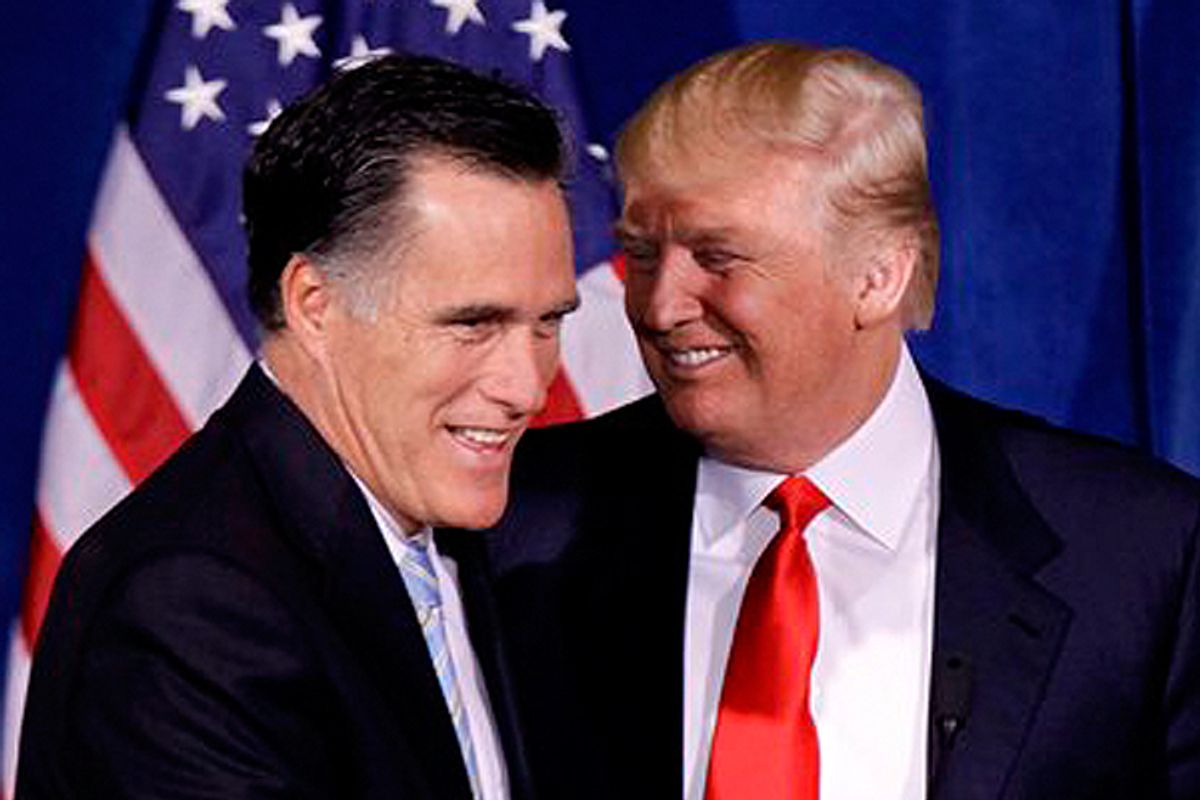
Mitt Romney and Donald Trump (Credit: AP/Julie Jacobson)

Oft-bankrupt make-believe mogul and sexist buffoon Donald Trump is figuratively hitting the campaign trail in support of the man he endorsed earlier this month, Mitt Romney.

The repellent reality television personality has recorded robo-calls for Romney, because nothing makes a person more excited to vote than the sound of Donald Trump invading your personal space and hectoring you for no reason. Citizens across Michigan can look forward to unsolicited phone calls from a recording of the guy who tells D-list celebrities that they’re fired, only instead he will be telling them that the former governor of Massachusetts is “a good man” and former Sen. Rick Santorum is a “career politician.”

Any decent human being with a modicum of shame would be embarrassed to be seen publicly with Mr. Trump, which is partly why Romney refused to be photographed with the grotesque parody of American wealth-worship when meeting with him late last year, but Romney is in desperation mode as he seeks to win the support of a bunch of people who just don’t like him very much. Now Trump is headlining Romney fundraisers and making radio appearances on behalf of the candidate and making sure that Americans know that they can expect Mr. Romney to be as fine a president as Trump University is a (non-accredited for-profit online) college.

Romney, truly the “Trump Steaks” of Republican presidential candidates, is statistically tied with Rick Santorum in the most recent Michigan poll, and running even with Santorum nationally as well, but this Trump endorsement should be a huge help in his efforts to win over the all-important “credulous racist birther moron” vote.

Trump made sure his big endorsement coincided with the premiere of the new season of “Celebrity Apprentice,” and he is also counting on the fact that everyone basically forgot exactly how toxic his own pretend run for the nomination eventually became last year. And basically only liberal blogs are even bringing up the fact that Trump’s “platform” as a candidate was dark insinuations about the president’s birthplace and personal history, and that it collapsed entirely after the president actually released his “long-form birth certificate,” which showed that his already released regular birth certificate was genuine and accurate. (Though a couple conservatives have criticized Romney’s open embrace of Trump, more because Trump is extremely unpopular than because he’s a racist fraud.)

Romney indulging Trump by accepting his endorsement was gross, and Romney recruiting Trump to actively campaign for him should be universally declared well outside the realm of “acceptable” national campaign behavior, but it’s maybe too obviously sad and desperate for people to get up in arms about. (And the political press is uncomfortable explicitly calling a ridiculous con artist a ridiculous con artist, even when it’s post-birtherism Donald Trump, so the lack of “nationally reviled untrustworthy clown endorses candidate” headlines at the traditional news organizations is not terribly surprising.) But it’s also gross that NBC renewed Trump’s contract and launched a new season of his terrible show, and it did it for similar reasons as Romney: He gets ratings, and headlines.

It just shouldn’t be forgotten or ignored that the only substantial difference between campaigning with Donald Trump and campaigning with Orly Taitz is that Trump is considered kosher because he’s a major-network TV star. (Well, and Orly has much better hair.)

Alex Pareene

Alex Pareene writes about politics for Salon and is the author of "The Rude Guide to Mitt." Email him at apareene@salon.com and follow him on Twitter @pareene

Romney’s Bill Clinton gambit

He's praising the former president to paint Obama as a liberal – and to court his devotees. Why it won't work

(Credit: Reuters/Jim Young)

Desperate Mitt Romney is not only taking credit for the auto bailout he opposed, and pretending to be a “job creator” rather than a Bain Capital job destroyer. Now he’s regularly praising former President Bill Clinton as a centrist whose legacy has been betrayed by the “liberal” President Obama. Actual liberals laugh, but can Romney’s gambit work?

Of course not, but Mitt’s not giving up.

In Lansing, Mich. last week, Romney derided Obama as an “old school liberal” compared to Clinton, who he called a “new Democrat.” Where Clinton “said the era of big government was over, President Obama brought it back with a vengeance,” Romney told a crowd of college students. A campaign official told CNN that Obama “really turned his back” on Clinton’s policies, including welfare reform and middle class tax cuts.

Huh? Of course Obama cut taxes for the middle class in the 2009 recovery act, which Republicans consistently lie about, and Clinton controversially raised taxes on high earners (Romney would lower them) to cut the deficit in 1993. Meanwhile, Obama has left President Clinton’s welfare reform alone, despite rising rates of poverty and unemployment in the recession.

On Tuesday Romney took his attack up a notch, suggesting that “a personal beef” between the two men accounts for Obama allegedly rejecting Clinton’s centrism.

According to Romney, Clinton understood that “Democrats should no longer try to govern by proposing a new program for every problem. President Obama tucked away the Clinton doctrine in his large drawer of discarded ideas, along with transparency and bipartisanship. It’s enough to make you wonder if maybe it was a personal beef with the Clintons … but really it runs much deeper.”

There he is again, mean ol’ Mitt, trying to hype reports of personal tension between the last two Democratic presidents. It’s silly. Nobody denies there was trouble on the 2008 campaign trail during the Democratic primary, when the former president smarted at Obama camp charges that his overenthusiastic support for his wife’s candidacy, and diminishing of Obama’s, smacked of racism. And today, nobody suggests that the two guys are sneaking off to basketball games together or planning their next joint family trips. But whatever personal strain may persist, they put their problems behind them a long time ago.

Clinton stumped enthusiastically for Obama in 2008, and on behalf of the president and beleaguered Democrats in the 2010 midterms. Who can forget the current president calling on the past president to help him sell the idea of a compromise on the Bush tax cuts (to liberals, by the way) in December 2010 – and then walking away and leaving Clinton by himself at the lectern happily holding forth with the White House press corps (as Obama reportedly went off and did some Christmas shopping)? Currently Clinton is, of course, working hard to help Obama beat Romney. He recently attacked the presumptive Republican nominee for backing failed Bush policies “on steroids.”

As to the notion that Clinton was a centrist and Obama is a liberal: I think they’re both politicians with liberal hearts and centrist political instincts, working to make life better for the non-wealthy in an age when Republicans have become strident, extremist servants of the super-rich. President Clinton raised taxes on the rich. He signed the Family and Medical Leave Act, belatedly letting parents take time off after the birth of a child or when needed by a sick family member.  He let Newt Gingrich’s GOP shut down the government rather than agree to Medicare cuts; on that point, he might be more traditionally liberal than Obama, who entertained the idea of Medicare cuts while trying to get a “grand bargain” on the deficit last summer. (Since then, though, Clinton himself has come out in support of Simpson-Bowles, which would trim Medicare.)

Clinton vastly expanded the Earned Income Tax Credit, which is one main reason why low-income people don’t pay any federal withholding taxes – a scandal (according to all the GOP presidential contenders) that Romney’s tax plan would remedy by imposing taxes on low-wage earners. The EITC is the absolute best proof that it’s Romney who’s moved away from the appealing mainstream ideas of his party’s past, not Obama. The low-wage tax-credit Clinton and Obama expanded was originally a Republican notion (inspired by Milton Friedman) to make poorly paying jobs an alternative to welfare. Signed into law by President Gerald R. Ford, it was expanded by George H.W. Bush, and also supported by George W. Bush.

It’s true that Clinton tried to pioneer a “Third Way” attempt at Democratic centrism, balancing the budget and ending “welfare as we know it.” He thought if he met increasingly radical Republicans half way, the country might make progress. He thought wrong. Instead Romney’s party attacked the man Romney now purports to admire; attacked him viciously, from Day One, culminating in a nihilistic effort at impeachment for sexual indiscretions that are common in Washington, D.C.

What Romney is really trying to do now, of course, is cause trouble with the segment of the electorate that admired Hillary Clinton but took a while to warm up to Barack Obama in 2008, particularly the white working class, as well as white female Democrats and independents. I don’t see it working. I’m on record saying repeatedly that dismissing Clinton’s support with working class whites as merely racism was mistaken and divisive when Democrats did it four years ago. Working class voters had valid reasons to doubt the charismatic newcomer whose economic platform was marginally less progressive than Clinton’s, and who talked riskily – and naively, as it turned out – of a post-partisan rapprochement with Republicans.

But that doesn’t make those voters easy targets for Romney. His record as Bain Capital job destroyer combined with his enduring prep-school entitlement should make him less simpatico than Obama to those voters. Romney lacks Bill Clinton’s “I feel your pain” empathy for working class folks; he comes across as the guy who’s more likely to cause them pain.

Oh, and Romney, by the way, wasn’t always such a Clinton admirer. In his book “Turnaround,” he tells the story of visiting the White House in 1999, while Clinton was president (h/t Andrew Kaczynski):

When we got through the Secret Service checkpoint for clearance at the West Wing, the agent handed each of us a badge to wear around our necks. Mine had a big, red A. I turned to Cindy and, in front of the agents, said, “Why do I have to wear this?” Thinking I was confused, she tried to explain that all visitors to the White House had to wear a badge. “I know that,” I responded, “I’m asking why I have to wear the red A around my neck. I’m not the one that cheated on my wife. He should be wearing the scarlet A- not me.” I grumbled all the way up the drive and into the West Wing lobby. The look on Cindy’s face was priceless.

What a jokester! What a hypocrite.

Continue Reading Close
Joan Walsh

Joan Walsh is Salon's editor at large.

Romney’s “vampire capitalism”

Obama's focus on Bain Capital could hurt Romney with working-class white voters and all the economy's victims

Mitt Romney (Credit: Reuters)

Former Obama auto “czar” Steve Rattner stepped on his old boss’s message a little Monday morning, telling the folks on “Morning Joe” that President Obama’s just-released ad blasting Mitt Romney’s Bain career was “unfair.” As Rattner explained: “Bain Capital’s responsibility was never to create 100,000 jobs, or some other number, it was to make profits for its investors.” Rattner is a big Democratic Party donor who worked at Lehman Brothers before starting his own private equity firm, Quadrangle (where he was accused of participating in a New York state pension fund kickback scheme and paid millions of dollars in settlements without admitting wrongdoing).

Rattner’s reaction to Obama’s tough Bain ad shows why Democrats have had a hard time capitalizing on anti-Wall Street sentiment among worried, screwed-over American voters: because for the last 20 years, at least, they’ve too often done Wall Street’s bidding almost as reliably as the GOP.

But Obama is to be praised for his aggressive rollout of RomneyEconomics.com, which features the new ads. The president is going to have a problem with voters who are not seeing signs of the economic recovery, particularly working-class whites who didn’t go to college. He probably can’t win a majority, but he has to defend his margin in 2008, when he did better with that group than John Kerry or Al Gore before him. He may not be able to do much before the election to make those voters feel less economic pain, but he can make clear that Romney would only make their pain worse. Because that’s what he’s done his whole career.

Obama’s new ad released Monday, which will run in the swing states of Iowa, Ohio, Pennsylvania, Virginia and Colorado, features laid-off workers from GST Steel in Kansas City describing how Romney’s Bain Capital acquired their employer and gutted it. GST went into bankruptcy in 2001, throwing 750 employees out of work with no health benefits and reduced pensions. Ultimately the federal government had to spend $44 million to bail out its pension fund. But Bain made $12 million on its original $8 million investment, along with another $4.5 million in “consulting fees.” This wasn’t an unusual situation for Bain: 22 percent of the company’s investments ultimately wound up in bankruptcy, but the company made healthy profits and consulting fees nonetheless.

“Bain Capital walked away with a lot of money that they made off this plant,” steel worker John Wiseman says. “We view Mitt Romney as a job destroyer.”

If that sounds familiar, that’s because Republican primary opponents Newt Gingrich and Rick Perry made similar charges against Romney. Obama’s ad accuses him of “vampire capitalism”; Perry accused him of “vulture capitalism.” Either one works for me. But the class warfare appeal didn’t seem to work in the GOP primary, where party leaders were more concerned about protecting business than trying to fake populism, and smacked down Gingrich and Perry for emulating Obama’s rhetoric. Will it work in November?

I think it will, as long as Obama combines it with practical proposals to ease the unemployment and underemployment crisis. One Wall Street Journal story that didn’t get enough attention last week found that if it wasn’t for public sector layoffs, the nation’s unemployment rate would be at roughly 7 percent. And those layoffs have been concentrated in red states, particularly Texas, Ohio, Wisconsin, Indiana, Michigan and Florida, where high-profile GOP governors have been spreading the pain on a state level that Paul Ryan would like to extend nationally. The nation’s unemployment crisis is at least partly a Republican production.

The economy is all Romney has against Obama. Just Monday morning, Romney spokesperson Andrea Saul falsely but energetically claimed that “Mitt Romney helped create more jobs in his private sector experience and more jobs as Governor of Massachusetts than President Obama has for the entire nation.” They’re brazen; they’ll keep repeating that without evidence. The most recent Gallup poll shows that 61 percent of voters say Romney would do a “good or very good job” with the economy if elected president. The CBS/New York Times poll released Monday showed Romney up over Obama by 3 points, with voters saying the economy was the most important issue to them. (The poll needs an asterisk because it’s following up with an earlier group of voters previously sampled, and only got in touch with two-thirds of them, which some analysts say could skew the results.)

But most voters haven’t tuned in to the presidential campaign yet. It’s important that Obama help those voters understand that Romney’s touted “experience” with the economy has more to do with job destruction than creation. The Obama ad features Romney saying, “I know why jobs come and why they go.” That last part is true. He certainly knows “why jobs go”: because guys like him make a fortune eliminating them.

I talked about the president’s new Bain Capital ad focus with Rep. Chaka Fattah on MSNBC’s “Politics Nation” with Rev. Al Sharpton:

Visit msnbc.com for breaking news, world news, and news about the economy

Continue Reading Close
Joan Walsh

Joan Walsh is Salon's editor at large.

Culture war commencements

Obama's speech at Barnard and Romney's at Liberty were a stark illustration of their ideological differences

President Obama at Barnard College and Mitt Romney at Liberty University (Credit: AP)

It’s come to this: “An incredibly boring white guy.” That was how a “Republican official familiar with the campaign officials” described the “prized pick” for Mitt Romney’s vice presidential candidate. Framed as the Romney campaign’s desire not to make John McCain’s mistakes, it distills something fundamental about this election — how it’s become a culture war in the most profound sense, one way of looking at the world diametrically opposed to the other.

This is not supposed to be the “change” election, and yet somehow we have an incumbent who, at a commencement address at Barnard just today, approvingly drew continuity from “Seneca Falls to Selma to Stonewall,” and talked about black and Latina girls seeing themselves in his administration. His challenger, meanwhile, visibly hopes same-old and presumed competence carry the day. There was so much in the 2008 election that scrambled the familiar calculus and allegiances – the young black man with the exotic upbringing against Hillary, the white boomer woman; and McCain, the only “white guy” in the picture, recruiting a guns-and-baby-toting Republican woman praising Title IX. But this week all you have to do is read Barack Obama’s speech at Barnard and Mitt Romney’s at Liberty University to see a dichotomy as stark as the one on either side of a picket line.

What mattered in Obama’s speech wasn’t the standard praise for his wife, mother or mother-in-law, or his hopes for his daughters. It was how he talked about the Constitution, of which he said, “Yes, it had its flaws — flaws that this nation has strived to perfect over time. Questions of race and gender were unresolved. No woman’s signature graced the original document.” But, he added, “What made this document special was that it provided the space — the possibility — for those who had been left out of our charter to fight their way in. It provided people the language to appeal to principles and ideals that broadened democracy’s reach. It allowed for protest, and movements, and the dissemination of new ideas that would repeatedly, decade after decade, change the world — a constant forward movement that continues to this day.”

It’s a formulation that sees the inclusion and participation of the excluded – even when the process is painful – as the consummation of the country’s ideals, not something from which it needs to be “taken back.” Contrast that with Romney at Liberty this weekend, in which he cited David Landes to declare that “Culture makes all the difference … Central to America’s rise to global leadership is our Judeo-Christian tradition, with its vision of the goodness and possibilities of every life.” There was the purposeful declaration that “marriage is a relationship between one man and one woman,” the shout-out to the anti-gay marriage Chick-fil-A founder and various clergy, the sermonizing. And crucially, there was an invocation of resentment, of persecution: “Your values will not always be the object of public admiration. In fact, the more you live by your beliefs, the more you will endure the censure of the world.” (Who’s supposed to play the politics of victimization, again?)

As for “incredibly boring white guy,” no one sentient would deny picking Palin was a mistake, but it wasn’t a mistake because she was a woman – the implication of that unnamed Republican’s comment, intended or not. It was a mistake because the McCain campaign thought demographics alone would give them the sheen of being transformative, and it blinded them to all else.

It’s not crazy to think that this time, safety and competence might appeal at a time of economic uncertainty. The Romney campaign didn’t create the supposition that a white guy is the standard, the safe and the certain, or that “diversity” is something you get one chance to try — even if they’re only too happy to exploit it. But in the end, from what can be determined from her wildly erratic public performance, Palin turned out to be a fairly conventional social conservative. (The erratic part ended up making all the difference.) This time around, Romney and his camp are manifestly uninterested in heeding what, per Newsweek’s headline today, “New Mexico’s Governor can teach the GOP.” That would be Susana Martinez, the first Latina governor, a pro-life, pro-gun Republican who differs from Palin in a crucial way: The worst thing a critic is quoted saying about her is that she’s “maintaining a competent, minimalist administration so there’s nothing to hang around her neck during the next campaign.” That sounds … incredibly boring, actually.

It’s not just being female and Latina that would set Martinez apart from the current GOP direction, though given their steady alienation of those groups, that’s not nothing. She’s chosen not to be a mother, off-message for a Republican moment that considers elaborate mother-worship an effective rejoinder to accusations of misogyny, and she has no patience for what little we know about Romney’s immigration stance (“‘Self-deport?’ What the heck does that mean?”).

But most significantly of all, she essentially dismisses the fiercest conservative dogma of the moment, calling the mantra of “lower taxes” “this five-liner of nothingness,” to Newsweek. The primary caretaker for a disabled sister, she says, “I believe in providing services to adults and children who can’t take care of themselves … Sometimes Republicans engage in number-crunching analysis that doesn’t always take the neediest into account.” It was a clear shot at the Ryan budget, an article of faith for Republicans – and a reminder that even when wrapped in social conservatism, there’s a whole other sort of radicalism at stake in this election.

Continue Reading Close
Irin Carmon

Irin Carmon is a staff writer for Salon. Follow her on Twitter at @irincarmon or email her at icarmon@salon.com.

Yes, Mitt gets worse

Romney's chuckling non-apology for his prep school bullying shows his entitlement and lack of empathy

Mitt Romney (Credit: AP/Jae C. Hong)

It’s not precisely the same as Gary Hart daring reporters to follow him, when faced with Donna Rice rumors back in 1988, and then getting caught in an affair. But when Ann Romney pointed to her husband’s fun-and-games prankster high school days to show us “the real Mitt,” she made those years even more interesting and relevant to political reporters, and potentially to voters. “I still look at him as the boy that I met in high school when he was playing all the jokes and really just being crazy, pretty crazy,” she told the CBS “Early Show” 10 days ago. “There’s a wild and crazy man in there.”

The right wing is now trying to accuse Washington Post reporter Jason Horowitz of an oppo-research operation, but his meticulously reported and well-sourced story of Romney’s prep-school bullying, including two cases involving gay classmates, won’t be destroyed by the noise machine.

What’s giving the story legs isn’t merely the homophobic hair-cutting episode, which a lawyer friend of Romney’s termed “assault and battery,” not “hijinks.” It’s Romney’s callous reaction. His campaign first tried to shrug off the story with an insincere non-apology, but when the details of Horowitz’s tale got people’s attention – the “terrified” classmate John Lauber “with tears in his eyes” as Romney chopped off his hair with a scissor; the callow preppie leading a sight-impaired teacher into a set of closed doors – the candidate made his own statement. And what a statement it was.

After Fox’s Brian Kilmeade shared the Lauber story, Romney actually chuckled, and said:

You know, I don’t, I don’t remember that incident. I’ll tell you, I certainly don’t believe that I or – I can’t speak for others – thought the fellow was homosexual. That was the furthest thing from our minds in the 1960s.

You really have to listen to it to hear that the callow preppie hasn’t changed much in 50 years. As I noted yesterday, it’s rather brazen to say he doesn’t “remember that incident,” but to immediately volunteer that he didn’t think “the fellow was homosexual.” How could Lauber’s being gay have anything to do with an incident he says he doesn’t remember?

The other way his answer hurts him is that it seems to have riled up the friends who told Horowitz the story. After 50 years, they all confessed that the incident made them feel guilty, but Romney says he doesn’t remember it?

The pro-Obama PAC American Bridge is using the incident in a campaign video it called “Mitt Gets Worse,” a play on the moving series of famous folks reassuring gay teens “It Gets Better.” I don’t think we should judge Romney’s actions of 50 years ago with the exact same values society has evolved to hold today. But I do think we should judge his reaction to the story with those values. At a time when we know bullying of any kind, but particularly homophobic bullying, can leave lasting scars and even lead to suicide, Romney’s non-apology shows he has an empathy problem, plain and simple.

I’ll be debating the issue on “Hardball” with former RNC chairman Michael Steele. In the meantime, here’s the “Mitt Gets Worse” video.

Continue Reading Close
Joan Walsh

Joan Walsh is Salon's editor at large.

Using Bush’s playbook

"Karl Rove politics" aren't quite dead: Obama's strategy in 2012 will mirror W's in 2004

George W. Bush and Barack Obama (Credit: Reuters/Larry Downing)

Barack Obama’s presidency was born from nothing so much as his repudiation of George W. Bush’s administration — its policies and politics, its style and tone. One of Obama’s most effective 2008 stump speech refrains was his promise to end the era of “Scooter Libby justice, ‘Brownie’ incompetence and Karl Rove politics.”

But the political dynamics for winning a second presidential term often differ markedly from winning the first. So don’t be surprised by many eerie parallels between Obama’s 2012 reelection bid and Bush’s 2004 campaign. The president may not rely upon “Karl Rove politics” in the strictest sense, and nobody would confuse David Axelrod with Rove. But Obama’s reelection route and rhetoric may bear more than a few Rovian hallmarks.

Now that Mitt Romney has won the Republican nomination, two key features prevail over the 2012 campaign — and both were also plainly evident in 2004. First, the incumbent president’s reelection fortunes are far from certain; and, second, the incumbent faces a decent but nevertheless weak challenger who is further hampered by internal problems within his party’s coalition.

Because incumbents can’t run for reelection promising “change,” and because “hope” during a lingering recession was also off the menu, the Obama campaign’s 2012 theme of  “forward” — a word that often follows “plow,” mind you — was the best available alternative. That said, and substituting the economy for terrorism, Obama is implicitly if not explicitly advancing the same theme Bush did in 2004: America suffered a tough blow, but the situation could have been worse and, more to the point, under my stewardship the nation is steadily regaining its footing.

This counterfactual campaign theme — vote for me not because of what happened, but what might have but didn’t — is a common thread for Bush and Obama. It’s not an uplifting message, but it sufficed in 2004 and Obama is counting on it working again in 2012.

Politics 101 further dictates that when an incumbent’s reelection is in doubt, he must go negative against the challenger. Obama political operatives in the White House and at the Democratic National Committee long ago made it abundantly clear they were willing to do just that. Team Obama may not go negative against Romney to the degree the Bush camp did against John Kerry in 2004. (By mid-summer 2004, 75 percent of Bush’s TV ads were negative attacks on Kerry.) But don’t be surprised if attacks on Romney’s record and even character are plentiful, harsh and relentless. In 2008, America saw candidate Obama’s toothy grin; four years later, expect to see President Obama’s fangs.

Expect the Obama camp to emphasize two major critiques of Romney: that he is a flip-flopper willing to say anything or reverse any position to win; and that he is an economic royalist whose personal and public life suggest a person incapable of understanding the lives and struggles of average Americans. Again — note the unusual parallels with 2004.

Although Romney is a Republican former governor and Kerry was at the time his state’s Democratic junior U.S. senator, the two Massachusetts pols make for similar targets. Each man is an extraordinarily rich preppie and Ivy Leaguer. Each represents the liberal wing of his respective party. Each has shown a propensity for ruining an otherwise valid point with sloppy, backfiring language. And each has a reputation for lacking political spine.

The flip-flop frame is candidate character assassination of the first order. Like the lone negative number in a string of multiplied positives, the critique that nobody can trust any statement or claim made by a politician has the potential to negate every accomplishment or promise. If it sticks, it can be fatal, as Kerry learned in 2004.

Obama and the Democratic National Committee know their electoral history and, sure enough, last November — a year before the election and two full months before a single Iowan had caucused — the DNC released a four-minute “Mitt vs. Mitt” ad and its accompanying website with the damning tag line, “the story of two men trapped in one body.” The site is a brilliant homage to the Bush campaign’s 2004 windsurfer attack ad and the devastating, 11-minute ad the Republican National Committee produced chronicling Kerry’s “evolution” on Iraq.

And then there is what might be called “the Willard factor”: Romney as Richy Rich, the Monopoly Guy with the Bain Capital background and the Swiss bank account. His bio would be political gold to Romney’s opponent any election cycle, but it’s gold-plated platinum in the first full presidential campaign following the biggest economic crisis since the Great Depression, the rise of the Occupy Wall Street movement, and the long overdue national debate over income inequality.

Again, the wealth-personified line of attack mirrors the out-of-touch, Martha’s Vineyard yoke the Bush team put around Kerry’s neck in 2004. Right on cue, in the first public event of his reelection campaign, last week Obama attacked Romney by name and invoked the economic disconnect card with relish. “He sincerely believes that if CEOs and wealthy investors like him make money the rest of us will automatically prosper as well,” said Obama of Romney, adding that “corporations aren’t people – -people are people.” (For the record, Kerry is actually wealthier than Romney, who would become one of the richest men ever to occupy the White House, should he win.)

Obama will also try to shift the national debate toward areas of strength, as Bush did. Historically, this meant the same strategy, but with inverse implications for each party: The so-called mommy party Democrats would encourage voters to focus on more favorable kitchen-table economy issues — healthcare, jobs, education — and away from less favorable “daddy party” Republican issues surrounding foreign wars abroad and culture wars. Because Obama is net-positive in foreign policy approval and net-negative on the economy, rather than mirroring by inversion, Obama will try to duplicate Bush’s shift-in-emphasis in 2004. GOP complaints that Obama is politicizing the killing of Osama bin Laden reveal Republican fears that Obama is going to play the terrorism card in 2012 just like Bush did eight years ago.

The 2004 parallels extend beyond message. Obama will be amply resourced and enjoy a field technology by virtue of his campaign’s state-of-the-art Web, donor, volunteer and social media innovations. Remember the Bush reelection campaign’s vaunted “72-hour” voter turnout model? That seems like an Edsel compared to the Ferrari the Obama team will be sporting this summer and fall. Among the perquisites modern presidential incumbents enjoy is the option to test-drive the best mobilization machines before anyone else.

Finally, what most connects Obama 2012 to Bush 2004 is the stability of the electoral map itself. Only three states — two net to Bush — flipped from one party to the other between 2000 and 2004; only nine states flipped between 2004 and 2008. Split the difference and a good, back-of-the-napkin over-under for number of states likely to flip between 2008 and 2012 is six. And thus, like the lead sailboat during a windless race, Obama doesn’t need or want conditions to change much from 2008: He merely has to replicate the map that swept him into office, with the burden of figuring out how to shake up the Electoral College falling to Romney, just as it did for Kerry against Bush. Even Karl Rove’s mapping of the 2012 election concedes this reality.

The 2008 election was memorable; to borrow the title of one best-selling chronicle, it was a “game changer.” But 2012 will not be. In many respects, it will be a game repeater, with Obama playing Bush to Romney’s Kerry of 2004. The president may be asking Americans to look “forward” in 2012, but the best preview of his reelection campaign can be found by looking backward eight years.

Continue Reading Close

Page 1 of 79 in Mitt Romney

www.salon.com/topic/mitt_romney/