

Among progressive friends and colleagues of mine, there seems to be a consensus that the longer the Republican presidential primary continues the better for progressives. The idea is that Republican infighting weakens the ultimate nominee and exposes just how radical all of the GOP candidates are. As the domino theory goes, that will help more Americans see the ugly truth about what the Republican Party really is, which will subsequently convince more Americans to vote against the GOP, which will eventually force the GOP to moderate its politics.
Straightforward as this hypothesis is, I don’t buy it — I believe the longer the Republican primary battle continues, the more the GOP’s most extreme proposals are given a mainstream platform, the more their ideas are granted public credibility and the more conservative propaganda is invisibly woven into our most basic political assumptions. In other words, I believe in the Goldwater Principle, which suggests that while the eventual nominee may fail to win the cycle’s general election, the elongated nomination contest — with its news cycle dominance and hardcore ideological edge — will help permanently shift the supposed mainstream “center” of our public debate to the fringe right.
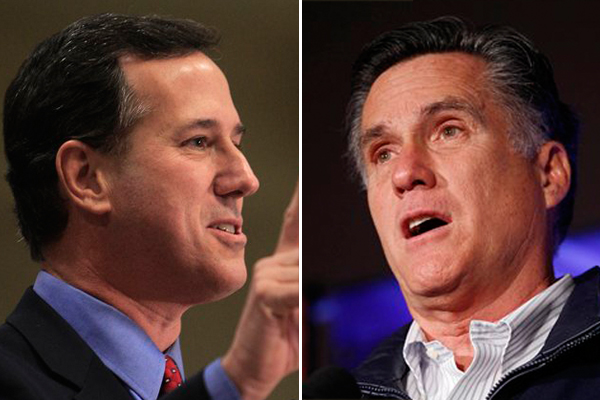
Consider the heated attacks Mitt Romney’s campaign is now lobbing at Rick Santorum in the run-up to Super Tuesday. By calling the former Pennsylvania senator “Big Labor’s favorite senator,” the effort aims to paint the viciously anti-union Santorum as nothing short of the flesh-and-blood reincarnation of Paul Wellstone. Romney is clearly hoping that such a portrayal will spur a GOP voter backlash, and sensational headlines across the country spur his framing on. The result is a troubling ripple effect that could transcend a single election.
Laugh all you want at the absurdity of calling Santorum union workers’ best friend, and tell yourself that it all will teach average Americans how ridiculous the GOP is, but in reality, it’s not funny and will most likely have the opposite effect: It will probably help the larger effort to undermine the once-undebatable idea of what “pro-labor” fundamentally means.
As the framing of the Republican primary debate argues, it no longer means consistently backing minimum wage increases; consistently opposing corporate-written “free” trade deals; supporting budgets that let the Labor Department enforce labor laws; opposing so-called right-to-work laws; or even casting a majority of one’s legislative votes in favor of unions’ agenda. It means the opposite: a senator who has repeatedly voted against minimum wage increases, for job-killing trade agreements, against budgets that adequately fund labor-law enforcement, and against unions’ stated priorities a whopping 88 percent of the time. It also means a presidential candidate who is actively campaigning in support of a national “right to work” law.
While this particular — and particularly ridiculous — definition of “pro-labor” might not fully stick in the American psyche, it does have a longer-term psychological effect, especially since so much media attention is focused on it. It’s part of a larger process that, over the years, gradually shifts our assumptions and definitions to the right — a process that makes Santorum into “Big Labor’s favorite senator” and by comparison, genuinely pro-labor lawmakers into wild-eyed leftists. Indeed, with Santorum depicted as Paul Wellstone, today’s conservative Democrats who sometime votes with unions are suddenly at risk of being seen as European socialists, and progressive Democrats who are actually pro-labor are almost certain to be reimagined as Marxist revolutionaries — even though nothing could be further from the truth. Meanwhile, the momentary argument over whether Santorum is pro- or anti-union bleeds out into the larger campaign to reset the political center and define both the terms “liberal” and “conservative” as something farther to the right than they were even a few years ago.
On that latter point, notice the response from the Pennsylvania AFL-CIO (emphasis added):
Rick Bloomingdale, president of the Pennsylvania AFL-CIO, remembered trying to schedule meetings with Santorum, but always being passed over to his staff. After appealing to the Republican Senator’s aides on the labor issue of the day, Bloomingdale said his office would receive a letter stating the senator “was opposing you on whatever that issue was.”
“His thing was, ‘I won without you.’ He’s an arrogant guy, he thinks he’s right and everyone else is wrong,” Bloomingdale said. “Calling him a labor supporter would be similar to calling Mitt Romney a conservative. They’re both ridiculous.”
So now, not only is the media forwarding the idea that Santorum is pro-labor, but labor leaders themselves are suggesting archconservative Mitt Romney is not actually conservative! For the national conservative movement, that means the whole affair — regardless of whom it helps in a given election — is a victory in the larger war to move America to the right.
This is precisely why the longer the GOP primary and these vernacular-changing skirmishes take center stage, the better it is for conservatives, and the worse it is for the progressive movement. Sure, an elongated primary battle may (and I stress may) minimally help President Obama’s reelection campaign. But over the long haul, it threatens to change the very parameters of our political discourse — and that will have consequences for many elections to come.
