
Adele

The obscene power of the middle finger

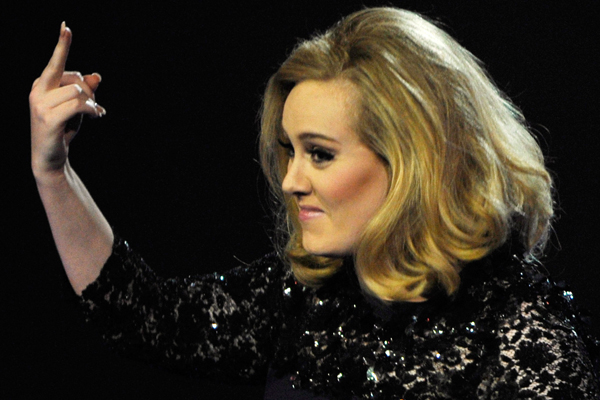
After M.I.A. shocked at the Super Bowl, Adele flips off the host of the Brit Awards. Let the phony outrage begin VIDEO

Adele (Credit: Reuters/Dylan Martinez)

The middle finger is making a comeback. I know what you’re thinking. Who knew it ever went away?

But the bird — specifically the flipping of it — has managed to make worldwide headlines twice now in the past month. First, there was M.I.A.’s apparently unscheduled additional choreography during her appearance at the Super Bowl halftime show, a move that occasional finger-giver Madonna “wasn’t happy about.” M.I.A.’s off-book version of double dream hands swiftly proved the power of a gesture to shock, as NBC – the same network that features “penis cleavage” gags on “Are You There, Chelsea?” — hastily issued an apology and lamented that “Our system was late to obscure the inappropriate gesture.” The NFL similarly decreed that “The obscene gesture in the performance was completely inappropriate, very disappointing and we apologize to our fans.”

And now, just as the world has begun to recover from the shock and horror of seeing the longest finger of a woman’s hand standing apart from its fellow digits, along comes Adele.

After cleaning up with six Grammy awards and making a triumphant comeback after vocal chord surgery, the British chanteuse and object of Karl Lagerfeld’s derision came back to the U.K. a hero, picking up album of the year and best British female solo artist at Tuesday’s Brit Awards. But in the midst of her emotional speech, just as she was declaring that  she was “so, so proud to be British and to be flying our flag and I’m so proud to be in the room with all of you,” the show’s mortified-looking host, actor James Corden, appeared onstage to whimper, “I’m so sorry…”

“Are you about to cut me off?” she replied, “Can I just say then, goodbye and I’ll see you next time round?” Then she gave him the one-finger salute to thunderous applause. Seriously, Brits, you were in that big a hurry to bring out Blur? What, was this the 1998 awards? You’ve got the biggest singer in the world right now, basking in the glow of hometown glory. Blur can freaking wait.

The finger is a powerful gesture – its origins go all the way back to a throwdown between Greek philosopher Diogenes and that punkass hater Demosthenes. The finger says, succinctly, “My penis!” and with it, all the power it wields and all the things that you, the object of said gesture, can do with it. Actual penis not required. The bird has been famously flipped by almost every public figure you can think of who doesn’t have the words “His Holiness” in front of his name – by everyone from George W. Bush to Katy Perry and Rihanna to most iconically, Johnny Cash. It is, in short, the most “obscene” a person can get without removing pants.

And in flipping off James Corden and all he stands for, Adele, who devoted a portion of her Grammy acceptance speech to a bit of rogue snot, achieved something that M.I.A. and her Super Bowl shenanigans could not. She gave the gesture context and meaning, proving yet again that under all that hair and eyeliner and singular cool is an artist who can really rage. Later Tuesday evening, she explained, “I flung the middle finger. That was for the suits at the Brit Awards, not my fans. I’m sorry if I offended anyone but the suits offended me.” Adele’s finger wasn’t a random moment of naughty provocation, calculated to get attention. It was, as a good flip-off should be, a wordless expression of genuine irritation, a thoroughly rock ‘n’ roll gesture that predates rock ‘n’ roll itself. Amazingly, one finger can still stun the world. And sometimes, the suits need to be reminded of that.

Mary Elizabeth Williams

Mary Elizabeth Williams is a staff writer for Salon and the author of "Gimme Shelter: My Three Years Searching for the American Dream." Follow her on Twitter: @embeedub.

Adele: The new Kurt Cobain

A Grammy sensation is cheered for her "authenticity." Coming next: Dour, humorless copycats invade the pop charts

Kurt Cobain and Adele (Credit: Reuters)

With her armload of Grammys, three nominations for tonight’s Brit Awards and a stack of platinum albums, England’s Adele reigns over pop music at home and abroad. “Someone Like You,” the closing track of her 17-million-selling album “21,” is arguably the past year’s signature song, widely hailed – as is all her music – for its “authenticity.” But beyond its piano-and-voice starkness, it sounds like, well … 1992.

The song’s quiet/loud structure, its nakedly personal lyrics, and Adele’s aggressive, cathartic yawp in the chorus are all hallmarks of grunge-era rock. And authenticity, that elusive concept, is what Kurt Cobain was said to embody 20 years ago. As a resolutely working-class singer who penned songs about psychological pain and refused to conform to a stereotypical pop-star image, he was seen as a beacon of “realness” in an era of manufactured pop. The same could be said of Adele. If her success is any gauge, we’re entering a new era where displays of “authenticity” will be de rigueur. Let’s just hope it doesn’t do away with fun.

The early ‘90s fetishization of authenticity arose at a time when R&B-flavored dance confections by C&C Music Factory and Paula Abdul topped the charts, and even the über-sincere U2 embraced electronics and irony. Revelations that Milli Vanilli had lip-synced their way to a best new artist Grammy led to album-burning and an S.O.S. for artists who believed there was nothing better than the real thing. Enter Kurt Cobain.

Nirvana’s breakthrough single, “Smells Like Teen Spirit,” was an attempt to emulate the arty rock of the iconoclastic Pixies, but it was received as the raw sound of disaffected youth. Cobain bought into his own mythology: He professed to feel “a duty to warn the kids of false music that’s claiming to be underground,” citing the “corporate” Pearl Jam as a prime example. Authenticity, as Hugh Barker and Yuval Taylor point out in their book “Faking It,” is “an absolute, a goal that can never be fully attained,” and Saint Kurt, the idealist, went “to tremendous lengths to ‘keep it real,’ to rebel against commercial expectations, and to expose his problems to the public.” At least Cobain had a sense of humor; after his suicide, however, his devotion to “rawness” became elevated to orthodoxy, adopted as dogma by a host of moaning miserabilists who delivered wave after wave of angst-soaked grunge and grunge-lite.

From Puddle of Mudd to Staind to Creed to Nickelback, the yarling grunge descendants replaced rock’s devil-may-care excitement with blazoned earnestness and sludge. In doing so, they forced a schism between rock and pop, two forms of music that, in terms of style, at least, had been creeping closer together over the course of the ‘80s. It took bands like the White Stripes, the Strokes and the Hives, in the early ‘00s, to bring self-awareness and fun back into rock music. Despite their own assertions of what Barker and Taylor would call “cultural” authenticity (or adherence to a well-defined tradition) in rock ‘n’ roll, they were self-consciously contrived: Theirs was authenticity at one remove, a stylistic decision.

In recent years, stylistic dogmatism has largely receded, and genres have intermingled freely; a rapper like Lil’ Wayne can sing through heavy Auto-Tune (a device beloved in pop and dance music) to produce a rock album (“Rebirth”). But high seriousness has once again started to creep in, as even former enfant terrible Eminem now delivers introspective lyrics with emo choruses, while the latest hip-hop superstar Drake shows us it’s best not to celebrate success without maudlin self-critique.

Cultural reasons for this broadcasting of inner turmoil might include the recession and Facebook-induced oversharing, but it may also be due to the cyclical nature of fashion and popular music, where each new trend reacts against the last; as flannel makes a catwalk comeback, it’s natural that “authenticity” should do so as well. Adele, clearly, is at the vanguard of such supposed bald, unmediated self-expression, and for her critics, this is integral to her appeal: She’s “a real person, with real music” (New York Examiner); a champion of “authenticity and old school talent in a sea of Auto-Tuned belly buttons” (Toronto Star); and “authentic because she is her own creation” (Daily Telegraph).

Her antithesis is widely held to be public whipping-girl Lana Del Rey, who (horrors!) has changed her name, gussied up her image, and dared to be somewhat theatrical; by implication, if she had sung her songs (which sound like anemic, monochrome versions of Adele’s glummest balladry anyway) as Lizzy Grant of Lake Placid, all would have been forgiven. And where one might expect dance-pop stars to challenge Adele’s pervasive earnestness, they’ve instead been joining her: Taio Cruz and Katy Perry, for instance, have delivered straight, po-faced covers of “Someone Like You.” Where authenticity has historically been the province of rock rather than pop, Adele’s crossover appeal extends its reach.

Adele-worship has, however, been greeted with some suspicion in her native England, where she has been seen as the standard-bearer for an artistic “movement” dubbed the New Boring, with her erstwhile tour mate, soul singer Michael Kiwanuka, cited as an acolyte. Undeterred, fellow English singer/songwriter Ed Sheeran has affirmed, “If Adele’s seen as boring, then I’m happy to be boring as well,” and in the wake of Adele’s Grammy sweep, Jessie J, who once sang, “Why is everybody so serious?,” has vowed to pare down her live show in order to prove she’s “real,” as “The English … can sniff a fake very easily.”

But exactly how “authentic” is Adele anyway? She’s a big fan of the Spice Girls, devotees of Auto-Tune and miming who, she has claimed, “made me who I am.” Her musical style is highly derivative of American soul music, with a smattering of heartbroken country. And the “highly personal” songs on “21″ were written in collaboration with the likes of Ryan Tedder (Backstreet Boys, Sugababes), Fraser T. Smith (Britney Spears, Taio Cruz), Francis White (James Blunt, Take That), and Greg Wells (Mika, Katy Perry).

Not that there’s anything wrong with any of this. Rather, it’s the concept of authenticity itself that’s problematic, especially when it’s linked to “honesty” and “sincerity,” which are easy to assert but impossible to prove, and to a serious mode of “expressing oneself,” which admits of no irony – and therefore no humor. And Adele is capable of both: On “21,” the cheeky stomper “Rumor Has It,” for instance, opens with the lines “She ain’t real,” describing a love rival, but later suggests that the singer ain’t exactly what she seems: “You made my heart melt, yet I’m cold to the core.”

Authenticity is as much a pose as it is a state of being, but we’re conditioned to value it nonetheless. What if Adele, who has recently claimed she’s “never writing a breakup record again,” were to release her next new album under a pseudonym and fill it with peppy, Auto-Tuned dance numbers? Nevermind, we’d find someone like her.

Continue Reading Close

The Grammys’ most memorable moments

Adele, Glen Campbell and the Boss triumph, Whitney's remembered -- but what was Nicki Minaj up to? VIDEO

Adele poses backstage with her six awards at the 54th annual Grammy Awards on Sunday, Feb. 12, 2012 in Los Angeles. Adele won awards for best pop solo performance for "Someone Like You," song of the year, record of the year, and best short form music video for "Rolling in the Deep," and album of the year and best pop vocal album for "21." (AP Photo/Mark J. Terrill) (Credit: AP)

The Grammys have always trod the line between dull veneration of industry success and outrageous celebration of rock ‘n’ roll excess. But this year, with the losses of Etta James, Clarence Clemons, Gil Scott-Heron and Amy Winehouse, the show had an even tougher time finding the right pitch than Coldplay’s Chris Martin did.

The specter of death would have hung heavily over the proceedings even if Whitney Houston hadn’t died suddenly the day before. But the singer’s untimely demise Saturday gave an unavoidable air of sorrow to the proceedings, a grim dose of reality that couldn’t help crashing into the fantasy realm of Lady Gaga scepters and Nicki Minaj eyelashes. That’s why the most memorable aspects of the broadcast weren’t just the loudest or the tackiest. They were sad, they were weird, they were sometimes awful; sometimes, they were even fantastic. And they were dominated by two big-throated ladies – the troubled diva from Newark and Adele, the whiskey-voiced British blonde. And though we loved The Civil Wars’ one minute of perfection and were baffled by Rihanna’s “When Harry Met Sally” hair and got weepy over Paul McCartney and company’s poignant and timely “Golden Slumbers/Carry That Weight,” these are Salon’s top-10 biggest moments of the night.

Bruce Springsteen

With all his trademark energy intact and backed with a massive string section, the Boss — who lost his longtime collaborator Clarence Clemons last year – kicked off the evening with a rousing version of “We Take Care of Our Own.” It was soulful, spirited and just the right touch of mournful.

LL Cool J

Admitting that “There is no way around this — we had a death in our family,” the night’s host then announced “the only thing right is to begin with a prayer … for our fallen sister.” Depending on your philosophic perspective, watching the audience solemnly bow its collective head while Cool James invoked our “heavenly father” was either a moving tribute or a sudden reminder of why having an atheist like Ricky Gervais host awards shows is a cool idea. But when he cut to clip of Whitney blowing the roof off with a live performance of “I Will Always Love You” at the Grammys a generation ago, it set a bar for vocal performance that would be damn near impossible to match for the rest of the night.

Alicia Keys and Bonnie Raitt

Honoring the late, great Etta James, two knockout performers of different eras and genres gave a stripped-down version of “Sunday Kind of Love.” It was one of the few pairings of the night that worked, a stunning moment of sincerity and finesse in an evening that often veered heavily to schmaltz.

Chris Brown

It’s not that we can expect the music industry to ignore chart-topping, domestic-abusing, frequently terrible Chris Brown. He’s had a huge year, and on Sunday’s broadcast, he even managed to pick up a Grammy. But aside from his historic awfulness, there’s another reason to ponder whether it was really necessary to subject America to two separate performances. Decked out in his preppy “I’m not dangerous, ladies!” varsity jacket, he jumped around lip-syncing “Turn Up the Music” and “Beautiful People” with a posse of bat-winged, masked performers in a performance apparently inspired by the old video game Q*Bert early in the night, then came back near the end for a dead-behind-the-eyes “tribute to dance.” At least he managed to prove that he doesn’t need his abusive record to be reviled; feel free to shun him just because he sucks.

Jennifer Hudson

It took the powerhouse Jennifer Hudson — who two years ago performed Houston’s most successful smash for the woman herself at the BET Awards — to take “I Will Always Love You” back from the place of power ballad clichés where it’s lived the last two decades and make it ache like new. No big crescendo, no sappy orchestration, just a clearly emotional Hudson belting her heart out. Beautiful.

Foo Fighters

In an intense performance outside the Staples Center for the regular folk, Dave Grohl and company – a gang whose own experience of tragedy was brought home by that audience member thrashing around in a Nirvana shirt — howled through a fiery rendition of their “never wanna die” anthem “Walk.” Later, picking up the Grammy for best rock performance, Grohl admitted, “We made this one in my garage with some microphones and a tape machine,” eloquently pleaded for “the human element of music” and promised, “It’s not about being perfect.” It was a shining example of old-school authenticity, only slightly undercut by the appearance, immediately after, of Ryan Seacrest.

Glen Campbell

Lifetime-achievement award winner Campbell, who last year announced he was facing Alzheimer’s and would release a final album and do one last tour, is not going gently into his disease. After the Band Perry shouted uncomprehendingly through “Gentle On My Mind” and Blake Shelton did a serviceable “Southern Nights,” it was Campbell himself who rocked the house. Looking undeniably unwell but in remarkably stronger voice than the likes of fellow Grammy performers Carrie Underwood or Paul McCartney, he staunchly belted out “Rhinestone Cowboy,” enthusiastically coaxing the entire audience to sing along. It was by the far the greatest exhibition of bad-ass, rock ‘n’ roll indominability of the night.

Katy Perry

Aw, remember when Katy Perry did the Grammys gently swaying in a trapeze swing, showing off home movies from her wedding? Sure you do; it was last year. Post-Russell Brand divorce Katy seems to have decided to go for a different vibe. Performing her new song “Part of Me,” she was all about shattering glass, engulfing ice effigies of men in flames, and declaring, “You can keep the diamond ring, in fact, you can keep everything.” Katy, you blue-haired, pissed-off little minx, you know what? I believe you.

Nicki Minaj

The Catholic Church hasn’t taken this much of a beating since Madonna’s “Like a Prayer” era. In a performance of “Roman Holiday” that topped even Lady Gaga’s “Alejandro,” Minaj went through a confession gone wrong, an exorcism, and wound up surrounded by dancing monks getting groped by hot leather babes – all while “Oh Come All Ye Faithful” took on a whole new meaning. Did we mention she levitated? It was the closest the Grammys has ever come to turning into a Ken Russell movie.

Adele

Taking the stage after vocal surgery in November, the night’s biggest winner was clearly not in as forceful voice as in her Royal Albert Hall performance of last year. But she was so clearly enjoying her triumphant night of multiple wins, pointing at herself while snarling, “You could have had this all,” she personified bittersweet awesomeness. When the audience thundered to its feet, Adele’s mastery of simultaneous heartbreak and victory was not just in powerful evidence, it was conspicuously infectious. And when, later, she tearfully picked up the final award of the night for album of the year, she copped both to an inspiring “rubbish relationship” and to fending off “oh my God, snot.” And that is whyyyyyyyy we will always love youuuuuuu, Adele.

Continue Reading Close
Mary Elizabeth Williams

Mary Elizabeth Williams is a staff writer for Salon and the author of "Gimme Shelter: My Three Years Searching for the American Dream." Follow her on Twitter: @embeedub.

www.salon.com/topic/adele/