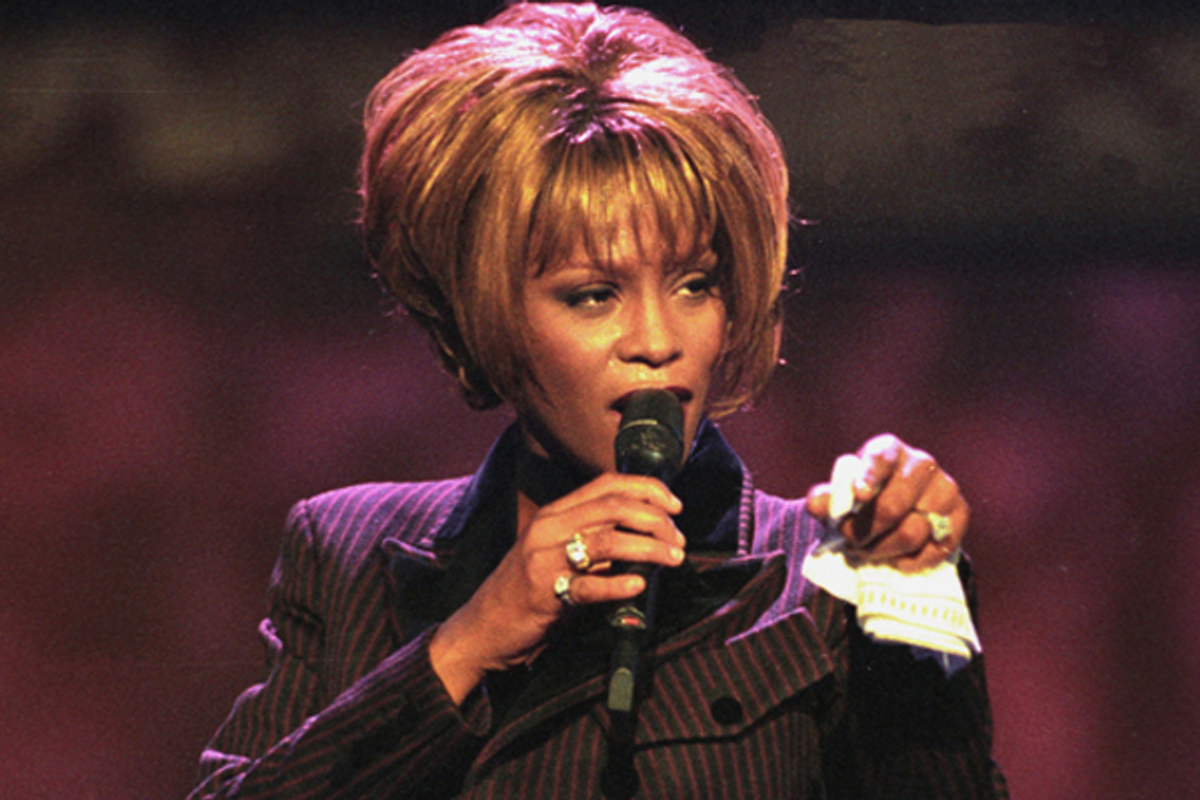
 Just minutes after Whitney Houston was found dead in a bathtub at the Beverly Hilton last Saturday at the age of 48, a caravan of network trucks began slowly encircling the plush hotel, morbidly eager to document her untimely demise. Since then, it's been nearly impossible to turn on the TV or log on to the Web without witnessing a tribute to the singer, often including depressing video footage of her long, painful decline. Her memorial on Saturday had the pomp and pageantry of a state event—complete with dignitaries, crying onlookers and flags at half-mast.
But while speakers talked movingly about her battles, mention of the word "addiction" was curiously scrubbed from the event.
It’s no surprise that the singer's death has struck such a chord in the country. Incredibly talented, beautiful and ambitious, Whitney Houston was a rare kind of legend who changed the face of American pop music. In her later life she also became an addict whose cruel struggle with the disease unfolded in full public view. That she lay dying for hours in a luxe bathroom suite while her bodyguards cooled their heels outside is a sad commentary on the state of modern celebrity. That it took less than 10 minutes for the press to begin broadcasting her death is an even more searing indictment of contemporary media culture.
Houston, of course, is not the only celebrity whose problems have received rapt press attention. Last month it was Demi Moore. The week before that it was Disney's Demi Lavato. Meanwhile, the weekly travails of Charlie Sheen and Lindsay Lohan have been breathless fodder for fleets of paparazzi. And for over a year before her death last year, fans of Amy Winehouse received daily updates of her ups and downs. One British tabloid even went so far as to embed a pack of paparazzi at her favorite pubs.
As a longtime editor at several magazines over the past two decades, I've admittedly been an active participant in this game—keenly aware that for ordinary readers grappling with the mundanities of daily life, stars offer a few rare moments of transcendence. But their intoxicating effect on the American public also gives them outsize power to shape public perception. In the 1980s, Rock Hudson and Magic Johnson forced the media to finally pay attention to AIDS only after it had already killed an army of Americans. Michael J. Fox's battle with Parkinson's helped bring invaluable attention and funding to the disease, while prompting a debate on stem cell research that promises to have profound effects on the treatment of other illnesses.
But substantive stories about alcoholism and drug addiction remain largely outside the media purview—focused on the tribulations of A and C-list celebrities, they're often ghettoized in gossip sites and channels like VH1. For all the daily hand wringing about celebrity overdoses and DUIs, there is precious little real reporting on the growing scientific understanding of the disease, the tragic lack of access to treatment or insurance coverage, or even the growing number of promising drugs that have begun to make real progress against this condition.
For a long time, I regarded this kind of journalism as business as usual. But my own perspective began to change as I was forced to confront the fact of my own addiction. For most of my early 30s I fancied myself a young version of the late Christopher Hitchens, a literary legend rarely spotted without a drink who once bragged that he couldn't write without a hangover. Alas, I soon learned that I possessed neither his talent nor his hardy constitution. As a result, I spent two years in a series of rehabs and sober living facilities, witnessing firsthand the ravenous toll taken by addiction and the abject failure of our medical and political system.
My first roommate was a 23-year-old violinist from Iowa who had cycled through five detoxes and five rehabs in just 11 months. At the same rehab, I befriended an ad executive whose proclivity for Absolut eventually landed her in a homeless shelter. I met an investment banker whose weekend crystal meth binges led to a lifelong HIV infection. At one sober living facility I played poker with a rum-loving Catholic priest who led one of the largest congregations in Nigeria. I met countless others who maintain publicly productive lives while suffering through their own private hell. You can be certain that none of them will ever show up on CNN. But neither will the pernicious behavior of the insurance companies and Big Pharma, who have often illegally profited off the scourge while accumulating blockbuster profits.
As someone who's seen the effects of alcoholism close-up, I've grown increasingly frustrated by the failure of my colleagues to get beyond the superficial details of addiction, or to empathize with the lives of people who aren't regulars on Perez or Page Six. Much of the mainstream media has been lazy—even downright derelict—when it comes to addressing the nation’s most pressing health crisis.
When I ask my journalist friends about their failure to take on the larger issues behind these stories, they usually reply that reporting on struggling stars is a teachable moment for many Americans. But that’s not much of an answer. It’s not really breaking news that drugs can be harmful and sometimes deadly. The real questions are: What can we do about it? And how exactly did we get here?
Ultimately, the torrent of coverage of the Whitneys and Winehouses of the world is little more than a distraction, a game of mirrors that deflects attention from millions of farmers, bankers and college kids who are also suffering and dying of drug-related causes at a record rate. It’s easier not to have to confront the reality of our drug-slammed towns, or jails full of untreated addicts, or high-school kids who swallow up to 50 Oxys a day. Entire regions of middle America have been decimated by poverty and crystal meth. America's seemingly ravenous appetite for drugs raises questions that demand deeper explanations.
The fact is, while most major causes of preventable death in the U.S. are in decline, drugs—especially pharmaceutical drugs—remain a dramatic exception. A 2010 national survey by the Department of Health and Human Services found that over 22 million Americans suffer from alcohol or drug dependency. Drug overdose rates have more than tripled since 1999, claiming a life every 14 minutes. In fact, it's hard to imagine a single person in the whole country who hasn’t been directly or indirectly affected. Rehabs and sober livings around the country have become a vast $20 billion business, many of them operating under woefully inadequate oversight. Many Americans under the age of 30 have become hooked on opiate painkillers like OxyContin and Vicodin, buying them on the street for prices as high as $80 a pill. According to the Centers for Disease Control and Prevention, the abuse of these painkillers was responsible for close to half a million emergency room visits in 2009, a number that has nearly doubled in just the past five years.
Our nation's seemingly ravenous appetite for drugs also raises problematic questions about the larger culture the media has helped create. Why is it that a nation that enjoys one of the highest standards of living in the world also suffers one of the highest rates of drug abuse? Why are so many of us driven to substances to obliterate reality? What does this continuing scourge say about the values and morals that underlie our society?
Given the expensive impact of drugs and alcohol on our medical and prison system and addiction's massive impact on workplace productivity, the continued lack of serious discourse on the issue remains surprising. Certainly it's not just reporters who are to blame. Though the Obama administration recently doled out extra funding for drug prevention programs, it still spends several billion more on a drug war than seems as unwinnable as Vietnam. To its credit, starting in 2014, Obama’s historic new health plan will mandate insurers for the first time ever to treat addicts the way they treat victims of other diseases, putting an end to decades in which desperately ill addicts were denied life-and-death treatment.
For their part, however, the Republicans have been uncharacteristically more restrained on the subject. Not long ago they could dismiss the drug epidemic as symptoms of urban permissiveness and decaying inner-city neighborhoods. But as drugs intrude deeper and deeper into the leafy middle-class suburbs and the wide-open ranges of America's heartland, the law and order types at the GOP have become tongue-tied. During the season's endless series of GOP debates, not a single candidate was quizzed about their policies on drugs or treatment. While Ron Paul has been an articulate advocate of drug legalization, Mitt Romney and Rick Santorum’s websites devote not a word to their drug policies, even though Bain Capital, once run by Mitt Romney, is one of the leading owners of the nation’s 20,000 rehabs and sober living facilities. Newt Gingrich, a one-time pot smoker who has lately taken to extolling the virtues of AA’s Big Book, has maintained a hard-line anti-drug stance, even though he's backed down on his former pledge to put drug dealers to death. Last year, in Florida, newly elected Tea Party Gov. Rick Scott mounted a crazy and ultimately doomed campaign against an effort to regulate the state's pill mills, which produce the vast majority of the country's illegal prescription painkillers. Not to be outdone, the Tallahassee Republicans recently voted for a bill that would dramatically slash funding for drug prevention in a state that has one of the highest percentages of drug abusers in the country.
In short, there’s no lack of important, compelling stories out there that could benefit from a little media attention. And while some enterprising reporters and bloggers have risen to the challenge, they're the exception rather than the rule. What's responsible for their continued reluctance? The continuing stigma around addiction undoubtedly has something to do with it. Even though decades of research proves addiction is a condition with complicated genetic and chemical roots, far too many journalists continue to see it as a sort of moral weakness. Their failure to actively report on the issue represents both a lack of initiative and funding. After all, covering Whitney’s last moments is a lot easier (and less expensive) than going up against the wrath of formidable lawyers and lobbyists employed by corrupt pharmaceutical behemoths. It's also a lot more comfortable than venturing into the ravaged small towns of Iowa and Montana to witness firsthand the devastation wrought by poverty and crystal meth.
The senseless death of one of America's most outsize talents is undoubtedly a cause for mourning. But tragic as her death may be, Houston is just another person lost to an epidemic that has also killed thousands more in just the path month. It would be a fitting coda to her impressive legacy if her death ended up providing a genuine "teaching moment" for America: one that would encourage the media and public to look beyond the scandals and personalities to the complicated causes and consequences of this miserable disease. But that's probably wishful thinking. More likely, in a couple of weeks the hysterical pundits and satellite trucks will roll on to the scene of the next tragedy. As Truman Capote famously noted, "The dogs bark and the caravan moves on." Meanwhile, the 22 million people affected by this disease will stay exactly where they are.
Shares