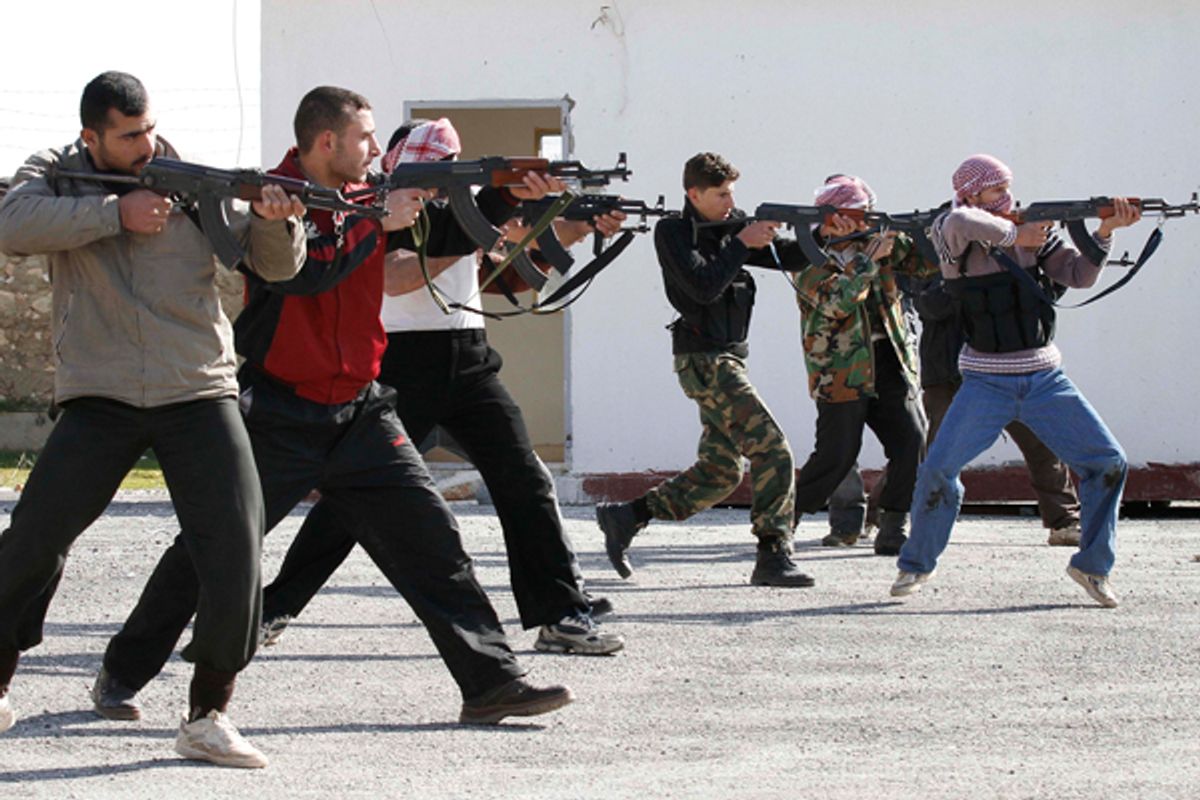
Syria looks like Libya all over again. A brutal dictator uses his military to repress his country’s protests. A civil war erupts. And, oh yes, a split opens among American liberals over what to do about it.
With a few notable exceptions, the conservative movement has been of one mind on foreign policy issues since 9/11. All right-wingers supported the Afghanistan war, and virtually all supported Iraq, as well. Every conservative believes President Obama has been a craven appeaser of America’s enemies, and now all believe that pressure should increase against Iran, even if that means another war in the Middle East.
Liberals have shown no such unanimity. They were divided not only on Iraq but also on President Bush’s 2006 surge, Obama’s Afghanistan escalation, and the intervention in Libya. Views fall roughly along two lines. Dominating the party since Bill Clinton’s ascension are liberal hawks who believe it is in America’s interest to use military power abroad to promote human rights and expand democracy. More popular among the rank-and-file of the Democratic Party are attitudes skeptical of the use of force in major wars. (The only exception to this split is over the use of drones, which nearly all Democrats support).
Though Barack Obama opposed the Iraq War when he was a state legislator, as president he is closer to the liberal hawks camp. The best account we have of the decision-making on Libya, from Michael Hastings in Rolling Stone, has the president explicitly declaring that America needs to have an expanded conception of its role in the world. Just looking after its own affairs, attending to its national interests, is “not how America leads,” Obama said. The rationale Obama employed in a speech delivered at the National Defense University in March of 2011 was the closest he has come to defining an Obama doctrine.
On the surface, the criteria that Obama outlined in his Libya speech are present in Syria: impending and ongoing massacres; a multilateral coalition led by America’s traditional allies; and an opportunity to side with the people in a crucial state in the Arab spring. For this reason, many liberal writers have called on the U.S. to intervene. Paul Berman has signed onto a conservative-led letter to the president asking him to intervene in Syria. The New Republic has an entire symposium with intellectuals (mostly) asking Obama to side militarily with the Syrian resistance. “Lead again from behind!” Leon Wieseltier exhorts. Especially powerful is a heartfelt plea for American help from a Syrian activist in Washington:
If the United States does successfully build a partnership with Syria’s democratic opposition right now, at its time of greatest need, it will have earned a steadfast regional ally for the long-term. Indeed, Syria’s political future, and its future alliances, are currently up for grabs. In that way, there are important strategic, as well as humanitarian, issues at stake.
Pressure is building in Congress. Republican Sens. John McCain and Lindsey Graham, who both serve on the Armed Services Committee, have argued for arming the Syrian rebels. Obama’s former State Department policy planning head Anne-Marie Slaughter was among the first to call for intervention. In late January, Director of National Intelligence James Clapper said it's only "a question of time" before President Bashar al Assad falls. In December, the State Department pointman said Syria's leader was a "dead man walking." More recently, White House press secretary said on Tuesday that "additional measures" such as rebel-arming may need to be taken if the international community keeps dithering.
There are two significant reasons the administration has not pushed for military intervention, however. First, the international consensus that existed on Libya is not present in Syria. Russia and China vetoed a Western- and Arab-sponsored U.N. Security Council resolution condemning the Syrian government. Imagining that they would agree to a military intervention is simply fanciful.
What hasn’t been much discussed is why China and Russia vetoed the resolution. And here we circle back to Libya. The resolution authorizing military action in Libya was limited to protecting civilians in Benghazi and other areas. NATO and its allies quickly went beyond the scope of this mandate, using airpower to assist the rebels in defeating Col. Gadhafi and his forces. Such actions may have been morally justified, but they didn’t go unnoticed by the Chinese and Russians, who are extremely sensitive to infringements on state sovereignty (lest they be targeted one day). Tellingly, foes of the proposed Syria resolution explained their decision in terms of national sovereignty. Russia’s foreign minister said that “the Security Council by definition does not engage in domestic affairs of member states." Russia’s U.N. envoy faulted the resolution for aiming at “regime change,” even though the wording of the text notably did not call for it and the Arab states explicitly rejected Western military intervention.
The second reason Libya isn’t acting as a template for Syria is one of logistics. As Middle East expert Marc Lynch has explained, “Military intervention in Syria has little prospect of success, a high risk of disastrous failure, and a near-certainty of escalation which should make the experience of Iraq weigh extremely heavily on anyone contemplating such an intervention.” The Syrian opposition, impressive and courageous as they have been, is divided, weak and controls no territory. Air power of the sort the West can provide would not be effective in preventing civilian deaths, and the fighting is taking place in densely populated cities. For these reasons and more, a Libya-style no-fly zone simply won’t fly.
Eventually, the Syrian government’s efforts to suppress the rebellion may be so bloody that the Obama administration feels compelled to intervene. But so far, the conditions that were present in Libya are not present in Syria. It may be a double standard, and one that liberal hawks are not comfortable with, but it is one with good reason.
Shares