
WhoWhatWhy

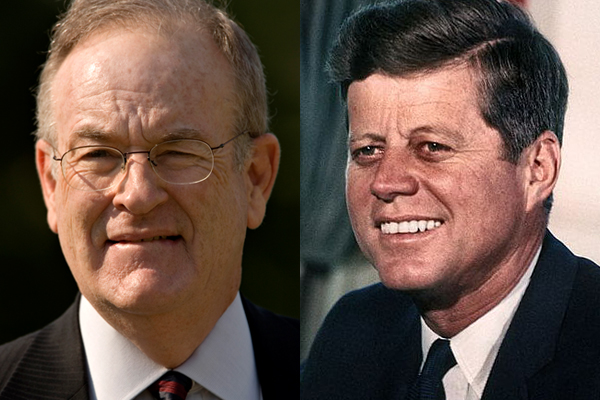
How will today’s O’Reilly explain JFK’s murder?

Before he made it big, Bill uncovered possible ties between Oswald and the CIA. His book likely won't be so daring VIDEO

(Credit: AP/Wikipedia)
This article originally appeared on WhoWhatWhy.

WhoWhatWhyYou may have heard that the Fox News celebrity host Bill O’Reilly has a forthcoming book on JFK, timed for release this fall. How could you have not heard? Scheduled in anticipation of the 50th anniversary of Kennedy’s death in 2013, the book has been heavily covered by the media—examples here, here and here–despite a near total lack of information as to the content. Here’s an excerpt from USA Today which is typical:

“As with most baby boomers, the murder of JFK was a signature moment in my life,” O’Reilly, the top-rated Fox News talk show host and a former high school history teacher, said in a statement. “’Killing Kennedy’ will answer many questions about the president and why his life was cut short.”

What sort of answer will O’Reilly provide to the fundamental and extremely controversial question about why Kennedy died? Will he perpetuate the mainstream media’s near-constant advocacy of the lone-nut scenario? O’Reilly did not even hint at how he would handle it or whether he has any new information.

Yet another book by O’Reilly, his recent “Killing Lincoln,” was, as some reviewers noted, more like a John Grisham rendition of the tragedy than the work of an investigative journalist or scholar intent on major breakthroughs—or even deeper understanding.

OBLIVION

Let’s compare the nature of O’Reilly’s current bestseller fare, and the media’s receptivity to it, with journalism done some years back, again on the JFK assassination—by the very same Bill O’Reilly. The earlier work had some major, groundbreaking revelations—and legitimate, very hot content, based on reporting conducted in the early 1990s. It will come as a surprise, because most of us never heard about the show’s revelations—not at the time, and not since. There’s a reason: the highly disturbing, even threatening evidence of a mostly unexplored link between Oswald and U.S. government agents.

Watch Bill O’Reilly below, back when he hosted the syndicated television show Inside Edition:

Key excerpts:

“O’REILLY: Living in Dallas, Oswald was befriended by Russian-born George de Mohrenschildt. Investigators determined he was a contract agent for the CIA in Central America and the Caribbean. In 1977, moments before he was to be interviewed by House investigators, de Mohrenschildt blew his brains out with a 20-gauge shotgun. House investigators believe he was a crucial link between the CIA and Lee Harvey Oswald.

There is no question that the sealed JFK Files are extremely embarrassing for the CIA. House investigators have told Inside Edition that the Agency did not fully cooperate in their investigation and that the CIA had final say in the final report that the House Assassinations Committee made public. Thus the public report makes no mention of the CIA’s links with Lee Harvey Oswald. But the secret documents are another story.

…House investigators uncovered evidence that the CIA planted nine agents inside the Garrison investigation to feed him false information and to report back to Langley what Garrison was finding out.

That was explosive content, and O’Reilly was prepared for major press interest in this scoop. That’s not, however, the way things played out. Jerry Policoff, who interviewed O’Reilly back in those days for an article in the alternative newsweekly The Village Voice remembers:

“He thought the piece was so important that he held a press conference to promote it. Of course no mainstream media showed up. He expressed his astonishment to USA Today, and I interviewed him as a follow-up. He repeated to me that he could not understand how the media could not even show up at a press conference on such an important issue.

Ok – so that was Bill O’Reilly back then, in the 1990s, before he became a breakout star. Will O’Reilly’s new Kennedy book really tell us why he died?

Not likely, if we consider what it took for O’Reilly to make it big-time.

One pundit, who used to appear on Fox a lot in O’Reilly’s first years there. recalls a producer mentioning that O’Reilly wanted to continue doing JFK assassination reports, but that network chief Roger Ailes and other top management “kept stepping on the story.”

Years later, O’Reilly is on a roll that is likely to continue—provided he plays his cards right.

The lesson is this: Listen to the higher-ups, don’t step on the wrong toes, and you, too, can make it to the top.

We look forward to seeing if today’s O’Reilly takes inspiration from his younger, feistier self in probing beneath the official story of the Kennedy assassination. But we’re not holding our breath.

Russ Baker, an award-winning investigative journalist, is founder and editor-in-chief of WhoWhatWhy.com.

Politicians’ beliefs deserve scrutiny

Mocking Mormons' special undies is silly, but we should question how a candidate's faith affects decision-making

(Credit: AP)
This article originally appeared on WhoWhatWhy.

The GOP candidates’ struggle to outdo each other in appealing to Christian fundamentalists continues. Rick Santorum, the current favorite of this constituency, topped his previous plays with his remark that John F. Kennedy’s famed 1960 speech on the importance of a separation between religion and government “makes me throw up.”

WhoWhatWhyThe separation of church and state is not some abstract notion, nor is it a means of oppressing people. It very reasonably keeps people from imposing their religious beliefs on other people. These are not beliefs that can be objectively measured or empirically tested — like, say, the hypothesis that public spending can affect employment levels. Religious beliefs may be comforting or helpful to some people, but no matter how deeply felt, they can have no place in a rational, shared system of managing outcomes for all Americans.

Yet because of the current political climate in this country, we’re not supposed to talk about any of that. The other day, the New York Times op-ed columnist Charles Blow got in a little trouble. He tweeted an admittedly rude and rather inappropriate remark about an eccentric element of Mitt Romney’s faith — the belief that wearing special underwear literally protects the person from harm.

Blow was hit with a barrage of criticism, and quickly apologized — which makes sense given the contextual irrelevancy and vulgarity of the comment. As a proud single parent, he was responding to a remark of Romney’s implying that single-parenting is per se bad for kids, and he should have stuck to that point in his rejoinder.

But that doesn’t mean that Romney’s avowed Mormon faith is incidental to his view on single-parenting or that a candidate’s religion is always out of bounds in political discourse. There are a number of valid questions that can be asked about practices of the Mormon Church, and their potential impact on policy decisions of a political leader of that persuasion.

One question would be about the effect of Mormon missionary work around the world, at a time when people of other faiths may strongly resent the presence of people trying to convert their children to a faith so clearly identified with American interests.

Another would concern the repeated, pernicious practice of posthumously baptizing Holocaust victims—obviously without their permission and presumably against what would be their wishes. Stephen Colbert made this point when he tweeted: If Mormons Posthumously Baptize Holocaust Victims, I’ll Posthumously Circumcise Mormons

There’s no reason we can’t talk about these things. And plenty of good reasons we should talk about them.

Making fun of religious beliefs is intellectually pointless since such beliefs by definition are beyond rational argument. (“Faith” is what you proclaim when you have no objective evidence for a particular belief.) Yet there’s an inherent double standard in the way we chuckle about Scientologists and “Xenu” or various cults that bubble up before quickly disappearing, when one could argue that, empirically, all beliefs about miracles, supernatural interventions in the natural course of events, etc. are delusions designed to comfort us in times of trouble—or distract us from the recognition that if we act in concert we can make life better by and for ourselves.

At the same time, questioning religious belief systems in terms of how they affect other people is certainly legitimate — a lot more legitimate than the subtly racist rhetoric aimed at Barack Obama. Clearly, we don’t choose what race we are born into, or what nationality, or even what religion. However, we certainly do decide, as adults, the values and beliefs we live by — whether or not they match what we were taught as children.

The fact is, we shouldn’t ridicule or question people for attributes or circumstances that are beyond their control, and that certainly includes their ethnicity. For example, an ESPN writer was rightly fired recently for the mobile headline “Chink in the Armor,” about the Chinese-American basketball player Jeremy Lin.

But when someone consciously embraces a particular religion and set of tenets, then asks to be selected to run this country, those beliefs could be seen as relevant—for praise or criticism, or even humor. That’s part of a vigorous discussion, and central to freedom of speech. Also, those who seek public office in a country where declared religious beliefs are at or near the center of the discussion of values can, and should, expect scrutiny and even criticism of those beliefs.

***

Now, Stephen Colbert is a humorist, so he has special license, but, really, isn’t the practice of posthumously baptizing those who would not have wished to be baptized something that can be discussed? And, given that Romney allots a substantial portion of his income to the Church of Latter Day Saints, why is it not okay to examine this practice and wonder what it says about prospective President Romney? If a leading candidate was a Muslim of any stripe, or, say, a Hasidic Jew, we would expect close scrutiny of what those beliefs entailed and what they might say about the values and likely actions of a future president (concerning, for example, the reproductive rights of women). Because if one’s religious beliefs have nothing to do with practical matters—well, why have them? And why tell others about them? And why reference them, explicitly or implicitly, when one seeks votes?

And what of the practice of other public figures — athletes, entertainers, etc. — choosing to openly draw attention to their beliefs? These figures inject their faith into the public arena as part of their brand. Does that make them fair game for criticism of those very beliefs? If so, should only those who explicitly draw attention to their beliefs face scrutiny? What about people who proclaim belief in religions that explicitly discriminate against other citizens – as official policy of the Church of Latter Day Saints did against blacks until 1978 and as the Catholic Church and other religious institutions do today against gay people? If a person’s faith has consequences that impact other people, why should that faith be out of bounds for public discussion?

Some of the online criticism of Charles Blow, an African-American, came from those who couched their protests in an overtly racist manner. Why do those critics think that skepticism toward religious beliefs is somehow worse than racism—or than the kinds of comments routinely directed at those from other backgrounds and countries that don’t fit into an America-centric, Christian-centric world view? What about the ways in which at least some of the Republican candidates implicitly but very obviously take swipes at those who are different through constant references to “American values” and “Christian values”?

Is the idea of special non-armored undergarments providing protection more or less credible than believing that one goes to heaven and is provided with sensual pleasures, including 72 virgins? Or the attitude toward the deity that prescribes the yarmulkes and tzitzit worn by religious Jews? Or ostentatiously displayed crosses, or anything else of this nature? Can someone’s belief in anthropogenic Climate Change more legitimately be attacked or ridiculed than faith in a God—who believers insist— would never let environmental harm come to his chosen flock (unless and until he deemed such punishment appropriate)?

In fact, isn’t the battle over religious beliefs and the secular practices they influence a central part of our political debate today? Isn’t evidence of anti-scientific, superstitious views a legitimate consideration when we choose whom we want to administer scientific funds, set broad educational policy, or consider whether to go to war with people who have different cultures, values and ideas?

If so, how can we not talk openly — even critically — about religious beliefs in choosing our leaders?

Continue Reading Close

Russ Baker, an award-winning investigative journalist, is founder and editor-in-chief of WhoWhatWhy.com.

The Libyan fairy tale

Behind the the myth of humanitarian intervention, a multinational land grab

Mashud Marjub Orabi, retired oil company worker, stands next to the grave of his son and other rebel fighters, who he says were killed in Tripoli fighting against Moammar Gadhafi's troops, at a cemetery on the first day of Eid al-Fitr in Tripoli, Libya, Wednesday, Aug. 31, 2011. Muslims are celebrating the festival of Eid al-Fitr which marks the end of the holy fasting month of Ramadan. (AP Photo/Alexandre Meneghini)(Credit: Alexandre Meneghini)

It’s true that Moammar Gadhafi, like many — perhaps a majority of — rulers in his region, was a thug and a brute, if at times a comical figure. One doesn’t need to be an apologist for him — nor deny the satisfaction of seeing the citizenry joyously celebrating his ouster — to demand some honesty about the motives behind his removal. Especially when it comes to our own government’s role in funding it, and thus every American’s unwitting participation.

A look at the events leading up to the “uprising” — and a consideration of the historical background–suggests that the war was never about the stated humanitarian objectives. Rather, humanitarian appeals were used to mask less acceptable purposes — a range of geopolitical motives shared by the leading NATO countries, that, as is so often the case with military action, is concerned principally with oil supplies and other strategic concerns.

A raw land grab is not politically correct in today’s world, and so the American and European publics were presented with something far more palatable: a desire to do the right thing. This hoary story line worked with a complacent media, but it doesn’t hold up well to scrutiny. Let’s start with the official justification for NATO’s launch of its bombing campaign — for without that campaign, it’s highly improbable the rebels could ever have toppled Gadhafi. We were told from the beginning that the major purpose of what was to be limited bombing — indeed, its sole purpose — was to protect those Libyan civilians rebelling against an oppressive regime from massive retaliation by Gadhafi. Perhaps because of NATO’s initial intervention, the feared genocidal bloodletting never did occur. However, protecting civilians apparently didn’t generate sufficient public support for intervention, so we started to hear about other purported reasons for it. Gadhafi was encouraging his soldiers to commit mass rape! And giving them Viagra! And condoms!

You can’t make this sort of thing up. And yet that’s just what the NATO crew did — made it up. The media, always glad to have a “sexy” story, especially a sick sexy story, even a sick sexy story with no evidence to back it up, covered this ad nauseam, but never bothered to find out if it was true.

We’ve been expressing doubts about these claims (see this and this and this.) But it’s tough to counterpoise hot-button issues with rationality. If you questioned the mass rape story, you were a “rape-enabler.” If you pointed out that Gadhafi was being bombed for anything other than humanitarian reasons, you were a “Gadhafi-lover.”

The media was so gullible that the professional disinformation guys went onto auto-pilot, recycling tired old tropes that nobody ought to be buying anymore. For example, most news outlets reported recently that Libya had fired a SCUD missile at the rebels.

“That it didn’t hit anything or kill anyone is not the point. It’s a weapon of mass destruction that Col. Gadhafi is willing to train on his own people,” said one Western official.

If the effort to rally public opinion against Gadhafi centered on any one factor, it was fury over Libya’s purported role in the 1988 bombing of Pan Am flight 103 over Lockerbie, Scotland. As we noted in a previous article, in the years since the conviction of a Libyan intelligence officer in the tragedy, a chorus of doubts has grown steadily. The doubt is based on new forensic evidence and research, plus subsequent claims by prosecution witnesses that their testimony was the result of threats, bribes, or other forms of coercion. It is an ugly and disturbing story, not well known to the larger news audience.

Lockerbie

Yet Lockerbie has continued to touch nerves. In February, when Gadhafi’s Justice Minister turned against him and became a rebel leader, he brought with him dynamite. Mustafa Mohamed Abud Al Jeleil made the dramatic claim that his ex-boss was the culprit behind the bombing of Pan Am 103. He asserted that he had proof of Gadhafi giving the direct order for the crime. This got considerable media attention, though almost no news organizations followed up or reported that Jeleil never did supply that proof. The Libyan convicted of the crime has consistently denied any involvement. Nonetheless, his conviction in the case has had Gadhafi on the defensive for years — and working hard to prove to the West that he can be a “good citizen.” Part of this has entailed his paying out huge sums in reparations.

***

From the beginning of the Libya saga in February until now, the NATO coalition has never wavered from its initial declaration of humanitarian motives. And, to be sure, we may still learn of horrible, previously-unknown atrocities by Gadhafi. Still, the United States and its allies have little history of using their might strictly to protect civilians. If so, millions of South Sudanese, Rwandans and others might not be in their graves.

Besides, with all the talk about Gadhafi harming his citizens, what about the effect of more than 7000 — yes, seven thousand — NATO bombing runs? We heard constant reports about how Gadhafi was facing charges of “war crimes,” with never a word about NATO. To learn the impact of this massive unleashing, you had to be visiting little-known sources such as the Canadian website, Global Research, which often probes beyond official Western accounts of global interventions.

NATO bombing

Some Western military officials couldn’t even be bothered to participate in the “humanitarianism” charade. For example, the top British general explicitly stated that the objective was really to remove Gadhafi. Nobody — including the media — paid much attention to this admission, perhaps because it was already assumed to be the case.

Gadhafi should never be seen as a victim — indeed, he has always been sleazy and monstrous in various ways. But the US and its allies appear to have cared little about this, while being deeply troubled by his role as a fly in the geopolitical ointment. A look at the long and complex historical relationship between Gadhafi and the West begins to explain the true reason he had to go. It also dovetails perfectly with a growing body of indications that Western elites encouraged and even provoked the uprising — while tapping into deep discontent with the dictator.

Continue Reading Close

Russ Baker, an award-winning investigative journalist, is founder and editor-in-chief of WhoWhatWhy.com.

www.salon.com/topic/whowhatwhy/