Barack Obama

Obama’s most dangerous foe: High gas prices

The president's energy speech calls for a review of his record. He gets a B+ overall, but an F on climate change

  • more
    • All Share Services

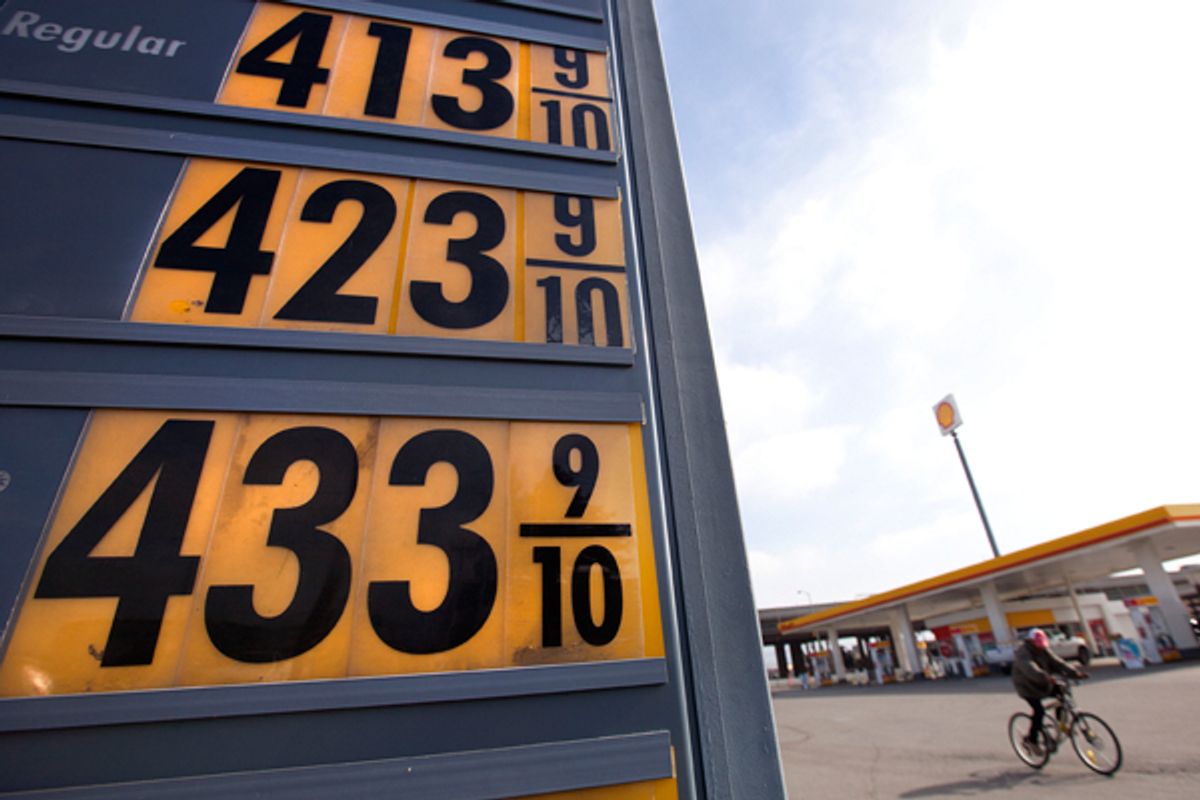
Obama's most dangerous foe: High gas prices (Credit: AP/Ben Margot)

Looking for the biggest threat to Obama’s reelection? Hint: It’s probably not Mitt Romney, Rick Santorum, Newt Gingrich or Ron Paul. The president’s most lethal opponent lurks wherever you choose to fill up your gas tank: high gas prices.

This week, the average price of a gallon of gas in the United States hit $3.57. That’s the highest prices have ever been in February, a fact that is all the more sobering when one considers that prices usually rise in the summer, so more pain is likely on the way. And while it has been reasonably well-established that high gas prices, in and of themselves, don’t necessarily sound the death knell for an incumbent, there is definitely a link between the cost of energy and the health of the economy. And since the health of the economy this summer will probably be the single most important factor determining who wins the White House, the equation becomes pretty simple. If high gas prices derail the current economic recovery, Obama becomes more vulnerable.

The hard political and economic truth of spiking energy prices explains why President Obama gave a speech in Miami on Thursday recapitulating his energy plan and why Newt Gingrich just recorded a 30-minute advertisement laying out his own energy strategy. As long as prices keep rising, Republicans will blame Obama for the pain, and they will blithely promise, should they be elected, to magically lower gas prices right back down.

But as the president himself declared in Miami, “It’s the easiest thing in the world to make election-year promises to lower gas prices.” The reality is that it is completely unrealistic to believe that any president has the capacity to meaningfully affect the price of gas in the short term.

“Anybody who tells you that we can drill our way out of this problem doesn’t know what they are talking about or isn’t telling the truth,” said Obama, and he’s absolutely right. Gas prices track the cost of oil, and the price of oil is determined by worldwide trends in supply and demand, geopolitical tensions, oil futures speculation, and the overall health of the global economy. For example, the current spike in prices is largely attributed to traders speculating that international pressure on Iran will devolve into a military debacle that closes the Straits of Hormuz and cuts off a significant portion of the world’s oil.

But more generally, the emergence of oil-hungry developing nations is the real long-term driver of higher gas prices. How fast the Chinese economy is growing is far more important to the price of oil than anything the White House can do.

In his speech, Obama hinted at a long-term plan to bring gas prices down, but even that goal is just as illusory as the quick-fix solutions proposed by his Republican opponents. As Chinese and Indians and Brazilians buy more cars and the cost of exploiting new sources of oil continues to rise, gas prices will generally trend up.

In light of that brute reality, perhaps the best way to judge Obama’s energy record is in the context of how well he has prepared the United States for that future.

His record here is mixed, a consequence of the tricky intersection of energy and environmental policy. For example, Obama loves to tout the fact that oil production in the United States has risen each year of his administration and now sits at an eight-year high. He stressed that point once again during his Miami speech (although interestingly, he received zero applause from the audience when he announced how aggressively his administration was opening up new offshore and onshore acreage for exploration and development, and how many new pipelines — “even one from Canada!” — he boasted — his administration has approved).

But rising levels of production now are really the consequence of decisions made long before Obama took office. And arguably, some of Obama’s current proposals and actions will work in the opposite direction. Environmentalists applaud Obama’s decisions to nix (at least temporarily) the Keystone XL pipeline and his proposal to eliminate tax subsidies to oil companies. In Miami, Obama got a big cheer from the crowd when he raged against the oil subsidy machine, but there’s no getting around the fact that those subsidies make it more profitable and attractive for international oil companies to drill in American waters. They are part of the explanation for why production has grown every year in Obama’s term, and eliminating them — in conjunction with another Obama proposal to raise royalty rates charged on oil company production — will make a difference in domestic production.

From an environmental perspective, discouraging Big Oil from exploiting U.S. resources is a great thing, but in the context of Obama’s “all-of-the-above” approach to developing every possible form of energy, they speak to a bit of a contradiction. Obama wants to have it all — to placate his environmentalist base while boasting of ever-higher domestic oil production. Even for a politician as skilled as he is, that’s a tough balancing act.

On the unambiguously plus side of the ledger, Obama is responsible for several strategic initiatives that have important positive implications for car-addicted Americans. The stimulus included $2.5 billion that was funneled to around 30 companies working on advanced battery technologies, an example of targeted industrial policy that has helped revive the Michigan economy and could potentially position the United States to be a major player in a hybrid/electric car-dominated future. The White house has also raised fuel economy standards, not once, but twice — a move that will surely force automakers to manufacture increasingly fuel-efficient cars.

Such efforts won’t solve the energy crisis, but they will help make energy costs a relatively smaller part of the American household budget, and thus insulate us from the pain of the next oil shock. In fact, that’s already happening. American gasoline consumption has steadily dropped throughout Obama’s term, because we’re driving fewer miles in more fuel-efficient cars. If, as Obama promised, the average American car will get 55 miles per gallon by the middle of the next decade, that could prove to be one of the president’s most important lasting legacies.

However, on the single most important component of any long-term energy policy strategy — a comprehensive carbon tax or cap-and-trade system that would force investment away from fossil fuel exploitation and into renewable energy — Obama’s record is abysmal. One can argue that legislation aimed at restricting greenhouse gas emissions never would have had any chance at passing Congress, but that doesn’t change the fact that Obama dedicated zero political capital to the challenge. Quite the opposite: The longer Obama has been in office, the less he has mentioned climate change. In his speech at Miami, I didn’t hear him say the words once. Imagine that: a speech on energy policy that did not touch on the most important energy issue on the planet.

Obama launched some vigorous attacks at his Republican opponents in his speech, but his own record of simultaneously touting enhanced oil production while promising to cut subsidies to oil companies, promising long-term relief on gas prices while ignoring the long-term challenge of climate change, mocking the “drill, drill, drill” “bumper sticker” of the GOP while touting a we-can-have-it-all “all-of-the-above” energy exploitation smorgasbord, exposes his own energy stance as fundamentally political. His speech was nowhere near as gratuitously hypocritical as the blatant falsehoods spewed by his opponents, but he still proved himself unwilling to grapple with the real menace: High gas prices are not the problem. Higher temperatures are.

Andrew Leonard

Andrew Leonard is a staff writer at Salon. On Twitter, @koxinga21.

Obama campaign raps Romney on Trump rhetoric

McCain has yet to speak out against "Birthers"

  • more
    • All Share Services

Obama campaign raps Romney on Trump rhetoricRepublican presidential candidate, former Massachusetts Gov. Mitt Romney, looks out the campaign charter airplane window during the flight between San Diego and Hayden, Co., Monday, May 28, 2012. (AP Photo/Mary Altaffer)(Credit: AP)

WASHINGTON (AP) — President Barack Obama’s re-election campaign is releasing a television advertisement accusing Mitt Romney of failing to stand up to “the voices of extremism” in his party.

The ad was released Tuesday as Romney was poised to clinch the Republican presidential nomination in the Texas primary. It takes the former Massachusetts governor to task for failing to speak out against real estate mogul Donald Trump, a supporter who has consistently charged that Obama is not a U.S. citizen.

The commercial opens by showing 2008 nominee John McCain brushing aside a woman who raised the citizenship issue at a town hall-style meeting, and asks, “Why won’t Mitt Romney do the same?”

A Romney aide is shown telling a TV interviewer that “a candidate can’t be responsible for everything a supporter has said.”

Guess who’s coming to dinner?

George and Laura Bush dine with the Obamas

  • more
    • All Share Services

Judy Gold

Emmy Award-winning actress and comedian Judy Gold is best known as the star of her two critically acclaimed off-Broadway shows, "The Judy Show - My Life As A Sitcom," and "25 Questions For A Jewish Mother." Judy has had her own comedy specials on HBO, Comedy Central and Logo. She appears regularly on Tru TV's World"s Dumbest. Check out www.JudyGold.com and follow her on Twitter at @JewdyGold.

Presidential race is most costly ever

The election is poised to dwarf the cost of 2008, when Super PACs didn't pump millions of dollars into the race

  • more
    • All Share Services

Presidential race is most costly everPresident Barack Obama, left, tours TPI Composites, a manufacturer of wind turbines blades, with plant manager Mark Parriott, Thursday, May 24, 2012 in Newton, Iowa. In Obama’s second visit as president to Newton, a city of about 15,000 east of Des Moines, he argued for Congress to renew wind energy tax credits.(AP Photo/Pablo Martinez Monsivais)(Credit: AP)

The battle between President Barack Obama and Republican Mitt Romney will be the most expensive presidential contest ever — by a long shot.

There are two main reasons. It’s the first time both major-party candidates are declining post-Watergate federal campaign financing — and the spending limits attached. And the proliferation of super PACS is pumping untold millions into the fray on both sides, mostly for advertising.

So fashion your seat belts and prepare for a howling tempest of broadcast ads, especially if you live in a battleground state.

Obama and Romney were both coming off a week of intensive national fundraising.

Without Democratic primary opposition, Obama had a huge early advantage.

But Romney, likely to surpass the 1,144 delegates needed for the GOP nomination next Tuesday with a primary win in Texas, is starting to catch up as major conservative donors begin opening their wallets.

Through April, Obama and Democratic groups supporting him have raised nearly $450 million and have more than $150 million in the bank. Romney and Republicans backing him have collected more than $400 million during the same stretch and have about $80 million at their disposal.

Both candidates are shooting for raising around $800 million, which would put their combined campaign spending at roughly $1.6 billion. Add another few hundred million from super PACs and convention spending.

Obama opted out of public financing in 2008 and raised $750 million. His spending swamped GOP rival Sen. John McCain, limited to spend the $84 million he received from taxpayers. Super PACs didn’t exist then.

We know what happened in that race. Romney didn’t want to see it happen to him.

Neither candidate had public appearances Friday. Romney was taking a long weekend California hiatus from campaigning, while Obama planned several ceremonial events on Memorial Day.


Continue Reading Close

When leaders actually lead

Some Obama backers insisted the president could do nothing on his own to advance gay marriage. Boy, were they wrong

  • more
    • All Share Services

When leaders actually leadU.S. President Barack Obama speaks at a campaign fund raising event in Denver, Colorado May 23, 2012. (Credit: Reuters/Kevin Lamarque)

I count myself as a supporter of President Obama who reserves the right to criticize him when I disagree. And I disagreed with his reluctance to come out in support of gay marriage for a long time. I’m also on record wishing he’d taken a stronger public stance behind several big progressive priorities — a larger stimulus, tougher Wall Street reform, a public option for health insurance, a big jobs bill – whether or not he had the congressional support to make it happen.

Throughout the president’s first term, his most ardent supporters have reacted to those of us pushing him to do – and say – more on such issues with frustration and anger, some of it nasty and personal, some of it thoughtful and well-argued. They rightly blame Congress for blocking action on key progressive priorities, but strangely downplay the power of presidential leadership. Late last year, New York magazine’s Jonathan Chait twice attacked liberal Obama critics for being “unreasonable” about what the president alone could accomplish, because “liberals, on the whole, are incapable of feeling satisfied with a Democratic president.”

Chait took particular aim at lefty image guru Drew Westen, a one-time Obama admirer who criticized the president in the New York Times not merely for what he hadn’t accomplished, but for failing to tell a compelling story. Chait accused Westen and other progressives of embracing:

…a model of American politics in which the president in not only the most important figure, but his most powerful weapon is rhetoric. The argument appears calculated to infuriate anybody with a passing familiarity with the basics of political science. In Westen’s telling, every known impediment to legislative progress — special interest lobbying, the filibuster, macroeconomic conditions, not to mention certain settled beliefs of public opinion — are but tiny stick huts trembling in the face of the atomic bomb of the presidential speech. The impediment to an era of total an uncompromising liberal success is Obama’s failure to properly deploy this awesome weapon.

Chait caricatured Westen’s argument (and the beliefs of those who agreed with it), but he got lots of love for both pieces in the pro-Obama blogosphere, where folks finally felt they had a real diagnosis for the illness of those they dismissed as “emoprogs.” But now that we see the changes wrought by Obama’s politically risky embrace of gay marriage, maybe it will be easier for folks to understand that it’s the job of political advocates not merely to praise, but to push their leaders forward.

Steve Kornacki runs down the astonishing political changes we’ve seen in the mere two weeks since the president carefully announced his supposed change of heart on gay marriage. The nation’s largest African-American organization, the NAACP, has come out behind it – and maybe most important, recognized it as an important civil rights issue. Maybe most dramatic, in Maryland, African-American voters have now flipped to support the state’s gay marriage ballot measure 55 to 36 percent –almost the exact percentage by which they opposed it in previous polling on the state issue. And in the latest ABC News/Washington Post poll, African-Americans’ support for gay marriage jumped to 59 percent from 41 percent in the wake of the president’s historic announcement.

Now, I’m not going to argue that Obama’s turnaround alone caused this sea change. The arc of the moral universe has been bending toward justice on gay rights for a long time, and as I wrote last week, the president gave it an additional tug. There have been advocates within the NAACP working to make this happen for a long time, and they deserve a lot of credit. African-American voter opinion had already been trending in this direction, even if black voters had been less receptive to gay marriage than other demographic groups. There is also an emotional and personal component to the president’s stance that makes his moral suasion hard to replicate on behalf of, say, the jobs bill or the public option. (And let’s also remember it’s white voters who are most hostile on some of those economic issues, thanks to the divide and conquer politics of the GOP over the last 40 years.)

Still, it’s hard not to conclude that Obama’s words made a significant difference in the political course of this debate. Ironically, it was once critics of Obama who mocked the power of words, and specifically the candidate’s own oratorical gifts. Obama shot back at them many times.

“Don’t tell me words don’t matter,” he told Wisconsin Democrats in February 2008. “‘I have a dream’ — just words. ‘We hold these truths to be self-evident, that all men are created equal’ — just words. ‘We have nothing to fear but fear itself’ – just words. Just speeches.” At many times over the last three years, I’ve been amazed at how Obama’s critics and supporters seemed to change sides on the question of the power of his words.

I give the folks who call themselves “prag progs” – pragmatic progressives, as opposed to “unreasonable” emoprogs – a lot of credit for fixing attention on what the president has accomplished, and reminding others not merely to fixate on what he hasn’t. But I think it’s time that all of us acknowledge that there’s a role for constructive pressure, too. Progressive change has always required impatient agitators – and it will continue to.

Continue Reading Close
Joan Walsh

Joan Walsh is Salon's editor at large.

Obama courts LGBT vote

The president has launched a new website and video touting his "evolution" on gay marriage

  • more
    • All Share Services

After a long “evolution” on marriage equality, the Obama campaign is moving to take full ownership over LGBT rights as a political issue today, rolling out a new website and video narrated by Glee’s Jane Lynch.

Lynch, who married her partner in 2010 after New York legalized same-sex marriage, praises Obama in the video, calling him “a leader who not only acknowledged the LGBT community, but who embraced us.” Lynch ticks off a series of Obama’s accomplishments, saying the president has made “more significant advances on LGBT issues than other president that came before him.”

But on a conference call this morning, campaign officials said the website, called “Obama Pride,” is as much about touting the president’s advances on LGBT rights as it is a means to organize and engage with the LGBT community. “We will run robust LGBT Vote programming to turn out LGBT voters this November,” said National LGBT vote director Jamie Citron.

The five-minute video also features new interview-style footage of Obama, who explains how his view on marriage has changed over time and notes that “we’ve seen a profound cultural shift just over the past decade,”

Indeed, the roll out — timed to coincide with Harvey Milk Day — comes as a new Washington Post/ABC News poll finds opposition to gay marriage at all time low in the wake of Obama’s announcement.

That puts Obama on the right side of history, the campaign said. “[Mitt] Romney’s position on same-sex marriage is also historic but not in the way it should be,” said Obama co-chair Joe Solmonese, the outgoing president of the LGBT advocacy group Human Rights Coalition, who noted that Romney has pledged to push for an anti-marriage equality amendment.

While the marriage reversal carries major political risks, the aggressive PR effort from the deliberate Obama campaign suggests they feel confident that Obama’s stance on gay rights will be a net gain, politically. Already, fundraising is reportedly up as both disillusioned gay Democrats and even some gay Republicans are coming back into the fold. Indeed, the founder of the Log Cabin Republicans, Rich Tafel, told NPR last weekend that he’s considering defecting to Obama in light of the announcement. If the campaign and Jane Lynch have their way, he won’t be the last.

Continue Reading Close

Alex Seitz-Wald is Salon's political reporter. Email him at aseitz-wald@salon.com, and follow him on Twitter @aseitzwald.

Page 1 of 586 in Barack Obama