
Pentagon
The Pentagon’s amnesia-inducing propaganda
The military's first feature-length film wants to make Americans forget about our imperialist misadventures
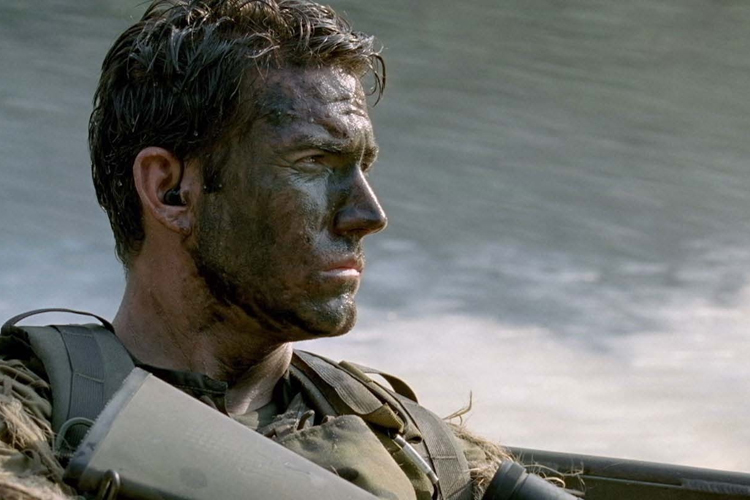
A still from "Act of Valor" When philosopher George Santayana said “those who cannot remember the past are condemned to repeat it,” he meant it as an admonition — not as an endorsement of mass amnesia or historical revision. This should be obvious. Yet those operating at the shadowy intersection of the Pentagon and Hollywood either don’t understand – or more likely, refuse to understand — the thrust of the aphorism. Instead, with this week’s release of a much-awaited film, Santayana’s omen has been transformed into a public mission statement for a burgeoning Military-Entertainment Complex.
Since 1986′s “Top Gun” rekindled the Pentagon-Hollywood relationship from its post-Vietnam doldrums, the collusion between the military and the entertainment industry has become a blockbuster con, generating huge benefits for both participants — and swindling the American public in the process.
The scheme is simple: The Pentagon allows studios to use military hardware and bases at a discounted, taxpayer-subsidized rate. In exchange, filmmakers must submit their scripts to the Pentagon for line edits. Not surprisingly, those edits often redact criticism of military policy, revise depictions of historical failures, and generally omit anything else that might make audiences wonder if our current defense policy is repeating past mistakes.
If a studio doesn’t agree to the edits, then it loses access to the martial equipment, and typically, the film is terminated. If, by contrast, filmmakers agree to the edits, access is granted, and the film gets made at a cut-rate price to the studio. Except in the credits’ fine print, the audience is never told about the censorship.
The predictable result is a glut of movies that both celebrate U.S. military policy and whitewash the checkered history of military adventurism — and relatively few major movies questioning that policy and that adventurism.
No doubt, as a system of stealth coercion, the arrangement has been wildly effective. But with America now questioning the efficacy of constant invasions and the morality of never-ending occupations, the Pentagon is getting worried and thus intensifying its agitprop to ever more manipulative extremes. Last year, for example, it cemented its first full sponsorship of a major film, “X-Men: First Class,” integrating the movie into recruitment ads. It’s now going even further, fully financing its own feature-length film, “Act of Valor,” appearing in theaters nationwide starting Feb. 24.
Casting active-duty SEALs, the film is ostensibly about a mission to neutralize terrorists. But as one of the filmmakers let slip this week, its heroic portrayals and triumphs are really designed to once again make us forget the past.
“I’d like to see the legacy of Vietnam put to bed,” said “Act of Valor” filmmaker Mike “Mouse” McCoy in an interview with the Huffington Post. “It was a really bad time in American history, absolutely, but it’s time to sort of forget that and forget those sensibilities and don’t associate our troops and our men and women to that conflict anymore, and time to really open our eyes to say, ‘What’s going on in this world? What are our men and women in uniform really doing right now for us?’”
While it’s true that America’s recent wars are not exactly the same as the Vietnam War, a stunning new report in Armed Forces Journal proves there are troubling similarities we could learn from. With history’s lessons in mind, we might learn to refrain from involving ourselves in foreign quagmires because the human costs are too high. We might also learn that some conflicts have no military solution at all.
But such lessons run counter to a Pentagon focused on perpetually repeating a military-centric past, so those lessons are being deliberately obscured. That’s indeed a triumph of the Military-Entertainment Complex, but it’s a Pyrrhic victory for America — one that guarantees Santayana’s warning goes unheeded.
David Sirota is a best-selling author of the new book "Back to Our Future: How the 1980s Explain the World We Live In Now." He hosts the morning show on AM760 in Colorado. E-mail him at ds@davidsirota.com, follow him on Twitter @davidsirota or visit his website at www.davidsirota.com. More David Sirota.
Obama’s secret warriors
Under his watch, the military's least accountable assets have become the pinnacle of military prestige
U.S. Navy SEALs after a demonstration of combat skills in Fort Pierce, Fla. (Credit: Reuters/Joe Skipper) As he campaigns for reelection, President Obama periodically reminds audiences of his success in terminating the deeply unpopular Iraq War. With fingers crossed for luck, he vows to do the same with the equally unpopular war in Afghanistan. If not exactly a peacemaker, our Nobel Peace Prize-winning president can (with some justification) at least claim credit for being a war-ender.
Yet when it comes to military policy, the Obama administration’s success in shutting down wars conducted in plain sight tells only half the story, and the lesser half at that. More significant has been this president’s enthusiasm for instigating or expanding secret wars, those conducted out of sight and by commandos.
Continue Reading CloseHas the Pentagon learned nothing?
The Army's response to the attacks in Kabul reflects deadly misunderstandings that date back to the Vietnam War
Afghan special forces are seen on top of a building which was occupied by militants in Kabul, Afghanistan, Monday, April 16, 2012.(Credit: AP Photo/Musadeq Sadeq) Recently, after insurgents unleashed sophisticated, synchronized attacks across Afghanistan involving dozens of fighters armed with suicide vests, rocket-propelled grenades and small arms, as well as car bombs, the Pentagon was quick to emphasize what hadn’t happened. “I’m not minimizing the seriousness of this, but this was in no way akin to the Tet Offensive,” said George Little, the Pentagon’s top spokesman. “We are looking at suicide bombers, RPG [rocket propelled grenade], mortar fire, etcetera. This was not a large-scale offensive sweeping into Kabul or other parts of the country.”
Continue Reading CloseNick Turse is the associate editor of TomDispatch.com and the winner of a 2009 Ridenhour Prize for Reportorial Distinction as well as a James Aronson Award for Social Justice Journalism. His work has appeared in the Los Angeles Times, the Nation, In These Times, and regularly at TomDispatch. This story is a joint investigative project of Salon, AlterNet, and Brave New Foundation. More Nick Turse.
Conservatives mad at liberal media, Obama over Afghanistan photos
Confused right-wing responses to a grisly scandal
U.S. Army soldiers from 4-73 Cavalry Regiment, 82nd Airborne Division walk during a mission in Zhary district of Kandahar province, southern Afghanistan April 17, 2012(Credit: REUTERS/Baz Ratner) The L.A. Times Wednesday published photos of American troops in Afghanistan posing and grinning with the body parts of dead Afghan insurgents. There are 18 photos in all of soldiers posing with human remains, all from 2010, and the Times published two of them. The newspaper received the photos from a soldier in the unit depicted, who, according to Times editors, sought to publicize “dysfunction in discipline and a breakdown in leadership that compromised the safety of the troops.”
Continue Reading Close
Alex Pareene writes about politics for Salon and is the author of "The Rude Guide to Mitt." Email him at apareene@salon.com and follow him on Twitter @pareene More Alex Pareene.
The GOP’s bloated Pentagon dreams
Romney and Santorum would both significantly expand America's unsustainable military budget
(Credit: AP/Steven Senne/Charlie Riedel) If you’ve been fretting about faltering math education and falling test scores here in the United States, you should be worried based on this campaign season of Republican math. When it comes to the American military, the leading Republican presidential candidates evidently only learned to add and multiply, never subtract or divide.
Advocates of Pentagon reform have criticized President Obama for his timid approach to reducing military spending. Despite current Pentagon budgets that have hovered at the highest levels since World War II and 13 years of steady growth, the administration’s latest plans would only reduce spending at the Department of Defense by 1.6 percent in inflation-adjusted dollars over the next five years.
Continue Reading CloseOur non-withdrawal from Afghanistan
Despite the alleged 2014 end date, the military has ramped up its construction of long-term bases
A helicopter lands near U.S. soldiers at the Forward Operating Base Bostic in Kunar, Afghanistan (Credit: Reuters/Erik de Castro) In late December, the lot was just a big blank: a few burgundy metal shipping containers sitting in an expanse of crushed eggshell-colored gravel inside a razor-wire-topped fence. The American military in Afghanistan doesn’t want to talk about it, but one day soon, it will be a new hub for the American drone war in the Greater Middle East.
Next year, that empty lot will be a two-story concrete intelligence facility for America’s drone war, brightly lit and filled with powerful computers kept in climate-controlled comfort in a country where most of the population has no access to electricity. It will boast almost 7,000 square feet of offices, briefing and conference rooms, and a large “processing, exploitation and dissemination” operations center — and, of course, it will be built with American tax dollars.
Continue Reading CloseNick Turse is the associate editor of TomDispatch.com and the winner of a 2009 Ridenhour Prize for Reportorial Distinction as well as a James Aronson Award for Social Justice Journalism. His work has appeared in the Los Angeles Times, the Nation, In These Times, and regularly at TomDispatch. This story is a joint investigative project of Salon, AlterNet, and Brave New Foundation. More Nick Turse.
Page 1 of 32 in Pentagon