

I can still remember when I first realized how naïve I was in thinking—hoping—that laying out the “facts” would suffice to change politicized minds, and especially Republican ones. It was a typically wonkish, liberal revelation: One based on statistics and data. Only this time, the data were showing, rather awkwardly, that people ignore data and evidence—and often, knowledge and education only make the problem worse.
 Someone had sent me a 2008 Pew report documenting the intense partisan divide in the U.S. over the reality of global warming.. It’s a divide that, maddeningly for scientists, has shown a paradoxical tendency to widen even as the basic facts about global warming have become more firmly established.
Those facts are these: Humans, since the Industrial Revolution, have been burning more and more fossil fuels to power their societies, and this has led to a steady accumulation of greenhouse gases, and especially carbon dioxide, in the atmosphere. At this point, very simple physics takes over, and you are pretty much doomed, by what scientists refer to as the “radiative” properties of carbon dioxide molecules (which trap infrared heat radiation that would otherwise escape to space), to have a warming planet. Since about 1995, scientists have not only confirmed that this warming is taking place, but have also grown confident that it has, like the gun in a murder mystery, our fingerprint on it. Natural fluctuations, although they exist, can’t explain what we’re seeing. The only reasonable verdict is that humans did it, in the atmosphere, with their cars and their smokestacks.
Such is what is known to science–what is true (no matter what Rick Santorum might say). But the Pew data showed that humans aren’t as predictable as carbon dioxide molecules. Despite a growing scientific consensus about global warming, as of 2008 Democrats and Republicans had cleaved over the facts stated above, like a divorcing couple. One side bought into them, one side didn’t—and if anything, knowledge and intelligence seemed to be worsening matters.
Buried in the Pew report was a little chart showing the relationship between one’s political party affiliation, one’s acceptance that humans are causing global warming, and one’s level of education. And here’s the mind-blowing surprise: For Republicans, having a college degree didn’t appear to make one any more open to what scientists have to say. On the contrary, better-educated Republicans were more skeptical of modern climate science than their less educated brethren. Only 19 percent of college-educated Republicans agreed that the planet is warming due to human actions, versus 31 percent of non-college-educated Republicans.
For Democrats and Independents, the opposite was the case. More education correlated with being more accepting of climate science—among Democrats, dramatically so. The difference in acceptance between more and less educated Democrats was 23 percentage points.
This was my first encounter with what I now like to call the “smart idiots” effect: The fact that politically sophisticated or knowledgeable people are often more biased, and less persuadable, than the ignorant. It’s a reality that generates endless frustration for many scientists—and indeed, for many well-educated, reasonable people.
And most of all, for many liberals.
Let’s face it: We liberals and progressives are absolutely outraged by partisan misinformation. Lies about “death panels.” People seriously thinking that President Obama is a Muslim, not born in the United States. Climate-change denial. Debt ceiling denial. These things drive us crazy, in large part because we can’t comprehend how such intellectual abominations could possibly exist.
And not only are we enraged by lies and misinformation; we want to refute them—to argue, argue, argue about why we’re right and Republicans are wrong. Indeed, we often act as though right-wing misinformation’s defeat is nigh, if we could only make people wiser and more educated (just like us) and get them the medicine that is correct information.
No less than President Obama’s science adviser John Holdren (a man whom I greatly admire, but disagree with in this instance) has stated, when asked how to get Republicans in Congress to accept our mainstream scientific understanding of climate change, that it’s an “education problem.”
But the facts, the scientific data, say otherwise.
Indeed, the rapidly growing social scientific literature on the resistance to global warming (see for examples here and here) says so pretty unequivocally. Again and again, Republicans or conservatives who say they know more about the topic, or are more educated, are shown to be more in denial, and often more sure of themselves as well—and are confident they don’t need any more information on the issue.
Tea Party members appear to be the worst of all. In a recent survey by Yale Project on Climate Change Communication, they rejected the science of global warming even more strongly than average Republicans did. For instance, considerably more Tea Party members than Republicans incorrectly thought there was a lot of scientific disagreement about global warming (69 percent to 56 percent). Most strikingly, the Tea Party members were very sure of themselves—they considered themselves “very well-informed” about global warming and were more likely than other groups to say they “do not need any more information” to make up their minds on the issue.
But it’s not just global warming where the “smart idiot” effect occurs. It also emerges on nonscientific but factually contested issues, like the claim that President Obama is a Muslim. Belief in this falsehood actually increased more among better-educated Republicans from 2009 to 2010 than it did among less-educated Republicans, according to research by George Washington University political scientist John Sides.
The same effect has also been captured in relation to the myth that the healthcare reform bill empowered government “death panels.” According to research by Dartmouth political scientist Brendan Nyhan, Republicans who thought they knew more about the Obama healthcare plan were “paradoxically more likely to endorse the misperception than those who did not.” Well-informed Democrats were the opposite—quite certain there were no “death panels” in the bill.
The Democrats also happened to be right, by the way.
The idealistic, liberal, Enlightenment notion that knowledge will save us, or unite us, was even put to a scientific test last year—and it failed badly.
Yale researcher Dan Kahan and his colleagues set out to study the relationship between political views, scientific knowledge or reasoning abilities, and opinions on contested scientific issues like global warming. In their study, more than 1,500 randomly selected Americans were asked about their political worldviews and their opinions about how dangerous global warming and nuclear power are. But that’s not all: They were also asked standard questions to determine their degree of scientific literacy (e.g, “Antibiotics kill viruses as well as bacteria—true or false?”) as well as their numeracy or capacity for mathematical reasoning (e.g., “If Person A’s chance of getting a disease is 1 in 100 in 10 years, and person B’s risk is double that of A, what is B’s risk?”).
The result was stunning and alarming. The standard view that knowing more science, or being better at mathematical reasoning, ought to make you more accepting of mainstream climate science simply crashed and burned.
Instead, here was the result. If you were already part of a cultural group predisposed to distrust climate science—e.g., a political conservative or “hierarchical-individualist”—then more science knowledge and more skill in mathematical reasoning tended to make you even more dismissive. Precisely the opposite happened with the other group—“egalitarian-communitarians” or liberals—who tended to worry more as they knew more science and math. The result was that, overall, more scientific literacy and mathematical ability led to greater political polarization over climate change—which, of course, is precisely what we see in the polls.
So much for education serving as an antidote to politically biased reasoning.
What accounts for the “smart idiot” effect?
For one thing, well-informed or well-educated conservatives probably consume more conservative news and opinion, such as by watching Fox News. Thus, they are more likely to know what they’re supposed to think about the issues—what people like them think—and to be familiar with the arguments or reasons for holding these views. If challenged, they can then recall and reiterate these arguments. They’ve made them a part of their identities, a part of their brains, and in doing so, they’ve drawn a strong emotional connection between certain “facts” or claims, and their deeply held political values. And they’re ready to argue.
What this suggests, critically, is that sophisticated conservatives may be very different from unsophisticated or less-informed ones. Paradoxically, we would expect less informed conservatives to be easier to persuade, and more responsive to new and challenging information.
In fact, there is even research suggesting that the most rigid and inflexible breed of conservatives—so-called authoritarians—do not really become their ideological selves until they actually learn something about politics first. A kind of “authoritarian activation” needs to occur, and it happens through the development of political “expertise.” Consuming a lot of political information seems to help authoritarians feel who they are—whereupon they become more accepting of inequality, more dogmatically traditionalist, and more resistant to change.
So now the big question: Are liberals also “smart idiots”?
There’s no doubt that more knowledge—or more political engagement—can produce more bias on either side of the aisle. That’s because it forges a stronger bond between our emotions and identities on the one hand, and a particular body of facts on the other.
But there are also reason to think that, with liberals, there is something else going on. Liberals, to quote George Lakoff, subscribe to a view that might be dubbed “Old Enlightenment reason.” They really do seem to like facts; it seems to be part of who they are. And fascinatingly, in Kahan’s study liberals did not act like smart idiots when the question posed was about the safety of nuclear power.
Nuclear power is a classic test case for liberal biases—kind of the flip side of the global warming issue–for the following reason. It’s well known that liberals tend to start out distrustful of nuclear energy: There’s a long history of this on the left. But this impulse puts them at odds with the views of the scientific community on the matter (scientists tend to think nuclear power risks are overblown, especially in light of the dangers of other energy sources, like coal).
So are liberals “smart idiots” on nukes? Not in Kahan’s study. As members of the “egalitarian communitarian” group in the study—people with more liberal values–knew more science and math, they did not become more worried, overall, about the risks of nuclear power. Rather, they moved in the opposite direction from where these initial impulses would have taken them. They become less worried—and, I might add, closer to the opinion of the scientific community on the matter.
You may or may not support nuclear power personally, but let’s face it: This is not the “smart idiot” effect. It looks a lot more like open-mindedness.
What does all of this mean?
First, these findings are just one small slice of an emerging body of science on liberal and conservative psychological differences, which I discuss in detail in my forthcoming book. An overall result is definitely that liberals tend to be more flexible and open to new ideas—so that’s a possible factor lying behind these data. In fact, recent evidence suggests that wanting to explore the world and try new things, as opposed to viewing the world as threatening, may subtly push people toward liberal ideologies (and vice versa).
Politically and strategically, meanwhile, the evidence presented here leaves liberals and progressives in a rather awkward situation. We like evidence—but evidence also suggests that politics doesn’t work in the way we want it to work, or think it should. We may be the children of the Enlightenment—convinced that you need good facts to make good policies—but that doesn’t mean this is equally true for all of humanity, or that it is as true of our political opponents as it is of us.
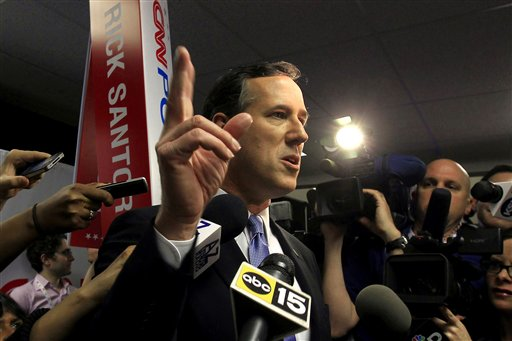
Nevertheless, this knowledge ought to be welcomed, for it offers a learning opportunity and, frankly, a better way of understanding politics and our opponents alike. For instance, it can help us see through the scientific-sounding arguments of someone like Rick Santorum, who has been talking a lot about climate science lately—if only in order to bash it.
On global warming, Santorum definitely has an argument, and he has “facts” to cite. And he is obviously intelligent and capable—but not, apparently, able to see past his ideological biases. Santorum’s argument ultimately comes down to a dismissal of climate science and climate scientists, and even the embrace of a conspiracy theory, one in which the scientists of the world are conspiring to subvert economic growth (yeah, right).
Viewing all this as an ideologically defensive maneuver not only explains a lot, it helps us realize that refuting Santorum probably serves little purpose. He’d just come up with another argument and response, probably even cleverer than the last, and certainly just as appealing to his audience. We’d be much better concentrating our energies elsewhere, where people are more persuadable.
A more scientific understanding of persuasion, then, should not be seen as threatening. It’s actually an opportunity to do better—to be more effective and politically successful.
Indeed, if we believe in evidence then we should also welcome the evidence showing its limited power to persuade–especially in politicized areas where deep emotions are involved. Before you start off your next argument with a fact, then, first think about what the facts say about that strategy. If you’re a liberal who is emotionally wedded to the idea that rationality wins the day—well, then, it’s high time to listen to reason.
