Were history a guide to today’s politics, progressives would be redoubling their efforts to turn the still-unraveling crisis of capitalism into an opportunity for system-changing reform. Certainly they would be doing everything within their power to combat the logic of austerity and entitlement-slashing that has crystalized into a new Washington “consensus,” and instead to shape the debate around issues of employment, inequality, the erosion of the safety net, and the unprecedented concentrations of wealth and economic power that have survived the Great Recession intact. But they would also move to engage the debate at a deeper level: in terms of what a just, equitable and socially as well as financially productive economy looks like and what roles the state and the market should play in bringing it about.
Yet, 2012 finds progressives without any such unifying vision to mobilize a broad-based reform movement, let alone to define the debate about the economic future. Instead, by some still-puzzling turn of events, the Tea Party infused political right has capitalized on the crisis produced by already radically deregulated “free-market” financial capitalism to promote an even more radically right-wing agenda based on the argument that what we need now is more of the same—further tax cutting, deeper spending cuts, more deregulation and the eventual elimination of what remains of social welfare and labor rights. Right-wing activists have also reclaimed the moral high ground by framing their agenda as a crusade to save capitalism and political freedom from the threat of liberal “big government,” albeit by resorting to the decidedly low-road tactics of blaming the Great Recession on overly-generous entitlements, organized labor and the “undeserving” poor. For the time being, this is the narrative that is setting the terms of the debate in Washington over what the post-recession economy should look like.
Still, there is reason for hope. From Wisconsin to Wall Street, grassroots movements have resuscitated flagging reform momentum, organizing to defend the rights and dignity of labor, to protest the rise and concentrated power of “the 1 percent,” and to make deeper, decades-in-the-making issues of inequality the center of a campaign to renew representative democracy. Whether and how this translates into a more concrete reform program — and whether it will be able to displace the still locked-in logic of austerity and retrenchment —remains to be seen.
Hope can also be found in the enduring salience of an older tradition of progressive economic reform. From the late 19th century through the New Deal, similarly fraught moments of economic crisis and inequality were used to frame a series of public debates about the rise of industrial and finance capitalism, and the hazards it introduced. Chief among these were the problems of inequality and concentrated economic power that marked the decades around the turn of that century as what, until very recently, was our first and only Gilded Age.
Indeed, that era’s skewed patterns of wealth and income distribution were much like our own. They stemmed from deliberate, ideologically slanted policy choices and industry practices in a political system dominated by the interests of big corporations and the wealthy. They reflected vast imbalances of power when it came to controlling wages, prices, working conditions and the broader fate of the economy. For the great majority of citizens, the material risks and consequences of these imbalances were palpable, and never more so than in the sequence of mass unemployment, falling property values, foreclosure and deepening depression that periodically gripped the economy in the wake of the financial panics endemic to unregulated industrial capitalism.
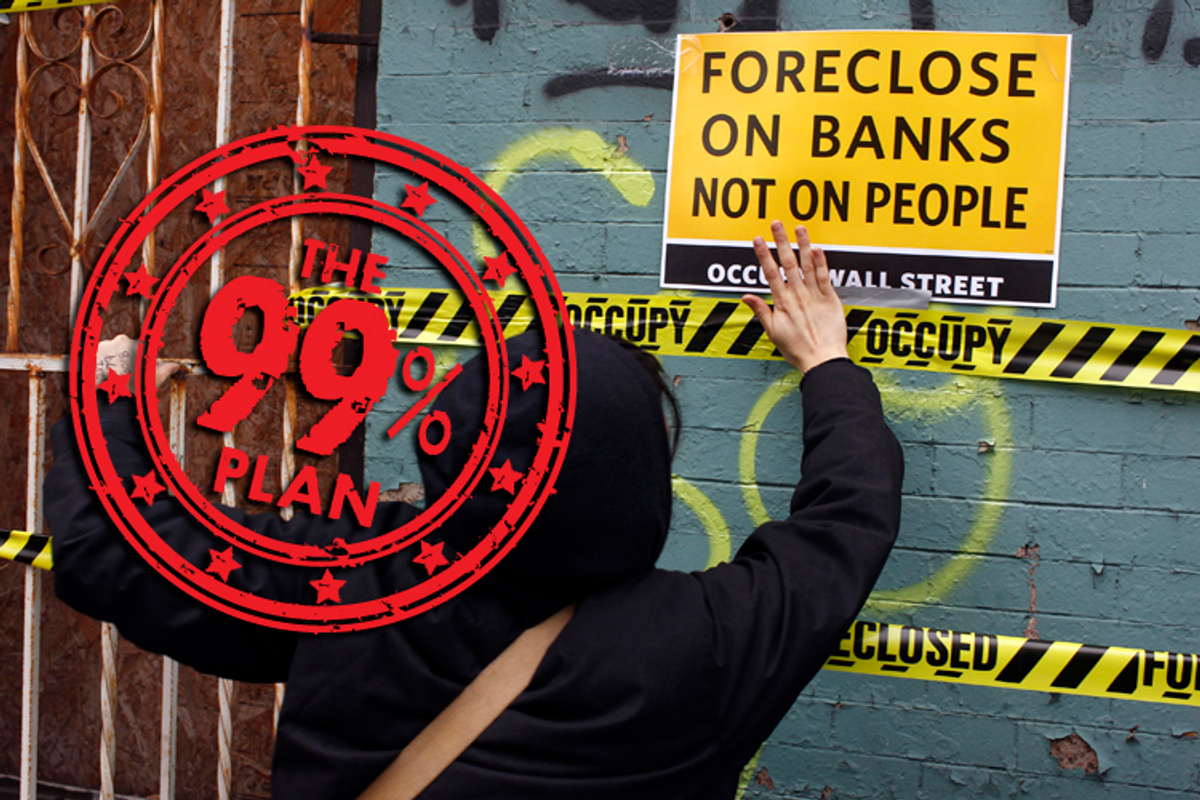
The moral and political hazards of Gilded Age capitalism were palpable as well, inspiring a language of protest most recently echoed in anti-Wall Street demonstrations in Zuccotti Park. Then as now critics protested the “evils” of inequality and wealth concentration as akin to plutocracy, predation, malefaction, economic oligarchy and outright theft. They worried about the corrupting influences of a financial sector that had grown too large and of the speculative pursuit of profit for its own sake.
But the progressives of yesteryear voiced their concerns in the name of more positive, traditionally republican principles as well: principles grounded in ideas about socially productive labor as the source of true economic value and civic virtue; about the need to balance the public interest against the overreaching claims of narrow private economic interests; about the importance of free (that is, autonomous and independent) and fairly compensated labor that were rapidly being undermined by the work conditions of industrial capitalism. While hardly uncontested, and by no means applied equitably across the lines of race, ethnicity and gender, these principles stood in sharp contrast to Andrew Carnegie’s self-justifying Gospel of Wealth and every-man-for-himself Social Darwinism. They provided the basis for framing Gilded Age inequality as a violation of traditional republican values, and for justifying such measures as anti-trust legislation, labor and environmental protections, the progressive income tax, and financial reform. The true radicals, in this narrative, were the proponents of laissez faire.
Over the course of several decades, a wide and by no means unified array of political actors — labor unions, farmer alliances, consumer groups and policy intellectuals as well as elected officials from both major political parties — would draw on these principles and values to build a case not only against the “evils” of wealth concentration and oligarchic control but for a political economy that represented the worth and served the interests of the people. Few issues absorbed as much public attention — or have as much contemporary relevance — as the Congressional investigations of Wall Street and the banking industry conducted in response to the system-shaking financial panics of 1907 and 1929.
The first of these investigations was conducted in 1912-13, and was aptly dubbed “the hunt for the money trust” in a series of riveting blow-by-blow articles by renowned investigative journalist Ida B. Tarbell. It also produced the well-known broadside by lawyer and future Supreme Court Justice Louis D. Brandeis, who published a series of articles in Harper’s Weekly in 1913, soon after collected in a book with the memorably aphoristic title “Other People’s Money, and How the Bankers Use It.” The articles, illustrated with caricatures of overfed plutocrats, used evidence from the “money trust” investigations to track the system of “interlocking directorates” that had allowed a small coterie of investment bankers to establish monopoly control over the nation’s credit, and hence over the economy writ large. Worse still, they financed their riskiest and most personally profitable ventures by using bank deposits — the modest savings of the average citizen — appropriating the people’s capital and putting it to self-enriching but otherwise unproductive speculative use. Brandeis looked to the state for regulation, suggesting, among other things, that banks be regulated as public utilities, entrusted as they were with safeguarding so much of the nation’s wealth. But in “Other People’s Money,” he offered a complementary strategy as well. Banking, he urged, could be by and for the “the people” if the millions of farmers, workers and clerks who entrusted their savings to the big banks would put it in credit unions and banking cooperatives — the financial instruments of industrial democracy — instead.
Although it would take another two decades — and a more massive financial collapse — to pass meaningful financial regulation, Brandeis’ basic formulation continued to serve as a powerful touchstone for reform throughout the New Deal. In 1933, the Senate instigated the well-known Pecora investigations of the Wall Street money trust and its role in the stock market crash of 1929. (Congress soon after passed the Glass-Steagall Act to prevent the very abuses that would lead once again to reckless financial speculation in the wake of its 1999 repeal.) Echoes of “Other People’s Money” could be heard in letters to Ferdinand Pecora, the chief counsel for the investigation, urging him to “bring all these crooks to their knees, and make them repay us decent and honest people” for the life savings they had lost.
In 1938, countering the ill-advised austerity measures that had led to the deep “Roosevelt recession” the previous year, progressives in the administration pushed a vacillating president to step up the battle against the monopoly practices that, they suspected, were stifling the recovery. After three years of research, the eventual recommendations of the Temporary National Economic Committee were fairly tepid, nor did the committee find evidence of the suspected capital strike. But by then FDR had used the TNEC’s creation to turn the tables on his conservative critics. The true threat to liberty came not from an elected and publicly accountable government, as detractors charged, but from “a concentration of private power without equal in history.” He also joined a host of other political activists and reformers in recognizing the necessity, indeed the imperative, of a government prepared to hold private industry accountable to the standards of democracy. “[T]he liberty of a democracy is not safe,” the president argued, “if its business system does not provide employment and produce and distribute goods in such a way as to sustain an acceptable standard of living.”
Though articulated in immediate response to the looming threat of economic oligarchy, these principles of reform and regulation were embedded in the more expansive idea of the economic and political rights of citizenship — and the role of government in protecting them — that had become the cornerstone of New Deal reform. FDR enumerated these as a “second,” economic bill of rights in his 1944 State of the Union address. Among them were the right to a job with a fair wage, a decent home, a good education and healthcare as well as the right to an equitable playing field and to protections against the power of organized wealth. Underlying these rights, FDR declared, was an even more basic and “self-evident” — republican — economic truth: True freedom rested on economic security and prosperity for all. This principle would be embraced by generations of civil rights, women’s rights and labor movement activists as they struggled to make the country live up to that promise.
It is against this historical backdrop that the convergence of Wisconsin and Occupy Wall Street can be seen as an opportunity to articulate some core principles of a progressive vision for the 21st century economy: jobs at living wages for all who want them; equal opportunity regardless of race, class, gender, religion or sexual orientation; universal access to social goods such as health, education, decent housing and economic security; a fair distribution of wealth and income; a democratic system of finance; respect for human dignity in the workplace and the public sphere; a market regulated by representative government rather than left to its own devices. These, at a minimum, are a starting point for an economy that creates the conditions within which modern-day democracy can thrive.
At a time when even the most modest healthcare and financial reform measures spur charges of “European-style social democracy,” it may be tempting to conclude that these expansive ideals are simply too far outside the realm of political possibility to be relevant. But that logic, decades in the making, has already exacted a devastating political price. We see it in the failure, after nearly 40 years of falling wages and rising inequality, to make full employment that sustains decent standards of living a standard-bearer for economic health. We see it in the absence -- public outrage over Wall Street bailouts and “too big to fail” aside -- of any real challenge to the logic and power that continues to sustain our modern-day money trust. We see it in the inability of progressive individuals, organizations and movements to connect to create an economy that works for the benefit of a democratic polity rather than the other way around. And we see it in the right’s enduring monopoly on the politics and the rhetoric of economic values and reform. It’s high time for progressives to reclaim that too-long neglected territory, lest we do ourselves the injustice of forgetting a vital part of our past.
Shares