

Maybe the joke about George Clooney kissing Billy Crystal in a fake scene from “The Descendants” would have been funnier if Crystal didn’t actually look like an old lady. That moment was awkward — like virtually everything else about Sunday’s 84th Academy Awards, — but it was also confusing. Was George supposed to be delivering a goodbye smooch to his wife, or his mom? Seconds later, we were treated to Crystal in blackface, or at least in tan-face, sorta-kinda doing Sammy Davis Jr. Extra-double awkward and confusing! Even if you’ve heard of Davis (and half the people watching probably hadn’t), it took several beats to grasp exactly what target Crystal was shooting for. (It’s been more than 25 years since Crystal played Davis on “Saturday Night Live.”) Liberace’s black half-sister, perhaps?
Angelina Jolie’s awkwardly exhibited right leg rapidly acquired its own Twitter handle, whose jokes were (at least in the moment) funnier than anything that actually happened inside the theater on Oscar night. Honestly, that sums it up. Was this worse than the James Franco-Anne Hathaway wannabe-hip debacle of last year? Perhaps not; almost nothing could be. But from Angie’s jambe droite — c’est pour toi, Jean Dujardin! — to Cameron Diaz and J.Lo’s derrières to Crystal’s quadruply warmed-over Borscht Belt gags to the fact that the best actor can’t speak English and nobody can pronounce the best director’s name, this was a monumentally awkward Oscar telecast. Most of the big moments felt weirdly off, and so did a lot of the little ones: Robert Downey Jr. trying to be funny and failing, the women from “Bridesmaids” likewise, Tom Hanks rocking a gray beard that made him look like a doubly-douchey guy who listens to jam-band music but works on Wall Street. It was the Off-scars. The Awk-scars.
Maybe the Squawk-scars. What in God’s name was that tinny, high-pitched, icepick-to-the-brain feedback noise that seemed to accompany all the live sounds from the stage? Was the sound-board being run by my ninth-grade drama teacher? I didn’t think the Ellen De Generes commercials were all that funny or effective, necessarily — right now, writing at 2 a.m., I have no idea what she was advertising — but holy cats, that was professional-grade entertainment compared to the show.
No, I know — the Oscars are still a big event, and this year was no exception. But the event-ness of it had very little to do with the actual telecast aired by ABC, which possessed the strange quality of seeming devoid of content and yet taking forever. (The supporting actor and actress awards weren’t handed out until about 45 minutes into the show.) As usual, it had even less to do with the movies being honored, which most viewers probably hadn’t seen and didn’t care about. It’s been true for years that getting together with your friends to ooh-and-ah and crack jokes and then momentarily get swept away by it all has been at least half the fun of Oscar night. But in the age of social media, we’ve reached the point of all tail and no dog. The torrent of electronic commentary has expanded to fill the entire space, leaving the awards show as a Potemkin village that doesn’t even try to look solid, a pseudo-event that makes no pretense of meaning anything.
I had the feeling on more than one occasion that the show itself was an afterthought, a distraction from what seemed really important — reading the outraged or joyous or ridiculously funny things that friends and acquaintances and total strangers were saying about it. Sure, Twitter is an evanescent literary form, one vanishing thought at a time flowing out of the spigot and down the drain. But at least nobody on Twitter was trying to compel me to listen to Adam Sandler talk earnestly, in a black-and-white video clip, about truth and beauty. (Here’s a thought, Adam: Make a silent movie.) Nobody on Twitter is responsible for the fact that neither Angelina Jolie nor her gams can adequately read a Teleprompter, or the fact that Clooney’s “Descendants” co-star Shailene Woodley said “under-exaggerated” in an interview and nobody cared enough to edit it out so she wouldn’t look like an ass.
It was nearly impossible to find a viable online feed of the Oscar telecast this year, which may just be a by-product of the recent crackdown on illegal live streaming. But it also feels like a way of trying to pump up ratings, to turn back the clock to some year when Billy Crystal was famous and less pickled-looking, and generally cram the genie back into the bottle. At least the dude Dujardin plays in “The Artist” ultimately has no choice but to deal with the massive social and technological change that has transformed the movie industry. The Academy’s approach, to this point, appears to involve two things. First, pretending that there’s no problem with this fast-sinking awards show or the industry it represents, and that the audience is just as fascinated by movie-star glamour as ever. And second, producing a really lackluster and mediocre television program.
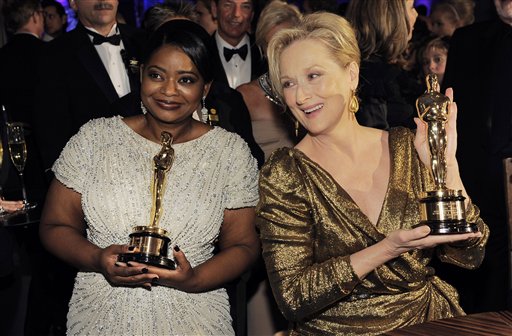
As far as the actual, y’know, Academy Awards, here’s my summary: Christopher Plummer, “A Separation,” and all those technical and design awards for “Hugo.” (And the big zero for “Extremely Loud & Incredibly Close.”) Those were the right prizes won for the right reasons. Oh, and I guess Octavia Spencer for “The Help,” although all the women in that category were terrific and there was no way to get it wrong. (Well, Crystal still managed to get it wrong, cracking that after seeing “The Help” he wanted to hug the first black woman he saw, “which in Beverly Hills is about a 45-minute drive.”) Even with Spencer and Plummer, there was more than a hint of Offscar-ness and Awkscar-ness. Both got standing ovations, which in the latter case could be justified as paying tribute to a life’s work, but jointly it all started to look like special circumstances. She’s black and he’s old, and isn’t it amazing of us to give major awards to people like that?
I have nothing against “The Artist,” which is a charming love letter to old Hollywood, executed with considerable craft. But in a year or two it’s going to look like an obvious fluke, the oddball film that Harvey Weinstein wizarded to five awards amid a weak field. Jean Dujardin is a delightful performer who pulled off an improbable feat, but I’m beginning to wonder whether he’ll ever be heard of again on this side of the pond. And for the second year in a row, after Tom Hooper of “The King’s Speech,” the directing Oscar goes to the least qualified of the five nominees. (Michel Hazanavicius — and by the way, the name is Lithuanian — over Woody Allen, Terrence Malick, Alexander Payne and Martin Scorsese. Please.) I’m sure the French nation is delirious right now, but eventually a moment of clarity will arrive: All the films we’ve made since the days of the Lumière brothers, and this one conquers Hollywood?
“The Artist’s” big awards were 100 percent expected, whereas we’d all talked ourselves into thinking that Meryl Streep wouldn’t win best actress for “The Iron Lady.” I definitely wanted to see and hear the crackerjack speech Viola Davis would have delivered, and there’s no point consoling ourselves with “oh, she’ll get her chance,” because we all know she probably won’t. As for Streep, yeah, on merit she absolutely deserves it, and she had a real moment up there, a moment of being tremendously moved and maybe something else too. Pissed, possibly? Deflated? Halfway wishing that she weren’t such a trouper, and had just stayed home like Woody Allen? She said herself that she knows she’ll never be on that stage again; she was turning a page in her life and in movie history. She wins her first Oscar in 28 years, and quite possibly her last, and it’s an Awk-scar.

