
NYPD

Can the NYPD (legally) spy on mosques?

A civil liberties expert explains how the city's Muslim surveillance program may have broken local and federal laws

  • more
    • All Share Services

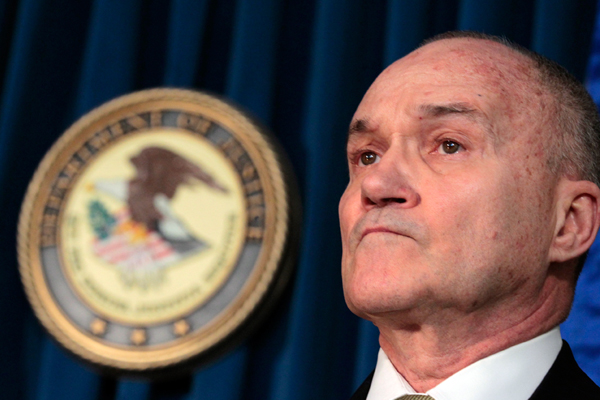
Can the NYPD (legally) spy on mosques? NYPD Police Commissioner Ray Kelly (Credit: Reuters/Brendan McDermid)
This piece originally appeared on ProPublica.

Last August, the Associated Press launched a series detailing how the New York Police Department has extensively investigated Muslims in New York and other states, including preparing reports on mosques and Muslim-owned businesses, apparently without any suspicion of crimes being committed.

The propriety and legality of the NYPD’s activities is under dispute. Mayor Michael Bloomberg – who claimed last year that the NYPD does not focus on religion and only follows threats or leads – is now arguing that, as he said last week, “Everything the NYPD has done is legal, it is appropriate, it is constitutional.” Others disagree. In fact, Bloomberg himself signed a law in 2004 prohibiting profiling by law enforcement based on religion.

This week, Attorney General Eric Holder told a congressional committee the Justice Department is reviewing whether to investigate potential civil rights violations by the NYPD.

To get a better understanding of the rules governing the NYPD – and whether the department has followed them in its surveillance of Muslims – we spoke to Faiza Patel, co-director of the Liberty and National Security Program at the Brennan Center at NYU Law School.

The NYPD did not respond to our request for comment about allegations it has violated the law.

So Mayor Bloomberg and police commissioner Ray Kelly say everything that the NYPD did was legal and constitutional. Other people have disagreed – Newark Mayor Cory Booker, for example, said the wholesale surveillance of a community without suspicion of a crime “clearly crosses a line.” What restrictions is the NYPD operating under?

They are operating under at least three sets of rules. The first and most basic set of rules is the consent decree from the Handschu case – the so-called Handschu guidelines. This was a 1970s-era political surveillance case that was settled through a consent decree. The NYPD had been conducting surveillance of a number of political groups in the ’60s and ’70s. The initial consent decree regulated the NYPD’s collection of intelligence about political activity. It first said the NYPD can only collect intelligence about political activity if it follows certain rules. For example, the NYPD had to get clearance from something called the Handschu authority, which was a three-member board that consisted of two high-level police officials and one civilian appointed by the mayor.

Then, post-9/11 the NYPD went to court and asked a judge to review the consent decree because they wanted to have greater freedom in their counter-terrorism operations. What they wound up doing was adopting guidelines based on the FBI’s guidelines from 2003, issued by Attorney General John Ashcroft. These were different in several important ways. The first was that there was no pre-clearance, at all. There was no requirement that the NYPD get approval from the Handschu authority before they undertook any intel gathering about political activity. The second was that the guidelines explicitly say the NYPD can attend any public event or gathering on the same basis as another member of the public. So if I can go to a church, the NYPD can go to a church. But it goes on to say that the NYPD can’t retain the information it gathers from going to such public events unless it is connected to suspected criminal or terrorist activity.

So if you look at, say, the NYPD’s guide to Newark’s Muslim community obtained and published by the AP – which maps out mosques and Muslim-owned businesses without mentioning and suspicions of crimes – aren’t the police retaining exactly this kind of information?

There are a couple of documents that suggest they may have violated Handschu. For example, the [2006 NYPD report] on the Danish cartoon controversy, which is a collection of statements in mosques and other places that have been taken down by undercover officers or confidential informants.

What are the other rules the NYPD operates under?

The second set is that the NYPD has a profiling order in place, and New York City also has a racial profiling law. They are slightly different. The NYPD order [issued in 2002] does not include religion among the categories that they define as profiling. But the New York City law does. It prohibits police officers from relying on race, ethnicity, religion or national origin as a determinative factor in initiating law enforcement action. Normally you have quite a difficult time in racial profiling cases showing they’ve used one of these factors as the determinative factor. In this case, if you look at the documents, it seems quite clear that the NYPD had its eyes quite firmly on the Muslim community. So it’s possible it is also in violation of this law.

The third set of rules is, of course, the U.S. and the New York state constitutions. Within the Constitution you’re looking at least two broad categories of provisions – potential First Amendment claims for free speech, freedom of association and free exercise of religion. The other piece of it would be potential equal protection claims.

There was another AP story this week reporting that a bunch of federal grant money and equipment used as part of surveillance and investigation of the Muslim community. Does that muddy the legal questions about whether they were following federal rules as well?

The federal program that was giving them money is the HIDTA program – High Intensity Drug Trafficking Area. It’s geared toward providing funds to combat drug trafficking. HIDTA itself does allow for counter-terrorism spending to be an incidental purpose. It requires the HIDTA Executive Board to basically make sure that funds were being used for the purposes that they were supposed to be used for. So I think there’s a real issue about accountability and oversight of the use of HIDTA funds here.

So if the NYPD did potentially violate the Handschu guidelines and city law you mentioned, what are the penalties?

Well the Handschu lawyers already went to court last year and told the judge that the documents that had been released by the AP suggested that there had been violations of the Handschu decree. They asked for discovery so they could check the files of the NYPD to see whether they had violated the prohibition on keeping dossiers. I believe that that discovery will likely be starting soon. So there’s clearly a remedy through the Handschu mechanism. Because it’s a consent decree, it’s an ongoing thing. The judge has supervisory jurisdiction. There are also issues under the racial profiling law and under the First Amendment.

We’ve also turned to the question of oversight. The FBI, for all its faults, does have a fair amount of oversight – an inspector general internally and congressional oversight. We think a similar thing would be a great idea for the NYPD.

Justin Elliott

Justin Elliott is a reporter for ProPublica. You can follow him on Twitter @ElliottJustin

Stop-and-frisk, eviscerated

A U.S. district judge exposes the NYPD's harassment strategy as racist, unconstitutional

  • more
    • All Share Services

Stop-and-frisk, eviscerated (Credit: Reuters/Carlo Allegri)
This article originally appeared on AlterNet.

AlterNetThis month, a federal judge in New York dealt a blow to “stop-and-frisk,” a policy that resulted in 685,000 recorded police stops in 2011. Eighty-five percent of those stopped were African American and Latino, mostly youths.

U.S. district judge Shira Scheindlin granted class-action certification to a stop-and-frisk lawsuit against the city of New York, Police Commissioner Raymond Kelly, and Mayor Michael Bloomberg. The plaintiffs allege that the NYPD’s stop-and-frisk policy regularly violates the Constitution by illegally stopping and searching scores of people belonging to a particular demographic — black and Latino. Pending the city’s appeal, the class-action ruling will put stop-and-frisk on trial.

Plaintiffs in Floyd et al. vs City of New York also argue that they were stopped by police who did not have the legally necessary “reasonable suspicion” that they had committed or were going to commit a crime. What’s more, the suit alleges, police often performed frisks, but not because they saw a bulge they suspected to be a weapon, another legal requirement.

In her written decision, Scheindlin said the alleged constitutional violations result not from the actions of rogue officers, but from a policy handed down from the very top. “The stop-and-frisk program is centralized and hierarchical,” said Scheindlin. “Those stops were made pursuant to a policy that is designed, implemented and monitored by the NYPD’s administration.”

Scheindlin’s ruling cites “overwhelming evidence” — a spike in stop-and-frisks and the NYPD’s own words — indicating that at the “highest levels of the department” police are enforcing a policy that leaves behind a trail of daily injustices.

For years, Mayor Bloomberg and Police Commissioner Kelly have used distortions and misinformation to promote and justify a policy that violates the constitutional rights of those who were stopped. Now, the Scheindlin findings have exposed the NYPD game for what it is, an illegal system of quotas and racial profiling imposed on field police from the top of the NYPD.

“Suspicionless stops should never occur,” Scheindlin wrote in her decision, adding that, “Defendants’ cavalier attitude towards the prospect of a ‘widespread practice of suspicionless stops’ displays a deeply troubling apathy towards New Yorkers’ most fundamental constitutional rights.” Stop-and-frisk, which the data shows is a form of racial profiling, violates not only the Fourth Amendment — protection from unreasonable searches — but also the 14th Amendment, which includes the equal protection clause, the plaintiffs charge.

The Scheindlin decision was informative and comprehensive, including a number of important facts and observations. Here are eight important points from the decision.

1. Soaring numbers. The rate of stops has grown exponentially under the Bloomberg administration. Scheindlin’s ruling notes that police conducted 2.8 million documented stops of people between 2004 and 2009, about half of whom were frisked. In contrast, in 1998, Scheindlin explains, NYPD officers made roughly 150,000 stops per year. In 2004 alone, officers recorded more than 313,000 stops, “and since then the number has increased every year except 2007, rising to over 684,000 in 2011.” Scheindlin cites the large increase as evidence of a centralized policy change.

2. No reasonable suspicion. Reasonable suspicion that a person is involved in a crime is necessary for a legal stop. Eighty-eight percent of those stopped, however, are not charged with any crime. As Scheindlin noted, the data shows that “according to their own records and judgment, officers’ ‘suspicions’ were wrong nearly nine times out of ten.”

3. Imaginary bulges. Officers’ suspicions were similarly unsubstantiated when reportedly searching for guns. A “suspicious bulge” was cited as a reason for about 10 percent of all stops, but guns were seized in less than 1 percent. “For every 69 stops that police officers justified specifically on the basis of a suspicious bulge, they found one gun,” the decision notes.

4. Stops for no reason. The absence of a legally necessary, interpretable “suspected crime” cited on official forms grew from 1.1 percent in 2004 to 35.9 percent (more than 200,000 reported stops) in 2009. During those years, “Overall, in more than half a million documented stops — 18.4 percent of the total — officers listed no coherent suspected crime,” Scheindlin wrote, meaning they either ignored the section altogether or did not cite suspected behavior that is indeed illegal.

5. Unlawful stops. Scheindlin writes, “According to their own explanations for their actions, NYPD officers conducted at least 170,000 unlawful stops between 2004 and 2009.” Stops based on nothing more than “furtive movement” or a “high-crime area” were the justifications of at least 100,000 stops, but as Scheindlin says, are illegal due to the Fourth Amendment law protecting Americans from unreasonable search.

6. Racial profiling. The NYPD’s stop-and-frisk program targets blacks and Latinos because of their skin color. Scheindlin admitted the testimony of Columbia University professor Jeffrey Fagan, who found that police stopped blacks and Latinos far more than white residents. Isolated from other factors like crime rates and neighborhood racial composition, racial disparity from racial targeting was statistically significant, strongly underscoring that skin color is the essential factor in determining who gets stopped and throwing weight behind allegations of 14th Amendment violations. Fagan’s research also found that “the search for weapons is (a) unrelated to crime, (b) takes place primarily where weapons offenses are less frequent than other crimes, and (c) is targeted at places where the black and Hispanic populations are highest.” Cops are more likely to list no suspected crime category, or what Scheindlin called “an incoherent one,” like “furtive movements,” when stopping blacks and Latinos than when stopping whites. They also are more likely to use force against people of color.

7. NYPD illegal quotas. Scheindlin links the rising number of stops and the targeting of black and Latinos to NYPD quotas and to Commissioner Kelly’s own admission that the NYPD has a quota policy, albeit disguised. In a recent operations order, Commissioner Kelly explained departmental policy under the euphemism “performance goal.” Kelly said in the order, “Department managers can and must set performance goals,” for “the issuance of summonses, the stopping and questioning of suspicious individuals, and the arrests of criminals.”

The order also explains a weekly review during which a sergeant compares each officer’s monthly “activity” with the “daily assignment,” whereby police who “do not demonstrate activities” — or keep their numbers up — “will be evaluated accordingly and their assignments re-assessed.” In other words, there will be consequences for officers who don’t meet quotas, even though New York labor law says penalizing cops for failing to meet quotas is illegal.

Former NYPD officers turned whistleblowers Adhyl Polanco and Adrian Schoolcraft have collected evidence documenting NYPD quotas in practice. From 2008 to 2009, Polanco, from the 41st Precinct, and Schoolcraft, from the 81st, recorded roll calls revealing supervisors’ and other high-ranking officers’ enforcement of quotas. In Scheindlin’s own words, Schoolcraft’s audio files expose supervisors “repeatedly telling officers to conduct unlawful stops and arrests and explaining that the instructions for higher performance numbers are coming down the chain of command.”

Similarly, Polanco testified that “his commanding officers announced specific quotas for arrests and summons (quotas that rose dramatically between early 2008 and 2009) and for UF-250s” (a term for the forms used in stops), said Scheindlin, “and threatened overtime and undesirable assignments for those who failed to meet them.”

8. Repeat performances. According to the NYCLU, in 2011 the NYPD stopped more young, black men than live in New York; that is, some individuals are stopped and frisked repeatedly. To protect their rights, plaintiffs are seeking “systemic relief” — an end to the unconstitutional practice of stop-and-frisk.

Kristen Gwynne covers drugs at AlterNet. She graduated from New York University with a degree in journalism and psychology.

Continue Reading Close

Police arrest artist setting up ‘I Love NY’ work

The installation included a plastic bag with a battery inside of it, hanging from a tree

  • more
    • All Share Services

Police arrest artist setting up 'I Love NY' work (Credit: http://tmiyakawadesign.com/)

NEW YORK (AP) — An artist who was setting up an “I Love New York”-themed public art display in Brooklyn was arrested after the wired contraption was mistaken for an explosive device.

Takeshi Miyakawa, a visual artist and furniture designer, was arrested Saturday after placing the installation in two separate areas of the same New York City neighborhood. His lawyer and employer both called the arrest a misunderstanding.

The first apparatus was found Friday morning after a caller reported a suspicious package to police. It consisted of a plastic bag that contained a battery and was suspended from a metal rod attached to a tree. The bag, which had the classic “I Love New York” logo printed on it, was connected by a wire to a plastic box that contained more wires.

The area was evacuated for two hours until a bomb squad determined that the device was not dangerous.

At about 2 a.m. Saturday, a police officer discovered Miyakawa on a ladder not far from where the first contraption was found. Police said he was tying a similar “I Love New York” bag to a public lamp post.

Miyakawa was charged with two counts of first-degree reckless endangerment, two counts of placing a false bomb or hazardous substance in the first degree, two counts of placing a false bomb or hazardous substance in the second degree, two counts of second-degree reckless endangerment and two counts of second-degree criminal nuisance.

A judge ordered him held pending a psychiatric evaluation. His lawyer, Deborah J. Blum, said Monday that she is filing for emergency relief to have Miyakawa released. A court date was set for June 21 to review the results of the evaluation.

“He’s still being held,” Blum said Monday. “I believe that it was a gross misunderstanding and other than that I don’t have any other comment.”

Miyakawa, who was born in Tokyo and is about 50 years old, has worked for a New York-based architect Rafael Vinoly for the last 20 years and also has an independent design practice.

Vinoly’s firm released a statement Monday praising Miyakawa for his “extraordinary brand of professionalism” and said he has been a mentor to generations of young architects.

“Takeshi is a fabulous human being and a person of extraordinary talent,” Vinoly said. “We hope this misunderstanding is cleared up as quickly as possible.”

New York Civil Liberties Union Executive Director Donna Lieberman said in a statement that the charges sounded “like a wild overreaction.”

“It’s hard to understand why a light-up bag in a tree would be treated as an attempted terrorist act unless there’s more to the story than has been reported in the press thus far,” she said.

In 2007, an artist touched off a terror scare in Boston by placing electronic devices around the city as part of a marketing stunt for Cartoon Network. The city closed bridges, roads and public transit before authorities realized the signs were not bombs.

On an average day, the NYPD receives nearly 100 reports of a suspicious package. Last year, there were more than 4,000 such reports. The number generally rises following any word of terror threats in New York and around the world.

Continue Reading Close

Why protesters curse cops

New stats about the NYPD's racist tactics show why some Occupiers chant "F*** the police."

  • more
    • All Share Services

Why protesters curse cops (Credit: Reuters/Andrew Kelly)

Attitudes toward the police are the source of innumerable disagreements and divisions between those who’ve participated in Occupy-related actions in the past half year. From Oakland, Calif., to New York “Fuck the Police” marches regularly snake through the streets, while in early encampments chants of “We are the 99%, and so are you!” would ring out invitingly to surrounding police officers. (Unsurprisingly, anti-police sentiment increasingly outweighed support for police as more and more Occupy participants felt the jab of billy clubs and the sting of tear gas.)

It’s beyond the purview of these paragraphs to explain the many reasons someone might take to the streets and shout “fuck the police!” However, as a new report from the New York Civil Liberties Union confirms, the consistently racist practices of the NYPD should make fierce anti-police sentiments understandable, even for those who find such an attitude unpalatable.

Using the NYPD’s own statistics, the NYCLU report highlights what they describe as a “two-tiered” policing system, in which black and Latino New Yorkers receive very different treatment from whites. Perhaps the most shocking finding of all: There were more stops of African-American young men in 2011 than there are African-American men living in the city — and nine out of 10 of those stopped had committed no crime.

In nearly half of New York’s 76 police precincts, black and Latino New Yorkers accounted for more than 90 percent of those stopped; in almost all precincts black and Latinos accounted for more than half of stops. Furthermore, frisks, which are only supposed to take place if police suspect someone is carrying a weapon, occurred far more often if the person stopped was black or Latino, even though white people were found more often to be carrying weapons. The report also notes that despite the 600 percent increase in stop-and-frisks under Mayor Bloomberg, the number of guns recovered has not increased proportionately.

“This cannot stand. Real people’s lives are in the balance. Whole generations of boys and girls are growing up afraid of the very people that are supposed to be keeping them safe,” Donna Lieberman, executive director of the NYCLU, told press on Wednesday.

Is it a surprise, then, that in a march of 5,000 predominantly non-white New Yorkers organized to call for justice for the murdered Trayvon Martin, with Occupy support, that chants moved smoothly from “We are Trayvon Martin!” to “Fuck the Police!”? The greater surprise should perhaps be why more people don’t feel angry at the NYPD. Of course, many will continue to disagree with anti-police marches. However, when statistics on policing show what the NYCLU’s Lieberman called “a tale of two cities,” disagreements should only arise over tactics to redress this system; it seems there’s an overwhelming case for fury at the police.

In a statement, NYPD spokesman Paul Browne defended police practices, saying that “stops save lives” and that New York has this year seen a record low for murders. He said that it is “the safest big city in America,” which prompts the question: safe for whom? When vast swaths of New York’s population live in constant fear of being harassed by a well-armed, uniformed gang — and that this fear is largely contingent on a person’s skin color — this strikes me as the sort of safety I have no interest in maintaining.

Continue Reading Close

Natasha Lennard covers the Occupy movement for Salon. A British-born, Brooklyn-based journalist, she has been covering Occupy Wall Street since before the first sleeping bag was unrolled in Zuccotti Park. One of the first journalists arrested at an Occupy action, she has managed to enrage Andrew Breitbart, Rush Limbaugh and Glenn Beck. You can follow her on Twitter (@natashalennard), and email her any Occupy updates/videos/ideas to natasha.lennard@gmail.com

The NYPD May Day siege

Pundits can argue back and forth over what Occupy's May Day achieved, but I just can't get over the police presence

  • more
    • All Share Services

The NYPD May Day siegeNew York City police officers watch as Occupy Wall Street activists march through the Lower East Side during May Day demonstrations on Tuesday. (Credit: Reuters/Andrew Kelly)

A number of reports have pointed out that the Occupy calls for a May Day general strike drew tens of thousands in the street Tuesday — with actions from the militant to the family-minded — in cities across the country, particularly in New York and Oakland, Calif. The culmination of scheduled action in New York — a mass march of around 30,000 union workers, immigrant workers and OWS supporters that descended (with a permit) on Manhattan’s financial district — felt powerful from within, as chanting bodies jostled south. But I jumped over the barricades, which hemmed in the crowd, and walked a few blocks away. Only a muffled din signaled the crowd’s presence nearby; that and the constant flow of riot cops flooding past me and the police vans lining the street as far as the eye could see.

Ample ink has already been spilled (outside the mainstream press, that is) about May 1, some praising Occupy’s success in staging events like teach-ins and the permitted solidarity march, which garnered a diversity of support from union and community groups; some point out the obvious — that no May Day actions actually shut down any of America’s vast metropolises; some have decried the property damage carried out by participants in Seattle; Reuters first reported the day as a “dud” and then recanted, noting it “far from a dud.” We could debate forever, using different, incommensurable metrics, as to whether May Day was or was not successful. But when I think about my Tuesday on strike, my memory is of New York City shrouded in an impenetrable blanket of police.

Having reported on, and participated in Occupy actions for seven months, heavy police presence is by no means unusual. Cops routinely flank banks when protests are called outside, they surround squares where Occupy groups gather, and are swift to disperse any attempts (even when legal) to assemble against capitalism in New York’s public spaces. But on Tuesday, I left downtown Manhattan shell-shocked.

It began on Monday night, when the NYPD, aided by the FBI, raided the homes of prominent activists in New York. Following these preemptive, unwarranted visits — during which activists were questioned about May Day plans –  the police presence throughout Manhattan on May 1 was incomparable to anything I’ve seen in my three short years in the city. Friends, whose time in New York and its radical subcultures far predate mine, agreed; they’d never seen anything quite like it.

Notably, the unpermitted “Wildcat March,” called by New York anarchists and anti-authoritarians, was surrounded by hundreds of police before the 300-strong crowd could even leave its rallying point at Sarah D. Roosevelt park. Barely reaching the sidewalk from the park’s steps, a line of cops stormed into the march’s front banner, snatching and grabbing three participants. I joined a running splinter group as the crowd was chaotically dispersed into smaller marches; we then proceeded, almost one cop to every striker, as we made our slow way to regroup at Washington Square Park.

I didn’t head to the Union Square rally to join crowds swelling to over 10,000; I missed the hundreds of guitarists marching alongside Rage Against the Machine’s Tom Morello in a “guitarmy”; I missed musical performances, free food and free lectures from prominent thinkers like Francis Fox Piven and David Graeber. Instead I wandered around Manhattan in shock and awe with a handful of co-strikers, counting as I passed every block: at least four cops per corner. The buzz of a police helicopter overhead continued all day; I couldn’t count the number of police vehicles.

Writing for In These Times, Rebecca Burns points out that the police have changed their tactics since the early days of Occupy. Although on May 1 Oakland police once again deployed tear gas, we did not see the mass arrests or large crowd kettles typical of police responses in previous months. Burns notes: “Unlike the now-familiar Occupy scene of demonstrators being arrested en masse in dramatic, late-night evictions, May Day protesters in many locales were arrested individually throughout the day, in some cases for crossing over onto sidewalks or, according to local media on the scene in Oakland, seemingly at random.” There were only a reported 97 arrests in New York relating to May Day activity.

Snatch-and-grab police tactics intimidate crowds, but do not lead to the sort of dramatic mass arrest scenes that capture national headlines; it’s a more insidious form of crowd control. It is worth adding, however, that there was no shortage of police aggression: At one point I saw firsthand as a marcher was grabbed by police in the Lower East Side, his face slammed to the street. When pulled up and taken away, officers covered his face with his T-shirt so onlookers could not see the blood.

Then, after the mass evening march in New York had finished and no more than a thousand people had moved to the Vietnam Veteran’s Memorial park at Manhattan’s southerly tip, the NYPD once again covered the area. Some remaining hundreds of the May Day participants had gathered for a mass general assembly; others milled around, sharing stories about the day or dancing to the ever-present drumbeats. The police encircled the small concrete park in time to disperse the relaxed crowd at 10 p.m., when the park closes. Clad in riot gear, the number of officers kept growing; hundreds and hundreds on foot and in vans surrounded the memorial park and every office building, street and corner. The NYPD is a standing army of around 35,000, and on the evening of May 1, New York felt like a city under military siege — it was terrifying.

Those of us who have been inspired by Occupy over the past year, those who see the importance of reclaiming and repurposing space (for public use that is not commerce), and who see the necessity of manifesting in the streets, are not fizzling or losing momentum. We are, however, being trampled, pushed, threatened and dispersed at every turn by well-armed, militarized police forces who once again made clear: We are not allowed to assemble on our own terms in this country.

Continue Reading Close

Natasha Lennard covers the Occupy movement for Salon. A British-born, Brooklyn-based journalist, she has been covering Occupy Wall Street since before the first sleeping bag was unrolled in Zuccotti Park. One of the first journalists arrested at an Occupy action, she has managed to enrage Andrew Breitbart, Rush Limbaugh and Glenn Beck. You can follow her on Twitter (@natashalennard), and email her any Occupy updates/videos/ideas to natasha.lennard@gmail.com

NYPD must spy on all Muslims to protect us from Iranian photographers

New York City's own constitutionally iffy intelligence agency justifies itself with fear-mongering

  • more
    • All Share Services

NYPD must spy on all Muslims to protect us from Iranian photographersRay Kelly (Credit: Reuters/Brendan McDermid)

The NYPD is less a “police department” than a secretive and unaccountable international intelligence-gathering organization with a large minority-frisking division and the firepower of a mid-sized army. Lately they have been facing a bit of criticism for their style of intelligence-gathering, which seems to be done with more gusto than concern for civil liberties or… accuracy. Sometimes the NYPD’s muscular-but-stupid approach to spying gets them in trouble with the FBI. And when the organization that fights terror by recruiting shady weirdos to try to trick random Muslims into saying “jihad” into tape recorders says your practices are counterproductive and out of line, they are probably pretty counterproductive and out of line.

But the NYPD’s “covertly follow every single Muslim in the tri-state area” approach to counter-terrorism has its defenders. Like Mayor Michael Bloomberg, who believes Americans Muslims have the right to worship wherever they see fit so long as they don’t pay any attention to the unmarked vans parked across the street.

And the department argues that it is allowed to carry out surveillance wherever it chooses, because there’s no law against just going around looking at things and taking some pictures, right? No, of course not, unless you look sort of Middle Eastern.

The NYPD earlier this week announced that they had totally caught some people who were almost definitely probably Iranian spies. These spies were caught red-handed spying all over the place!

Authorities have interviewed at least 13 people since 2005 with ties to Iran’s government who were seen taking pictures of New York City landmarks, a senior New York Police Department official said Wednesday.

The NYPD’s Mitchell Silber told Congress that Hezbollah and Iran definitely want to blow up New York, and the proof is three incidents of people “associated with the Iranian government” getting caught photographing things, in New York. (I am not much of a terrorist, but if you want pictures of New York City landmarks in order to figure out how best to blow them up why not try Flickr? There are hundreds of thousands of photos of every landmark in the city already online!)

While other so-called intelligence experts say ” there are no known or specific threats indicating Iranian plans to attack inside the U.S.,” Long Island-based Islamaphobe Republican Congressman Peter King and documented supporter of terrorism wants us all to be on high alert, because Hezbollah is everywhere:

Opening the hearing, King said, “We have a duty to prepare for the worst,” warning there may be hundreds of Hezbollah operatives in the United States, including 84 Iranian diplomats at the United Nations and in Washington who, “it must be presumed, are intelligence officers.”

Stop telling the NYPD not to spy on all the Muslims, everywhere! If they don’t keep tabs on all of them, the Iranians will get us!

Continue Reading Close
Alex Pareene

Alex Pareene writes about politics for Salon and is the author of "The Rude Guide to Mitt." Email him at apareene@salon.com and follow him on Twitter @pareene

Page 1 of 3 in NYPD