

Last fall, a series of articles in outlets ranging from the Israeli newspaper Haaretz to Time and the New Republic examined the exploding Occupy Wall Street movement in light of what the authors recognized as similar phenomena in Israel. The New York-Israel connection seemed obvious, and Haaretz even ran a piece on “The Israeli ex-settler at the center of Occupy Wall Street,” which described the role of Kobi Skolnick, who grew up on the national-religious settlement of Itamar, just five kilometers southeast of Nablus in the West Bank of Palestine. Once arrested in a right-wing protest against the Oslo Accords, Skolnick was now a tattooed, self-described “man of peace” — and an Occupy Wall Street activist in New York.
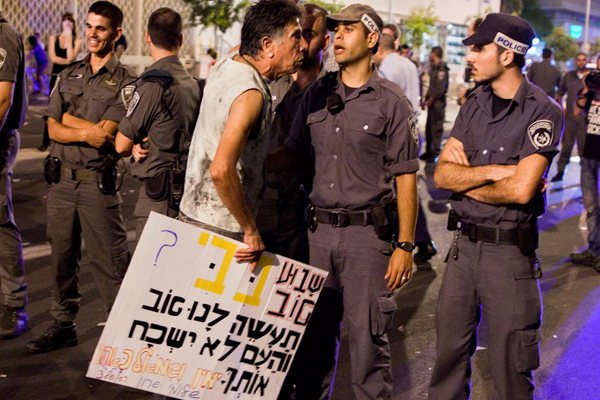
Skolnick may have been a nice subject for a human-interest piece, but the serious connections Martin Peretz had in mind were the #J14 housing protests that swept across Israel last summer. At that movement’s height, thousands of people were camped out in tents on Tel Aviv’s swanky Rothschild Boulevard (renamed “If I were a Rothschild”), and smaller encampments peppered green space in nearly every city in Israel. The Saturday night protests in Tel Aviv drew upwards of 300,000 people who made a broad call for “social justice,” with specific demands focusing on skyrocketing housing prices, health care, childcare and the overall high cost of living.
I am myself weary of the junctures suggested in these articles. The movement’s intellectual and tactical roots in Greece, London, France and the California student uprisings of the fall of 2009 (which is when the “Occupy California” blog started) are obvious to anyone who looks, and they have drawn as well on the energy of the so-called Arab Spring. But while an Israeli genealogy of the U.S. Occupy Movement would be a stretch, there is a particular sort of rhetoric about the middle class that circulated around both the Israeli and the U.S. protests and that can shed light on both of these contexts.
In Israel-Palestine, the giant aporia on the list of social justice grievances is the expropriation of and settlement on Palestinian land. Although I don’t see the Israeli movement in the U.S. one, I do see the settlers in the Israeli movement. What runs through all three situations is a common notion of the middle class — succinctly summarized by Occupy Wall Street as “the 99 percent” — which has produced and shaped these movements as they have become increasingly popular. This notion of the middle class has obscured structures of domination at the same time at it has mobilized populations to support and even join these movements. In this light, although the U.S. protests have been explicitly articulated around issues of class, both Occupy Wall Street and the #J14 tent cities are ultimately premised on the erasure of both class and race difference and the political struggles that have been historically (and contemporaneously) waged on these fronts.
The #J14 movement in particular was noteworthy for its explicit rejection of “politics.” Protesters drew a distinction between a “social” and a “political” agenda, placing their demands for a lower cost of living squarely in the domain of “social justice,” even as they directed their demands at political figures, and went sofar as to call for Prime Minister Netanyahu’s resignation. The protesters’ confusing insistence that their economic demands were apolitical in nature drew criticism from the left and suspicion from the right, but they nonetheless attracted support from as much as 90 percent of the Israeli population. In a society notorious for its political bickering and seesawing polls, this level of support could only be accomplished through the evacuation of politics (at least in name), further bolstered by articulating the movement around the suffering of the Jewish Israeli middle class at the moment of a serious housing crisis. The pairing of this particular brand of political vacancy with an expansive or even populist notion of a suffering middle class is of importance not only to the #J14 housing protests, but to a broader conceptualization of politics in Israel, and to understanding the continuing popularity of Occupy Wall Street in the United States.
What does it mean to insist that these very basic demands for a reasonable cost of living are “social” demands, rather than “political” ones? What does this say about the “social” in Israel?
We can look for answers in how the social is articulated through both the formal and the informal demands of the #J14 protesters, or — perhaps more to the point — what is left out of the demands. The protest communicated a vision of the middle-class existence to which “the nation” is entitled: affordable, comfortable homes; adequate childcare and healthcare; and so on. But “the nation” of the protesters’ rallying cry — “The nation demands social justice!” — was decidedly a Jewish nation, excluding around one-quarter of the state’s population, and eschewing the question of the ongoing occupation all together. For those protesters I spoke to, this was the threshold of politics: engagement with Palestinians. Everything up until that point was simply “social.”
If we take seriously the protesters’ claims that they were not engaging in politics, then the political and the social in Israel are narrow, scarcely overlapping fields. In this formulation, the social is, in effect, an apartheid sociality: a space where the protesters hope to attain a general consensus through the maintenance of an almost exclusively Jewish conversation. This is the formulation of the protesters themselves: The protests were social in nature precisely because they did not address the Palestinian question. In contrast, the political is an agonistic domain, dominated by the Israeli-Palestinian conflict.
For the #J14 protests, the conflict only mattered insofar as it related to state budgetary considerations and what is considered by many to be the provision of a welfare state for settlers and religious Jews at the expense of secular, middle-class Israelis. As far as the movement was concerned (although many individual participants would disagree), the moral or political dilemma of settlement was not the issue — rather, it was the disproportionate level of funding required to keep these settlements in place. Middle-class participants in these protests expressed frustration that while they couldn’t afford their own rent, they were effectively subsidizing settlers and religious Jews through their tax dollars.
While tent cities sprouted up on public lawns across Israel-Palestine this past summer, I was in neck-deep in my own ethnographic research on the settlements. Although I spent a good deal of time on Rothschild Boulevard, I witnessed much of the movement through the settlers’ eyes and television sets. It would surprise most people to hear that the Jewish Israeli settlers I know by and large supported the #J14 tent city movement, despite the fact that the #J14 movement, by and large, did not support the settlers.
With the number of Jewish Israeli settlers in the West Bank swelling toward — or even surpassing — a half million, there remains a widespread scholarly and popular misconception as to who these people are. The overwhelming majority of Israeli settlers in the Occupied Palestinian Territories do not identify with the much-talked-about national-religious settler movement, but rather seek in the settlements the same as suburbanites the world over: peace and quiet, comfort, and an overall high quality of life for themselves and their families, all at a price scarcely heard of in the city. In contrast with the “illegal outposts,” which draw nearly all of the scholarly and media attention, these state-endorsed settlements are considered safe, legal, and, in the words of the settlers themselves, just another part of Israel.
Like the #J14 protesters, suburban settlers do not consider themselves political on account of their actions. Nor do they feel excluded by the protesters’ anti-settlement rhetoric. Watching the massive Saturday night protests on television, settlers told me that they were on the settlements for the same reasons that others took to the streets: to secure a better standard of living in the face of skyrocketing housing costs. This, they told me, was not a matter of ideology or even politics. They were doing what was necessary for themselves and their children.
The settlers I spoke to did not feel that they were addressed by the #J14 anti-settler rhetoric, but they weren’t just deluded. When I spoke to protesters, they echoed the affinity. Recognizing the reasons behind suburban settlement on the edges of the Green Line, they said that they were really talking about what they called “ideological” settlers, who identify with the national-religious settler movement.
The stance of the #J14 protesters thus reveals itself not only to be apolitical, but against politics as such. The single definitive characteristic that divides the ideological and suburban settlers is the articulation by the former of an expressly political agenda. In many other respects, they are the same, most importantly, in the massive impact on the nearly two-and-a-half million Palestinians in the occupied West Bank. It is the exclusion of these Palestinians from the realm of the social — not to mention the exclusion of the one-and-a-half million Palestinian citizens of Israel — that enables the neat compartmentalization of political violence and social justice. Settlers and #J14 protesters had a singular purpose in mind. One took to the streets in Tel Aviv in what might appear to be a left-wing movement, the other built homes on the literal battlefield of the Israeli occupation. And yet these two phenomena rely on a common grammar of middle-class desire.
Although the Occupy Wall Street movement may have been started by anti-capitalists on the radical left, it quickly spread as a brand of middle-class populism. And while those who started it don’t have exclusive rights over the direction of the movement, the rhetoric of “the 99 percent” presents a worrisome analog to Tel Aviv’s rejection of politics in favor of a sweeping, general consensus. Indeed, Karl Vick’s article in Time magazine article advocated precisely that — non-partisanship — as the important lesson for Occupy Wall Street to take from Tel Aviv. The language of “the 99 percent” speaks to a moment in the United States at which nearly everybody identifies as “middle class.”
Like the Israeli distinction of the social, such a bizarre formulation must raise questions as to the kinds of erasures effected by an expansive notion of the middle class. What are the contours of a struggle that claims to represent nearly everybody? What is the legibility of a class struggle, waged on behalf of the middle class?
Certainly, there are those who would object to the characterization of Occupy Wall Street as a middle-class phenomenon. One could argue that the power of “the 99 percent” is that it brings together the working classes with the middle class. But despite this rhetoric, the poorest people have continued to play a controversial role in the movement. As a participant in Occupy Oakland, I was proud to watch as members of my General Assembly burned a letter from the city that demanded, among other things, that homeless people be removed from our camp. But not every occupation was so supportive. In an article that tracks the movement’s reaction to people without homes across the nation, the New York Times’ Adam Nagourney refers to these people as “interlopers,” and suggested that “their presence is posing a mounting quandary for protesters and the authorities” in protests from Los Angeles to Nashville to New York. The idea that people who live on the streets would have nothing to say about the movement’s take on the economy is not only puzzling, it is also painfully revealing of what, thinking about the Israeli context, we may call the “social” of “the 99 percent.” Here, the exclusions are not explicitly racial, they are class-based at the same time that the movement attempts to stake a claim in class struggle. The homeless do not figure into our body politic.
“The 99 percent” has been an extraordinarily powerful symbol in the popularization of this movement, but it has done so precisely because it meaningless. It speaks to the suffering of a middle class hit by economic crisis and claims to represent them, at the same time that it demands nothing of them. It draws upon a lesson learned by the #J14 protesters: You can achieve a social consensus through the reproduction of existing social exclusion. The crucial question, in occupied territories here and abroad, is 99 percent of what?
The New Inquiry is an online journal of social and cultural criticism. Every month,TNI releases a subscription-based magazine for $2, available for download in both PDF and e-reader formats. The New Inquiry Magazine, No.2: “Youth” (March, 2012) is available now! Support TNI and subscribe for $2 here.
