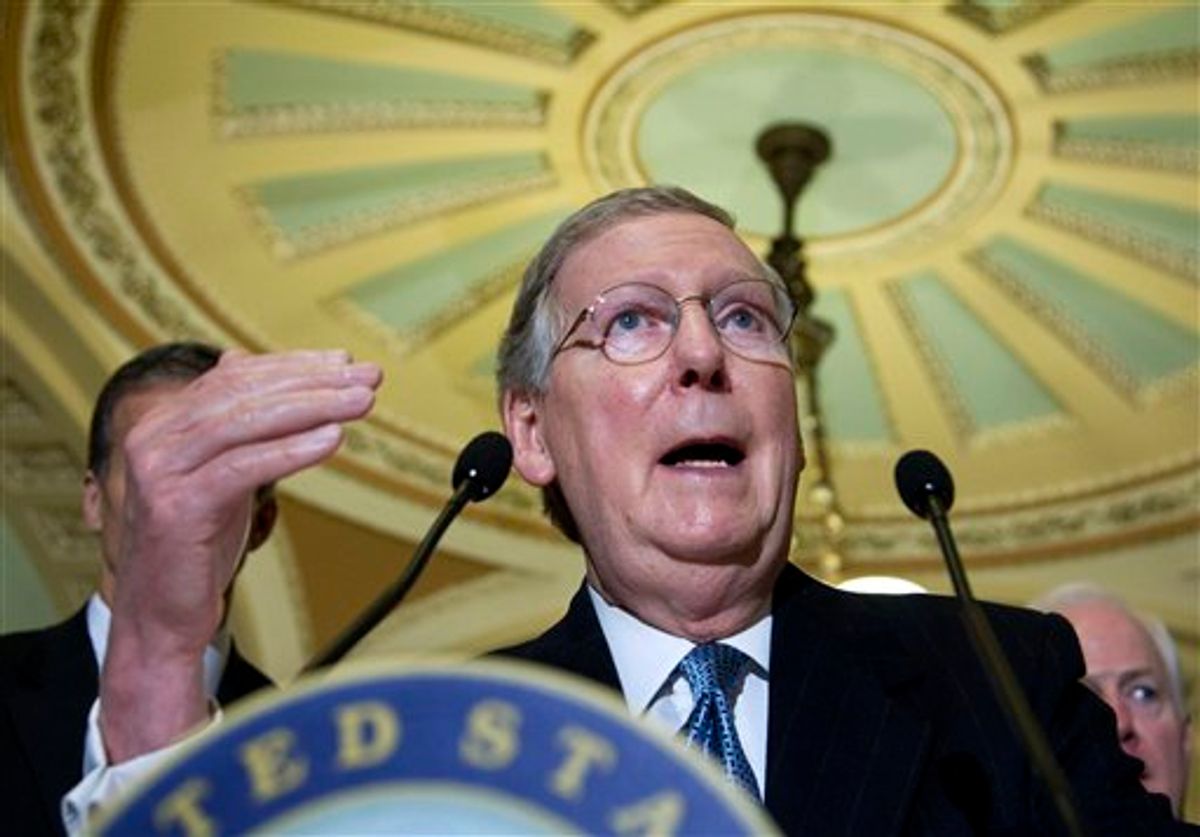
Senate Republicans used a filibuster to kill the Buffett Rule last night. There was no surprise in this. Without substantial GOP defections, there was no way Democrats would have the 60 votes needed to force an up/down vote. They ended up with 51, with one Republican (Maine’s Susan Collins) crossing over to side with them, and one of their own (Arkansas’ Mark Pryor) joining the GOP blockade.
This is fine by Democrats, who have embraced legislative futility as a political strategy of last resort. The idea, which President Obama and his party’s congressional leaders came around to after last summer’s debt ceiling spectacle, is to force Senate votes that illustrate how out of the mainstream the Obama-era Republican Party has become – and how its obstinacy is preventing progress on the issues that voters most want to see addressed.
This approach has been derided as gimmickry, especially in the case of the Buffett Rule, which would guarantee that the super-affluent pay at least 30 percent in federal income taxes without making much of a dent in long-term deficits.
But the criticism misses the point: Some serious decisions about tax rates and spending levels have to be made by the end of this year, and there’s no reasonable solution to the country’s fiscal problems that doesn’t involve collecting more revenue from the wealthy. And yet, the GOP remains absolutely unwilling to even consider this. As Greg Sargent argued the other day, there’s really nothing left for Democrats to do but shine a light on the GOP’s intransigence and hope it creates enough public pressure to scare Republicans into compromise.
Which brings us to the real suspense surrounding last night’s Buffett Rule filibuster: Will anyone outside of political reporters and C-SPAN2 junkies notice what happened?
On paper, Republicans have fallen into a very dangerous trap here. A CNN poll released earlier in the day found that 72 percent of voters said they favor “a proposal to change the federal income tax rates so that people who make more than one million dollars a year will pay at least 30 percent of their income in taxes.” So popular is the Buffett Rule in the abstract that 53 percent of Republicans and 40 percent of Tea Party supporters say they favor it as well.
But, of course, this isn’t really how mass opinion works – which is why, for instance, the component parts of Barack Obama’s healthcare law tend to poll much better than “Obamacare.” Most voters, even registered independents, generally identify with one party and respond to partisan cues, while authentic swing voters frequently work backward to form their opinions – deciding, for instance, that they don’t like a president and think he’s pursuing bad policies when their own sense of economic anxiety is high.
There’s also the likelihood that most people who will vote in November aren’t even aware of what happened in the Senate last night. Maybe they’ll happen upon a televised debate later this year, with the Democratic Senate candidate in their state pointing out that the Republican candidate is OK with billionaires paying lower tax rates than secretaries. Then the Republican candidate will respond that the Democrat is being very misleading – that the vote in question was a political stunt that even Democrats admitted would have done little to reduce the deficit, and that the time Democrats wasted is emblematic of their refusal to grapple seriously with the country’s profound fiscal crisis. How many voters who don’t follow Washington closely will have any idea what to make of this?
This isn’t to argue that Democrats are erring by bringing up the Buffett Rule, or that they erred last fall when they forced a series of doomed votes on popular components of Obama’s jobs bill. Rather, it’s a reminder of how fixed mass opinion can be. Realistically, the best Democrats can hope for with this strategy is to swing the electorate their way by a few percentage points, if that. In a close race, this could make all the difference, but there’s also no guarantee they’ll even have that much success.
That said, there is some reason to believe that Obama’s more aggressive posture since the debt ceiling impasse last summer has helped boost his poll numbers (although there are other possible explanations for his improvement). And, as Sargent noted, it’s not like Democrats have any better options at this point. Republicans have dug in their heels on taxes and aren’t going to change their minds unless they’re forced to.
And there is one other, somewhat indirect way that the Democrats’ strategy could succeed. It has to do with how the political world would interpret an Obama victory this fall. Let’s say the economy is still in shaky condition, enough that an Obama win is no slam dunk. If Obama spends the year highlighting and railing against Republican stubbornness on taxing the rich and wins a toss-up election, his victory might then be regarded as a direct result of that message – even if some other factor or collection of factors was really behind it. This wouldn’t make Republican resistance suddenly disappear, but it might cause public fissures in the party that don’t now exist – and that might produce compromise that isn’t now imaginable.
Shares