Citigroup’s warning shot

Shareholders say no to a $15 million pay package for Citi's CEO as investors push back against overcompensation

Topics: Citigroup, Wall Street, ,

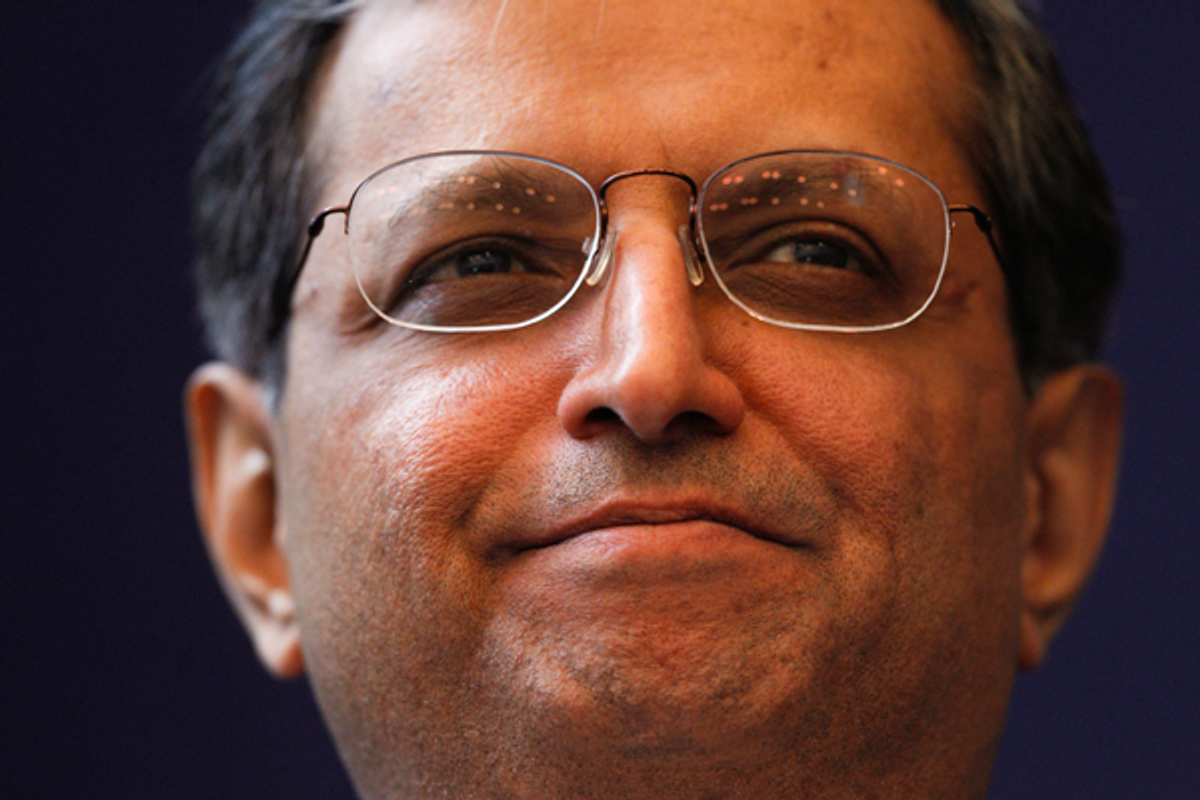
Citigroup's warning shot Citigroup CEO Vikram Pandit (Credit: Reuters/Christian Hartmann)
This originally appeared on Robert Reich's blog.

The shareholders of Wall Street giant Citigroup are out to prove that corporate democracy isn’t an oxymoron. They’ve said no to the exorbitant $15 million pay package of Citi’s CEO Vikram Pandit, as well as to the giant pay packages of Citi’s four other top executives.

The vote, at Citigroup’s annual meeting in Dallas Tuesday, isn’t binding on Citigroup. But it’s a warning shot across the bow of every corporate boardroom in America.

Shareholders aren’t happy about executive pay.

And why should they be? CEO pay at large publicly-held corporations is now typically 300 times the pay of the average American worker. It was 40 times average worker pay in the 1960s and has steadily crept upward since then as corporations have morphed into “winner-take-all” contraptions that reward their top executives with boundless beneficence and perks while slicing the jobs, wages, and benefits of almost everyone else.

Meanwhile, too many of these same corporations have failed to deliver for their shareholders. Citigroup, for example, has delivered the worst stock performance mong all large banks for the last decade but ranked among the highest in executive pay.

The real news here is new-found activism among institutional investors – especially the managers of pension funds and mutual funds. They’re the ones who fired the warning shot Tuesday.

Institutional investors are catching on to a truth they should have understood years ago: When executive pay goes through the roof, there’s less money left for everyone else who owns shares of the company.

For too long, most fund managers played the game passively and obediently. Some have been too cozy with top corporate management, forgetting their fiduciary duty to their own investors. How else do you explain the abject failure of fund managers to police Wall Street as it careened toward the abyss in 2008? Or to adequately oversee executives, such as the Enron criminals, who were looting their companies in the years before 2002?

The new Dodd-Frank law, much of which is being eviscerated by Wall Street’s lawyers and lobbyists, at least requires that public companies give shareholders a say on pay. As a practical matter, this gives institutional investors the chance to speak clearly and openly about the scandal of unbridled executive compensation.

Two key questions for the future: Will institutional investors keep the pressure on? And will CEOs and boards of directors get the message?

Robert Reich

Robert Reich, one of the nation’s leading experts on work and the economy, is Chancellor’s Professor of Public Policy at the Goldman School of Public Policy at the University of California at Berkeley. He has served in three national administrations, most recently as secretary of labor under President Bill Clinton. Time Magazine has named him one of the ten most effective cabinet secretaries of the last century. He has written 13 books, including his latest best-seller, “Aftershock: The Next Economy and America’s Future;” “The Work of Nations,” which has been translated into 22 languages; and his newest, an e-book, “Beyond Outrage.” His syndicated columns, television appearances, and public radio commentaries reach millions of people each week. He is also a founding editor of the American Prospect magazine, and Chairman of the citizen’s group Common Cause. His widely-read blog can be found at www.robertreich.org.

Next Article

Featured Slide Shows

Gripping photos: The people of the Turkey protests (slideshow)

close X
  • Share on Twitter
  • Share on Facebook
  • Thumbnails
  • Fullscreen
  • 1 of 11
  • The protests take on a festive element as police forces move out of the park and square. Wearing a gas mask, this young man dances to traditional Turkish music in front of Taksim Square’s Ataturk Monument.

  • In Gezi Park since March 31st, this protester, originally caught off-guard by the Government’s teargas and water cannons, went out and bought a Russian army mask from WWII, preparing for what was to come.

  • This rambunctious boy seems to be enjoying the chaos. After taking this picture he threw a stone at the already destroyed building in the background.

  • Forming a line, the police face off directly with protesters in Taksim Square. After a while, they retreated and there was a general cheer – a back-and-forth dance that has been common since the beginning of this protest.

  • An elderly woman in Gezi Park reads the news. The tent community occupying the park was violently destroyed on June 16th.

  • Many different groups had set up booths to promote their cause in Taksim Square and Gezi Park. Standing in front of one, this man waves his flag while posing with conviction.

  • Many home-remedies are used to minimize the effects of tear gas. This woman has put a milky solution on her face, removing her mask after the tear gas dissipated. Before sunrise, the police came again for another round of teargasing.

  • People capitalize on the uprising -- selling flags, beer, gas masks, sky lanterns and spray paint to name just a few of the popular items.

  • On Monday morning, June 11, the police execute a strong offensive. Many plain-clothed police officers, like the ones seen here, clash with protesters in the side streets away from the main stand-off in Taksim.

  • The authorities seem to be most aggressive in the night, pushing protesters away from the square and park. After being teargassed this young woman catches her breath with other protesters on Siraselviler Street.

  • Recent Slide Shows

  • Share on Twitter
  • Share on Facebook
  • Thumbnails
  • Fullscreen
  • 1 of 11

Comments

7 Comments

Comment Preview

Your name will appear as username ( settings | log out )

You may use these HTML tags and attributes: <a href=""> <b> <em> <strong> <i> <blockquote>