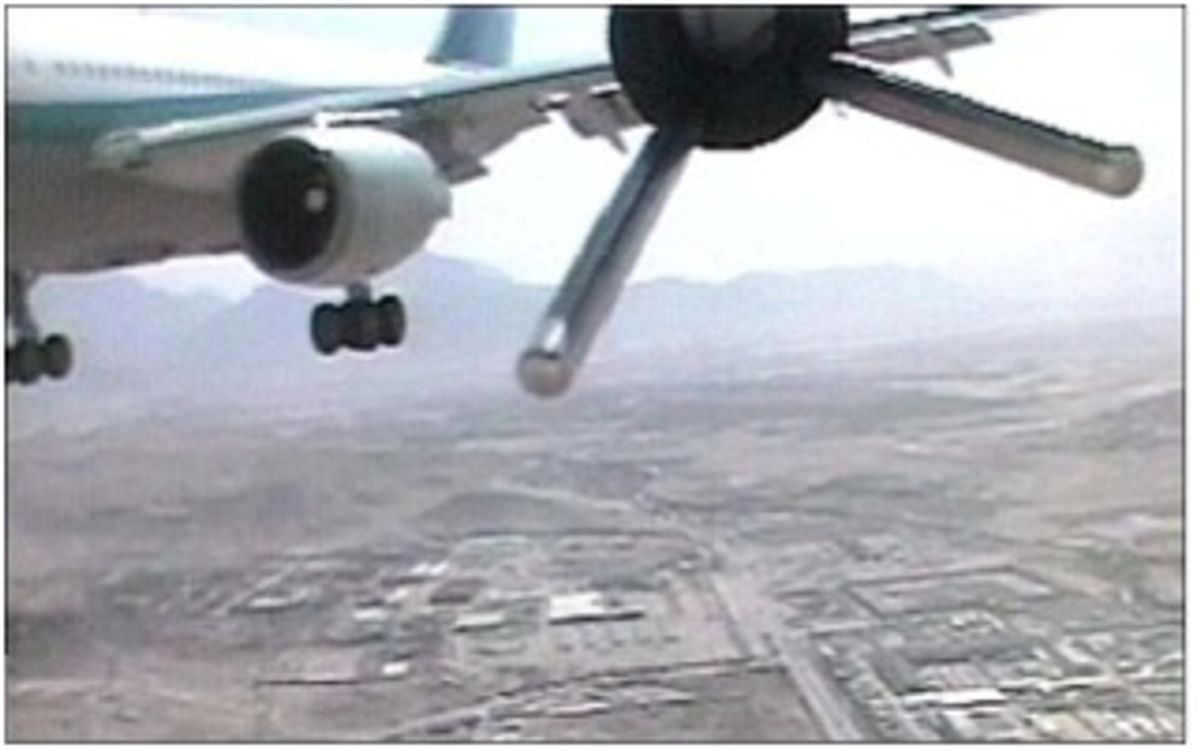
For a sickening moment, disaster loomed over Kabul in August 2004. A surveillance drone operated by the German armed forces was taking pictures over the Afghan capital when a civilian airliner filled the viewfinder of the drone's camera. The Air Force later concluded the airliner, carrying more than a hundred passengers, missed the German drone by just 170 feet. (The photo could fool you into thinking it missed by about 17 feet.)
That near-miss is a cautionary tale for the Federal Aviation Administration, the U.S. military and civilian aviation as they seek to open up domestic airspace to unmanned aviation systems. While most of the critical attention on domestic drones has focused on privacy issues, safety is an equally pressing concern: How do we launch thousands of new aircraft into already crowded airways?
Last Friday, Michael Toscano, president of the Association for Unmanned Vehicle Systems International, called on the FAA to expedite its rule-making for unmanned aviations systems in the U.S. airspace. “UAS will be the next big revolution in aviation," Toscano wrote in a letter to Transportation Secretary Ray LaHood. "However, before this industry can really take off, we need rules from the FAA on how to safely operate alongside manned aircraft."
So while civil liberties groups fear drone surveillance, universities teach the new technology, and Silicon Valley entrepreneurs dream of start-ups like the TacoCopter, the FAA has the more mundane task of ensuring the safety of domestic airspace, something Congress has ordered it to do for drones under 4.4 pounds by mid-May. The FAA has yet to publish draft drone regulations and solicit public comment on small drones, much less on the larger unmanned systems, which can have wingspans up to 20 feet and weigh hundreds of pounds.
In a timely post last month, Public Intelligence pointed out some of the perils involved. "Is it even logistically possible to operate thousands of pilot-less aircraft in the domestic airspace?" PI editor Michael Haynes asked in his article, "The Problems With Domestic Drones." Haynes reviewed several recent Pentagon studies about drone safety in war zones, which highlight some of the daunting issues facing the FAA.
One problem is the potential for so-called zombie drones. In an April 2011 report, the Air Force Scientific Advisory Board identified "limited communications" systems as a problem for drone operators, especially "lost-link events," in which the operator loses contact with the vehicle.
As PI notes:
Sometimes the link is reestablished and the pilot is able to maintain control of the drone. Sometimes the link cannot be reestablished and the drone is effectively turned into a zombie that can drift far from its intended target, as may have occurred recently with the RQ-170 captured by Iran in December 2011.
"Lost-link events are operationally uncommon," the Air Force science panel concluded, but are obviously "of primary concern" for drone operations in U.S. airspace, where there's reason to fear they might be more likely.
That's because there's a lot more potential for electronic magnetic interference in crowded domestic spaces than there is in remote war zones. When the Pentagon's Joint Spectrum Center analyzed the deployment of Predator drones over the Mexico-Arizona border, it had to examine potential conflicts between the drones and fixed microwave links in Mexico, nearby radio astronomy observatories and various other potential sources of interference.
Another example from PI:
When several Predator drones were needed for tests at Creech Air Force Base in Nevada, the Joint Spectrum Center had to study the potential for interaction with residential indoor and industrial outdoor radio local area networks, outdoor video surveillance networks and other potential signals arising from a nearby residential community.
A 2010 Air Force report on lessons learned from the use of small unmanned aircraft systems (known as SUAS) in Iraq and Afghanistan concluded "many of the current SUAS use datalink equipment that is not interoperable with other datalinks or tunable to other frequencies." The limitations of this technology will "hinder" the integration of drones into U.S. airspace.
Another problem is the risk of midair collisions. These risks can be reduced with ground- and air-based "sense and avoid" radar systems, according to the Air Force study group. But installation of such systems may take two to three years and cost up to $3 million per aviation site, the study group said. No such systems for drones have been installed anywhere in the United States.
And then there's the question of the electronic spectrum on which the whole drone business depends. "This might be the biggest issue of all because none of these aircraft can fly without a communications channel," said Ben Gielow, manager of government relations for the Association of Unmanned Vehicles Systems International. Parts of the spectrum are allocated for specific uses such as civil aviation, law enforcement and the military. But there is no part of the spectrum that is reserved for command and control of unmanned aviation. In February, the United Nations' World Radiocommunication Conference called for studying "additional allocations, to accommodate spectrum requirements of UAS consistent with the protection of incumbent services." Which doesn't sound like it's going to happen quickly.
Gielow says the AUVSI is calling on the FAA to first issue proposed regulations on small drones operated by public safety agencies so it can meet the congressional deadline of opening U.S. airspace to drones of all sizes by the end of 2015. "A lot needs to be done," he said.
In response to Toscano's letter, an FAA spokesman issued a statement saying the agency would act "later this year."
Significant work is underway to ensure the safe integration of unmanned aircraft systems into the national air space. Specifically, the FAA is committed to safely integrating small UAS, and we expect to publish a proposed rule later this year.
So drones are coming to U.S. airspace, and these rules will be the best hope against Kabul's near-disaster happening over an American city.
Shares