
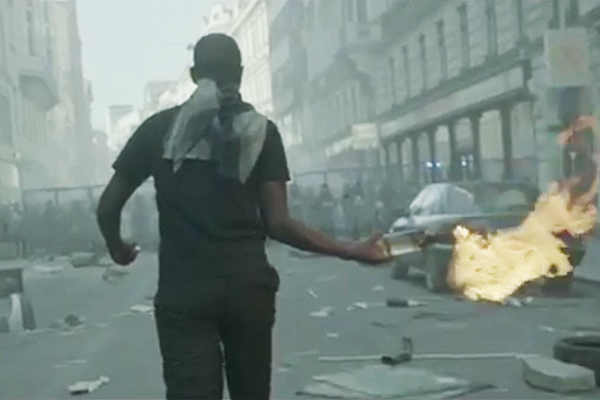

There is a name for videos capturing particularly dramatic riot scenes — the sort with fire, tear gas, charging police horses, careening masked crowds and, often, a hardcore backing track. We call it riot porn. I’ve always thought it’s a bad name. Not because the street scenes — shot from Egypt to Oakland to Greece — aren’t titillating spectacles (and pornographic in that sense), but because all porn — good or bad, exploitative or sex-positive — is staged for the filming. Riots very much are not.
In this sense, the new music video for Kanye West and Jay-Z’s track “No Church in the Wild” is the best actual riot porn I’ve ever seen. The video, directed by Romain Gavras, is five minutes of a graphic, fiery and entirely staged riot. It opens with a young man lighting a Molotov cocktail and lobbing it at a line of riot cops as masked comrades behind him raise their arms in support. Filmed in Prague, but presented as a non-specific yet decidedly European urban battleground, riot cops on horses violently beat the masked crowd, who fight back with fire and fists while Greco-Roman statues look on. Were it not for the surprising appearance of a chained elephant amidst the fray in the video’s final frames, the footage looks (almost) like something straight out of Athen’s Syntagma Square. Jay-Z and Kanye don’t feature in the video at all, which makes artistic sense: I’d be more surprised to see Hove in a riot than a two-tonne elephant.
So what to make of riot porn brought to you by those hip-hop moguls and emblems of excess Jay-Z and Kanye? As I noted last year when purveyors of eau-de-date-rape Axe came out with a scent called “Anarchy”, the depiction of anarchism and riotousness in commercial ventures are at least “a nod to the popularity of dissent.” Gavras, who directed the “No Church in the Wild” video, has long riffed on the idea of social upheaval and fierce state repression in his work. His short film for rapper M.I.A’s “Born Free” told the story of U.S. military forces brutally rounding up and executing ginger-haired civilians. The message was lost on no one, and the video was banned from YouTube. Gavras offers a stylized, gritty and startling depiction of social rupture; that his brutal vision of a street riot is deemed popular and consumable enough to accompany some the most mainstream of music is worth consideration. It’s not just anarchists getting off on riot porn anymore.
This isn’t entirely new: There was the Levi’s jeans commercial last year that featured a young man in Levi’s squaring up to riot cops under the tagline, “Now is our time.” The ad was pulled from British television in light of the summer riots in London. The video for Kanye and Jay-Z’s anthem with Rihanna, “Run This Town,” also featured gangs in black bandanas — but it was a far cry in terms of realism and police-on-protester brutality from the riot scenes in “No Church in the Wild.”
My friends at the New Inquiry magazine, Malcolm Harris and Max Fox, have argued that riot imagery and revolutionary calls in products can serve as genuine threats to capitalism, even though they may be expensive ad campaigns or music videos. In a published dialogue between the two (which is well worth reading in its entirety) Fox and Harris agree that subway ads and select lyrics from pop songs are ample materials for would-be rioters. So, while some might see the depiction and glorification of rioters in a hip-hop video as exemplifying capitalist recuperation (even Molotov cocktails can help sell records now!), Harris and Fox suggest that these images can be reappropriated by anti-capitalists — after all, the accessibility of a music video featuring a riot suggests, at the very least, that this sort of dissent resonates. Indeed, Harris quipped on Twitter today, linking to the Jay-Z and Kanye video, “Oh hey, capital, are you sure that’s such a good idea?” and continued to joke about whether the hip-hop artists endorsed black bloc anarchism. We don’t need to make new anti-capitalist propaganda; Kanye and Jay-Z can have Romain Gavras do it while they accidentally offer up revolutionary slogans in their otherwise problematic lyrics. The bridge for “No Church in the Wild”, sung by Frank Ocean, is an insurrectionist two-liner: “I live by you, desire; I stand by you, walk through the fire.”
Of course, none of this is to say Kanye or Jay-Z should be praised as agents for revolutionary change. Jay-Z, aside from celebrating a life of unadulterated excess, is a key voice behind developer Bruce Ratner’s controversial Atlantic Yards project in Brooklyn, which has been widely criticized for pushing people out of their homes and failing to provide affordable housing and jobs. Meanwhile, Kanye is a famous jerk; he walked by Zuccotti Park once to check out Occupy Wall Street last year, but, again, he is mainly a jerk.
And, it’s worth noting, that the way in which the rioters are glorified in the music video is problematic. I question Gavras’s decision to only feature male rioters. It’s a common criticism of black bloc tactics that they alienate women and perpetuate a masculinist expression of anarchist street actions. Problems of patriarchy in radical scenes certainly abound — indeed it’s an issue too huge to really address here. Suffice to say, however, women across the world who have fought riot police in the streets might take issue with Gavras’s ubiquitously male scene.
But what strikes me the most, and what might make a lot of anarchists and other proponents of street confrontation feel pretty smug, is that Kanye and Jay-Z have the resources to produce pretty much any kind of spectacular music video imaginable. And they opted for riot porn.
Watch the “No Church in the Wild” video below:
