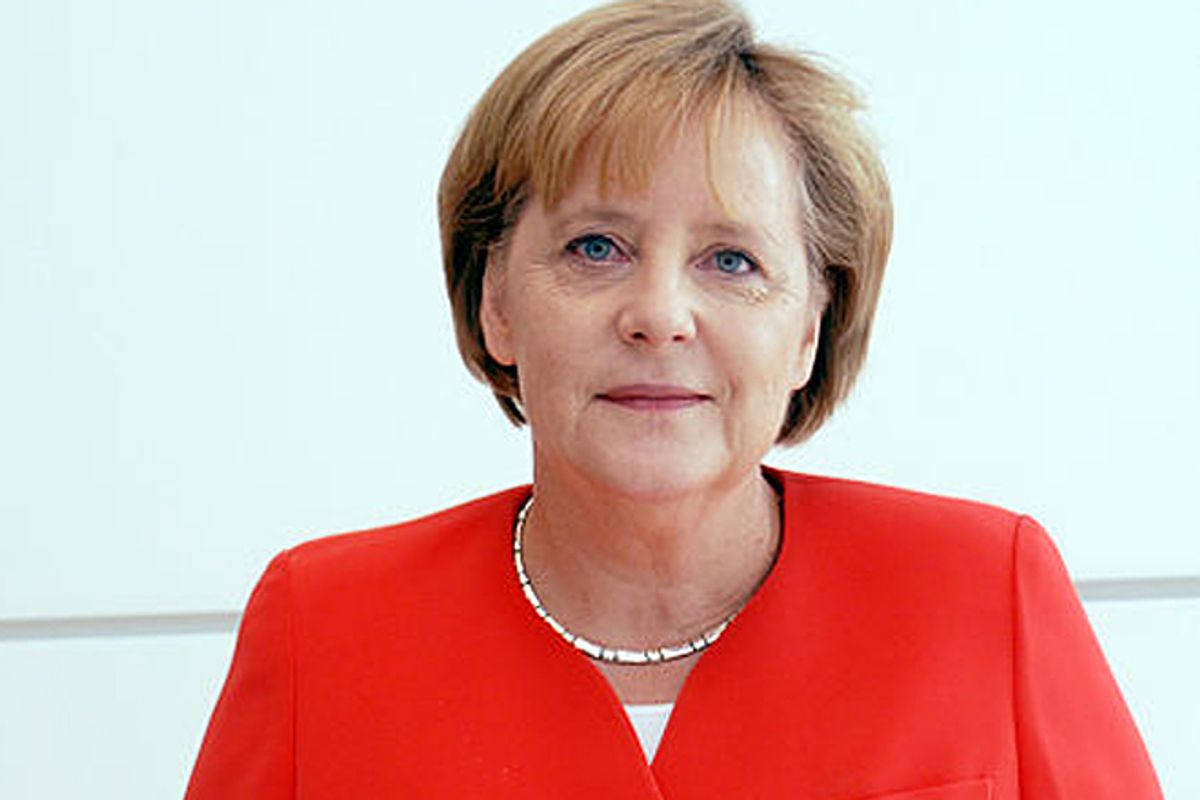
Greek Prime Minister Antonis Samaras has asked Germany to give his country more time to meet its obligations under an international bailout. Speaking to reporters after meeting with German Chancellor Angela Merkel, he said Greece needed "breathing space."

Merkel said Greece would have to meet reform targets, saying she would wait until the “troika” of donors — the International Monetary Fund, the European Central Bank and the European Commission — reports in late September about whether Athens is making enough progress.
But in words that would have pleased Samaras, she said Germany wants Greece to remain in the euro zone. She said she wants to end a dispute between Greek and German politicians who question Greece’s ability to see reform through and have called for it to be kicked out of the euro zone.
“I am deeply convinced that the new government under the leadership of Prime Minister Samaras will do what it takes to solve the problem in Greece,” Merkel said in what was seen as a rebuke to hard-line members of her own coalition. She added that she wanted to help Greece see “the light at the end of the tunnel."
Samaras said Greece would meet its obligations, but is asking for two more years to impose $14 billion worth of budget cuts and other reforms. He says Greece must postpone the painful steps, currently required by 2014, to provide the growth it needs to improve its finances.
The euro’s fate may hinge on his success.
Germany has so far refused to back decisive steps to end the euro crisis even as its worsening is pushing the euro zone’s economy back into a second recession in three years. A survey of new orders in manufacturing and services by Markit Economics on Thursday suggested a contraction of 0.5 to 0.6 percent for the third quarter.
Samaras’s meeting with Merkel comes at a crucial time for Greece, which must be seen to be complying with the bailout terms to receive the next $42 billion installment of its $162 billion bailout.
Without new funds, Greece would probably default on its debts and be forced to leave the common currency, which some believe would prompt other struggling countries to follow.
Samaras, who is due to meet French President Francois Hollande on Saturday, argued that a Greek exit from the euro zone would be “catastrophic for us, but also bad for Europe.”
Although no formal decisions will be made, Antonis Samaras hopes his meeting with German Chancellor Angela Merkel here on Friday sends decisive signals.
The Greek prime minister will seek to persuade her that his country needs two more years to impose $14 billion worth of budget cuts and other reforms under the terms of an international bailout agreement. He will argue that Greece must postpone the painful steps, currently required by 2014, to provide the growth it needs to improve its finances.
Samaras has campaigned this week to convince skeptical Germans he’s serious about implementing measures international lenders have been demanding for the past two years.
“First we have to show everyone that we are delivering,” he told the newspaper Sueddeutsche Zeitung before addressing the main concern in the EU’s richest country, which is providing the lion’s share of bailout funds and has the biggest say in the matter: “The Germans will get their money back.”
The euro’s fate may hinge on his success.
Germany has so far refused to back decisive steps to end the euro crisis even as its worsening is pushing the euro zone’s economy back into a second recession in three years. A survey of new orders in manufacturing and services by Markit Economics on Thursday suggested a contraction of 0.5 to 0.6 percent for the third quarter.
Samaras’s meeting with Merkel comes at a crucial time for Greece, which must be seen to be complying with the bailout terms to receive the next $42 billion installment of its $162 billion bailout.
The “troika” of donors — the International Monetary Fund, the European Central Bank and the European Commission — is due to report in late September about whether Athens is making enough progress.
Without new funds, Greece would probably default on its debts and be forced to leave the common currency, which some believe would prompt other struggling countries to follow.
Samaras, who is due to meet French President Francois Hollande on Saturday, argued that a Greek exit from the euro zone would be “catastrophic for us, but also bad for Europe.”
After meeting Samaras on Wednesday, euro zone finance chief Jean-Claude Juncker said the decision over an extension would depend on the report, saying Greece was facing its “last chance” to undertake its reforms.
Germany has led the criticism of Greece’s reform efforts.
Although Merkel has generally remained above the fray, many members of her fractious coalition have been making negative comments about Greece for some time. In particular, members of the junior coalition parties, the pro-business Free Democrats (FDP) and the Bavarian Christian Social Union (CSU), have been stepping up calls for Greece to leave the euro zone.
Economics Minister and FDP leader Philipp Roesler recently said the idea of a Greek exit had “lost its horror.”
He rejected Samaras’ calls for easing the timetable for reforms. “Those who don’t stick firmly to the reform commitments can’t expect any further financial help,” he told the newspaper Bild. “And an extension in the time frame, as demanded by the Greek government, won’t help.”
Even some within Merkel’s own Christian Democrats (CDU) have taken a tough line.
The CDU’s leader in the Bundestag, Volker Kauder, said that there was “no room for maneuver” on the timing or substance of the agreement.
Finance Minister Wolfgang Schaeuble also dismissed the Greek leader’s pleas, which come just a few months after the latest agreement was signed.
"You can’t just say after half a year, all of that is not enough, because you’ll never win the confidence of financial markets," he told Germany's SWR radio. "More time is not a solution.”
Greece’s ongoing economic decline — it is now in a fifth year of recession —exacerbated by tough austerity measures has made efforts to reduce the deficit painfully difficult. The holding of two elections this year also helped slow reform.
Samaras argues that the uncertainty about Greece’s future in the euro zone, particularly in Germany, is making it even harder to implement new measures.
He told Sueddeutsche Zeitung that every time a German politician makes a call for Greece to leave the euro zone he thinks: “How am I supposed to privatize state companies with this? What companies will invest euros with us if they might only get drachmas back?”
Despite the hard line from some in Berlin, however, other leading officials have displayed a softer tone, indicating concessions are possible.
If Athens “presents a credible plan to implement the measures,” deputy CDU leader Michael Meister told the Handelsblatt business daily, “maximum flexibility” was possible.
The conflicting signals reflect the tough task German politicians face balancing efforts to keep Greece in the euro zone and their own voters happy.
They’re acutely aware that any more concessions to Greece would be hugely unpopular. A majority of voters rejects the existing bailout and polls show many favor a Greek exit from the euro zone.
But it’s not just about politics. Many German politicians and economists believe maintaining pressure on the euro zone’s struggling countries instead of providing more rescue packages is the only way to ensure reforms they deem essential are implemented.
However, with elections looming in 2013, Merkel won’t want to be seen as responsible for the consequences of a euro zone break-up, which would probably incur massive costs for German banks and the economy in general.
There are already signs the euro zone’s contraction is affecting the German economy, which has so far boomed partly thanks to its exports to emerging countries.
The EU’s economic engine room grew only 0.3 percent in the second quarter, indicating the euro crisis is affecting the wider global economy.
That is narrowing Merkel’s room for action even as it increases the pressure on her to act. Although she still enjoys great popularity, that may evaporate if the crisis starts to seriously bite.
Shares