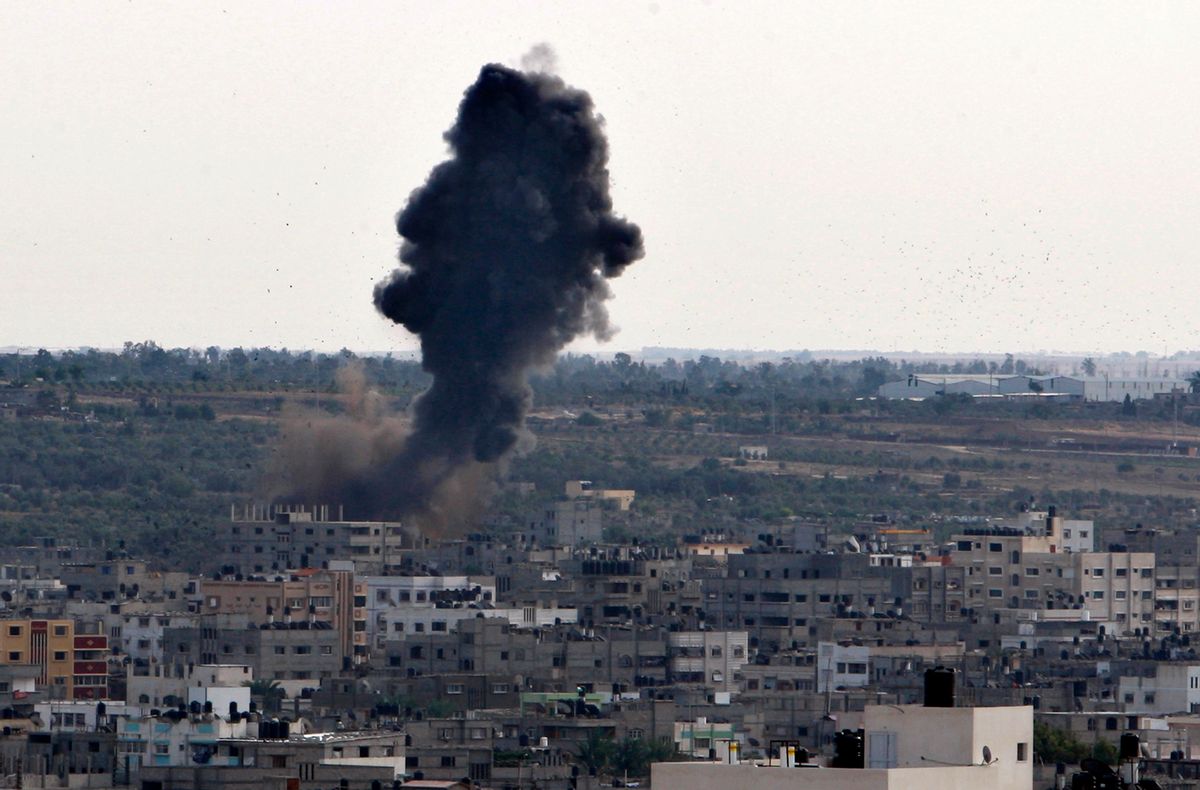
“There is no country on Earth that would tolerate missiles raining down on its citizens from outside its borders,” President Barack Obama said at a press conference last week. He drew on this general observation in order to justify Operation Pillar of Defense, Israel’s most recent military campaign in the Gaza Strip. In describing the situation this way, he assumes, like many others, that Gaza is a political entity external and independent of Israel. This is not so. It is true that Israel officially disengaged from the Gaza Strip in August 2005, withdrawing its ground troops and evacuating the Israeli settlements there. But despite the absence of a permanent ground presence, Israel has maintained a crushing control over Gaza from that moment until today.
The testimonies of Israeli army veterans expose the truth of that “disengagement.” Before Operation Pillar of Defense, after all, Israel launched Operations Summer Rains and Autumn Clouds in 2006, and Hot Winter and Cast Lead in 2008 -- all involving ground invasions. In one testimony, a veteran speaks of “a battalion operation” in Gaza that lasted for five months, where the soldiers were ordered to shoot “to draw out terrorists” so they “could kill a few.”
Israeli naval blockades stop Gazans from fishing, a main source of food in the Strip. Air blockades prevent freedom of movement. Israel does not allow building materials into the area, forbids exports to the West Bank and Israel, and (other than emergency humanitarian cases) prohibits movement between the Gaza Strip and the West Bank. It controls the Palestinian economy by periodically withholding import taxes. Its restrictions have impeded the expansion and upgrading of the Strip’s woeful sewage infrastructure, which could render life in Gaza untenable within a decade. The blocking of seawater desalination has turned the water supply into a health hazard. Israel has repeatedly demolished small power plants in Gaza, ensuring that the Strip would have to continue to rely on the Israeli electricity supply. Daily power shortages have been the norm for several years now. Israel’s presence is felt everywhere, militarily and otherwise.
By relying on factual misconceptions, political leaders, deliberately or not, conceal information that is critical to our understanding of events. Among the people best qualified to correct those misconceptions are the individuals who have been charged with executing a state’s policies -- in this case, Israeli soldiers themselves, an authoritative source of information about their government’s actions. I am a veteran of the Israeli Defense Forces (IDF), and I know that our first-hand experiences refute the assumption, accepted by many, including President Obama, that Gaza is an independent political entity that exists wholly outside Israel. If Gaza is outside Israel, how come we were stationed there? If Gaza is outside Israel, how come we control it? Oded Na’aman
[The testimonies by Israeli veterans that follow are taken from 145 collected by the nongovernmental organization Breaking the Silence and published in Our Harsh Logic: Israeli Soldiers’ Testimonies From the Occupied Territories, 2000-2010. Those in the book represent every division in the IDF and all locations in the West Bank and the Gaza Strip.]
1. House Demolition
Unit: Kfir Brigade
Location: Nablus district
Year: 2009
During your service in the territories, what shook you up the most?
The searches we did in Hares. They said there are sixty houses that have to be searched. I thought there must have been some information from intelligence. I tried to justify it to myself.
You went out as a patrol?
It was a battalion operation. They spread out over the whole village, took over the school, smashed the locks, the classrooms. One was used as the investigation room for the Shin Bet, one room for detainees, one for the soldiers to rest. We went in house by house, banging on the door at two in the morning. The family’s dying of fear, the girls are peeing in their pants with fear. We go into the house and turn everything upside down.
What’s the procedure?
Gather the family in a certain room, put a guard there, tell the guard to aim his gun at them, and then search the rest of the house. We got another order that everyone born after 1980... everyone between sixteen and twenty-nine, doesn’t matter who, bring them in cuffed and blindfolded. They yelled at old people, one of them had an epileptic seizure but they carried on yelling at him. Every house we went into, we brought everyone between sixteen and twenty-nine to the school. They sat tied up in the schoolyard.
Did they tell you the purpose of all this?
To locate weapons. But we didn’t find any weapons. They confiscated kitchen knives. There was also stealing. One guy took twenty shekels. Guys went into the houses and looked for things to steal. This was a very poor village. The guys were saying, “What a bummer, there’s nothing to steal.”
That was said in a conversation among the soldiers?
Yeah. They enjoyed seeing the misery, the guys were happy talking about it. There was a moment someone yelled at the soldiers. They knew he was mentally ill, but one of the soldiers decided that he’d beat him up anyway, so they smashed him. They hit him in the head with the butt of the gun, he was bleeding, then they brought him to the school along with everyone else. There were a pile of arrest orders signed by the battalion commander, ready, with one area left blank. They’d fill in that the person was detained on suspicion of disturbing the peace. They just filled in the name and the reason for arrest. There were people with plastic handcuffs that had been put on really tight. I got to speak with the people there. One of them had been brought into Israel to work for a settler and after two months the guy didn’t pay him and handed him over to the police.
All these people came from that one village?
Yes.
Anything else you remember from that night?
A small thing, but it bothered me -- one house that they just destroyed. They have a dog for weapons searches, but they didn’t bring him; they just wrecked the house. The mother watched from the side and cried. Her kids sat with her and stroked her.
What do you mean, they just destroyed the house?
They smashed the floors, turned over sofas, threw plants and pictures, turned over beds, smashed the closets, the tiles. There were other things -- the look on the people’s faces when you go into their house. And after all that, they were left tied up and blindfolded in the school for hours. The order came to free them at four in the afternoon. So that was more than twelve hours. There were investigators from the security services there who interrogated them one by one.
Had there been a terrorist attack in the area?
No. We didn’t even find any weapons. The brigade commander claimed that the Shin Bet did find some intelligence, that there were a lot of guys there who throw stones.
2. Naval Blockade
Unit: Navy
Location: Gaza Strip
Year: 2008
It’s mostly punishment. I hate that: “They did this to us, so we’ll do that to them.” Do you know what a naval blockade means for the people in Gaza? There’s no food for a few days. For example, suppose there’s an attack in Netanya, so they impose a naval blockade for four days on the entire Strip. No seagoing vessel can leave. A Dabur patrol boat is stationed at the entrance to the port, if they try to go out, within seconds the soldiers shoot at the bow and even deploy attack helicopters to scare them. We did a lot of operations with attack helicopters -- they don’t shoot much because they prefer to let us deal with that, but they’re there to scare people, they circle over their heads. All of a sudden there’s a Cobra right over your head, stirring up the wind and throwing everything around.
And how frequent were the blockades?
Very. It could be three times one month, and then three months of nothing. It depends.
The blockade goes on for a day, two days, three days, four, or more than that?
I can’t remember anything longer than four days. If it was longer than that, they’d die there, and I think the IDF knows that. Seventy percent of Gaza lives on fishing -- they have no other choice. For them it means not eating. There are whole families who don’t eat for a few days because of the blockade. They eat bread and water.
3. Shoot to Kill
Unit: Engineering Corps
Location: Rafah
Year: 2006
During the operations in Gaza, anyone walking around in the street, you shoot at the torso. In one operation in the Philadelphi corridor, anyone walking around at night, you shoot at the torso.
How often were the operations?
Daily. In the Philadelphi corridor, every day.
When you’re searching for tunnels, how do people manage to get around -- I mean, they live in the area.
It’s like this: You bring one force up to the third or fourth floor of a building. Another group does the search below. They know that while they’re doing the search there’ll be people trying to attack them. So they put the force up high, so they can shoot at anyone down in the street.
How much shooting was there?
Endless.
Say I’m there, I’m up on the third floor. I shoot at anyone I see?
Yes.
But it’s in Gaza, it’s a street, it’s the most crowded place in the world.
No, no, I’m talking about the Philadelphi corridor.
So that’s a rural area?
Not exactly, there’s a road, it’s like the suburbs, not the center. During operations in the other Gaza neighborhoods it’s the same thing. Shooting, during night operations -- shooting.
It there any kind of announcement telling people to stay indoors?
No.
They actually shot people?
They shot anyone walking around in the street. It always ended with, “We killed six terrorists today.” Whoever you shot in the street is “a terrorist.”
That’s what they say at the briefings?
The goal is to kill terrorists.
What are the rules of engagement?
Whoever’s walking around at night, shoot to kill.
During the day, too?
They talked about that in the briefings: whoever’s walking around during the day, look for something suspicious. But something suspicious could be a cane.
4. Elimination Operation
Unit: Special Forces
Location: Gaza Strip
Year: 2000
There was a period at the beginning of the Intifada where they assassinated people using helicopter missiles.
This was at the beginning of the Second Intifada?
Yes. But it was a huge mess because there were mistakes and other people were killed, so they told us we were now going to be doing a ground elimination operation.
Is that the terminology they used? “Ground elimination operation”?
I don’t remember. But we knew it was going to be the first one of the Intifada. That was very important for the commanders and we started to train for it. The plan was to catch a terrorist on his way to Rafah, trap him in the middle of the road, and eliminate him.
Not to arrest him?
No, direct elimination. Targeted. But that operation was canceled, and then a few days later they told us that we’re going on an arrest operation. I remember the disappointment. We were going to arrest the guy instead of doing something groundbreaking, changing the terms. So the operation was planned...
Anyway, we’re waiting inside the APC [armored personnel carrier], there are Shin Bet agents with us, and we can hear the updates from intelligence. It was amazing, like, “He’s sitting in his house drinking coffee, he’s going downstairs, saying hi to the neighbor” -- stuff like that. “He’s going back up, coming down again, saying this and that, opening the trunk now, picking up a friend” -- really detailed stuff. He didn’t drive, someone else drove, and they told us his weapon was in the trunk. So we knew he didn’t have the weapon with him in the car, which would make the arrest easier. At least it relieved my stress, because I knew that if he ran to get the weapon, they’d shoot at him.
Where did the Shin Bet agent sit?
With me. In the APC. We were in contact with command and they told us he’d arrive in another five minutes, four minutes, one minute. And then there was a change in the orders, apparently from the brigade commander: elimination operation. A minute ahead of time. They hadn’t prepared us for that. A minute to go and it’s an elimination operation.
Why do you say “apparently from the brigade commander”?
I think it was the brigade commander. Looking back, the whole thing seems like a political ploy by the commander, trying to get bonus points for doing the first elimination operation, and the brigade commander trying, too. . . everyone wanted it, everyone was hot for it. The car arrives, and it’s not according to plan: their car stops here, and there’s another car in front of it, here. From what I remember, we had to shoot, he was three meters away. We had to shoot. After they stopped the cars, I fired through the scope and the gunfire made an insane amount of noise, just crazy. And then the car, the moment we started shooting, started speeding in this direction.
The car in front?
No, the terrorist’s car -- apparently when they shot the driver his leg was stuck on the gas, and they started flying. The gunfire increased, and the commander next to me is yelling “Stop, stop, hold your fire,” but they don’t stop shooting. Our guys get out and start running, away from the jeep and the armored truck, shoot a few rounds, and then go back. Insane bullets flying around for a few minutes. “Stop, stop, hold your fire,” and then they stop. They fired dozens if not hundreds of bullets into the car in front.
Are you saying this because you checked afterward?
Because we carried out the bodies. There were three people in that car. Nothing happened to the person in the back. He got out, looked around like this, put his hands in the air. But the two bodies in the front were hacked to pieces...
Afterward, I counted how many bullets I had left -- I’d shot ten bullets. The whole thing was terrifying -- more and more and more noise. It all took about a second and a half. And then they took out the bodies, carried the bodies. We went to a debriefing. I’ll never forget when they brought the bodies out at the base. We were standing two meters away in a semicircle, the bodies were covered in flies, and we had the debriefing. It was, “Great job, a success. Someone shot the wrong car, and we’ll talk about the rest back on the base.” I was in total shock from all the bullets, from the crazy noise. We saw it on the video, it was all documented on video for the debriefing. I saw all the things that I told you, the people running, the minute of gunfire, I don’t know if it’s twenty seconds or a minute, but it was hundreds of bullets and it was clear that the people had been killed, but the gunfire went on and the soldiers were running from the armored truck. What I saw was a bunch of bloodthirsty guys firing an insane amount of bullets, and at the wrong car, too. The video was just awful, and then the unit commander got up. I’m sure we’ll be hearing a lot from him.
What do you mean?
That he’ll be a regional commanding officer or the chief of staff one day. He said, “The operation wasn’t carried out perfectly, but the mission was accomplished, and we got calls from the chief of staff, the defense minister, the prime minister” -- everyone was happy, it’s good for the unit, and the operation was like, you know, just: “Great job.” The debriefing was just a cover-up.
Meaning?
Meaning no one stopped to say, “Three innocent people died.” Maybe with the driver there was no other way, but who were the others?
Who were they, in fact?
At that time I had a friend training with the Shin Bet, he told me about the jokes going around that the terrorist was a nobody. He’d probably taken part in some shooting and the other two had nothing to do with anything. What shocked me was that the day after the operation, the newspapers said that “a secret unit killed four terrorists,” and there was a whole story on each one, where he came from, who he’d been involved with, the operations he’d done. But I know that on the Shin Bet base they’re joking about how we killed a nobody and the other two weren’t even connected, and at the debriefing itself they didn’t even mention it.
Who did the debriefing?
The unit commander. The first thing I expected to hear was that something bad happened, that we did the operation to eliminate one person and ended up eliminating four. I expected that he’d say, “I want to know who shot at the first car. I want to know why A-B-C ran to join in the big bullet-fest.” But that didn’t happen, and I understood that they just didn’t care. These people do what they do. They don’t care.
Did the guys talk about it?
Yes. There were two I could talk to. One of them was really shocked but it didn’t stop him. It didn’t stop me, either. It was only after I came out of the army that I understood. No, even when I was in the army I understood that something really bad had happened. But the Shin Bet agents were as happy as kids at a summer camp.
What does that mean?
They were high-fiving and hugging. Really pleased with themselves. They didn’t join in the debriefing, it was of no interest to them. But what was the politics of the operation? How come my commanders, not one of them, admitted that the operation had failed? And failed so badly with the shooting all over the place that the guys sitting in the truck got hit with shrapnel from the bullets. It’s a miracle we didn’t kill each other.
5. Her limbs were smeared on the wall
Unit: Givati Brigade
Location: Gaza Strip
Year: 2008
One company told me they did an operation where a woman was blown up and smeared all over the wall. They kept knocking on her door and there was no answer, so they decided to open it with explosives. They placed them at the door and right at that moment the woman came to open it. Then her kids came down and saw her. I heard about it after the operation at dinner. Someone said it was funny that the kids saw their mother smeared on the wall and everyone cracked up. Another time I got screamed at by my platoon when I went to give the detainees some water from our field kit canteen. They said, “What, are you crazy?” I couldn’t see what their problem was, so they said, “Come on, germs.” In Nahal Oz, there was an incident with kids who’d been sent by their parents to try to get into Israel to find food, because their families were hungry. They were fourteen- or fifteen-year-old boys, I think. I remember one of them sitting blindfolded and then someone came and hit him, here.
On the legs.
And poured oil on him, the stuff we use to clean weapons.
6. We shot at fishermen
Unit: Navy
Location: Gaza Strip
Year: 2007
There’s an area bordering Gaza that’s under the navy’s control. Even after Israel disengaged from the Strip, nothing changed in the sea sector. I remember that near Area K, which divided Israel and Gaza, there were kids as young as four or six, who’d get up early in the morning to fish, in the areas that were off-limits. They’d go there because the other areas were crowded with fishermen. The kids always tried to cross, and every morning we’d shoot in their direction to scare them off. It got to the point of shooting at the kids’ feet where they were standing on the beach or at the ones on surfboards. We had Druze police officers on board who’d scream at them in Arabic. We’d see the poor kids crying.
What do you mean, “shoot in their direction”?
It starts with shooting in the air, then it shifts to shooting close by, and in extreme cases it becomes shooting toward their legs.
At what distance?
Five or six hundred meters, with a Rafael heavy machine gun, it’s all automatic.
Where do you aim?
It’s about perspective. On the screen, there’s a measure for height and a one for width, and you mark where you want the bullet to go with the cursor. It cancels out the effect of the waves and hits where it’s supposed to, it’s precise.
You aim a meter away from the surfboard?
More like five or six meters. I heard about cases where they actually hit the surfboards, but I didn’t see it. There were other things that bothered me, this thing with Palestinian fishing nets. The nets cost around four thousand shekels, which is like a million dollars for them. When they wouldn’t do what we said too many times, we’d sink their nets. They leave their nets in the water for something like six hours. The Dabur patrol boat comes along and cuts their nets.
Why?
As a punishment.
For what?
Because they didn’t do what we said. Let’s say a boat drifts over to an area that’s off-limits, so a Dabur comes, circles, shoots in the air, and goes back. Then an hour later, the boat comes back and so does the Dabur. The third time around, the Dabur starts shooting at the nets, at the boat, and then shoots to sink them.
Is the off-limits area close to Israel?
There’s one area close to Israel and another along the Israeli-Egyptian border… Israel’s sea border is twelve miles out, and Gaza’s is only three. They’ve only got those three miles, and that’s because of one reason, which is that Israel wants its gas, and there’s an offshore drilling rig something like three and a half miles out facing the Gaza Strip, which should be Palestinian, except that it’s ours… the Navy Special Forces unit provides security for the rig. A bird comes near the area, they shoot it. There’s an insane amount of security for that thing. One time there were Egyptian fishing nets over the three-mile limit, and we dealt with them. A total disaster.
Meaning?
They were in international waters, we don’t have jurisdiction there, but we’d shoot at them.
At Egyptian fishing nets?
Yes. Although we’re at peace with Egypt.
Shares